

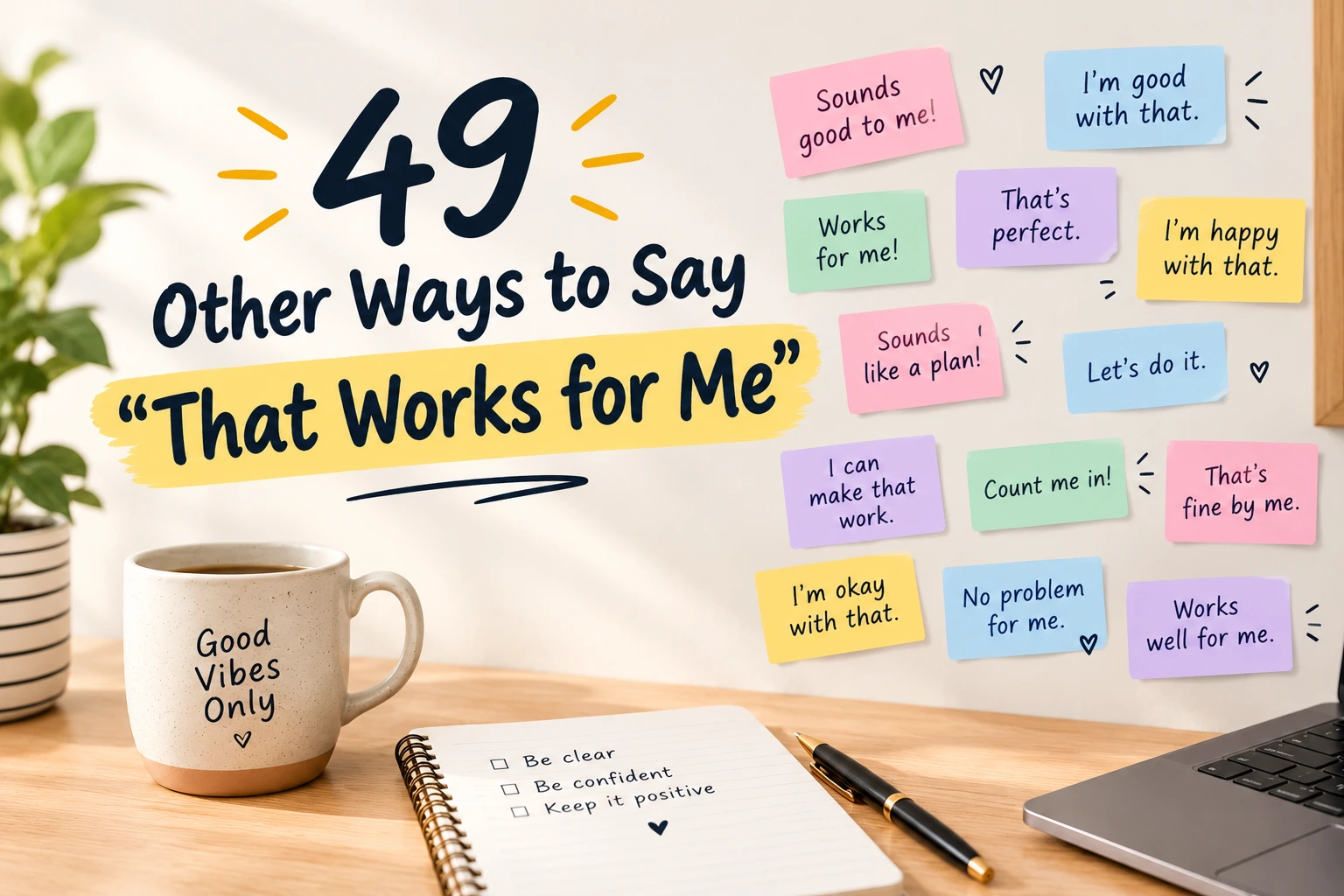
Have you ever agreed to a plan, meeting, or suggestion and found yourself typing “That works for me” for what feels like the hundredth time? It’s a perfectly good phrase, but using it in every conversation can make your messages sound a little repetitive. Sometimes, you want to sound more professional. Other times, you might want to show excitement, appreciate someone’s effort, or add a little humor to the conversation.
The good news is that there are plenty of natural alternatives to choose from. Whether you’re replying to your manager’s meeting proposal, confirming weekend plans with friends, or responding to someone you’re interested in, the right words can make a difference.
In this guide, you’ll find 49 other ways to say “that works for me,” organized by tone and situation. Each alternative includes a realistic example to help you use it confidently in everyday conversations.
What Does “That Works for Me” Mean?
The phrase “that works for me” means that you agree with a suggestion, plan, arrangement, or decision because it suits your needs or availability.
People commonly use it when confirming appointments, accepting invitations, choosing meeting times, or agreeing on a shared plan. It’s a friendly and flexible expression that communicates agreement without sounding overly formal.
For example, if your colleague suggests meeting at 2 p.m. on Thursday, you might reply, “That works for me.” You’re letting them know that the proposed time fits your schedule.
The phrase can also be used outside professional settings. If your friend suggests watching a movie on Saturday, saying “That works for me” confirms that you’re happy with the plan.
Depending on the situation, you might prefer something more enthusiastic, polished, playful, or direct. Choosing the right alternative helps you express agreement while keeping your communication natural and engaging.
Here are 49 alternatives divided into five categories, so you can find the perfect expression for professional messages, casual chats, romantic conversations, and everyday situations.
Category 1: Polite and Appreciative
These expressions are ideal for work emails, university projects, meetings, and conversations where you want to sound respectful and cooperative.
1. “That sounds good to me.”
This is a friendly, polite way to agree with a suggestion. It works in both professional and casual conversations.
Example: Your colleague suggests moving the meeting to Friday morning. You reply, “That sounds good to me. I’ll prepare the documents beforehand.”
2. “That would be perfect.”
Use this when a proposed arrangement suits your needs particularly well.
Example: Your professor offers to meet after class to discuss your assignment. You respond, “That would be perfect. Thank you for making time for me.”
3. “I appreciate that arrangement.”
This sounds professional and shows that you value the effort someone made to accommodate you.
Example: Your manager adjusts your shift to help you attend an important appointment. You say, “I appreciate that arrangement. Thank you for being flexible.”
4. “That suits me just fine.”
This is a courteous and natural way to confirm that a plan fits your schedule.
Example: A classmate suggests working on the project at the library on Saturday. You reply, “That suits me just fine. I’ll bring my notes.”
5. “I’m happy with that.”
This expresses satisfaction with a suggestion without sounding overly enthusiastic.
Example: Your team agrees to divide the presentation into three sections. You say, “I’m happy with that. The division seems fair to everyone.”
6. “That sounds absolutely fine.”
This is a reassuring expression that confirms your agreement.
Example: A client asks whether the consultation can begin fifteen minutes later. You respond, “That sounds absolutely fine. I’ll adjust my schedule.”
7. “Thank you, that arrangement works well for me.”
This combines appreciation with a clear confirmation.
Example: Your supervisor offers you a convenient deadline for a report. You reply, “Thank you, that arrangement works well for me. I’ll submit everything by then.”
8. “I’m comfortable with that plan.”
Use this when you want to show that you agree and feel satisfied with the proposed approach.
Example: Your group decides to complete the research before designing the slides. You say, “I’m comfortable with that plan. It should help us stay organized.”
9. “That sounds reasonable.”
This is useful when you agree that a suggestion is practical and fair.
Example: Your teammate proposes dividing the remaining tasks according to everyone’s availability. You respond, “That sounds reasonable. Let’s go ahead with it.”
10. “I can certainly work with that.”
This communicates flexibility and a willingness to cooperate.
Example: A client suggests a slightly earlier submission date. You say, “I can certainly work with that. I’ll prioritize the first draft.”
Category 2: Flirty and Playful
Sometimes, agreeing with a plan is an opportunity to add charm to a conversation. These alternatives are suitable for someone you like, your partner, or a friend who enjoys playful banter.
11. “Sounds like a date.”
This is a playful way to agree when someone suggests meeting romantically.
Example: Your crush asks whether you’d like to try a new café on Saturday. You reply, “Sounds like a date. You pick the café, and I’ll bring the conversation.”
12. “I’m definitely not complaining.”
Use this when you genuinely like someone’s suggestion and want to sound relaxed.
Example: Your partner suggests ordering your favorite food and watching a movie. You respond, “I’m definitely not complaining. That sounds like the perfect evening.”
13. “You’ve got yourself a deal.”
This sounds confident and playful, especially when agreeing on a fun plan.
Example: Your crush suggests a friendly competition at the bowling alley. You reply, “You’ve got yourself a deal. Just don’t blame me when I win.”
14. “Now we’re talking.”
This shows excitement when someone finally suggests something you like.
Example: Your friend suggests skipping the crowded mall and visiting a quiet seaside café instead. You say, “Now we’re talking. That’s much more my style.”
15. “I like the sound of that.”
This is a warm way to express interest without making your response too serious.
Example: Someone you’re dating suggests a weekend road trip. You reply, “I like the sound of that. Where are we heading?”
16. “You know how to make plans.”
Use this as a compliment when someone suggests something appealing.
Example: Your partner plans dinner at your favorite restaurant. You respond, “You know how to make plans. I’m already looking forward to it.”
17. “Count me in, especially if you’re coming.”
This adds a little flirtation to your agreement.
Example: Your crush invites you to a group outing. You reply, “Count me in, especially if you’re coming.”
18. “Well, that just made my day.”
This is a sweet response when someone’s suggestion genuinely excites you.
Example: Your partner suggests spending the entire Sunday together. You say, “Well, that just made my day. I’ve missed having time with you.”
19. “I’m sold.”
This short expression shows that someone’s idea has convinced you.
Example: Your crush suggests a movie night with homemade snacks. You reply, “I’m sold. You handle the movie, and I’ll bring the snacks.”
20. “How could I say no to that?”
This is a playful way to accept an appealing invitation.
Example: Your partner offers to take you shopping and then get dessert. You respond, “How could I say no to that?”
Category 3: Confident and Self-Respecting
These alternatives communicate agreement without sounding uncertain or overly eager. They’re especially useful when discussing schedules, boundaries, responsibilities, and shared decisions.
21. “That works on my end.”
This is a clear and professional confirmation.
Example: Your teammate asks whether the revised deadline is manageable. You reply, “That works on my end. I’ll have my section ready by Wednesday.”
22. “I’m good with that.”
This sounds relaxed and confident. It’s suitable for everyday conversations and informal work messages.
Example: Your group agrees to meet at the university library at noon. You say, “I’m good with that. See you there.”
23. “Let’s go with that.”
Use this when you’re ready to make a decision and move forward.
Example: Your team has compared three possible project topics. You say, “Let’s go with that. It gives us enough material for the presentation.”
24. “That fits my schedule.”
This clearly confirms that the proposed timing is convenient for you.
Example: A recruiter suggests an interview at 10 a.m. on Tuesday. You respond, “That fits my schedule. I look forward to speaking with you.”
25. “I’m on board with that.”
This expresses support for a plan or decision.
Example: Your classmates suggest creating a shared document to track everyone’s progress. You reply, “I’m on board with that. It’ll make coordination easier.”
26. “That meets my needs.”
This is direct and useful when discussing practical arrangements or requirements.
Example: A client presents a revised project proposal that includes all the requested features. You say, “That meets my needs. We can proceed with the next stage.”
27. “I can commit to that.”
Use this when you want to confirm that you can genuinely follow through on an agreement.
Example: Your project leader asks whether you can finish the design by Friday. You respond, “I can commit to that. I’ll send the final version before the deadline.”
28. “That aligns with my plans.”
This sounds thoughtful and professional when a suggestion fits your existing priorities.
Example: Your manager proposes a training session next month. You reply, “That aligns with my plans. I’d be glad to participate.”
29. “That works within my availability.”
This is a more formal way to confirm that a proposed time is suitable.
Example: A client asks if you can attend a virtual meeting on Thursday afternoon. You say, “That works within my availability. Please send the meeting invitation.”
30. “Agreed. Let’s move forward.”
This is direct, decisive, and appropriate when a discussion has reached a conclusion.
Example: Your team has finalized its marketing strategy after reviewing the options. You say, “Agreed. Let’s move forward and start assigning responsibilities.”
Category 4: Funny and Savage
If you’re talking to close friends or people who appreciate sarcasm, a humorous response can make a simple agreement more entertaining. Use these expressions when the situation is relaxed and your humor will be understood.
31. “Well, look at us agreeing on something.”
This is a playful response when you and another person don’t usually agree.
Example: You and your sibling usually argue about what to watch. They finally suggest a movie you both like, and you say, “Well, look at us agreeing on something.”
32. “For once, someone has made a sensible suggestion.”
Use this with someone who enjoys a little teasing.
Example: Your friend usually proposes expensive outings but suggests a budget-friendly picnic this time. You reply, “For once, someone has made a sensible suggestion.”
33. “Approved by the committee of me.”
This is a funny way to announce that you’ve decided to accept an idea.
Example: Your friend suggests getting pizza instead of cooking dinner. You respond, “Approved by the committee of me. Order the large one.”
34. “Consider it officially accepted.”
This gives an ordinary agreement a deliberately dramatic twist.
Example: Your roommate asks whether you’re happy to split the cost of a new coffee machine. You reply, “Consider it officially accepted. My mornings are about to improve.”
35. “Well, that was surprisingly easy to agree to.”
This works when a suggestion is so appealing that you don’t need to think twice.
Example: Your friend suggests spending the afternoon at an amusement park. You say, “Well, that was surprisingly easy to agree to. When are we leaving?”
36. “Finally, a plan worthy of my attention.”
This is a dramatic, sarcastic response for friends who enjoy exaggerated humor.
Example: Your group chat has spent an hour debating weekend plans. Someone suggests ordering food and playing games, and you reply, “Finally, a plan worthy of my attention.”
37. “I see no reason to ruin a perfectly good idea.”
This is a witty way to agree without sounding overly enthusiastic.
Example: Your friend suggests taking a day off to relax after exams. You say, “I see no reason to ruin a perfectly good idea.”
38. “My approval has been granted. You’re welcome.”
This works when you want to exaggerate your importance for a joke.
Example: Your sibling asks if you’re happy to share your snacks during movie night. You respond, “My approval has been granted. You’re welcome.”
39. “I’m in. Don’t make me regret this.”
This is a playful way to accept a plan while teasing the person who suggested it.
Example: Your friend convinces you to join a karaoke night. You reply, “I’m in. Don’t make me regret this when the videos come out.”
40. “Fine, but only because that idea is actually good.”
Use this when you want to sound mock-reluctant while making it clear that you agree.
Example: Your friend suggests a spontaneous trip to the beach. You say, “Fine, but only because that idea is actually good.”
Category 5: Curious, Thoughtful, and Mature
These alternatives are useful when you want to agree while encouraging discussion, confirming details, or making sure everyone understands the arrangement.
41. “That sounds like a good plan.”
This is a thoughtful way to express agreement when you believe a suggestion makes sense.
Example: Your classmate suggests dividing the research before starting the presentation. You reply, “That sounds like a good plan. It’ll help us avoid doing the same work twice.”
42. “I’m happy to go with your suggestion.”
This shows that you’re comfortable letting the other person guide the decision.
Example: Your friend knows the city better and recommends a restaurant for dinner. You say, “I’m happy to go with your suggestion. You know the best places around here.”
43. “That should work well for both of us.”
Use this when a decision considers everyone’s needs and availability.
Example: You and your project partner find a meeting time that fits both schedules. You reply, “That should work well for both of us. Let’s confirm it.”
44. “I think that’s a sensible approach.”
This sounds mature and considered, particularly during discussions about work or shared responsibilities.
Example: Your team proposes testing a small version of an idea before investing more resources. You say, “I think that’s a sensible approach. We’ll learn what needs improvement before expanding.”
45. “I’m happy with that arrangement, provided we confirm the details.”
This shows agreement while making it clear that some practical information still needs to be settled.
Example: A colleague suggests a new schedule for a group project. You respond, “I’m happy with that arrangement, provided we confirm the deadlines and responsibilities.”
46. “That sounds like a fair compromise.”
Use this when everyone has made adjustments to reach a mutually acceptable decision.
Example: You and your roommate disagree about household chores but settle on a shared weekly schedule. You say, “That sounds like a fair compromise. Let’s try it for a month.”
47. “I’m glad we found something that works.”
This expresses relief and appreciation when a discussion finally leads to an agreement.
Example: You and your classmates have struggled to coordinate everyone’s availability. You reply, “I’m glad we found something that works. Now we can focus on the assignment.”
48. “That seems like the best option.”
This is useful when you’ve considered several possibilities and feel comfortable with the final choice.
Example: Your team compares different presentation formats before choosing one. You say, “That seems like the best option. It’s clear, practical, and easy to follow.”
49. “Let’s confirm the details and make it happen.”
This combines agreement with a willingness to take action.
Example: Your friend suggests launching a small online project together. You reply, “Let’s confirm the details and make it happen. We can start planning this weekend.”
Real-Life Situations: Which Reply Should You Use?
The same phrase can sound different depending on the situation. Here’s how to choose a response that feels natural and appropriate.
1. When Your Crush Suggests a Date
You want to show interest without making your response sound forced or overly formal.
Best reply: “I like the sound of that.”
For example, if your crush suggests visiting a new café, this response shows enthusiasm and gives the conversation room to continue.
2. When a Friend Makes a Joke
If a friend suggests something funny or unexpected, a playful agreement can keep the conversation going.
Best reply: “You’ve got yourself a deal.”
For example, if your friend challenges you to a cooking competition, you can accept while keeping the mood light.
3. When Your Manager Proposes a Meeting Time
Professional situations require clear communication and a respectful tone.
Best reply: “That works on my end.”
For example, if your manager suggests a meeting at 11 a.m., this response confirms your availability without adding unnecessary details.
4. When Someone Suggests a Plan That Needs Adjustments
You might agree with the general idea but still need to clarify a few details.
Best reply: “I’m happy with that arrangement, provided we confirm the details.”
For example, if your group agrees on a project deadline but hasn’t assigned responsibilities, this response keeps everyone on the same page.
5. When You’re Not Comfortable With the Suggestion
You don’t have to agree just to avoid disappointing someone. Be respectful and offer an alternative if you want to find a middle ground.
Best reply: “That timing doesn’t work for me, but could we try another option?”
For example, if a friend suggests meeting early in the morning and you have other commitments, you can suggest a more suitable time without rejecting the invitation entirely.
What to Avoid When Saying “That Works for Me”
Even a simple confirmation can create confusion if the wording doesn’t match the situation. Here are six common mistakes to avoid.
1. Sounding too formal in casual conversations
You don’t need to say, “I find this arrangement acceptable” when your friend suggests getting coffee. A simple “Sounds good” feels more natural.
2. Agreeing before checking your schedule
Don’t confirm a meeting just because you want to sound cooperative. Check your availability first so you don’t have to cancel later.
3. Using sarcasm in professional settings
Funny replies can work with friends, but a sarcastic message may come across as disrespectful in a business email. Choose a straightforward expression when in doubt.
4. Sounding uninterested when you’re actually excited
A short “Fine” can sometimes sound dismissive. If you’re genuinely happy with a suggestion, try “That sounds great” or “I’m looking forward to it.”
5. Agreeing without clarifying important details
If a plan involves a deadline, meeting place, or shared responsibility, make sure everyone understands the arrangement. Agreement is only useful when the expectations are clear.
6. Saying yes when you really mean no
You don’t have to accept every suggestion. If a plan doesn’t suit you, communicate that honestly and offer an alternative when appropriate.
Pro Tips for Choosing the Right Alternative
A few small adjustments can make your replies sound more natural, confident, and considerate.
1. Match your response to the situation.
Use “That works on my end” for professional conversations, “Sounds good to me” for everyday plans, and “Sounds like a date” when you’re flirting. The right tone matters more than using impressive vocabulary.
2. Add a little detail when it helps.
Instead of simply saying, “That works for me,” try, “Friday afternoon works for me. I’ll see you at the library.” Confirming the time or next step reduces confusion.
3. Don’t confuse confidence with overenthusiasm.
You can express agreement without exaggerating your excitement. A calm, clear response often sounds more confident than a long explanation. Be genuine, respect your own availability, and let your words reflect how you actually feel.
Bonus: 8 Quick Replies for Everyday Conversations
Need a short alternative for a text message or quick response? These options are easy to remember and work in many situations.
- “Sounds good.”
- “I’m in.”
- “Works for me.”
- “Absolutely.”
- “That’ll do.”
- “I’m on board.”
- “Let’s do it.”
- “Deal.”
Conclusion
Finding other ways to say “that works for me” can make your conversations feel more natural, engaging, and personal. Whether you’re confirming a business meeting, accepting a friend’s invitation, or responding to someone you like, a small change in wording can help you express yourself more clearly.
The key is to choose a phrase that matches the situation and reflects how you genuinely feel. You don’t need to memorize every alternative or overthink every message. Start with a few expressions that suit your personality and use them when they feel right.
Good communication isn’t about finding the fanciest words. It’s about making your meaning clear while staying true to yourself.
Discover more
formal synonyms for did you know