

Have you ever written a professional email, prepared a presentation, or started an article with the words “Did you know?” and wondered whether there was a more formal way to express the same idea? You are not alone. Although this phrase works well in everyday conversations, it can sometimes sound too casual in business communication, academic writing, or professional presentations.
The good news is that you have plenty of alternatives. Whether you want to introduce an interesting fact, share useful information with a client, or encourage readers to consider a surprising detail, choosing the right wording can make your message sound clearer and more polished.
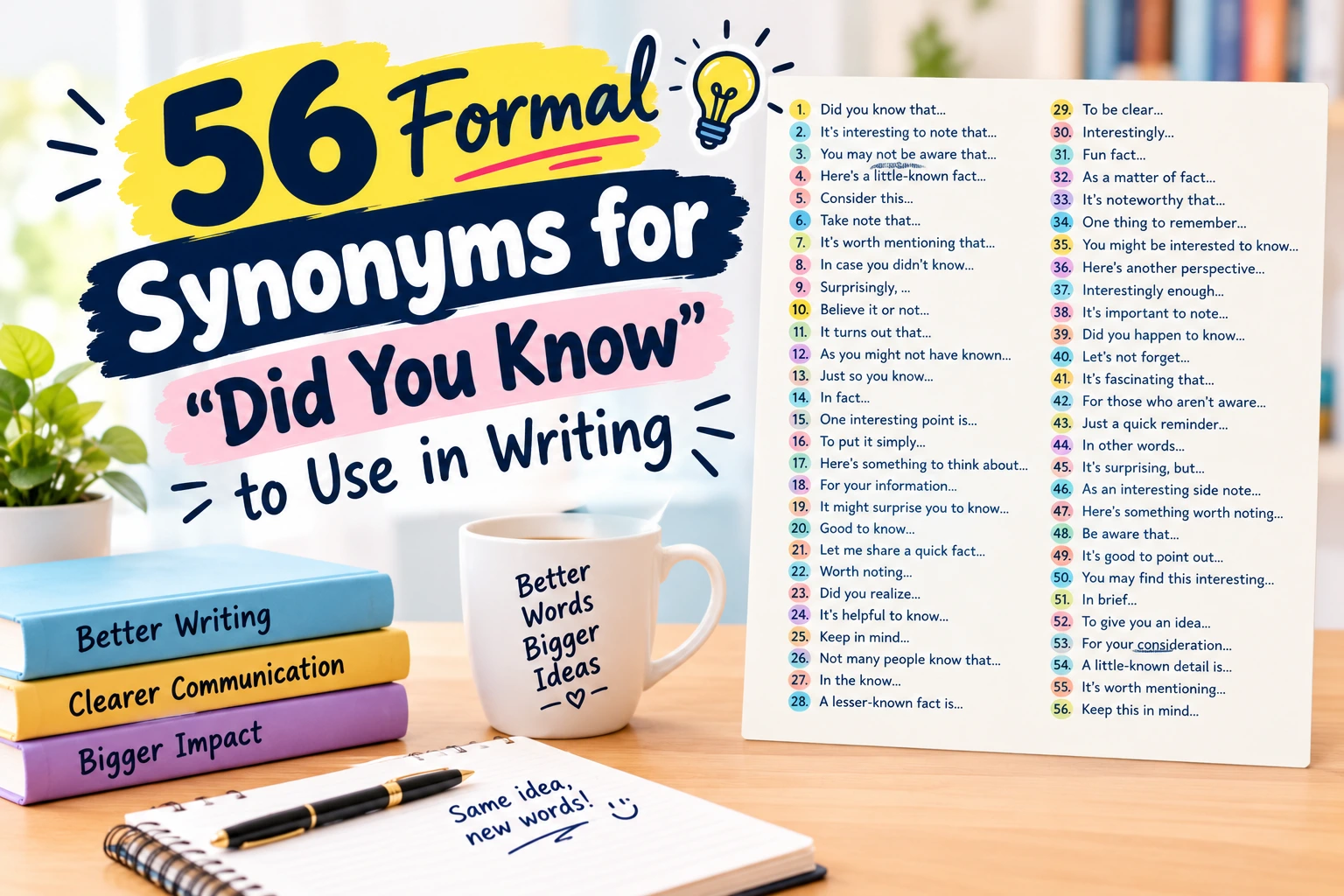
In this guide, you will discover 56 formal synonyms and alternatives to “Did you know,” complete with practical examples. You will also learn when to use each expression so your writing feels professional without sounding stiff or unnatural.
What Does “Did You Know” Mean?
“Did you know?” is a question used to introduce information that someone may not already be aware of. It often appears before an interesting fact, a useful detail, or a surprising discovery.
For example:
- “Did you know that regular feedback can improve employee performance?”
- “Did you know that this service is available to students?”
The phrase is friendly and engaging, but it may not always fit formal situations. In an academic paper, business proposal, or professional email, you might prefer expressions such as “Are you aware that,” “It is worth noting that,” or “Research indicates that.”
The best alternative depends on your purpose. Some expressions invite the reader to consider new information, while others introduce evidence, highlight an important point, or politely check someone’s awareness.
56 Formal Synonyms for “Did You Know”
The following alternatives are organized into five categories to help you find the right expression for your message. Each one includes a realistic example so you can understand how it works in context.
Category 1: Polite and Appreciative Alternatives
These expressions are useful when communicating respectfully with colleagues, clients, teachers, or other professionals. They introduce information without sounding demanding or overly direct.
1. Are You Aware That
This is one of the closest formal alternatives to “Did you know?” It works particularly well when you want to check whether someone has received important information.
Example: “Are you aware that the application deadline has been extended to Friday?”
2. May I Bring to Your Attention
Use this phrase when you want to direct someone’s attention toward a relevant detail. It is especially suitable for formal emails and workplace communication.
Example: “May I bring to your attention that the revised document is now available?”
3. I Would Like to Inform You That
This expression introduces information clearly and respectfully. It is useful when sharing an update rather than asking a direct question.
Example: “I would like to inform you that the meeting has been rescheduled for Monday.”
4. Please Be Advised That
This phrase is common in official notices, administrative emails, and workplace announcements. It communicates information in a direct, professional manner.
Example: “Please be advised that the office will remain closed during the public holiday.”
5. You May Be Interested to Know That
Choose this alternative when sharing something that could be useful or relevant to the recipient.
Example: “You may be interested to know that our company has introduced a flexible working policy.”
6. I Thought You Should Know That
This expression sounds considerate and personal while remaining appropriate in many professional conversations.
Example: “I thought you should know that the client has approved the proposed changes.”
7. I Would Like to Highlight That
Use this phrase to draw attention to a particular fact or detail without sounding overly forceful.
Example: “I would like to highlight that the final report includes the latest survey results.”
8. For Your Information
This concise expression is useful when sharing details that the recipient may need to reference later. It can sound abrupt if used without context, so a polite sentence often works best.
Example: “For your information, the updated schedule has been attached to this email.”
9. I Would Like to Point Out That
This phrase helps you emphasize a relevant detail, especially when clarifying a matter or explaining a decision.
Example: “I would like to point out that the current proposal already addresses the main concerns.”
10. It May Be Helpful for You to Know That
Use this alternative when the information could help someone make a decision or complete a task.
Example: “It may be helpful for you to know that the software also offers a free version.”
Category 2: Academic and Research-Based Alternatives
These expressions are especially useful for essays, research papers, reports, lectures, and educational presentations. They focus on evidence and information rather than directly asking whether the reader knows something.
11. Research Indicates That
This is an effective alternative when introducing findings supported by research. Use it only when you have credible evidence to support the claim.
Example: “Research indicates that regular practice can improve long-term learning.”
12. Studies Have Shown That
Choose this expression when referring to findings from relevant studies. Ideally, cite the specific research in formal academic writing.
Example: “Studies have shown that adequate sleep supports attention and memory.”
13. Evidence Suggests That
This phrase is useful when the available evidence supports a conclusion without necessarily proving it beyond doubt.
Example: “Evidence suggests that early feedback can help students identify learning gaps.”
14. It Is Important to Note That
Use this expression to introduce a detail that readers should consider when understanding your argument.
Example: “It is important to note that the survey included participants from different age groups.”
15. It Is Worth Noting That
This is a slightly softer way to highlight a relevant fact. It fits essays, reports, presentations, and professional documents.
Example: “It is worth noting that the results varied across the three regions.”
16. The Available Data Indicates That
Use this phrase when explaining what a dataset appears to show. Make sure the statement accurately reflects the data.
Example: “The available data indicates that customer satisfaction increased during the final quarter.”
17. According to Recent Research
This expression introduces information drawn from relatively recent research. It works best when you identify the source where appropriate.
Example: “According to recent research, personalized learning can help address different educational needs.”
18. Findings Reveal That
Choose this alternative when reporting the results of an investigation, survey, or study.
Example: “The findings reveal that most participants preferred online registration.”
19. Previous Research Has Established That
This phrase is useful when referring to a conclusion that has been supported by earlier research. Avoid using “established” if the evidence remains uncertain or disputed.
Example: “Previous research has established that consistent practice plays an important role in skill development.”
20. A Key Observation Is That
Use this expression to introduce an important observation from your analysis.
Example: “A key observation is that smaller teams completed the task with fewer communication delays.”
21. It Is Relevant to Mention That
This phrase helps introduce information that directly relates to your main point.
Example: “It is relevant to mention that the participants received the same instructions before beginning the assessment.”
22. The Evidence Demonstrates That
This alternative is suitable when strong evidence clearly supports your statement. Avoid it when the evidence is incomplete.
Example: “The evidence demonstrates that the revised process reduced the number of errors.”
Category 3: Professional and Business Alternatives
These expressions work well in business emails, meetings, proposals, reports, and presentations. They help you communicate important information with clarity and confidence.
23. Please Note That
This is a simple, widely understood way to draw attention to a specific detail.
Example: “Please note that all expense claims must be submitted by the end of the month.”
24. I Would Like to Emphasize That
Use this phrase when a particular point deserves special attention.
Example: “I would like to emphasize that meeting the quality standards remains our top priority.”
25. It Is Important to Recognize That
This expression encourages readers to consider a significant fact or broader implication.
Example: “It is important to recognize that customer expectations can change over time.”
26. One Should Be Mindful That
This alternative is useful when highlighting a consideration, limitation, or potential concern.
Example: “One should be mindful that additional features may increase the overall project cost.”
27. It Should Be Taken into Account That
Use this phrase when a factor needs to be considered before making a decision or reaching a conclusion.
Example: “It should be taken into account that the estimated delivery date depends on supplier availability.”
28. A Relevant Consideration Is That
This expression introduces a factor that has a direct bearing on the discussion.
Example: “A relevant consideration is that the new policy applies to remote employees as well.”
29. It Is Essential to Understand That
Choose this phrase when the reader needs to understand a point before moving forward.
Example: “It is essential to understand that the final budget includes both direct and indirect costs.”
30. I Would Like to Clarify That
This alternative works well when correcting a misunderstanding or explaining something that may not have been clear.
Example: “I would like to clarify that the revised deadline applies to all departments.”
31. It Is Worth Considering That
Use this expression when introducing a factor that deserves careful thought rather than presenting it as an unquestionable fact.
Example: “It is worth considering that a shorter onboarding process may require additional staff support.”
32. Please Keep in Mind That
This phrase sounds professional without being overly formal. It is useful for reminders and practical guidance.
Example: “Please keep in mind that all submitted files must follow the required naming format.”
33. A Point Worth Highlighting Is That
Choose this expression when you want to draw attention to a detail during a meeting, report, or presentation.
Example: “A point worth highlighting is that the team achieved these results without increasing its budget.”
34. It Is Useful to Be Aware That
This alternative introduces information that may help the reader understand a process or make an informed decision.
Example: “It is useful to be aware that the platform supports several file formats.”
Category 4: Confident and Direct Alternatives
These expressions are suitable when you want to sound clear, knowledgeable, and authoritative. They are particularly effective in presentations, reports, and informative writing.
35. Notably
Use this concise word to introduce a particularly interesting or significant detail.
Example: “Notably, the revised strategy improved response times across all departments.”
36. Significantly
This word highlights a detail that has considerable importance. In research writing, use it carefully because it can also refer to statistical significance.
Example: “Significantly, the updated system reduced processing time by nearly half.”
37. In Particular
This phrase directs attention to one specific aspect of a broader subject.
Example: “In particular, the report highlights the need for better communication between teams.”
38. Of Particular Importance Is the Fact That
Use this expression when a fact is especially important to your argument or conclusion.
Example: “Of particular importance is the fact that the project remained within its approved budget.”
39. A Noteworthy Fact Is That
This phrase introduces information that deserves attention because it is unusual, interesting, or significant.
Example: “A noteworthy fact is that the organization serves communities in several remote areas.”
40. One Significant Detail Is That
Choose this alternative when you want to focus on one important detail without overwhelming the reader with additional information.
Example: “One significant detail is that the new policy takes effect immediately.”
41. An Important Point to Consider Is That
This expression introduces a factor that could influence someone’s understanding or decision.
Example: “An important point to consider is that the proposed solution requires ongoing maintenance.”
42. It Is Particularly Interesting That
Use this phrase to highlight something surprising or intellectually engaging.
Example: “It is particularly interesting that younger participants reported different preferences from older respondents.”
43. A Notable Aspect Is That
This expression works well when describing a distinctive feature of a product, process, project, or finding.
Example: “A notable aspect is that the application works on both desktop and mobile devices.”
44. One Fact That Deserves Attention Is That
Choose this alternative when a particular fact is easy to overlook but important to understand.
Example: “One fact that deserves attention is that the training is available to new employees at no additional cost.”
Category 5: Informative and Thoughtful Alternatives
These expressions are useful when introducing background information, explaining a discovery, or helping readers understand why a particular detail matters.
45. Interestingly
This word introduces something that may surprise or engage your audience. It is suitable for articles, presentations, and less rigid professional writing.
Example: “Interestingly, the simplest design received the highest rating from users.”
46. For Context
Use this concise phrase when providing background that helps the reader understand the main point.
Example: “For context, the company received twice as many applications this year as it did last year.”
47. To Put This into Perspective
This expression helps readers understand the importance or scale of a fact by giving them something to compare it with.
Example: “To put this into perspective, the revised process saves each employee approximately two hours per week.”
48. One Detail That May Surprise You Is That
Choose this phrase when introducing an unexpected fact in an article, speech, or informative presentation.
Example: “One detail that may surprise you is that the library offers free access to several digital resources.”
49. A Little-Known Fact Is That
This expression introduces information that many people may not be familiar with. Make sure the fact is genuinely not widely known among your intended audience.
Example: “A little-known fact is that some public libraries provide free access to online learning platforms.”
50. An Interesting Point to Consider Is That
Use this alternative when you want readers to think more deeply about a particular idea.
Example: “An interesting point to consider is that convenience does not always lead to better long-term results.”
51. What Is Often Overlooked Is That
This phrase highlights a detail that people may ignore or underestimate.
Example: “What is often overlooked is that effective communication also requires active listening.”
52. It Is Easy to Overlook That
Choose this expression when pointing out a detail that can be missed during a quick review.
Example: “It is easy to overlook that the total cost includes a separate maintenance fee.”
53. A Useful Insight Is That
This phrase introduces an observation that could help readers understand a situation or improve their approach.
Example: “A useful insight is that customers often value clear instructions as much as a wide range of features.”
54. An Important Insight to Keep in Mind Is That
Use this alternative when presenting a lesson or observation that could influence future decisions.
Example: “An important insight to keep in mind is that consistent progress often matters more than occasional bursts of effort.”
55. This Is Worth Knowing Because
This expression explains not only the information itself but also why it matters to the reader.
Example: “This is worth knowing because early registration gives students more time to resolve application issues.”
56. The Key Takeaway Is That
Use this phrase when summarizing the most important lesson or conclusion from a discussion.
Example: “The key takeaway is that careful planning can prevent many avoidable delays.”
Real-Life Situations: Which Alternative Should You Use?
Knowing several formal alternatives is helpful, but choosing the right one for a particular situation makes your writing much more effective.
Here are five common situations and the expressions that fit them best.
1. When Writing a Formal Email
If you need to share an update with a colleague, manager, or client, choose wording that is direct and respectful.
Best reply: “I would like to inform you that…”
Example:
“I would like to inform you that the revised proposal has been approved. Please let me know if you require any additional details.”
Why it works: It communicates the update clearly without making the email unnecessarily complicated.
2. When Preparing an Academic Essay
Academic writing usually benefits from precise language and evidence-based statements.
Best reply: “Research indicates that…”
Example:
“Research indicates that regular feedback can support student learning, particularly when it provides clear guidance for improvement.”
Why it works: It introduces a research-based claim rather than relying on a conversational question.
3. When Giving a Business Presentation
During a presentation, you want to guide the audience toward the information that matters most.
Best reply: “It is important to note that…”
Example:
“It is important to note that customer retention improved after the company introduced its new support process.”
Why it works: It highlights a relevant detail and helps the audience follow your argument.
4. When Sharing a Surprising Fact
If you are writing an educational article or introducing an unexpected discovery, a slightly engaging expression may work better than a highly formal one.
Best reply: “Interestingly…”
Example:
“Interestingly, the most popular option was not the most expensive one, but the one that offered the simplest user experience.”
Why it works: It creates curiosity while keeping the sentence natural and easy to read.
5. When Clarifying a Misunderstanding
If someone has misunderstood a deadline, instruction, or decision, be clear without sounding confrontational.
Best reply: “I would like to clarify that…”
Example:
“I would like to clarify that the submission deadline is Thursday, not Friday. The original schedule has not changed.”
Why it works: It corrects the misunderstanding directly while maintaining a professional tone.
Common Mistakes to Avoid
Even a good formal alternative can sound awkward when it is used in the wrong context. Keep these common mistakes in mind.
1. Using Overly Complicated Language
Formal writing does not require long, complicated expressions. A phrase such as “Please note that” is often more effective than a lengthy sentence filled with unnecessary wording.
Better approach: Choose the simplest expression that communicates your meaning clearly.
2. Using the Same Phrase Repeatedly
Repeating “It is important to note that” throughout a report can make your writing feel monotonous.
Better approach: Vary your wording naturally. Use “A key observation is that,” “Notably,” or “The evidence suggests that” when each expression accurately fits the point.
3. Making Unsupported Claims
Expressions such as “Research indicates that” and “Studies have shown that” suggest that evidence exists.
Better approach: Use these phrases only when you can support the statement with reliable research or data.
4. Sounding Too Formal in Everyday Messages
A simple message to a classmate or colleague may not need language such as “Of particular importance is the fact that.”
Better approach: Match your wording to your audience. Professional communication should be clear, not unnecessarily stiff.
5. Confusing Questions with Statements
“Are you aware that?” is a question, while “It is worth noting that” introduces a statement. They may communicate similar information, but they are not grammatically interchangeable in every sentence.
Better approach: Check whether your sentence needs a question mark or whether you are introducing a fact directly.
6. Using Formal Phrases Without a Clear Purpose
Adding expressions such as “Notably” or “Significantly” to every sentence can weaken their impact.
Better approach: Reserve emphasis for details that genuinely deserve attention.
Pro Tips for Using Formal Alternatives Naturally
1. Think about your purpose before choosing a phrase.
If you are checking someone’s awareness, use “Are you aware that?” If you are sharing an update, try “I would like to inform you that.” If you are presenting evidence, “Research indicates that” may be more appropriate.
2. Match your tone to your audience.
A university essay may require research-based language, while a professional email may benefit from a simple expression such as “Please note that.” Formality should help your message, not make it harder to understand.
3. Read the sentence aloud before sending it.
If the wording sounds unnatural when spoken, it may also feel awkward to the reader. Choose a phrase that fits smoothly into the sentence and communicates your point without unnecessary words.
Bonus: 8 Short Alternatives to “Did You Know”
If you need a quick expression for an email, presentation, or article, these eight options are easy to remember.
- Please note that — for important information.
- Interestingly — for an engaging fact.
- For context — for useful background.
- Notably — for a significant detail.
- It is worth noting that — for a relevant observation.
- Research indicates that — for evidence-based information.
- Are you aware that — for checking someone’s awareness.
- The key takeaway is that — for summarizing an important point.
Conclusion
Replacing “Did you know?” with a more formal expression can make your emails, essays, reports, and presentations sound clearer and more professional. The key is not to choose the most complicated phrase, but to select the one that best fits your message.
Use “Are you aware that?” when checking someone’s knowledge, “Research indicates that” when introducing supported findings, and “It is worth noting that” when highlighting an important detail. Small changes in wording can make a meaningful difference in how your message is received.
Discover more
formal synonyms for just in case