
You know that feeling when something is coming up and you are already thinking about it? Maybe your friend has finally agreed to meet you, your crush is coming over, or you are waiting for an exciting trip. Saying “I can’t wait” works perfectly, but using the same phrase every time can make your messages feel predictable.
That is why people often look for other ways to say “can’t wait.” The right alternative can make your message sound warmer, more excited, playful, confident, romantic, or even funny. It all depends on who you are talking to and what you are looking forward to.
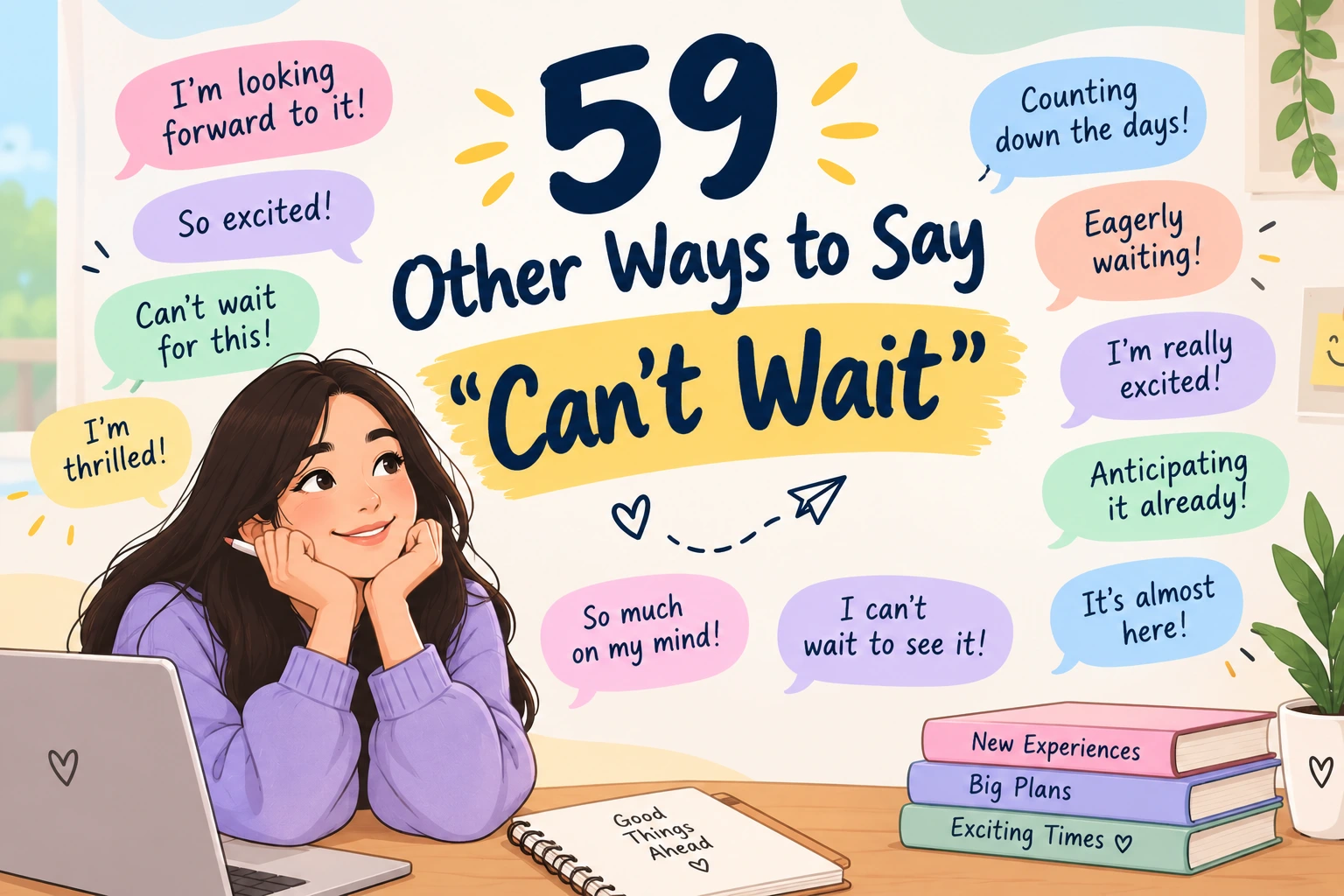
Whether you are texting a friend, replying to your crush, talking to a coworker, or writing a thoughtful message, there is a better expression for almost every situation. Here are 59 natural alternatives, complete with real-life examples.
What Does “Other Ways to Say Can’t Wait” Mean?
“Can’t wait” is a common expression used when you are very excited about something that is going to happen in the future.
For example, if your friend says, “We are finally going on that trip next weekend,” you might reply, “I can’t wait!”
It does not literally mean that you are unable to wait. It simply shows strong anticipation and excitement.
People use it when talking about upcoming plans, meetings, events, trips, dates, celebrations, opportunities, or even something as simple as seeing a friend.
Depending on your wording, you can make the same feeling sound different. “Looking forward to it” sounds more professional, while “I’m so ready for this” feels casual. “I’m counting down the days” sounds enthusiastic, while “Bring it on” has a more confident and playful energy.
The goal is not to find one perfect replacement. It is to choose a phrase that sounds like you.
Polite and Appreciative
These responses work well when you want to express excitement while still sounding warm, respectful, and genuine. They are especially useful for friends, colleagues, family members, and professional situations.
1. “I’m Really Looking Forward to It.”
Reply: “I’m really looking forward to it.”
Example: Your coworker confirms that you will finally attend the conference together. You reply, “Thanks for letting me know. I’m really looking forward to it.”
This is one of the safest and most versatile alternatives to “can’t wait.” It sounds enthusiastic without being overly casual.
2. “I’m Looking Forward to It.”
Reply: “I’m looking forward to it.”
Example: Your professor tells you about an upcoming workshop. You respond, “Thank you for the information. I’m looking forward to it.”
This is polite, professional, and appropriate for emails, workplace conversations, and formal situations.
3. “I’m Excited About It.”
Reply: “I’m genuinely excited about it.”
Example: A friend tells you that your favorite band is performing next month. You say, “I’m genuinely excited about it.”
This makes your excitement clear while keeping the wording natural.
4. “I’m Really Excited for This.”
Reply: “I’m really excited for this.”
Example: Your friends finally choose a destination for your weekend trip. You text, “Okay, now I’m really excited for this.”
It works especially well when something has just been confirmed.
5. “That Sounds Wonderful. I’m Looking Forward to It.”
Reply: “That sounds wonderful. I’m looking forward to it.”
Example: Someone invites you to a dinner party and gives you the details. You respond with this warm and appreciative message.
This is a good choice when you want to acknowledge the invitation before expressing excitement.
6. “I’m Happy We’re Doing This.”
Reply: “I’m really happy we’re doing this.”
Example: Your old school friend suggests meeting after years apart. You reply, “I’m really happy we’re doing this.”
This sounds sincere because it focuses on the meaning behind the event rather than simply saying you are excited.
7. “I’m Glad It’s Finally Happening.”
Reply: “I’m glad it’s finally happening.”
Example: You and your friends have been planning a trip for months. Once the tickets are booked, you say, “I’m glad it’s finally happening.”
Use this when something has taken a long time to arrange.
8. “I’m Excited to Be Part of It.”
Reply: “I’m excited to be part of it.”
Example: Your team invites you to participate in an important university project. You respond, “Thank you for including me. I’m excited to be part of it.”
This sounds appreciative and confident at the same time.
9. “I’m Happy to Hear That. Looking Forward to It.”
Reply: “I’m happy to hear that. Looking forward to it.”
Example: Your friend tells you they have finally received approval for your planned outing. You reply with this simple message.
It is a friendly way to show appreciation and anticipation together.
10. “I’m Eager to Get Started.”
Reply: “I’m eager to get started.”
Example: Your manager tells you when your new project begins. You answer, “Thanks for the update. I’m eager to get started.”
This works particularly well in professional or academic settings.
11. “I’m Excited to See How It Goes.”
Reply: “I’m excited to see how it goes.”
Example: Your friend has launched a small business. You tell them, “I’m excited to see how it goes.”
It expresses enthusiasm without making the situation sound exaggerated.
12. “I’m Glad We Have Something to Look Forward To.”
Reply: “I’m glad we have something to look forward to.”
Example: You and your sibling have planned a family trip after a stressful few months. You say, “Honestly, I’m glad we have something to look forward to.”
This feels thoughtful and emotionally genuine.
Flirty and Playful
When the person is someone you like, “I can’t wait” can sometimes feel too ordinary. These alternatives add personality without making the message overly intense.
13. “I’m Counting Down the Days.”
Reply: “I’m counting down the days.”
Example: Your crush says, “Only five more days until we finally meet.” You respond, “Trust me, I’m counting down the days.”
It creates a sweet sense of anticipation.
14. “I’m Already Looking Forward to Seeing You.”
Reply: “I’m already looking forward to seeing you.”
Example: After making plans for a date, you text, “I’m already looking forward to seeing you.”
This is warm and romantic without sounding too dramatic.
15. “I’m More Excited Than I Should Be.”
Reply: “I’m probably more excited than I should be.”
Example: Your crush confirms your weekend plans. You reply, “Okay, I’m probably more excited than I should be.”
The playful self-awareness makes this sound natural and slightly flirty.
16. “You Have No Idea How Excited I Am.”
Reply: “You have no idea how excited I am.”
Example: Your partner surprises you with tickets to a concert you love. You immediately text, “You have no idea how excited I am.”
This is ideal when you genuinely want to emphasize your excitement.
17. “I’m So Ready to See You.”
Reply: “I’m so ready to see you.”
Example: You have been busy for weeks and finally make plans with someone you like. You say, “I’m so ready to see you.”
It feels personal and affectionate.
18. “I’ve Been Looking Forward to This All Week.”
Reply: “I’ve been looking forward to this all week.”
Example: Your date finally arrives after several days of texting. You tell them, “Honestly, I’ve been looking forward to this all week.”
This makes your interest clear without being overwhelming.
19. “I’m Definitely Excited for This One.”
Reply: “I’m definitely excited for this one.”
Example: Someone you like invites you to an event. You reply, “I’m definitely excited for this one.”
The wording feels relaxed rather than overly romantic.
20. “This Is Going to Be Fun.”
Reply: “This is going to be fun.”
Example: Your friend plans a spontaneous road trip with you. You answer, “This is going to be fun.”
It communicates excitement while keeping the mood easygoing.
21. “I Have a Feeling I’m Going to Love This.”
Reply: “I have a feeling I’m going to love this.”
Example: Your crush takes you to a restaurant you have never tried before. You text beforehand, “I have a feeling I’m going to love this.”
It creates a playful sense of anticipation.
22. “Okay, Now I’m Excited.”
Reply: “Okay, now I’m excited.”
Example: Someone tells you a surprise is planned for your birthday. You reply, “Okay, now I’m excited.”
Short, natural, and perfect for texting.
23. “I’m Getting Excited Already.”
Reply: “I’m getting excited already.”
Example: Your friends start discussing your upcoming beach trip. You say, “I’m getting excited already.”
This works when the excitement is gradually building.
24. “Bring on the Good Times.”
Reply: “Bring on the good times.”
Example: Your friends have finally planned the weekend party. You text, “Everything’s ready? Bring on the good times.”
It adds a playful, upbeat energy.
Confident and Self-Respecting
Excitement does not have to sound desperate. These alternatives let you show genuine interest while maintaining confidence and composure.
25. “I’m Definitely Looking Forward to It.”
Reply: “I’m definitely looking forward to it.”
Example: Someone confirms an important meeting you have been preparing for. You respond, “Perfect. I’m definitely looking forward to it.”
It shows enthusiasm without sounding overly eager.
26. “I’m Ready When You Are.”
Reply: “I’m ready when you are.”
Example: Your friend says, “Should we finally plan that trip?” You answer, “Absolutely. I’m ready when you are.”
This communicates confidence and readiness.
27. “I’m All In.”
Reply: “I’m all in.”
Example: Your friends suggest trying something new, and you genuinely want to participate. You say, “Sounds good. I’m all in.”
It is short, confident, and decisive.
28. “I’m Looking Forward to What’s Ahead.”
Reply: “I’m looking forward to what’s ahead.”
Example: You have accepted a new university opportunity. You tell your friend, “There’s a lot to learn, but I’m looking forward to what’s ahead.”
This works particularly well for future goals and new chapters.
29. “I’m Ready for It.”
Reply: “I’m ready for it.”
Example: Your friend asks if you are prepared for tomorrow’s competition. You answer, “I’ve prepared all week. I’m ready for it.”
It sounds focused rather than overly emotional.
30. “I’m Excited to See What Comes Next.”
Reply: “I’m excited to see what comes next.”
Example: After completing an important project, you tell your teammate, “We’ve done our part. I’m excited to see what comes next.”
It expresses optimism without exaggeration.
31. “I’m Looking Forward to Making It Happen.”
Reply: “I’m looking forward to making it happen.”
Example: Your team has developed a new project idea. You say, “We have a solid plan, and I’m looking forward to making it happen.”
This is excellent for ambitious or goal-oriented conversations.
32. “I’m Fully On Board.”
Reply: “I’m fully on board.”
Example: Your classmates suggest a new approach for the group project. You respond, “I like the idea. I’m fully on board.”
It communicates agreement and confidence.
33. “I’m Ready to See Where This Goes.”
Reply: “I’m ready to see where this goes.”
Example: You have started getting to know someone new. Instead of rushing things, you say, “I like where this is going. I’m ready to see where this goes.”
This sounds confident and emotionally balanced.
34. “I’m Looking Forward to the Experience.”
Reply: “I’m looking forward to the experience.”
Example: You are about to attend your first major conference. You tell a friend, “I’ve never done anything like this before, but I’m looking forward to the experience.”
It sounds mature and composed.
35. “I’m Ready for Whatever Comes Next.”
Reply: “I’m ready for whatever comes next.”
Example: After finishing your exams, you tell your friend, “No matter what happens now, I’m ready for whatever comes next.”
This has a strong, optimistic tone.
36. “I’m Excited, but I’m Keeping My Expectations Realistic.”
Reply: “I’m excited, but I’m keeping my expectations realistic.”
Example: You are meeting someone you have only talked to online. You tell your friend, “I’m excited, but I’m keeping my expectations realistic.”
This is useful when you want to show interest without getting carried away.
Funny and Savage
Sometimes the best response is one that makes the other person laugh. These alternatives are perfect for friends, playful conversations, and situations where a little attitude is welcome.
37. “I’ve Been Waiting Forever.”
Reply: “I’ve been waiting forever.”
Example: Your friend finally agrees to watch the movie you recommended months ago. You reply, “Finally. I’ve been waiting forever.”
The exaggeration makes it funny without being genuinely annoyed.
38. “About Time!”
Reply: “About time!”
Example: Your friend finally sends you the photos they promised last week. You respond, “About time!”
This works best when you already have a playful relationship.
39. “Let’s Not Keep Me Waiting Too Long.”
Reply: “Let’s not keep me waiting too long.”
Example: Your friend says they will tell you the big news tomorrow. You reply, “Fine, but let’s not keep me waiting too long.”
It adds playful pressure.
40. “I’m Trying Very Hard to Act Patient.”
Reply: “I’m trying very hard to act patient.”
Example: Your friend says the surprise is coming soon but refuses to reveal anything. You text, “I’m trying very hard to act patient here.”
This is perfect for teasing situations.
41. “My Patience Has Left the Chat.”
Reply: “My patience has officially left the chat.”
Example: Your friends keep postponing your dinner plans. You message the group, “My patience has officially left the chat.”
It is dramatic in a deliberately funny way.
42. “Okay, Hurry Up Then.”
Reply: “Okay, hurry up then.”
Example: Your friend says, “We’re meeting soon!” You answer, “Okay, hurry up then.”
Short, teasing, and natural.
43. “I’m Practically Ready at This Point.”
Reply: “I’m practically ready at this point.”
Example: Your friends have been planning a trip for months. You text, “The tickets aren’t even booked yet and I’m practically ready at this point.”
The exaggeration gives it personality.
44. “My Excitement Is Getting Slightly Ridiculous.”
Reply: “My excitement is getting slightly ridiculous.”
Example: Your favorite artist announces a concert you have been hoping for. You tell your friend, “My excitement is getting slightly ridiculous.”
This is humorous while still sounding genuinely excited.
45. “Someone Fast-Forward Time, Please.”
Reply: “Someone fast-forward time, please.”
Example: Your vacation is still two weeks away. You text your friends, “Two weeks is too long. Someone fast-forward time, please.”
It is a fun alternative for texting.
46. “I’m Ready Yesterday.”
Reply: “I’m ready yesterday.”
Example: Your friend asks if you are ready for tomorrow’s road trip. You reply, “Ready? I’m ready yesterday.”
The intentionally impossible wording makes the message playful.
47. “Can We Just Skip to the Good Part?”
Reply: “Can we just skip to the good part?”
Example: Your friend says the event is still three days away. You respond, “Can we just skip to the good part already?”
Use this when you want to exaggerate your excitement.
48. “My Calendar and I Are Having a Countdown.”
Reply: “My calendar and I are having a countdown.”
Example: Your birthday is approaching and you have been planning a party. You joke, “At this point, my calendar and I are having a countdown.”
It works well in lighthearted conversations.
Curious, Thoughtful, and Mature
Sometimes you want to express anticipation while also showing that you care about what is actually going to happen. These responses are especially useful for deeper conversations, new relationships, and important plans.
49. “I’m Looking Forward to Seeing How It Unfolds.”
Reply: “I’m looking forward to seeing how it unfolds.”
Example: You and your friend have started working on a creative project. You say, “We have a lot of ideas, and I’m looking forward to seeing how it unfolds.”
This sounds thoughtful and open-minded.
50. “I’m Curious to See What Happens.”
Reply: “I’m curious to see what happens.”
Example: You are trying a new class for the first time. You tell your friend, “I have no idea what to expect, but I’m curious to see what happens.”
It combines anticipation with curiosity.
51. “I’m Looking Forward to Spending Time Together.”
Reply: “I’m looking forward to spending time together.”
Example: A close friend you have not seen for months confirms their visit. You reply, “It’s been too long. I’m looking forward to spending time together.”
This sounds sincere and emotionally meaningful.
52. “I’m Glad We’ll Finally Get the Chance.”
Reply: “I’m glad we’ll finally get the chance.”
Example: You have been trying to meet an old friend for months. Once your schedules match, you say, “I’m glad we’ll finally get the chance to catch up.”
This works beautifully when circumstances have kept people apart.
53. “I’m Interested to See How Things Develop.”
Reply: “I’m interested to see how things develop.”
Example: You have started working with a new team and want to see how the collaboration goes. You say, “Everyone has different ideas, so I’m interested to see how things develop.”
It sounds mature and measured.
54. “I’m Looking Forward to the Conversation.”
Reply: “I’m looking forward to the conversation.”
Example: You have scheduled an important discussion with a mentor. You write, “Thank you for making time. I’m looking forward to the conversation.”
This is excellent for professional and meaningful discussions.
55. “I’m Excited to Learn More.”
Reply: “I’m excited to learn more.”
Example: A company invites you to an internship interview. You respond, “Thank you for the opportunity. I’m excited to learn more about the role.”
This communicates enthusiasm without sounding desperate.
56. “I’m Looking Forward to Catching Up.”
Reply: “I’m looking forward to catching up.”
Example: An old classmate messages you after a long time. You reply, “It has been ages. I’m looking forward to catching up.”
It feels warm and genuine.
57. “I’m Curious to Experience It for Myself.”
Reply: “I’m curious to experience it for myself.”
Example: Your friend keeps recommending a restaurant you have never visited. You say, “Everyone keeps talking about it, so I’m curious to experience it for myself.”
This sounds natural when you want to show interest without overhyping something.
58. “I’m Looking Forward to Sharing the Experience.”
Reply: “I’m looking forward to sharing the experience.”
Example: You and your sibling have planned your first international trip together. You say, “It means a lot that we get to do this together. I’m looking forward to sharing the experience.”
This feels thoughtful and personal.
59. “I’m Excited for What This Could Become.”
Reply: “I’m excited for what this could become.”
Example: You have started a new friendship or creative partnership that feels promising. You tell them, “I really enjoy talking with you. I’m excited for what this could become.”
This is an excellent choice when you want to express genuine optimism while leaving room for things to develop naturally.
Real-Life Situations: What Should You Say?
Knowing different alternatives is useful, but the real question is often: Which one should I actually send?
When Your Crush Says It
If your crush says, “I can’t wait to see you,” you do not need to respond with something overly intense.
Best reply: “I’ve been looking forward to seeing you too.”
It shows that you are interested without sounding desperate. If you want something more playful, try, “Okay, now I’m getting excited too.”
When a Friend Is Joking
If a friend says, “I can’t wait for our trip,” match their playful energy.
Best reply: “Same. My patience has already left the chat.”
A little humor makes the conversation feel more natural.
When Someone Says It Too Early
If someone you barely know says, “I can’t wait to see you,” you may not want to mirror their intensity.
Best reply: “It’ll be nice to meet and see how things go.”
This keeps things positive without making promises you are not ready to make.
When You Are Not Interested
You do not have to pretend to be excited just because someone else is.
Best reply: “Thanks. I appreciate that. Let’s see how things work out.”
It is polite, calm, and avoids sending mixed signals.
When It Is a Professional Situation
If a manager, professor, client, or colleague says they are looking forward to something, keep your response professional.
Best reply: “Likewise. I’m looking forward to it.”
It is concise, confident, and appropriate for work or academic communication.
What to Avoid When Saying “Can’t Wait”
Even a simple expression can send the wrong message if you use it without considering the situation.
1. Do Not Overdo the Excitement
Writing “I CAN’T WAIT!!!” repeatedly can make your message feel forced. Let your relationship and the situation determine how enthusiastic you sound.
2. Do Not Sound Desperate
There is a difference between showing interest and chasing someone’s attention. “I’m looking forward to it” often sounds more balanced than repeatedly saying, “I really, really can’t wait.”
3. Avoid Using Flirty Replies in Professional Situations
A playful response might work with your crush but feel completely inappropriate with your professor, manager, or client.
4. Do Not Force a Personality That Is Not Yours
If you normally communicate simply, suddenly sending an extremely dramatic response may feel unnatural. Choose words you would actually say.
5. Do Not Misread the Other Person’s Tone
If someone is being polite, do not automatically assume they are flirting. Match their energy before making your response more personal.
6. Avoid Giving False Enthusiasm
If you are genuinely unsure about something, you do not have to pretend you are incredibly excited. A neutral response such as “That sounds good” can be more honest.
Pro Tips for Choosing the Right Response
Match their energy. If they are casual, you can be casual. If they are formal, keep your response polished. The best reply usually feels like a natural continuation of the conversation.
Think about timing. “I’m counting down the days” works when something is genuinely approaching. If the plan is still uncertain, “I’m looking forward to seeing how it works out” may be more appropriate.
Show interest without losing yourself. You can be excited and still maintain confidence. You do not need to over-explain your feelings to prove that you care.
The best response is rarely the most complicated one. It is the one that sounds like something you would actually say.
Bonus: Quick One-Liner Alternatives to “Can’t Wait”
If you need something short, try one of these:
- “Really looking forward to it.”
- “I’m so ready.”
- “I’m excited for this.”
- “Counting down already.”
- “Bring it on.”
- “I’m all in.”
- “This should be fun.”
- “I’m ready when you are.”
- “Looking forward to seeing you.”
- “Let’s make it happen.”
Conclusion
There are plenty of ways to say “can’t wait” without repeating the same phrase every time. You can sound warm and appreciative, playful and flirty, confident and composed, or thoughtful and mature depending on the situation. The important thing is to choose words that match both the moment and your relationship with the person.
A good response does more than express excitement. It communicates your personality and helps the conversation feel natural.
So the next time you feel tempted to type “I can’t wait,” pause for a second. Choose a phrase that actually captures how you feel.
The best words are not the ones that sound impressive. They are the ones that sound like you.
Discover more
other ways to ask did you receive my email