
“Let me know if you have any questions” sounds simple, but it can leave you wondering what to say next. Whether it comes from a teacher, manager, coworker, client, friend, or someone you are getting to know, the right response can keep the conversation comfortable and natural.
Sometimes, a simple “Thank you” is enough. Other times, you may want to sound professional, confident, friendly, or even a little playful. That is why knowing different replies to “Let me know if you have any questions” can be surprisingly useful.
The best response depends on the situation. In a professional setting, you may want to acknowledge the offer politely. In a casual conversation, you can keep things relaxed. And if you genuinely have a question, this is the perfect opportunity to ask it.
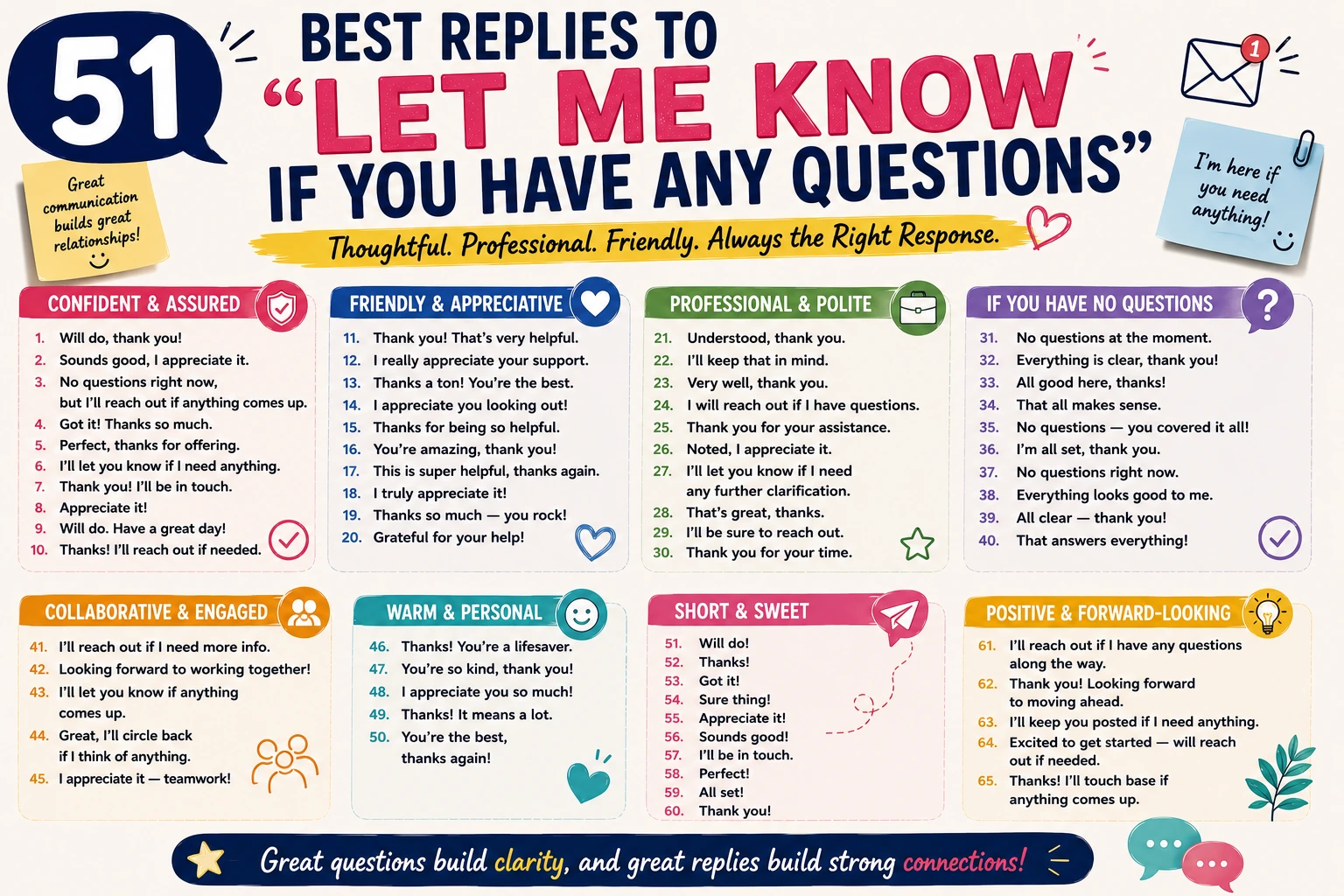
Here are 51 natural responses you can use without sounding awkward or repetitive.
2. What Does “Let Me Know If You Have Any Questions” Mean?
“Let me know if you have any questions” means “Feel free to ask me if anything is unclear or if you need more information.”
It is commonly used at the end of emails, presentations, instructions, meetings, interviews, and conversations.
For example, a manager might explain a new task and say, “Let me know if you have any questions.” A teacher might say the same thing after explaining an assignment.
The phrase is generally friendly, helpful, and professional. It shows that the other person is available to provide clarification or support.
Your response can simply acknowledge their offer, show appreciation, or continue the conversation by asking something specific.
Polite and Appreciative Replies
1. “Thank you, I really appreciate that.”
Meaning: You are politely thanking the person for offering their help.
Tone: Warm and respectful.
Example:
Your manager explains a new project and offers to answer questions. You reply, “Thank you, I really appreciate that.”
2. “Absolutely, thank you.”
Meaning: You acknowledge their offer and appreciate their willingness to help.
Tone: Polite and professional.
Example:
After your professor explains an assignment, you say, “Absolutely, thank you. I’ll reach out if anything comes up.”
3. “I will, thank you.”
Meaning: You are letting them know you will ask if you need clarification.
Tone: Simple and professional.
Example:
A coworker walks you through a new task. You respond, “I will, thank you. I appreciate the guidance.”
4. “Thanks for offering to help.”
Meaning: Shows appreciation for their availability.
Tone: Friendly and sincere.
Example:
A colleague sends you information about a project and adds that they are available for questions. You reply, “Thanks for offering to help.”
5. “I appreciate your help.”
Meaning: Expresses gratitude for their support.
Tone: Professional and genuine.
Example:
Someone has spent time explaining a complicated process to you. You say, “I appreciate your help. I’ll let you know if I need anything else.”
6. “That’s very helpful, thank you.”
Meaning: Acknowledges that their offer makes things easier for you.
Tone: Polite and appreciative.
Example:
Your instructor gives you detailed instructions before an assignment. You reply, “That’s very helpful, thank you.”
7. “Thanks, I’ll keep that in mind.”
Meaning: You acknowledge their offer without making an immediate request.
Tone: Casual and respectful.
Example:
Your coworker tells you to contact them if you run into problems. You respond, “Thanks, I’ll keep that in mind.”
8. “I appreciate you being available.”
Meaning: Recognizes that they are willing to support you.
Tone: Mature and professional.
Example:
Your supervisor offers to discuss any difficulties with your new responsibilities. You say, “I appreciate you being available.”
9. “Thank you. I’ll reach out if I need clarification.”
Meaning: Clearly explains what you will do if something is unclear.
Tone: Professional and polished.
Example:
After receiving project instructions, you reply, “Thank you. I’ll reach out if I need clarification.”
10. “Thanks for letting me know.”
Meaning: A simple way to acknowledge their offer.
Tone: Natural and versatile.
Example:
A teammate tells you that you can contact them with questions. You respond, “Thanks for letting me know.”
Flirty and Playful Replies
11. “I might just take you up on that.”
Meaning: Playfully suggests that you may ask for their help.
Tone: Light and friendly.
Example:
Someone offers to help you understand something. You smile and say, “I might just take you up on that.”
12. “Careful, I might actually ask a lot.”
Meaning: Jokes that you could have plenty of questions.
Tone: Playful and teasing.
Example:
A friend offers to answer your questions about their new hobby. You reply, “Careful, I might actually ask a lot.”
13. “Good to know I have someone to ask.”
Meaning: Shows that you are glad they are available.
Tone: Warm and playful.
Example:
Someone you enjoy talking to offers help with a project. You say, “Good to know I have someone to ask.”
14. “I’ll remember that.”
Meaning: Lightly acknowledges that you can contact them later.
Tone: Casual and slightly playful.
Example:
A friend says they can help you choose between two options. You reply, “I’ll remember that.”
15. “Don’t tempt me; I have plenty of questions.”
Meaning: Jokingly suggests that you are ready to ask questions.
Tone: Playful and humorous.
Example:
Your friend says they are happy to explain something. You respond, “Don’t tempt me; I have plenty of questions.”
16. “You just made yourself my official help desk.”
Meaning: Humorously assigns the person the role of answering your questions.
Tone: Funny and playful.
Example:
Your friend knows everything about a subject you are learning. You say, “You just made yourself my official help desk.”
17. “I’ll keep you on speed dial.”
Meaning: Playfully suggests that you may contact them often.
Tone: Friendly and teasing.
Example:
A friend offers to help you with a difficult assignment. You reply, “I’ll keep you on speed dial.”
18. “That offer might come back to haunt you.”
Meaning: Jokes that you may ask many questions later.
Tone: Teasing and humorous.
Example:
Your classmate offers to explain a difficult topic. You say, “That offer might come back to haunt you.”
19. “I’ll try not to abuse the privilege.”
Meaning: Jokingly promises not to ask too many questions.
Tone: Playful and witty.
Example:
A coworker offers to help you with a new system. You reply, “I’ll try not to abuse the privilege.”
20. “I’ll save my questions for when you least expect them.”
Meaning: A humorous way of teasing the other person.
Tone: Playful and mischievous.
Example:
Your friend offers to answer anything about their trip. You say, “I’ll save my questions for when you least expect them.”
Confident and Self-Respecting Replies
21. “I’ll reach out if I need anything.”
Meaning: Shows that you are comfortable handling things independently while knowing help is available.
Tone: Confident and professional.
Example:
Your supervisor gives you instructions for a task. You reply, “I’ll reach out if I need anything.”
22. “I’ll let you know if anything comes up.”
Meaning: You will contact them if you encounter an issue.
Tone: Calm and confident.
Example:
A teammate offers support during a project. You say, “I’ll let you know if anything comes up.”
23. “Sounds good. I’ll ask if I need clarification.”
Meaning: Shows that you understand the information and know when to seek help.
Tone: Professional and assured.
Example:
Your manager explains a new responsibility. You respond, “Sounds good. I’ll ask if I need clarification.”
24. “Got it. I’ll reach out if necessary.”
Meaning: Confirms that you understand and will contact them only when needed.
Tone: Direct and confident.
Example:
After receiving detailed instructions, you say, “Got it. I’ll reach out if necessary.”
25. “I think I’m all set for now.”
Meaning: Politely indicates that you currently have no questions.
Tone: Confident and relaxed.
Example:
After a presentation, the speaker asks if anyone has questions. You reply, “I think I’m all set for now.”
26. “Everything makes sense so far.”
Meaning: Confirms that you understand what has been explained.
Tone: Clear and professional.
Example:
Your teacher finishes explaining the assignment. You say, “Everything makes sense so far. Thank you.”
27. “I’ll speak up if I need more information.”
Meaning: Shows that you are comfortable asking for help when necessary.
Tone: Mature and confident.
Example:
Your supervisor explains your responsibilities. You respond, “I’ll speak up if I need more information.”
28. “Thanks. I’ll handle it from here.”
Meaning: Shows appreciation while communicating independence.
Tone: Confident and self-assured.
Example:
A colleague helps you get started with a task. You say, “Thanks. I’ll handle it from here.”
29. “I’m clear on everything for now.”
Meaning: Indicates that you currently understand the information.
Tone: Professional and composed.
Example:
After a meeting, your manager asks whether you have questions. You reply, “I’m clear on everything for now.”
30. “I’ll let you know if I run into anything.”
Meaning: Tells the person that you will ask for assistance if a problem appears.
Tone: Natural and confident.
Example:
Your teammate gives you access to a new software system. You say, “I’ll let you know if I run into anything.”
Funny and Savage Replies
31. “Oh, you’re going to regret saying that.”
Meaning: Jokes that you have plenty of questions ready.
Tone: Funny and teasing.
Example:
Your friend offers to answer questions about their new job. You respond, “Oh, you’re going to regret saying that.”
32. “You have no idea how many questions I have.”
Meaning: Humorously suggests that you have a lot to ask.
Tone: Funny and casual.
Example:
A friend says they are happy to explain a complicated situation. You say, “You have no idea how many questions I have.”
33. “I was waiting for you to say that.”
Meaning: Jokes that you were already looking for an opportunity to ask.
Tone: Clever and playful.
Example:
Your classmate offers to explain the homework. You reply, “I was waiting for you to say that.”
34. “You just opened the floodgates.”
Meaning: Suggests that you now have permission to ask everything.
Tone: Funny and dramatic.
Example:
Someone says you can ask anything about their new project. You say, “You just opened the floodgates.”
35. “Prepare yourself.”
Meaning: A humorous warning that questions are coming.
Tone: Short and playful.
Example:
Your friend offers to answer your questions about their trip. You reply, “Prepare yourself.”
36. “That was a dangerous offer.”
Meaning: Jokes that offering help may result in many questions.
Tone: Sarcastic and funny.
Example:
Your coworker says, “Let me know if you need anything.” You answer, “That was a dangerous offer.”
37. “I have entered question mode.”
Meaning: Announces humorously that you are ready to ask questions.
Tone: Funny and casual.
Example:
Your friend starts explaining a new game. You say, “I have entered question mode.”
38. “You said the magic words.”
Meaning: Jokes that their offer has given you permission to start asking.
Tone: Playful and humorous.
Example:
Your friend offers to explain their travel plans. You respond, “You said the magic words.”
39. “Well, since you asked…”
Meaning: A humorous way to begin asking questions.
Tone: Witty and conversational.
Example:
Your friend offers to answer anything about a situation. You reply, “Well, since you asked…”
40. “I hope you have a lot of free time.”
Meaning: Jokes that your questions may take a while.
Tone: Funny and teasing.
Example:
Your friend offers to help you choose a laptop. You say, “I hope you have a lot of free time.”
Curious, Thoughtful, and Mature Replies
41. “Actually, I do have one question.”
Meaning: Directly signals that you need clarification.
Tone: Clear and natural.
Example:
After your manager explains a project, you say, “Actually, I do have one question. When would you like the first draft?”
42. “Could I clarify one thing?”
Meaning: Politely asks permission to clear up a specific point.
Tone: Professional and thoughtful.
Example:
Your professor explains an assignment. You ask, “Could I clarify one thing about the deadline?”
43. “There is one thing I’d like to understand better.”
Meaning: Indicates that one part of the information needs further explanation.
Tone: Mature and respectful.
Example:
After a meeting, you say, “There is one thing I’d like to understand better. Could you explain the final step?”
44. “I’m curious about one part of this.”
Meaning: Introduces a genuine question without sounding demanding.
Tone: Friendly and thoughtful.
Example:
A friend explains a new project. You reply, “I’m curious about one part of this. How did you come up with the idea?”
45. “Could you explain that part a little more?”
Meaning: Politely asks for additional information.
Tone: Respectful and natural.
Example:
Your teacher introduces a difficult concept. You ask, “Could you explain that part a little more?”
46. “I understand most of it, but I’m unsure about one thing.”
Meaning: Clearly identifies that you need help with a specific point.
Tone: Honest and mature.
Example:
After reading the instructions, you tell your instructor, “I understand most of it, but I’m unsure about one thing.”
47. “I’d appreciate some clarification on this.”
Meaning: Politely requests a clearer explanation.
Tone: Professional and polished.
Example:
You receive an email with unclear instructions and respond, “I’d appreciate some clarification on this before I proceed.”
48. “Could you help me understand this better?”
Meaning: Asks someone to explain something more clearly.
Tone: Open and respectful.
Example:
Your coworker explains a complicated process. You say, “Could you help me understand this better?”
49. “Everything is clear so far, but I may have a question later.”
Meaning: Shows that you currently understand but may need assistance later.
Tone: Thoughtful and professional.
Example:
After a training session, you tell your manager, “Everything is clear so far, but I may have a question later.”
50. “I’ll review everything and get back to you.”
Meaning: Indicates that you want to consider the information before asking questions.
Tone: Mature and professional.
Example:
A client sends you detailed project information. You reply, “I’ll review everything and get back to you if I have any questions.”
51. “Thanks. I’ll reach out if I need any further clarification.”
Meaning: Politely acknowledges their offer while making it clear that you will contact them if necessary.
Tone: Professional, respectful, and polished.
Example:
After receiving detailed instructions from your supervisor, you say, “Thanks. I’ll reach out if I need any further clarification.”
4. Real-Life Situations and the Best Replies
When a Teacher Says It
If your teacher finishes explaining an assignment and says, “Let me know if you have any questions,” there is no need to overthink your response.
Best reply:
“Thank you. I’ll reach out if I need clarification.”
It sounds respectful and shows that you understand the offer.
When Your Manager Says It
A workplace conversation usually calls for something concise and professional.
Best reply:
“Absolutely. I’ll let you know if anything comes up.”
It shows confidence without sounding overly formal.
When a Friend Says It
You can be much more relaxed with friends.
Best reply:
“Careful, I might actually ask a lot.”
It keeps the conversation light and adds some personality.
When Someone You Like Says It
If someone you enjoy talking to offers their help, you can respond warmly without overdoing it.
Best reply:
“I might just take you up on that.”
It keeps things natural and leaves room for the conversation to continue.
When You Have No Questions
You do not need to invent a question just to keep talking.
Best reply:
“I think I’m all set for now. Thank you.”
It is polite, clear, and confident.
5. What to Avoid When Responding
1. Saying “Okay” Every Time
“Okay” is not wrong, but constantly using it can make your replies feel flat. Try acknowledging the person’s effort instead.
2. Asking a Question You Already Know the Answer To
If everything is clear, there is no reason to create unnecessary confusion just to continue the conversation.
3. Sounding Too Formal in Casual Conversations
A response like “I shall contact you should further clarification become necessary” may sound strange when texting a friend.
4. Ignoring the Offer Completely
If someone has genuinely offered their help, a quick acknowledgment is usually appropriate.
5. Overexplaining
You rarely need a long response. A simple sentence can communicate appreciation and confidence.
6. Asking Too Many Unrelated Questions
If someone is offering help about one topic, keep your questions relevant unless the conversation naturally moves elsewhere.
6. Pro Tips for Choosing the Right Response
Match the Setting
Use phrases such as “I’ll reach out if I need clarification” for professional situations. With friends, something like “You just opened the floodgates” can feel much more natural.
Be Comfortable Asking for Help
Asking a genuine question does not make you look unprepared. It often shows that you are paying attention and want to understand something properly.
Keep Your Response Proportional
Not every “Let me know if you have any questions” needs a detailed answer. Sometimes “Thanks, I’ll keep that in mind” is all you need.
7. Bonus: Quick One-Liner Replies
If you need a fast response, try one of these:
- “Absolutely, thank you.”
- “I will, thanks.”
- “I’ll keep that in mind.”
- “Sounds good.”
- “I’ll reach out if needed.”
- “Thanks for offering.”
- “I appreciate that.”
- “I think I’m all set for now.”
- “I might take you up on that.”
- “Actually, I do have one question.”
8. Conclusion
“Let me know if you have any questions” is an open invitation to communicate. Your response does not need to be complicated. The best reply simply matches the situation and sounds like you.
For professional conversations, choose something clear such as “I’ll reach out if I need clarification.” For friends, add some humor with “You just opened the floodgates.” And when you genuinely need more information, do not hesitate to ask directly.
Good communication is not about having the perfect words every time. It is about responding naturally, respectfully, and with confidence.
Discover more