

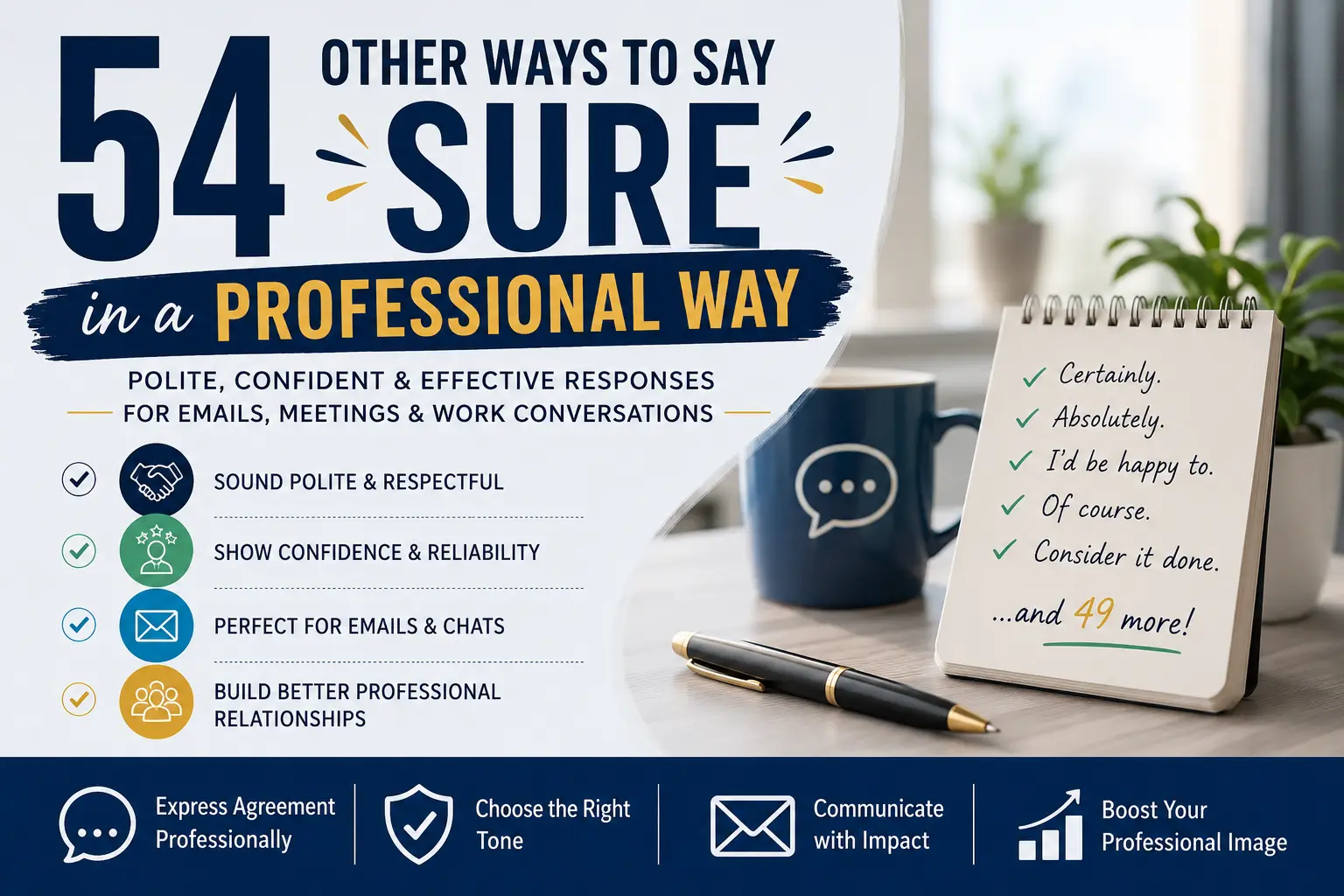
Have you ever typed “Sure” in a work email and then wondered if it sounded too casual? You’re not alone. While “sure” is friendly and widely understood, it isn’t always the best choice in professional communication. Whether you’re replying to a client, responding to your manager, or confirming a request from a colleague, the words you choose can shape how professional and confident you appear.
Learning other ways to say sure in a professional way helps you communicate with greater clarity, courtesy, and confidence. A polished response can make your emails sound more respectful, your meetings more productive, and your workplace conversations more effective. In this guide, you’ll discover 54 professional alternatives to sure, complete with meanings, real life examples, and practical tips so you can choose the right response for every situation.
What Does “Sure” Mean in a Professional Context?
In everyday English, “sure” is a simple way of saying yes, of course, or I agree. It shows willingness to help, approval, or confirmation.
In professional settings, however, “sure” can sometimes sound too informal, especially when communicating with clients, senior managers, or business partners. Replacing it with a more polished expression helps create a stronger impression while maintaining a friendly tone.
For example, instead of saying:
“Sure, I’ll do that.”
You could say:
“Certainly. I’ll take care of it right away.”
The message remains the same, but the second response sounds more professional and reassuring.
Polite and Professional Alternatives
1. Certainly
Meaning
A formal and confident way to agree.
Reply: “Certainly.”
Example:
Your manager asks whether you can prepare tomorrow’s presentation. You reply, “Certainly. I’ll have it ready before the meeting.”
2. Absolutely
Meaning
Expresses enthusiastic agreement.
Reply: “Absolutely.”
Example:
A client asks whether you can provide additional information. You respond, “Absolutely. I’ll send the details this afternoon.”
3. Of Course
Meaning
Shows willingness to help without hesitation.
Reply: “Of course.”
Example:
A coworker asks if you can review a document. You smile and say, “Of course. I’ll look it over before lunch.”
4. I’d Be Happy To
Meaning
Shows both agreement and enthusiasm.
Reply: “I’d be happy to.”
Example:
Your supervisor asks if you can mentor a new employee. You answer, “I’d be happy to help them get started.”
5. I’d Be Glad To
Meaning
A warm and respectful way to accept a request.
Reply: “I’d be glad to.”
Example:
A customer requests additional guidance, and you respond, “I’d be glad to explain the process in more detail.”
6. Without a Doubt
Meaning
Shows complete confidence in your agreement.
Reply: “Without a doubt.”
Example:
Your team asks if you can support an upcoming project. You reply, “Without a doubt. Count me in.”
7. You Can Count on Me
Meaning
Promises reliability and commitment.
Reply: “You can count on me.”
Example:
A colleague needs help meeting a deadline. You reassure them by saying, “You can count on me to finish my part today.”
8. Consider It Done
Meaning
Confidently promises that the task will be completed.
Reply: “Consider it done.”
Example:
Your manager asks you to update a report before the afternoon meeting. You answer, “Consider it done.”
9. No Problem at All
Meaning
Shows willingness while keeping the conversation friendly.
Reply: “No problem at all.”
Example:
A coworker apologizes for asking a last minute favor. You respond, “No problem at all. I’m happy to help.”
10. With Pleasure
Meaning
A polite expression that shows genuine willingness.
Reply: “With pleasure.”
Example:
A client thanks you for offering assistance, and you reply, “With pleasure. Let me know if you need anything else.”
11. I’d Be Delighted To
Meaning
Expresses sincere enthusiasm.
Reply: “I’d be delighted to.”
Example:
Your company invites you to speak at an event. You reply, “I’d be delighted to participate.”
Appreciative and Respectful Alternatives
12. It Would Be My Pleasure
Meaning
A formal way to accept a request politely.
Reply: “It would be my pleasure.”
Example:
A long time client asks for your assistance. You respond, “It would be my pleasure to help you.”
13. I’m Happy to Assist
Meaning
Shows readiness to provide support.
Reply: “I’m happy to assist.”
Example:
A customer contacts your support team. You reply, “I’m happy to assist with your request.”
14. I’d Love To Help
Meaning
A friendly but professional way to agree.
Reply: “I’d love to help.”
Example:
A coworker asks if you can review their presentation slides. You respond, “I’d love to help before tomorrow’s meeting.”
15. That Works for Me
Meaning
Confirms agreement with a suggestion or plan.
Reply: “That works for me.”
Example:
Your team suggests meeting at 2 p.m. You reply, “That works for me. I’ll see everyone then.”
Friendly and Appreciative Alternatives
16. I’d Be More Than Happy To
Meaning
Expresses genuine enthusiasm while remaining professional.
Reply: “I’d be more than happy to.”
Example:
A teammate asks if you can help onboard a new employee. You reply, “I’d be more than happy to help with the onboarding process.”
17. I’d Appreciate the Opportunity
Meaning
Shows gratitude while accepting a task or responsibility.
Reply: “I’d appreciate the opportunity.”
Example:
Your manager offers you the chance to lead a new project. You respond, “I’d appreciate the opportunity to lead the team.”
18. I’m Available to Help
Meaning
Lets others know you’re ready to assist.
Reply: “I’m available to help.”
Example:
A coworker asks whether anyone can review a proposal. You say, “I’m available to help this afternoon.”
19. I’d Be Pleased To
Meaning
A courteous way to accept a request.
Reply: “I’d be pleased to.”
Example:
A client asks if you can explain a service in more detail. You answer, “I’d be pleased to walk you through the process.”
20. I’ll Take Care of It
Meaning
Confirms that you will handle the task.
Reply: “I’ll take care of it.”
Example:
Your supervisor asks you to update the presentation. You reply, “I’ll take care of it before the meeting begins.”
21. You Have My Support
Meaning
Shows agreement and willingness to help.
Reply: “You have my support.”
Example:
A colleague proposes a new idea during a meeting. You respond, “You have my support. Let’s move forward with the plan.”
22. I’d Be Honored To
Meaning
Expresses appreciation for being trusted with a responsibility.
Reply: “I’d be honored to.”
Example:
Your department invites you to represent the team at a conference. You say, “I’d be honored to represent our department.”
23. I’m On It
Meaning
A modern and concise way to confirm you’re handling the request.
Reply: “I’m on it.”
Example:
Your manager asks for an updated spreadsheet. You respond, “I’m on it. I’ll send it shortly.”
24. I’ll Handle It
Meaning
Shows confidence and ownership.
Reply: “I’ll handle it.”
Example:
A teammate is concerned about an unfinished task. You reassure them by saying, “Don’t worry. I’ll handle it.”
25. Leave It With Me
Meaning
Politely tells someone you’ll take responsibility.
Reply: “Leave it with me.”
Example:
A client has a technical issue. You reply, “Leave it with me. I’ll investigate and get back to you.”
26. I’ll Be Glad To Help
Meaning
Combines professionalism with friendliness.
Reply: “I’ll be glad to help.”
Example:
A coworker asks if you can explain a process. You answer, “I’ll be glad to help after our meeting.”
27. I’d Welcome the Opportunity
Meaning
Shows enthusiasm for taking on a new task.
Reply: “I’d welcome the opportunity.”
Example:
Your manager asks if you’re interested in leading a client presentation. You reply, “I’d welcome the opportunity to present.”
28. I Can Certainly Do That
Meaning
A confident and polished way to agree.
Reply: “I can certainly do that.”
Example:
A client requests a few revisions. You respond, “I can certainly do that and send the updated version today.”
29. That Sounds Good
Meaning
Confirms agreement with a suggestion or plan.
Reply: “That sounds good.”
Example:
Your teammate suggests meeting earlier in the day. You answer, “That sounds good. Let’s meet at 10 a.m.”
30. I’m Happy to Move Forward
Meaning
Shows agreement while emphasizing progress.
Reply: “I’m happy to move forward.”
Example:
After reviewing a proposal, you tell the client, “Everything looks great. I’m happy to move forward whenever you are.”
Confident and Workplace Alternatives
31. I Can Do That
Meaning
A direct and confident way to accept a request.
Reply: “I can do that.”
Example:
Your manager asks if you can update the quarterly report. You reply, “I can do that and have it ready before the deadline.”
32. I’ll Get Started Right Away
Meaning
Shows immediate commitment to the task.
Reply: “I’ll get started right away.”
Example:
A client approves a project proposal. You respond, “Excellent. I’ll get started right away.”
33. I’ll Make It a Priority
Meaning
Assures someone their request is important.
Reply: “I’ll make it a priority.”
Example:
Your supervisor asks for an urgent revision. You answer, “I’ll make it a priority and send the updated version today.”
34. You Can Rely on Me
Meaning
Builds trust by emphasizing reliability.
Reply: “You can rely on me.”
Example:
A teammate worries about meeting a deadline. You reassure them by saying, “You can rely on me to finish my portion on time.”
35. I’ll See to It
Meaning
Promises personal responsibility for completing the task.
Reply: “I’ll see to it.”
Example:
Your department head asks you to arrange the meeting room. You respond, “I’ll see to it before everyone arrives.”
36. I’ll Make Sure It Gets Done
Meaning
Expresses accountability and commitment.
Reply: “I’ll make sure it gets done.”
Example:
A project manager asks if the final documents will be ready. You reply, “I’ll make sure it gets done before the deadline.”
37. I’m Ready to Help
Meaning
Shows willingness and availability.
Reply: “I’m ready to help.”
Example:
Your team needs volunteers for a new initiative. You say, “I’m ready to help wherever I’m needed.”
38. I’ll Be There
Meaning
Confirms your attendance or support.
Reply: “I’ll be there.”
Example:
Your colleague invites you to an important client meeting. You answer, “I’ll be there ten minutes early.”
39. I’ll Follow Up
Meaning
Confirms you’ll take the next step.
Reply: “I’ll follow up.”
Example:
After receiving a customer inquiry, you respond, “I’ll follow up with the requested information tomorrow morning.”
40. I’ll Get It Done
Meaning
A confident promise to complete the work.
Reply: “I’ll get it done.”
Example:
Your manager gives you an urgent assignment. You respond, “I’ll get it done before the end of the day.”
41. That Will Work Perfectly
Meaning
Shows complete agreement with a plan.
Reply: “That will work perfectly.”
Example:
A client proposes a meeting time. You answer, “That will work perfectly for our team.”
42. I’m Comfortable With That
Meaning
Expresses agreement while showing confidence.
Reply: “I’m comfortable with that.”
Example:
Your supervisor asks if you’re willing to present to senior management. You reply, “I’m comfortable with that responsibility.”
43. I Agree Completely
Meaning
Shows full support for an idea or proposal.
Reply: “I agree completely.”
Example:
During a planning meeting, a colleague presents a strategy. You respond, “I agree completely. It aligns with our goals.”
44. That Is Acceptable
Meaning
A formal way to approve a suggestion.
Reply: “That is acceptable.”
Example:
A vendor suggests a revised delivery schedule. You reply, “That is acceptable. Thank you for the update.”
45. I Approve
Meaning
Clearly communicates authorization or agreement.
Reply: “I approve.”
Example:
After reviewing the final design, you tell your team, “I approve. You can proceed with production.”
46. You Have My Approval
Meaning
Officially grants permission.
Reply: “You have my approval.”
Example:
A team member asks to implement a new workflow. You answer, “You have my approval to move forward.”
47. Please Proceed
Meaning
Formally authorizes the next step.
Reply: “Please proceed.”
Example:
After reviewing the proposal, you email the vendor, “Everything looks good. Please proceed with the order.”
48. Go Ahead
Meaning
A simple but professional way to give permission.
Reply: “Go ahead.”
Example:
A coworker asks whether they can contact the client directly. You reply, “Go ahead. Keep me updated afterward.”
49. You Have the Green Light
Meaning
Indicates that approval has been granted.
Reply: “You have the green light.”
Example:
The development team completes testing, and you say, “You have the green light to launch the update.”
50. Everything Looks Good
Meaning
Confirms satisfaction after reviewing something.
Reply: “Everything looks good.”
Example:
After checking the final report, you respond, “Everything looks good. Thank you for your hard work.”
51. I Fully Support This
Meaning
Expresses strong agreement.
Reply: “I fully support this.”
Example:
A teammate suggests improving customer onboarding. You reply, “I fully support this initiative.”
52. I Have No Objections
Meaning
A formal way to express agreement.
Reply: “I have no objections.”
Example:
During a meeting, the proposed timeline is discussed. You say, “I have no objections to the revised schedule.”
53. That Is Fine With Me
Meaning
Politely accepts a suggestion or decision.
Reply: “That is fine with me.”
Example:
Your coworker asks to move tomorrow’s meeting to the afternoon. You respond, “That is fine with me.”
54. Let’s Move Forward
Meaning
Shows agreement while encouraging progress.
Reply: “Let’s move forward.”
Example:
After everyone agrees on the final proposal, you conclude the meeting by saying, “Great discussion. Let’s move forward with the implementation.”
Real Life Situations
When Replying to Your Manager
A manager asks if you can prepare a report before tomorrow’s meeting.
Best Reply: “Certainly. I’ll have it ready before the deadline.”
This response sounds confident, respectful, and dependable.
When Responding to a Client’s Request
A client asks whether you can make a few changes to a proposal.
Best Reply: “Absolutely. I’ll update the document and send it over this afternoon.”
This reassures the client while maintaining a professional tone.
During a Team Meeting
A teammate suggests moving the meeting to 3 p.m.
Best Reply: “That works for me.”
It’s polite, natural, and keeps the discussion moving.
In a Professional Email
Your supervisor asks if you can review a document before it’s sent.
Best Reply: “I’d be happy to. I’ll review it and share my feedback shortly.”
This sounds much warmer and more polished than simply saying “Sure.”
When Accepting a New Responsibility
Your manager offers you the chance to lead a project.
Best Reply: “I’d welcome the opportunity. Thank you for your confidence in me.”
This shows professionalism, enthusiasm, and appreciation.
Common Mistakes to Avoid
1. Saying “Sure” in Every Conversation
Repeating the same response can make your communication feel repetitive and less professional. Use different alternatives depending on the situation.
2. Being Too Casual With Clients
Phrases like “Yep,” “No worries,” or “Sounds good” may be appropriate with close coworkers but can sound too informal in client communication.
3. Sounding Overly Formal
Expressions such as “You have my approval” may feel unnatural when responding to a simple request from a colleague. Match your language to the situation.
4. Making Promises You Cannot Keep
Only say “Consider it done” or “I’ll get it done today” if you’re confident you can deliver.
5. Ignoring Tone
The same phrase won’t fit every conversation. A client email requires a different tone than an internal team chat.
Pro Tips
Match Your Words to the Relationship
Use formal expressions such as “Certainly” or “I’d be pleased to” with clients and senior leaders. With coworkers, “I’m on it” or “That works for me” often sounds more natural.
Keep Your Responses Specific
Instead of replying with only one word, add a little context.
For example:
“Certainly. I’ll send the updated file before 4 p.m.”
This builds confidence and reduces unnecessary follow up questions.
Be Positive and Confident
Professional communication isn’t about using complicated words. It’s about sounding reliable, respectful, and clear.
Bonus: Quick One Line Alternatives
- Certainly.
- Absolutely.
- Of course.
- I’d be happy to.
- I’d be glad to.
- Consider it done.
- I’m on it.
- Leave it with me.
- I’ll take care of it.
- You can count on me.
- I’ll handle it.
- That works for me.
- Please proceed.
- I’ll get started right away.
- Let’s move forward.
Frequently Asked Questions
What is the most professional way to say “sure”?
Certainly, Absolutely, and I’d be happy to are among the most professional alternatives. They sound polite, confident, and appropriate in workplace communication.
Is “sure” unprofessional?
Not necessarily. “Sure” is perfectly acceptable in many situations, especially with coworkers. However, when communicating with clients, executives, or in formal emails, using more polished alternatives creates a stronger impression.
What can I say instead of “sure” in an email?
Some excellent options include:
- Certainly.
- I’d be happy to.
- Absolutely.
- Of course.
- Consider it done.
- I’ll take care of it.
Which alternative sounds best in customer service?
Phrases such as I’d be happy to assist, Certainly, and It would be my pleasure sound warm, professional, and customer focused.
Conclusion
Using professional alternatives to “sure” can instantly improve the way you communicate at work. Whether you’re responding to a client, confirming a request from your manager, or collaborating with teammates, choosing the right words helps you sound more confident, reliable, and approachable. The best alternative depends on the situation, your audience, and the tone you want to create. Try incorporating these expressions into your daily conversations and emails, and you’ll quickly notice how much more polished and effective your communication becomes.
Discover more
other ways to say peace of mind