

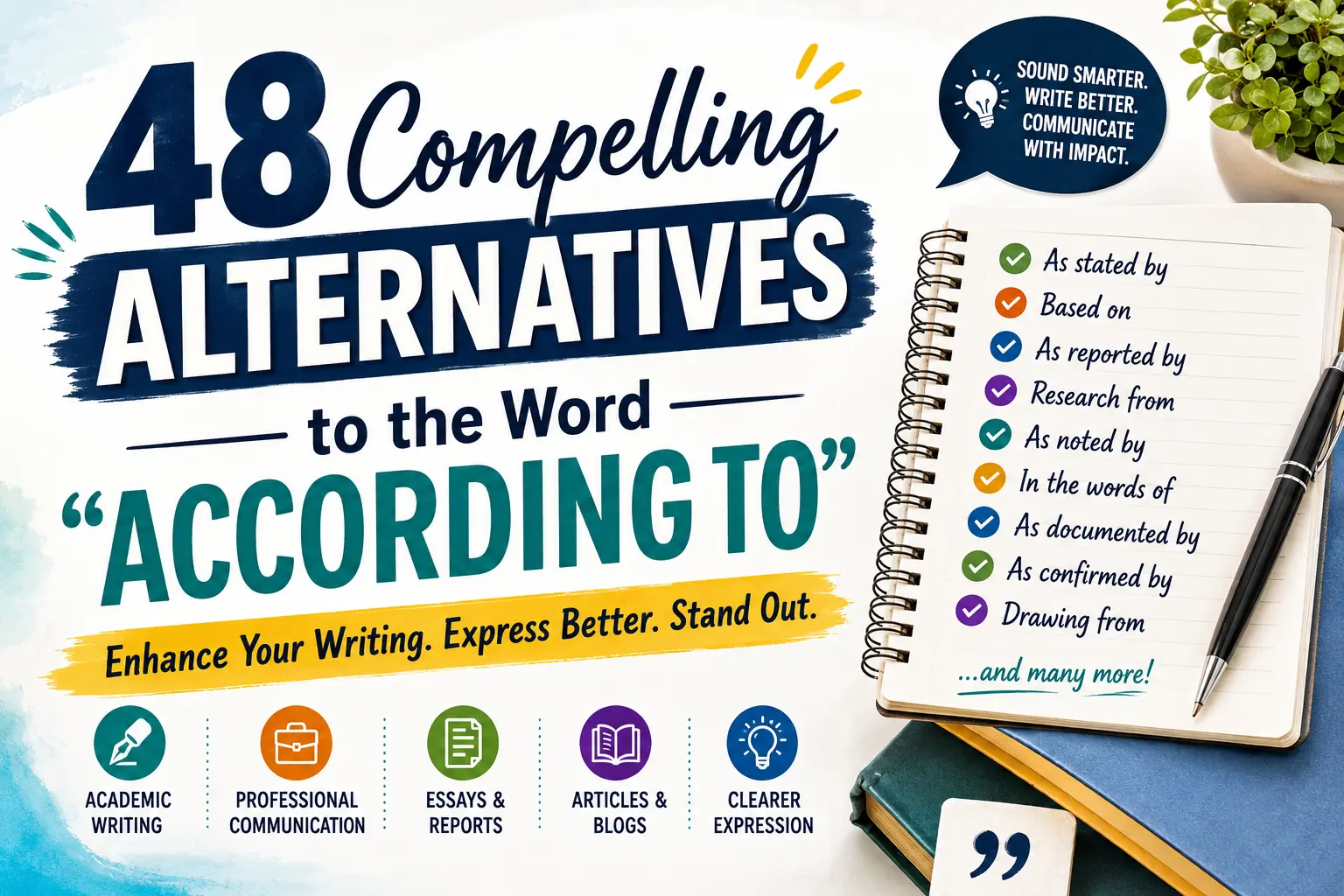
If you’ve ever written an essay, blog post, research paper, or business email, you’ve probably noticed how often the phrase “according to” appears. While it’s a perfectly correct expression, repeating it too frequently can make your writing sound predictable and less engaging. That’s why many writers, students, professionals, and content creators look for better alternatives that add variety without changing the meaning.
Using different expressions can make your writing feel more polished, natural, and authoritative. Whether you’re citing research, quoting an expert, referencing a report, or introducing someone’s opinion, choosing the right alternative helps your ideas flow more smoothly. In this guide, you’ll discover compelling alternatives to “according to,” along with practical examples and explanations that will help you write with greater confidence and clarity in both academic and everyday situations.
What Does “According To” Mean?
The phrase “according to” is used to introduce information that comes from another person, organization, publication, or source. It tells readers that the statement is based on someone else’s opinion, findings, report, or authority rather than your own.
For example:
“According to the World Health Organization, regular exercise improves overall health.”
Here, the information comes from the World Health Organization, not the writer.
People commonly use “according to” in essays, news articles, research papers, reports, presentations, and everyday conversations. While it’s clear and reliable, using alternative phrases can make your writing more engaging and prevent unnecessary repetition.
Formal & Academic Alternatives
1. As Stated By
Meaning:
Introduces information that has been clearly expressed by a person or source.
Example:
“As stated by the university’s research team, student engagement improves academic performance.”
This alternative sounds polished and is commonly used in academic papers, reports, and formal presentations.
2. As Reported By
Meaning:
Indicates that the information comes from an official report, publication, or news source.
Example:
“As reported by the National Weather Service, heavy rainfall is expected this weekend.”
This phrase works particularly well in journalism, research, and business writing.
3. Based On the Findings Of
Meaning:
Shows that a statement relies on research or collected evidence.
Example:
“Based on the findings of the latest survey, customer satisfaction has increased significantly.”
Use this when discussing studies, surveys, experiments, or data-driven conclusions.
4. As Documented By
Meaning:
Refers to information officially recorded or published.
Example:
“As documented by the historical archives, the building dates back to the nineteenth century.”
This alternative is excellent for historical, legal, and academic writing.
5. As Indicated By
Meaning:
Suggests that evidence or data points toward a particular conclusion.
Example:
“As indicated by recent statistics, online learning continues to grow in popularity.”
A professional phrase that’s useful in reports and analytical writing.
6. As Noted By
Meaning:
Highlights an observation or comment made by a credible source.
Example:
“As noted by the author, consistent practice leads to lasting improvement.”
This expression is widely used in essays, literature reviews, and research papers.
7. As Highlighted By
Meaning:
Draws attention to an important point emphasized by another source.
Example:
“As highlighted by industry experts, cybersecurity should remain a top priority.”
This phrase adds emphasis while maintaining a formal tone.
8. In the Words Of
Meaning:
Introduces a direct quotation from a person.
Example:
“In the words of Maya Angelou, ‘Do the best you can until you know better.'”
This alternative is ideal for speeches, articles, and inspirational writing.
9. As Explained By
Meaning:
Shows that an expert or source has provided an explanation.
Example:
“As explained by the professor, the experiment demonstrates the principle of conservation of energy.”
Use this phrase when simplifying or discussing expert explanations.
10. As Described By
Meaning:
Introduces a description given by another person or publication.
Example:
“As described by the researchers, the new process reduces production costs.”
This alternative is effective in scientific, technical, and academic writing.
Professional & Business Alternatives
11. Based On
Meaning:
Shows that information or decisions rely on evidence, research, or experience.
Example:
“Based on customer feedback, the company introduced several new features.”
Short, clear, and one of the most common alternatives in business communication.
12. As Confirmed By
Meaning:
Indicates that a reliable source has verified the information.
Example:
“As confirmed by the finance department, the payment has been processed.”
This phrase builds credibility and trust in professional writing.
13. As Shared By
Meaning:
Refers to information provided by another person or organization.
Example:
“As shared by our marketing team, website traffic has increased by 30 percent.”
A friendly yet professional expression that’s common in workplace communication.
14. As Presented By
Meaning:
Introduces information delivered during a presentation, report, or meeting.
Example:
“As presented by the project manager, the timeline remains on schedule.”
Ideal for meeting summaries and corporate reports.
15. As Provided By
Meaning:
Shows that information comes directly from a particular source.
Example:
“As provided by the client, these are the final project requirements.”
A precise and professional alternative that’s especially useful in business documents.
16. As Outlined By
Meaning:
Refers to information organized or explained in a structured way.
Example:
“As outlined by the policy manual, employees must complete annual training.”
This phrase is commonly used in workplace guidelines, manuals, and official documents.
Journalistic & Research Alternatives
17. As Revealed By
Meaning:
Introduces information that has recently been discovered or uncovered.
Example:
“As revealed by the latest market research, consumer preferences have shifted toward sustainable products.”
This phrase adds emphasis and works well in news articles, reports, and research writing.
18. As Found By
Meaning:
Shows that the information comes from research or an investigation.
Example:
“As found by the research team, regular exercise improves mental well-being.”
A straightforward alternative that’s common in scientific and academic writing.
19. Research From
Meaning:
Introduces evidence from a study or research institution.
Example:
“Research from Harvard University suggests that quality sleep improves memory.”
This phrase sounds modern and authoritative, especially in blogs and educational content.
20. Evidence From
Meaning:
Indicates that a statement is supported by factual evidence.
Example:
“Evidence from recent clinical trials shows promising results.”
Use this alternative when discussing verified facts or scientific findings.
21. The Report From
Meaning:
Introduces information taken from an official report.
Example:
“The report from the Environmental Protection Agency highlights rising air pollution levels.”
A professional phrase that’s useful in journalism and business writing.
22. The Study By
Meaning:
References findings from a specific research study.
Example:
“The study by Stanford University found that remote work increased productivity.”
Perfect for essays, research papers, and informative articles.
23. Figures From
Meaning:
Introduces statistical data from a trusted source.
Example:
“Figures from the national census show steady population growth.”
This alternative works well whenever you’re discussing numbers or statistics.
24. Data From
Meaning:
Shows that your information is supported by collected data.
Example:
“Data from the customer survey indicates higher satisfaction rates this year.”
A clear and concise phrase commonly used in reports and analytics.
25. Statistics From
Meaning:
Introduces numerical evidence from surveys or studies.
Example:
“Statistics from the World Bank show continued economic growth.”
This phrase immediately signals credibility and factual support.
26. As Cited By
Meaning:
Indicates that another source has referenced the information.
Example:
“As cited by the journal, the experiment was repeated several times to ensure accuracy.”
A formal expression commonly used in academic citations and literature reviews.
Casual & Everyday Alternatives
27. In the Opinion Of
Meaning:
Introduces someone’s personal viewpoint.
Example:
“In the opinion of many teachers, reading every day improves vocabulary.”
A simple phrase that works well in conversations and opinion pieces.
28. From the Perspective Of
Meaning:
Shows information from someone’s point of view.
Example:
“From the perspective of small business owners, lower taxes encourage growth.”
Useful when discussing different viewpoints or experiences.
29. As Seen By
Meaning:
Explains how someone views or interprets a situation.
Example:
“As seen by local residents, the new park has greatly improved the neighborhood.”
This phrase adds a human perspective to your writing.
30. From the Viewpoint Of
Meaning:
Introduces a specific perspective or interpretation.
Example:
“From the viewpoint of environmental experts, renewable energy remains essential.”
Ideal for balanced discussions and comparison articles.
31. In the Eyes Of
Meaning:
Describes how someone perceives a person, idea, or event.
Example:
“In the eyes of many customers, excellent service matters more than price.”
This alternative creates a more conversational tone.
32. By the Account Of
Meaning:
Refers to someone’s version or description of an event.
Example:
“By the account of eyewitnesses, the event ended peacefully.”
Often used in storytelling and news reporting.
33. From What…Says
Meaning:
Introduces information based on someone’s statement.
Example:
“From what the manager says, the project will finish ahead of schedule.”
A natural phrase suitable for informal writing.
34. Going By
Meaning:
Means making a conclusion based on available information.
Example:
“Going by the latest reviews, the restaurant is worth visiting.”
Commonly used in everyday conversations and blogs.
35. Judging By
Meaning:
Suggests drawing a conclusion from evidence or observations.
Example:
“Judging by customer feedback, the update has been well received.”
A conversational yet effective alternative.
36. If We Follow
Meaning:
Introduces an idea based on someone’s reasoning or guidance.
Example:
“If we follow the economist’s analysis, inflation should slow next year.”
A smooth option for explanatory articles and discussions.
Creative & Literary Alternatives
37. In the View of
Meaning:
Introduces someone’s opinion or interpretation in a polished way.
Example:
“In the view of many educators, creativity is just as important as technical skills.”
This phrase sounds elegant and is suitable for essays, editorials, and thoughtful articles.
38. On the Authority Of
Meaning:
Shows that the information comes from a trusted or authoritative source.
Example:
“On the authority of the museum curator, the artifact dates back over 500 years.”
Use this when you want to emphasize credibility and expertise.
39. Drawing From
Meaning:
Indicates that ideas or information are taken from a particular source.
Example:
“Drawing from recent customer feedback, the company redesigned its website.”
This alternative feels modern and works well in blogs, reports, and presentations.
40. As Mentioned By
Meaning:
Refers to something another person has already said or written.
Example:
“As mentioned by the keynote speaker, continuous learning drives long-term success.”
A versatile option that’s suitable for both formal and informal writing.
41. As Expressed By
Meaning:
Introduces thoughts, feelings, or opinions shared by another person.
Example:
“As expressed by the author, hope remains the central theme of the novel.”
This phrase is especially useful in literary analysis and reflective writing.
42. As Observed By
Meaning:
Shows that the information comes from someone’s careful observation.
Example:
“As observed by marine biologists, coral reefs are recovering in some protected areas.”
A strong choice for scientific, environmental, and academic writing.
43. As Recognized By
Meaning:
Indicates that an authority or respected group acknowledges something.
Example:
“As recognized by industry leaders, customer experience is a key competitive advantage.”
This phrase adds credibility and professionalism.
44. As Recorded By
Meaning:
Refers to information officially documented or preserved.
Example:
“As recorded by historical documents, the city was founded in the early eighteenth century.”
An excellent alternative for history, legal writing, and formal reports.
45. As Acknowledged By
Meaning:
Shows that someone has officially accepted or admitted a fact.
Example:
“As acknowledged by the committee, additional funding is necessary for the project.”
This phrase works well in formal discussions and policy documents.
46. As Referenced By
Meaning:
Introduces information that has been cited by another source.
Example:
“As referenced by several academic journals, the theory continues to gain support.”
Ideal for research papers, articles, and professional writing.
47. As Illustrated By
Meaning:
Uses another source to demonstrate or support an idea.
Example:
“As illustrated by recent case studies, small changes can lead to significant improvements.”
This alternative helps explain concepts clearly and persuasively.
48. As Supported By
Meaning:
Shows that evidence or research backs up a statement.
Example:
“As supported by clinical evidence, a balanced diet contributes to better overall health.”
A strong, evidence-based phrase that’s perfect for academic, business, and technical writing.
Conclusion
Finding compelling alternatives to “according to” is one of the easiest ways to improve your writing style. Whether you’re writing an essay, article, business report, research paper, or blog post, varying your language makes your content more engaging, polished, and enjoyable to read. Instead of relying on the same phrase repeatedly, choose alternatives that match your audience, purpose, and tone. Small vocabulary changes can make a surprisingly big difference in how professional and confident your writing sounds.
Discover more
other ways to say sounds good professionally