

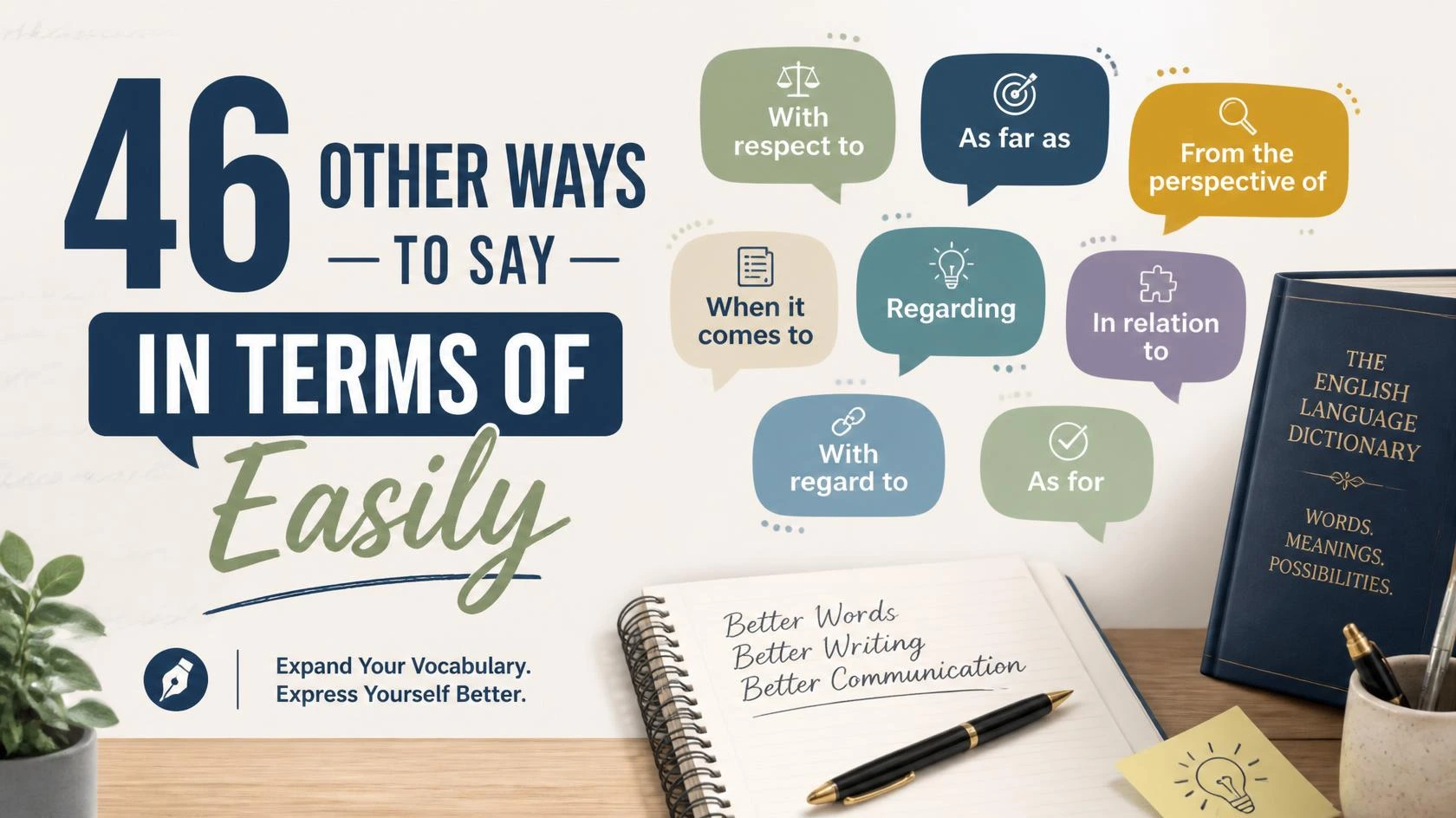
Have you ever written a sentence and suddenly felt that the phrase “in terms of” sounds a little too repetitive? Whether you’re writing an email, preparing an assignment, creating content, or simply having a conversation, using the same phrase again and again can make your words feel less natural.
The phrase “in terms of” is common, but there are many other ways to express the same idea depending on the situation. Sometimes you need a more professional alternative, while other times a simple conversational phrase works better.
Finding the right replacement can make your writing sound clearer, more confident, and more engaging. In this guide, we’ll explore the best other ways to say “in terms of” with real-life examples so you can choose the perfect phrase for any situation.
What Does “In Terms Of” Mean?
“In terms of” means when talking about a specific aspect, area, point, or perspective of something.
People use this phrase when they want to focus on one particular part of a bigger topic.
For example:
- “In terms of performance, this laptop is excellent.”
This means:
- “When we look at its performance specifically, this laptop is excellent.”
Another example:
- “In terms of experience, she is the best candidate.”
Here, the speaker is focusing only on the candidate’s experience, not other qualities.
The phrase is commonly used in professional conversations, reports, presentations, academic writing, and everyday discussions. However, depending on your tone and audience, alternatives can make your communication smoother and more interesting.
46 Best Other Ways To Say “In Terms Of”
1. Polite & Appreciative Alternatives
These options work well in professional conversations, emails, formal writing, and respectful discussions.
1. Regarding
Reply: “Regarding your performance, you have made impressive progress.”
👉 Example:
A manager is giving feedback to an employee after reviewing their work. Instead of saying “in terms of your performance,” they use “regarding” to sound professional and polite.
2. With Respect To
Reply: “With respect to your request, we will review the details carefully.”
👉 Example:
A customer sends an inquiry, and a company representative responds formally while addressing the specific issue.
3. When It Comes To
Reply: “When it comes to customer service, this company sets a high standard.”
👉 Example:
A friend is recommending a restaurant and explains why it stands out compared to others.
4. As For
Reply: “As for your suggestion, I think it’s a great idea.”
👉 Example:
Someone shares an opinion during a group discussion, and another person responds by focusing on that specific suggestion.
5. Speaking Of
Reply: “Speaking of your new project, I would love to hear more about it.”
👉 Example:
A friend mentions work, and you naturally shift the conversation toward their project.
6. In Relation To
Reply: “In relation to your application, we will contact you soon.”
👉 Example:
A university or company sends a formal update about a person’s application status.
7. Concerning
Reply: “Concerning your feedback, we have already started making improvements.”
👉 Example:
A business owner responds to customer comments and explains what actions are being taken.
8. About
Reply: “About your idea, I think we should discuss it further.”
👉 Example:
A colleague brings up a new plan, and you want to continue the conversation casually.
9. Regarding The Matter Of
Reply: “Regarding the matter of your schedule, we can find a suitable solution.”
👉 Example:
A teacher and student discuss adjusting deadlines in a respectful conversation.
10. From The Perspective Of
Reply: “From the perspective of users, this design is easy to understand.”
👉 Example:
A designer explains why they created an app in a certain way by focusing on the users’ viewpoint.
Flirty & Playful Alternatives
These alternatives are useful when you want your response to sound relaxed, charming, or slightly playful. They work well in casual conversations, texting, and situations where you want to keep the interaction interesting without sounding too formal.
11. When It Comes To
Reply: “When it comes to creativity, you always surprise me.”
Example:
Your friend shares a new idea or project, and you want to compliment their ability in a natural and engaging way.
12. Speaking About
Reply: “Speaking about your future plans, I’m curious to know what you’re thinking.”
Example:
Someone mentions their goals, and you continue the conversation by showing genuine interest.
13. Looking At
Reply: “Looking at your effort, I’d say you’re doing really well.”
Example:
You are encouraging someone after seeing how much work they have put into something.
14. As Far As ___ Is Concerned
Reply: “As far as your personality is concerned, you’re definitely one of a kind.”
Example:
You are complimenting someone by focusing on a specific quality you admire about them.
15. In The Area Of
Reply: “In the area of making people smile, you’re pretty talented.”
Example:
You are teasing someone playfully while highlighting something positive about them.
16. About
Reply: “About your new idea, I think there’s something really interesting there.”
Example:
Someone tells you about their plan, and you respond in a friendly and encouraging way.
17. When Discussing
Reply: “When discussing your achievements, I think you deserve more credit.”
Example:
You are supporting someone who does not recognize their own success.
18. In Regard To
Reply: “In regard to your style, you always know how to stand out.”
Example:
You are giving someone a thoughtful compliment about their appearance or personality.
19. Looking At It From The Side Of
Reply: “Looking at it from your side, I understand why you made that choice.”
Example:
Someone explains their decision, and you show that you understand their perspective.
20. Based On
Reply: “Based on what I know about you, I think you’ll do great.”
Example:
You encourage someone by referring to your experience with their personality and abilities.
Confident & Self-Respect Alternatives
These alternatives help you sound clear, mature, and confident. They are useful when discussing opinions, decisions, boundaries, or personal values.
21. From My Point Of View
Reply: “From my point of view, honesty matters more than popularity.”
Example:
You are sharing your personal opinion during a serious discussion without being disrespectful.
22. In My Experience
Reply: “In my experience, patience makes a big difference.”
Example:
Someone asks for your advice, and you respond by sharing what you have learned.
23. Looking At The Bigger Picture
Reply: “Looking at the bigger picture, this decision will benefit us long term.”
Example:
You are helping someone think beyond a short-term problem.
24. From A Practical Standpoint
Reply: “From a practical standpoint, this option makes more sense.”
Example:
You are comparing choices and explaining your reasoning confidently.
25. When Considering
Reply: “When considering the results, this was the best choice.”
Example:
You are explaining why you selected a particular option after evaluating everything.
26. In The Context Of
Reply: “In the context of your goals, this decision seems reasonable.”
Example:
You are analyzing someone’s choice by connecting it to their larger plans.
27. In Regard To
Reply: “In regard to my priorities, I need to focus on what matters most.”
Example:
You are explaining your boundaries or decisions clearly.
28. With That In Mind
Reply: “With that in mind, I think we should choose the better opportunity.”
Example:
You acknowledge previous information and confidently move toward a decision.
29. Based On The Facts
Reply: “Based on the facts, this seems like the right approach.”
Example:
You are making a logical argument during a discussion.
30. From A Personal Perspective
Reply: “From a personal perspective, I value growth more than perfection.”
Example:
You are expressing your personal beliefs in a thoughtful way.
Funny & Savage Alternatives
These alternatives are more casual and expressive. They work well when you want your response to sound witty, confident, or slightly sarcastic while still keeping the conversation fun.
31. When It Comes Down To
Reply: “When it comes down to talent, you already know where you stand.”
Example:
A friend is comparing skills between people, and you respond with confidence while giving them a compliment.
32. Let’s Talk About
Reply: “Let’s talk about your decision-making skills because that’s where the real story is.”
Example:
You are jokingly pointing out someone’s choices during a casual conversation.
33. If We’re Talking About
Reply: “If we’re talking about confidence, you definitely have enough for everyone.”
Example:
A friend is acting overly confident, and you tease them in a playful way.
34. As For
Reply: “As for your excuses, I think we’ve heard enough of those.”
Example:
Your friend keeps making reasons for not completing a task, and you jokingly call them out.
35. Speaking Of
Reply: “Speaking of bad decisions, should we discuss your last adventure?”
Example:
You bring up a funny memory while teasing a close friend.
36. Regarding The Situation
Reply: “Regarding the situation, we both know who caused the chaos.”
Example:
Friends are discussing a funny problem, and you make a humorous observation.
37. On The Topic Of
Reply: “On the topic of confidence, you never run out of it.”
Example:
You are playfully teasing someone who always believes they are right.
38. Looking At The Facts
Reply: “Looking at the facts, your argument needs some serious help.”
Example:
You are jokingly challenging a friend’s opinion during a debate.
39. If We’re Being Honest About
Reply: “If we’re being honest about your cooking skills, you still have practice to do.”
Example:
You tease someone about their cooking while keeping the conversation light.
40. The Truth About
Reply: “The truth about this situation is that you made it more dramatic than it needed to be.”
Example:
A friend overreacts to something small, and you respond humorously.
Curious, Thoughtful & Mature Alternatives
These alternatives are useful when you want to sound reflective, interested, and emotionally intelligent. They are ideal for meaningful conversations, discussions, and deeper communication.
41. From The Viewpoint Of
Reply: “From the viewpoint of a beginner, this can seem challenging.”
Example:
You are explaining a situation while considering how another person might feel.
42. In Light Of
Reply: “In light of recent changes, we should reconsider our plans.”
Example:
You are discussing a decision after receiving new information.
43. Taking Into Account
Reply: “Taking into account your circumstances, I understand your choice.”
Example:
Someone explains their situation, and you respond with empathy and understanding.
44. Considering
Reply: “Considering your experience, you handled the situation very well.”
Example:
You acknowledge someone’s efforts and give them meaningful appreciation.
45. In The Case Of
Reply: “In the case of this project, teamwork matters the most.”
Example:
You are discussing a specific example or situation in a conversation.
46. With Regard To
Reply: “With regard to your future plans, I think you are moving in the right direction.”
Example:
You are giving thoughtful advice to someone about their goals.
Quick Summary: Choosing The Right AltReal Life Situations: Best Alternatives To Say “In Terms Of”
Knowing different alternatives is useful, but choosing the right one depends on the situation. The same phrase can sound professional in one conversation and awkward in another. Here are some common situations where you can replace “in terms of” naturally.
1. When Discussing Work Or Professional Topics
Situation:
You are talking about someone’s performance, skills, or achievements at work.
Best Replies:
- “Regarding your performance, you have shown great improvement.”
- “When it comes to teamwork, you are one of the strongest members.”
- “From a professional perspective, this approach makes sense.”
Example:
A manager is giving feedback during a meeting and wants to highlight an employee’s strengths without sounding repetitive.
2. When Someone Asks About Your Opinion
Situation:
A friend asks what you think about a decision, idea, or situation.
Best Replies:
- “From my point of view, this is the better option.”
- “In my experience, patience usually works best.”
- “Looking at the bigger picture, this could be a good opportunity.”
Example:
Your friend is confused about choosing between two options, and you share your honest thoughts.
3. When Your Crush Or Someone You Like Says It
Situation:
Someone you like talks about their personality, goals, or qualities, and you want to respond naturally.
Best Replies:
- “When it comes to your personality, I think you’re pretty amazing.”
- “Speaking of your goals, I actually admire your ambition.”
- “Based on what I know about you, I think you’ll achieve great things.”
Example:
Your crush tells you about their dreams, and you respond in a way that shows interest without making the conversation feel forced.
4. When A Friend Makes A Joke
Situation:
Your friend says something funny, and you want to respond playfully.
Best Replies:
- “If we’re talking about confidence, you definitely have plenty.”
- “Regarding your excuses, we need a whole documentary.”
- “When it comes down to dramatic reactions, you win.”
Example:
Your friend exaggerates a small problem, and you tease them in a friendly way.
5. When You Are Not Interested In Something
Situation:
Someone is discussing a topic you do not want to continue.
Best Replies:
- “As far as that topic is concerned, I don’t have much to add.”
- “Regarding that matter, I would rather focus on something else.”
- “From my perspective, I don’t think it’s the right choice for me.”
Example:
Someone asks you about an activity or plan you do not want to participate in, and you respond politely.
Common Mistakes To Avoid
1. Using Formal Phrases In Casual Conversations
Some alternatives like “with respect to” or “in relation to” can sound too serious when texting friends.
Instead, use simpler phrases like:
- “When it comes to”
- “About”
- “Speaking of”
2. Repeating The Same Phrase Too Often
Using “in terms of” in every sentence can make your writing feel boring.
Try mixing different alternatives depending on the context.
3. Choosing Words Without Understanding Their Meaning
Not every replacement works exactly the same way.
For example:
- “Regarding” focuses on a topic.
- “From my point of view” shows an opinion.
- “Based on” shows evidence or information.
Choose the phrase that matches your meaning.
4. Making Simple Ideas Sound Too Complicated
Sometimes people use long phrases when a simple word works better.
Instead of:
“From the perspective of your current situation…”
You can simply say:
“Considering your situation…”
5. Ignoring Your Audience
Think about who you are speaking to.
A professional email, a school assignment, and a casual chat all require different tones.
Pro Tips For Using Alternatives Naturally
1. Match The Tone With The Situation
For formal writing:
- Regarding
- With respect to
- In relation to
For everyday conversations:
- When it comes to
- About
- Speaking of
The right phrase makes your message feel more natural.
2. Use Alternatives To Show Confidence
Instead of saying:
“In terms of my opinion…”
Say:
“From my point of view…”
It sounds clearer and shows that you are comfortable expressing your thoughts.
3. Focus On Meaning, Not Just Variety
The goal is not to replace every “in terms of” with a different phrase. The goal is to communicate your idea clearly.
Good communication is about choosing the right words at the right moment.
Conclusion
The phrase “in terms of” is useful, but relying on it too much can make your writing feel repetitive. Learning different alternatives helps you communicate with more confidence, whether you are writing professionally, having a casual conversation, or sharing your thoughts.
The best words are not always the biggest or most complicated ones. They are the ones that sound natural, match the situation, and express exactly what you mean.
Choose your words wisely because the way you say something can be just as powerful as what you say.
Discover more
other ways to say to whom it may concern