
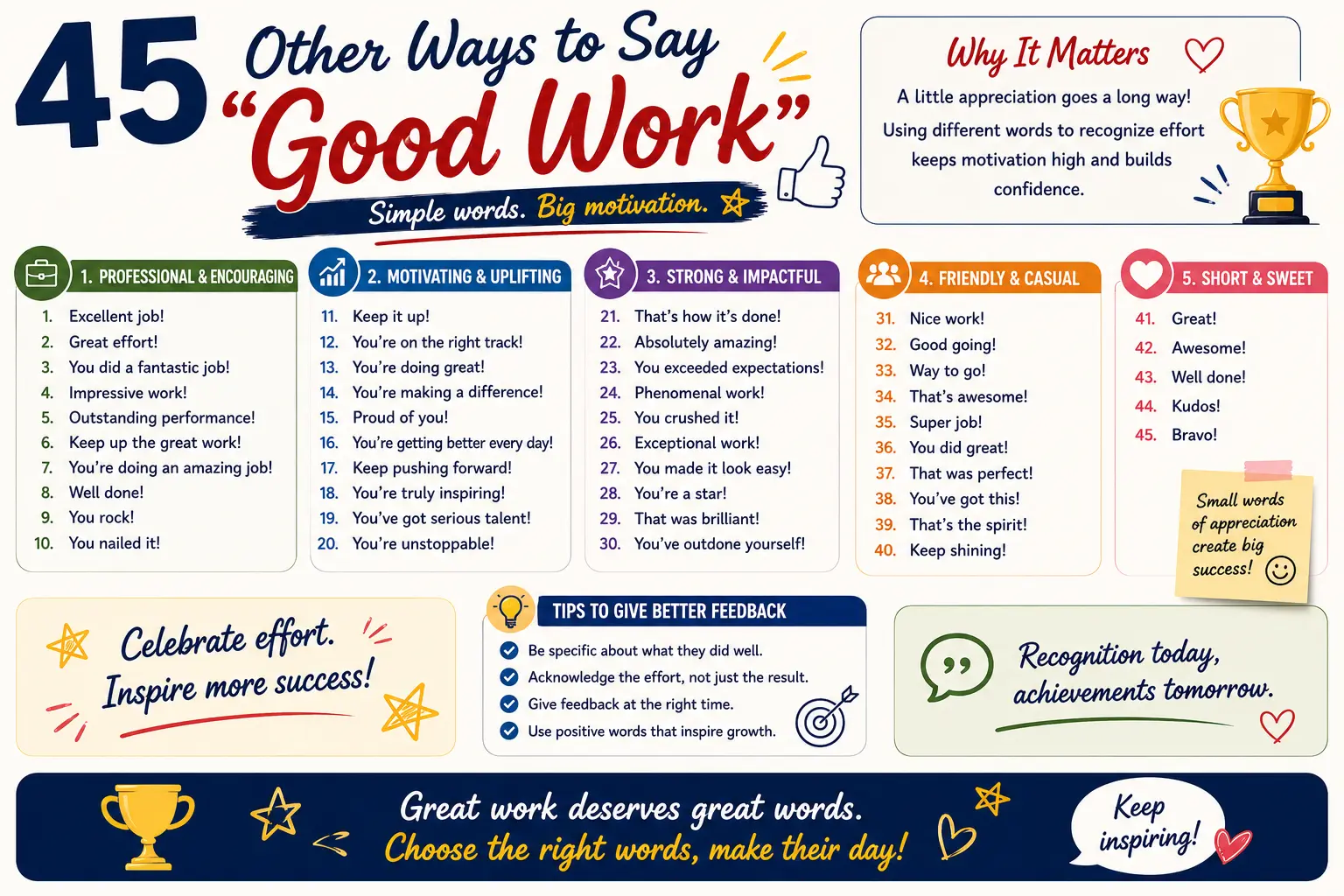
A simple “Good work” can make someone’s day, but saying the same phrase every time can start to feel a little repetitive. Whether you are praising a coworker, encouraging a student, congratulating a friend, or recognizing someone’s effort, the right words can make your appreciation feel more genuine.
That is why many people look for other ways to say “good work.” A thoughtful compliment does more than acknowledge a finished task. It can highlight effort, creativity, improvement, reliability, or a job well done.
The good news is that you do not need complicated vocabulary to sound impressive. Sometimes, a short and specific compliment has the strongest impact. Below, you will find 45 natural alternatives, organized by tone, along with real-life examples to help you choose the right expression for every situation.
2. What Does “Good Work” Mean?
“Good work” is a simple expression used to praise someone for completing a task successfully or putting in strong effort.
It can recognize the quality of the result, the effort behind it, or both. For example, a manager might say “Good work” after an employee finishes an important project, while a teacher might use it to encourage a student after a successful assignment.
The phrase is generally positive, friendly, and encouraging. However, its exact meaning depends on context and tone.
For example:
- “Good work on the presentation.” — Professional and appreciative.
- “Good work! You finally fixed it.” — Casual and encouraging.
- “Good work today.” — Simple and supportive.
If you want your compliment to feel more personal, choosing a more specific alternative can make a noticeable difference.
3. When to Use It
“Good work” and its alternatives can be used in many everyday situations.
At Work
Use it when a colleague completes a project, solves a problem, or contributes something valuable.
Example: “Excellent job on the client report. The details were very clear.”
At School or University
Teachers, classmates, and students can use these expressions to recognize effort and improvement.
Example: “You handled that presentation really well.”
With Friends
A casual compliment works well when a friend accomplishes something or helps with a task.
Example: “Nice one! You absolutely nailed it.”
In Emails
Professional alternatives are useful when giving written feedback.
Example: “I appreciate the effort you put into this project.”
During Team Projects
Specific praise can motivate people and strengthen teamwork.
Example: “Great contribution to the discussion. Your idea helped move the project forward.”
4. Is “Good Work” Polite or Professional?
Yes. “Good work” is polite, positive, and generally appropriate in professional settings.
However, it can sometimes sound brief or generic, especially in formal emails or performance feedback. If you want your praise to have more impact, mention exactly what the person did well.
Instead of:
“Good work.”
Try:
“Excellent work on the analysis. Your attention to detail made the report much stronger.”
The second version feels more sincere because it explains why the work was good.
For casual conversations, shorter expressions such as “Nice job,” “You nailed it,” or “That was impressive” work naturally.
Category 1: Polite and Appreciative
1. Excellent Work
Meaning: A strong way to recognize high-quality performance.
Tone: Professional, appreciative.
Example: “Excellent work on preparing the final report. Everything was organized clearly.”
Short Explanation: Use this when someone has produced work that genuinely stands out.
Purpose and Personalization: Add a specific detail afterward to make the compliment more meaningful.
2. Great Job
Meaning: A warm and straightforward way to praise someone’s performance.
Tone: Friendly, positive.
Example: “Great job on the presentation. You explained the main points really clearly.”
Short Explanation: This is one of the easiest alternatives for everyday conversations.
Purpose and Personalization: It works especially well when you want to sound encouraging without being overly formal.
3. Well Done
Meaning: Acknowledges that someone completed something successfully.
Tone: Polite, professional.
Example: “Well done on completing the project ahead of schedule.”
Short Explanation: A classic choice for workplace, academic, and personal situations.
Purpose and Personalization: Pair it with the achievement for a stronger compliment.
4. I Appreciate Your Effort
Meaning: Shows that you noticed and value someone’s hard work.
Tone: Sincere, respectful.
Example: “I appreciate your effort in getting this finished before the deadline.”
Short Explanation: Use this when the effort matters just as much as the final result.
Purpose and Personalization: It is particularly effective when someone worked through a difficult task.
5. You Did an Excellent Job
Meaning: Clearly communicates that someone’s performance was impressive.
Tone: Professional, warm.
Example: “You did an excellent job handling the meeting with the new client.”
Short Explanation: A more complete and personal version of “good work.”
Purpose and Personalization: Mention the specific task to make the praise feel genuine.
6. That Was Very Well Done
Meaning: Recognizes the quality and execution of someone’s work.
Tone: Polished, appreciative.
Example: “That was very well done. The proposal was concise and easy to understand.”
Short Explanation: A useful option for professional feedback.
Purpose and Personalization: It sounds especially natural in formal conversations.
7. I’m Impressed With Your Work
Meaning: Shows genuine admiration for someone’s performance.
Tone: Warm, professional.
Example: “I’m impressed with your work on this assignment. You clearly put a lot of thought into it.”
Short Explanation: Use this when the person’s work has exceeded your expectations.
Purpose and Personalization: It adds a stronger emotional element than a basic compliment.
8. Thank You for Your Hard Work
Meaning: Combines appreciation with recognition of effort.
Tone: Grateful, professional.
Example: “Thank you for your hard work during the launch. Your support made a real difference.”
Short Explanation: Ideal when someone’s contribution helped a team or project succeed.
Purpose and Personalization: This is particularly effective in workplace communication.
9. Your Effort Really Paid Off
Meaning: Suggests that someone’s hard work produced a successful result.
Tone: Encouraging, appreciative.
Example: “Your effort really paid off. The final presentation looked fantastic.”
Short Explanation: Use this when you have seen someone work consistently toward a goal.
Purpose and Personalization: It recognizes both the journey and the outcome.
Category 2: Playful and Lighthearted
10. You Nailed It
Meaning: You performed extremely well.
Tone: Casual, energetic.
Example: “You nailed it with that presentation. Everyone understood the concept.”
Short Explanation: A fun alternative for friends, classmates, or relaxed workplaces.
Purpose and Personalization: Best when the situation is informal and the achievement is clear.
11. Look at You Go
Meaning: Playfully celebrates someone’s success.
Tone: Friendly, playful.
Example: “Look at you go! You finished the entire project before Friday.”
Short Explanation: Use it when you want praise to sound enthusiastic rather than formal.
Purpose and Personalization: Great for encouraging someone who has made noticeable progress.
12. You Crushed It
Meaning: You performed exceptionally well.
Tone: Casual, energetic.
Example: “You crushed it during the debate today.”
Short Explanation: This expression works well among friends and younger teams.
Purpose and Personalization: It adds energy to a simple compliment.
13. You Absolutely Delivered
Meaning: Someone successfully met or exceeded expectations.
Tone: Confident, modern.
Example: “You absolutely delivered with that campaign idea.”
Short Explanation: A stylish option for creative and professional environments.
Purpose and Personalization: Particularly useful when someone has produced exactly what was needed.
14. That’s a Win
Meaning: The result is successful or worth celebrating.
Tone: Casual, playful.
Example: “The client approved the proposal on the first try. That’s a win.”
Short Explanation: Use it to celebrate a successful outcome.
Purpose and Personalization: It works naturally in team chats and informal conversations.
15. You’re on Fire
Meaning: Someone is performing exceptionally well.
Tone: Playful, enthusiastic.
Example: “You’re on fire this week. That’s your third great idea.”
Short Explanation: This is best for casual settings where energetic language feels natural.
Purpose and Personalization: Use it when someone is consistently doing impressive work.
16. That’s How It’s Done
Meaning: Praises someone for showing an effective way to complete something.
Tone: Confident, playful.
Example: “You solved the problem in five minutes. That’s how it’s done.”
Short Explanation: A fun way to acknowledge skill or efficiency.
Purpose and Personalization: It works especially well after someone handles a challenge successfully.
17. You Came Through
Meaning: Someone successfully delivered when their contribution mattered.
Tone: Casual, appreciative.
Example: “We needed those figures quickly, and you came through.”
Short Explanation: Use it when someone has helped you or the team at an important moment.
Purpose and Personalization: It feels personal because it connects the achievement with its impact.
18. That Was a Solid Performance
Meaning: Recognizes dependable and successful work.
Tone: Casual, confident.
Example: “That was a solid performance. You kept the meeting focused from start to finish.”
Short Explanation: A good choice when you want praise that sounds mature but not overly formal.
Purpose and Personalization: Useful for sports, presentations, projects, and performances.
Category 3: Confident and Respectful
19. You Should Be Proud of This
Meaning: Encourages someone to recognize the quality of their own achievement.
Tone: Supportive, confident.
Example: “You should be proud of this. You put a lot of thought into the final design.”
Short Explanation: Use it when someone’s accomplishment deserves genuine recognition.
Purpose and Personalization: It shifts the compliment toward the person’s own sense of achievement.
20. You’ve Done Yourself Proud
Meaning: Someone has achieved something worthy of personal pride.
Tone: Warm, respectful.
Example: “You’ve done yourself proud with this project.”
Short Explanation: A thoughtful alternative that emphasizes personal accomplishment.
Purpose and Personalization: It works particularly well after a challenging task.
21. You Handled That Exceptionally Well
Meaning: Praises someone for managing a situation with skill.
Tone: Professional, respectful.
Example: “You handled that difficult client conversation exceptionally well.”
Short Explanation: Ideal when the person’s judgment or communication skills were important.
Purpose and Personalization: More specific than simply saying “good work.”
22. Your Work Really Stands Out
Meaning: Someone’s work is noticeably better or different in a positive way.
Tone: Professional, confident.
Example: “Your proposal really stands out because it is both practical and creative.”
Short Explanation: Use it when the work has a distinctive quality.
Purpose and Personalization: Great for creative projects, portfolios, proposals, and presentations.
23. You’ve Made a Strong Contribution
Meaning: Recognizes someone’s valuable input or participation.
Tone: Professional, mature.
Example: “You’ve made a strong contribution to the team throughout this project.”
Short Explanation: Excellent for workplace feedback and team settings.
Purpose and Personalization: It emphasizes the person’s value rather than just the final result.
24. Your Attention to Detail Shows
Meaning: Praises careful and precise work.
Tone: Professional, thoughtful.
Example: “Your attention to detail shows in every section of the report.”
Short Explanation: Use this when accuracy and careful planning are important.
Purpose and Personalization: It makes praise more specific and credible.
25. You’ve Raised the Bar
Meaning: Someone has set a higher standard through their performance.
Tone: Confident, motivational.
Example: “You’ve raised the bar with this presentation.”
Short Explanation: Use this when someone’s work is likely to influence others positively.
Purpose and Personalization: It is especially effective for standout achievements.
26. Your Work Made a Difference
Meaning: Shows that someone’s contribution had a meaningful impact.
Tone: Sincere, respectful.
Example: “Your research made a real difference to the final report.”
Short Explanation: Use it when you want to connect someone’s effort with its outcome.
Purpose and Personalization: This makes praise feel purposeful rather than generic.
27. You’ve Shown Real Skill Here
Meaning: Recognizes someone’s ability and competence.
Tone: Confident, respectful.
Example: “You’ve shown real skill here, especially in the way you explained the technical details.”
Short Explanation: Useful when you want to praise ability rather than simply effort.
Purpose and Personalization: Mention the particular skill you noticed for a stronger compliment.
Category 4: Funny and Lighthearted
28. Well, Someone Came to Impress
Meaning: Playfully suggests that someone’s work is unusually impressive.
Tone: Humorous, friendly.
Example: “Well, someone came to impress. This presentation looks fantastic.”
Short Explanation: Use it with friends or coworkers who appreciate light humor.
Purpose and Personalization: It adds personality to an otherwise ordinary compliment.
29. Okay, Overachiever
Meaning: Playfully praises someone for doing exceptionally well.
Tone: Teasing, friendly.
Example: “Okay, overachiever. You finished the assignment two days early.”
Short Explanation: Works when you have a comfortable relationship with the person.
Purpose and Personalization: The humor makes the compliment feel less formal.
30. You Didn’t Come to Play
Meaning: Someone clearly put serious effort into succeeding.
Tone: Playful, confident.
Example: “You didn’t come to play with that final presentation.”
Short Explanation: Use it when someone’s performance clearly exceeded expectations.
Purpose and Personalization: Best suited to casual conversations.
31. Well, That Escalated Into Excellence
Meaning: A humorous way to say something turned out surprisingly well.
Tone: Funny, creative.
Example: “We started with a rough idea, and now we have a complete campaign. That escalated into excellence.”
Short Explanation: A fun choice for creative teams and friends.
Purpose and Personalization: It works especially well when the final result is much better than expected.
32. Someone’s Been Putting in the Work
Meaning: Playfully recognizes obvious effort and improvement.
Tone: Casual, encouraging.
Example: “Someone’s been putting in the work. Your presentation skills have improved a lot.”
Short Explanation: Great for acknowledging progress.
Purpose and Personalization: It focuses on consistent effort rather than natural talent.
33. Now That’s What I Call Effort
Meaning: Highlights unusually strong dedication.
Tone: Playful, appreciative.
Example: “You revised the whole proposal overnight? Now that’s what I call effort.”
Short Explanation: Use it when someone’s commitment deserves recognition.
Purpose and Personalization: The expression adds humor while still communicating genuine appreciation.
34. You Understood the Assignment
Meaning: Someone did exactly what was required, often exceptionally well.
Tone: Modern, playful.
Example: “The brief asked for something simple and memorable. You understood the assignment.”
Short Explanation: Popular in casual online and everyday language.
Purpose and Personalization: Best for relaxed conversations and creative work.
35. That Deserves a Round of Applause
Meaning: Suggests that someone’s achievement deserves special recognition.
Tone: Humorous, enthusiastic.
Example: “You finished the entire report before lunch? That deserves a round of applause.”
Short Explanation: Use it for a playful celebration of success.
Purpose and Personalization: It can make ordinary praise feel more memorable.
36. You Made That Look Easy
Meaning: Praises someone for handling a difficult task smoothly.
Tone: Friendly, admiring.
Example: “That presentation looked effortless. You made it look easy.”
Short Explanation: A great compliment when someone has performed a challenging task confidently.
Purpose and Personalization: It recognizes both skill and composure.
Category 5: Curious, Thoughtful, and Mature
37. What Was Your Approach to This?
Meaning: Shows interest in how someone achieved a good result.
Tone: Curious, thoughtful.
Example: “The report is very clear. What was your approach to organizing all that information?”
Short Explanation: Use it when you want to praise someone while encouraging them to share their process.
Purpose and Personalization: This can turn a compliment into a meaningful conversation.
38. What Inspired This Approach?
Meaning: Asks about the thinking or inspiration behind someone’s work.
Tone: Thoughtful, professional.
Example: “The design feels very different from the earlier version. What inspired this approach?”
Short Explanation: Particularly useful for creative projects.
Purpose and Personalization: It shows that you are interested in the person’s ideas, not just the final product.
39. I Can See the Thought You Put Into This
Meaning: Recognizes careful thinking and preparation.
Tone: Sincere, mature.
Example: “I can see the thought you put into this. The structure makes the argument much easier to follow.”
Short Explanation: Use it when someone’s preparation is visible in the finished work.
Purpose and Personalization: It feels more genuine than a generic compliment.
40. This Shows How Much You’ve Improved
Meaning: Highlights growth and development.
Tone: Encouraging, thoughtful.
Example: “This shows how much you’ve improved since your last presentation.”
Short Explanation: Excellent for students, teammates, or anyone developing a skill.
Purpose and Personalization: It celebrates progress rather than perfection.
41. You’ve Clearly Put a Lot of Thought Into This
Meaning: Recognizes careful planning and consideration.
Tone: Warm, mature.
Example: “You’ve clearly put a lot of thought into this proposal. The recommendations are very practical.”
Short Explanation: Use it when the work demonstrates preparation and careful reasoning.
Purpose and Personalization: Add a specific observation to make it stronger.
42. I Really Value Your Contribution
Meaning: Communicates that someone’s input is important and appreciated.
Tone: Professional, sincere.
Example: “I really value your contribution to the discussion. Your perspective helped us consider another option.”
Short Explanation: Ideal for meetings, group projects, and professional relationships.
Purpose and Personalization: It focuses on the person’s unique value.
43. You’ve Made Considerable Progress
Meaning: Recognizes meaningful improvement over time.
Tone: Professional, encouraging.
Example: “You’ve made considerable progress with your writing over the past few months.”
Short Explanation: Use this when someone has developed their skills or performance.
Purpose and Personalization: It is especially useful in mentoring and academic settings.
44. This Is a Strong Piece of Work
Meaning: Gives a measured but meaningful compliment about quality.
Tone: Professional, mature.
Example: “This is a strong piece of work. The research supports your conclusions well.”
Short Explanation: A polished choice for formal feedback.
Purpose and Personalization: It works well in academic and professional environments.
45. You’ve Done a Remarkable Job
Meaning: Expresses strong admiration for someone’s performance.
Tone: Warm, professional.
Example: “You’ve done a remarkable job bringing all the different parts of the project together.”
Short Explanation: Use it when ordinary praise does not seem strong enough.
Purpose and Personalization: It is suitable for significant achievements and memorable contributions.
6. Real-Life Situations: Which Response Should You Use?
When a Coworker Finishes an Important Project
Choose a professional and specific compliment.
Best response: “Excellent work on the project. Your attention to detail really shows.”
This feels more meaningful than simply saying “good work.”
When a Friend Accomplishes Something
Keep it relaxed and enthusiastic.
Best response: “You absolutely nailed it. I knew you could do it.”
The casual tone makes the praise feel natural between friends.
When Someone Has Improved Over Time
Focus on their progress.
Best response: “This really shows how much you’ve improved.”
This acknowledges their journey rather than only the final result.
When Someone Helps the Whole Team
Recognize their contribution.
Best response: “You’ve made a strong contribution to the team.”
This is particularly useful in workplace conversations.
When Someone Does Something Unexpectedly Well
Add a little humor.
Best response: “Okay, overachiever. That was seriously impressive.”
This works best when you already have a relaxed relationship with the person.
7. What to Avoid When Praising Someone
1. Using the Same Compliment Every Time
If you always say “good work,” your praise can lose some of its impact. Try to identify what the person actually did well.
2. Giving Empty Praise
“Great job” is nice, but specific praise is stronger.
Instead of saying:
“Great job.”
Try:
“Great job explaining the difficult part of the presentation so clearly.”
3. Overdoing It
Not every small task needs an extravagant compliment. Match your words to the achievement.
4. Comparing People
Praise someone’s work without putting another person down.
5. Ignoring Effort
Sometimes the result is not perfect, but the effort and improvement are significant. Recognizing progress can be more encouraging than focusing only on the final outcome.
6. Using Humor in the Wrong Setting
Expressions such as “Okay, overachiever” can be fun with friends but may not suit every professional situation.
8. Pro Tips for Giving Better Compliments
Be Specific
The most effective praise answers a simple question: What exactly was good?
Instead of “Good work,” try “Your explanation made the complicated section much easier to understand.”
Match Your Tone
Use formal language for managers, clients, and professional emails. Save playful expressions for friends, classmates, and people you know well.
Recognize More Than Results
Praise effort, improvement, creativity, reliability, teamwork, and problem-solving. This makes your compliments more thoughtful and useful.
9. Conclusion
“Good work” is a perfectly useful phrase, but your appreciation does not have to sound repetitive. From “Well done” and “Excellent work” to “You raised the bar” and “I really value your contribution,” there are plenty of ways to make praise more specific and memorable.
The best compliment is not necessarily the most sophisticated one. It is the one that feels genuine and fits the situation. Notice what someone actually did well, choose words that match the relationship, and let your appreciation sound natural. A few thoughtful words can turn simple feedback into meaningful encouragement.
Discover more
better ways to say good with examples