

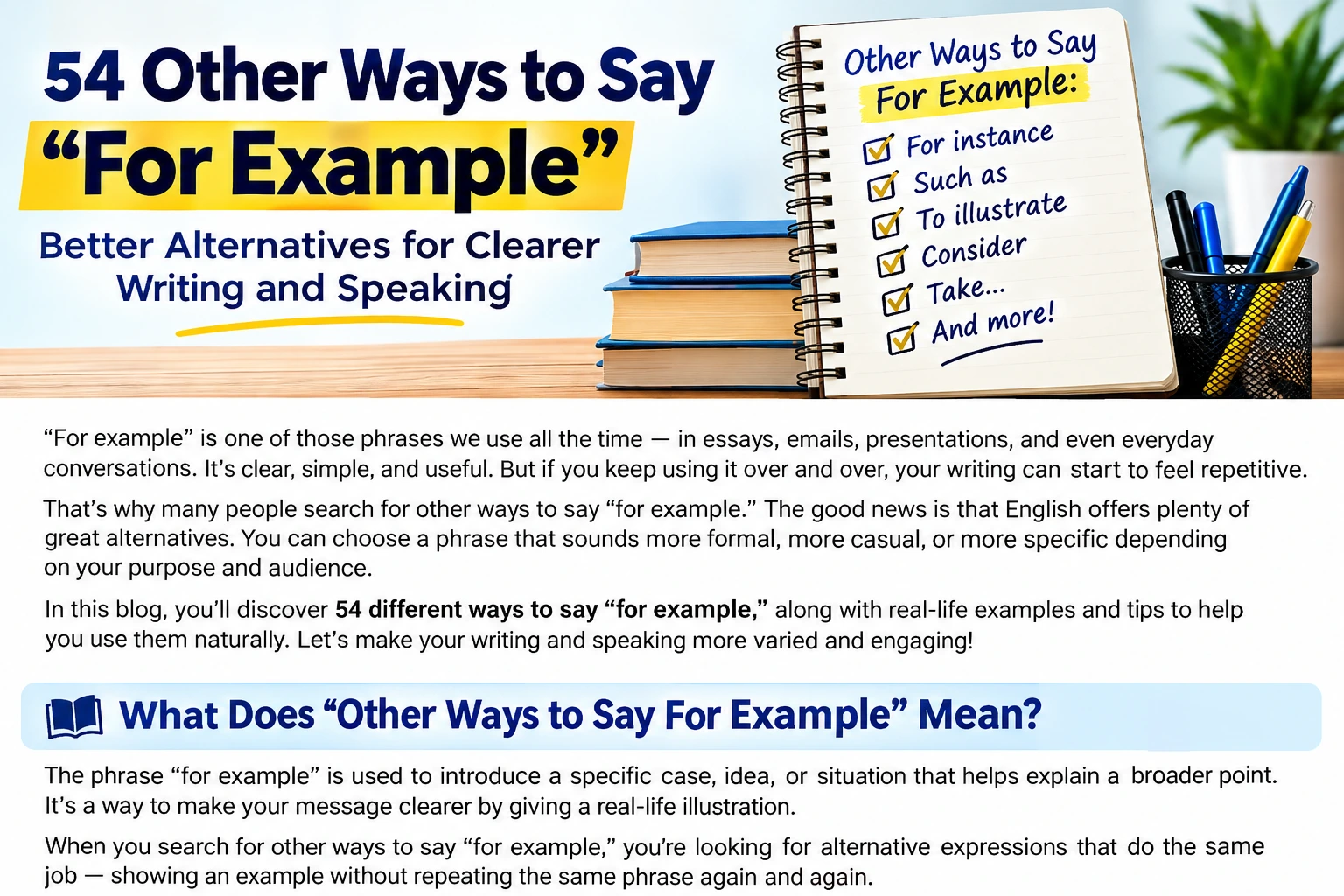
Sometimes, the smallest phrases are the ones we repeat the most. “For example” is useful, familiar, and perfectly correct, but using it again and again can make an essay, email, presentation, or conversation sound repetitive. That is why many writers search for other ways to say “for example.”
The good news is that you have plenty of alternatives. Depending on the situation, you can use a formal expression such as “for instance,” a conversational phrase such as “take this case,” or a concise option such as “e.g.” Choosing the right alternative can make your writing smoother and help your ideas connect more naturally.
Whether you are writing an academic assignment, professional email, blog post, speech, or casual message, this guide gives you 54 useful alternatives to “for example,” along with realistic examples showing exactly how to use them.
2. What Does “Other Ways to Say For Example” Mean?
The phrase “for example” is used when you want to introduce a specific case, idea, person, situation, or piece of evidence that helps explain a broader statement.
For instance, if you write:
“There are many ways to stay healthy. For example, you can walk every day.”
The second sentence provides a specific example that supports the first idea.
Searching for other ways to say “for example” simply means looking for alternative expressions that perform the same or a similar function.
Common alternatives include:
- For instance
- Such as
- To illustrate
- As an example
- Namely
- Take…
- Consider…
- Specifically
- In particular
- By way of illustration
The best choice depends on your audience and purpose. Some expressions are formal and academic, while others sound much more natural in everyday conversation.
Category 1: Polite and Appreciative
These alternatives work particularly well in professional writing, academic assignments, presentations, and respectful conversations.
1. For instance
Meaning: Used to introduce a specific example that supports a general statement.
Reply: “For instance, regular reading can improve your vocabulary.”
Example: A student is explaining effective study habits in an assignment and wants to provide a specific illustration without sounding repetitive.
2. Such as
Meaning: Introduces one or more specific examples from a larger group.
Reply: “You can learn practical skills such as coding, writing, and graphic design.”
Example: A career advisor is discussing useful skills students can develop before entering university.
3. To illustrate
Meaning: Introduces an example that makes an idea easier to understand.
Reply: “To illustrate, imagine a student managing five deadlines at once.”
Example: A teacher uses a realistic situation to explain why time management matters.
4. As an example
Meaning: Directly signals that the following information demonstrates the previous point.
Reply: “As an example, consider how small businesses use social media to attract customers.”
Example: A writer is explaining digital marketing and wants to move naturally from a general point to a specific case.
5. By way of example
Meaning: A slightly formal way to introduce an illustration.
Reply: “By way of example, a simple budget can help students manage their monthly expenses.”
Example: This works particularly well in formal articles, reports, and presentations.
6. To give an example
Meaning: Clearly introduces a specific situation or case.
Reply: “To give an example, many students use online courses to learn skills outside the classroom.”
Example: A speaker is explaining how people supplement traditional education with online learning.
7. To demonstrate
Meaning: Introduces evidence or a situation that makes something clear.
Reply: “To demonstrate this point, consider the results of the latest survey.”
Example: A presenter uses data to support an argument during a presentation.
8. Consider
Meaning: Invites the reader to look at a particular case as evidence.
Reply: “Consider a student who studies for two hours every morning.”
Example: A productivity blogger wants readers to visualize how a consistent routine works in practice.
9. Take, for example
Meaning: Draws attention to a specific person, situation, or thing.
Reply: “Take, for example, a small business trying to reach new customers.”
Example: A business writer introduces a realistic scenario to explain a marketing strategy.
10. One example is
Meaning: Directly identifies one specific illustration.
Reply: “One example is the growing popularity of online learning.”
Example: A student is writing an essay and wants a simple transition into supporting evidence.
Category 2: Flowy and Conversational
These alternatives sound natural in blogs, discussions, presentations, and everyday writing.
11. Take…
Meaning: Introduces a specific situation without explicitly saying “for example.”
Reply: “Take social media. It has completely changed how businesses communicate.”
Example: Two friends are discussing how technology has affected modern communication.
12. Think of…
Meaning: Encourages someone to imagine a particular example.
Reply: “Think of a student preparing for three exams in the same week.”
Example: A tutor uses a familiar situation to make a difficult concept easier to understand.
13. Imagine…
Meaning: Creates a hypothetical example for explanation.
Reply: “Imagine you have an important interview tomorrow but haven’t prepared.”
Example: A career coach uses a realistic situation to explain why preparation matters.
14. Let’s say…
Meaning: Introduces a hypothetical situation in a relaxed way.
Reply: “Let’s say you have $100 and need to make it last for the week.”
Example: A financial educator is explaining basic budgeting to beginners.
15. Suppose…
Meaning: Introduces an imagined situation.
Reply: “Suppose you receive two job offers at the same time.”
Example: Someone is discussing how to compare career opportunities.
16. Say…
Meaning: A short conversational way to introduce a hypothetical case.
Reply: “Say you want to learn a new language. You could start with ten minutes a day.”
Example: A friend is giving practical advice about building a new habit.
17. Take this case
Meaning: Directs attention toward a particular situation.
Reply: “Take this case: a student who works part-time while studying.”
Example: A discussion about balancing responsibilities becomes more concrete through a specific scenario.
18. Here’s one
Meaning: Introduces one example in a relaxed, direct way.
Reply: “Here’s one: working for fifteen minutes before taking a short break.”
Example: A productivity discussion becomes more practical by giving the audience an immediately usable idea.
19. Here’s a case
Meaning: Introduces a particular situation that supports an argument.
Reply: “Here’s a case where preparation made all the difference.”
Example: A speaker shares a real-world situation during a presentation.
20. A good example is
Meaning: Highlights a particularly useful or relevant example.
Reply: “A good example is the way online communities help people learn new skills.”
Example: A blogger wants to connect a broad statement with something readers already understand.
21. One case in point is
Meaning: Introduces a specific example that strongly supports a previous statement.
Reply: “One case in point is the rapid growth of remote learning.”
Example: A writer is discussing changes in education and wants to introduce supporting evidence.
Category 3: Confident and Precise
These expressions are useful when you want your writing to sound clear, authoritative, and organized.
22. Specifically
Meaning: Narrows a broad statement to a particular detail.
Reply: “Several skills are useful in the workplace, specifically communication and problem-solving.”
Example: A professional writer moves from a general statement to precise information.
23. In particular
Meaning: Highlights one specific item or situation.
Reply: “Students can benefit from several activities, in particular, volunteering.”
Example: An academic writer wants to emphasize one especially relevant example.
24. Namely
Meaning: Identifies the exact people or things being discussed.
Reply: “The project requires three skills, namely research, communication, and organization.”
Example: A report lists specific elements after making a broader statement.
25. To be specific
Meaning: Signals that more precise information is about to follow.
Reply: “To be specific, the course requires six hours of study each week.”
Example: A student clarifies a general statement in an academic discussion.
26. More specifically
Meaning: Moves from a general idea to a narrower detail.
Reply: “Technology has changed education. More specifically, online platforms have made learning more accessible.”
Example: An essay uses the phrase to create a logical transition between ideas.
27. In this case
Meaning: Refers to a particular situation under discussion.
Reply: “Several solutions are possible. In this case, improving communication may be the best option.”
Example: A colleague is discussing how to solve a workplace problem.
28. In one case
Meaning: Introduces a particular instance among several possibilities.
Reply: “In one case, the team reduced costs without reducing productivity.”
Example: A business report uses a specific result to support a broader claim.
29. One illustration is
Meaning: Introduces a particular example that helps explain an idea.
Reply: “One illustration is the rise of digital banking among younger consumers.”
Example: A writer is explaining a larger social or technological trend.
30. A clear illustration is
Meaning: Highlights an especially obvious example.
Reply: “A clear illustration is the increasing use of artificial intelligence in education.”
Example: An academic writer wants to make an abstract point easier to understand.
31. A notable example is
Meaning: Introduces an example that is particularly important or interesting.
Reply: “A notable example is the way small businesses have adapted to online shopping.”
Example: A professional article uses a specific case to reinforce its main argument.
Category 4: Funny and Casual
These options are more relaxed and work well in conversations, social posts, blogs, and informal explanations.
32. For starters
Meaning: Introduces one example or point among several.
Reply: “For starters, you could try turning off notifications.”
Example: A friend is giving simple advice to someone who feels distracted.
33. Just look at…
Meaning: Directs attention to a specific example that proves a point.
Reply: “Just look at online shopping—it has changed completely.”
Example: Someone is casually discussing how technology has transformed everyday life.
34. Take something like…
Meaning: Introduces a relatable example.
Reply: “Take something like meal planning. It can save you a lot of time.”
Example: A friend explains why planning ahead makes daily life easier.
35. Here’s the thing
Meaning: Introduces an explanation or example in a conversational way.
Reply: “Here’s the thing: even ten minutes of practice can make a difference.”
Example: A speaker wants to make advice feel personal rather than overly formal.
36. Picture this
Meaning: Asks the reader or listener to imagine a particular scenario.
Reply: “Picture this: you walk into an interview completely prepared.”
Example: A career-content creator uses a scenario to make advice more engaging.
37. Just imagine
Meaning: Introduces an imagined situation.
Reply: “Just imagine having all your assignments finished two days early.”
Example: A student jokingly describes the ideal version of academic life.
38. Here’s a simple one
Meaning: Introduces an easy-to-understand example.
Reply: “Here’s a simple one: write down your three priorities before starting work.”
Example: Someone shares a practical productivity tip with a friend.
39. Think about…
Meaning: Encourages someone to consider a specific case.
Reply: “Think about how often you check your phone without even realizing it.”
Example: A conversation about screen time becomes more relatable through a familiar situation.
40. Look at…
Meaning: Points toward a specific example as evidence.
Reply: “Look at how quickly online trends can spread.”
Example: A social media discussion uses a familiar phenomenon to make its point.
41. Take something as simple as…
Meaning: Introduces an ordinary example to explain a larger idea.
Reply: “Take something as simple as making a daily to-do list.”
Example: A productivity writer uses a basic habit to explain a broader principle.
Category 5: Curious, Thoughtful, and Mature
These alternatives are especially useful when you want your writing to encourage reflection or provide deeper context.
42. To put this into perspective
Meaning: Introduces information that helps someone understand the significance of an idea.
Reply: “To put this into perspective, a small daily saving can become a significant amount over several years.”
Example: A financial writer uses a concrete comparison to explain long-term benefits.
43. To put it another way
Meaning: Restates an idea using a clearer or more relatable example.
Reply: “To put it another way, consistency matters more than occasional bursts of effort.”
Example: A teacher rephrases a complicated concept so students can understand it more easily.
44. To make this clearer
Meaning: Introduces an example intended to simplify an explanation.
Reply: “To make this clearer, imagine trying to learn a language without ever practicing it.”
Example: A tutor explains why theoretical knowledge needs practical application.
45. As a case in point
Meaning: Introduces a specific case that supports a broader argument.
Reply: “As a case in point, many successful entrepreneurs began by solving a small everyday problem.”
Example: A business writer supports a statement with a recognizable pattern.
46. As evidence
Meaning: Introduces information that supports a claim.
Reply: “As evidence, consider the steady increase in online education.”
Example: An academic writer presents supporting information after making an argument.
47. To show what I mean
Meaning: Introduces an example that clarifies the speaker’s idea.
Reply: “To show what I mean, imagine receiving feedback before submitting your final project.”
Example: A mentor uses a hypothetical situation to make advice easier to understand.
48. To put it in context
Meaning: Provides an example or background that makes information easier to interpret.
Reply: “To put it in context, the company had only five employees when it started.”
Example: A business article explains the background behind a company’s growth.
49. A useful comparison is
Meaning: Introduces a comparison that helps explain an unfamiliar concept.
Reply: “A useful comparison is learning a skill like training for a marathon.”
Example: A teacher compares skill development with physical training to make an abstract idea easier to understand.
50. This can be seen in
Meaning: Introduces a real situation where the previous idea is visible.
Reply: “This can be seen in the growing number of students using online resources.”
Example: An academic article connects a general observation with a real-world trend.
51. This is evident in
Meaning: Introduces evidence that clearly supports the previous statement.
Reply: “This is evident in the increasing demand for digital skills.”
Example: A professional report uses a trend as evidence for a broader conclusion.
52. A practical example would be
Meaning: Introduces a real-world situation that demonstrates an idea.
Reply: “A practical example would be creating a weekly schedule before starting a new semester.”
Example: A university advisor gives students an actionable illustration of planning.
53. A real-world example is
Meaning: Introduces an example drawn from an actual situation rather than theory.
Reply: “A real-world example is how businesses use customer reviews to improve their services.”
Example: A marketing article connects a theoretical concept to something companies actually do.
54. One way to see this is
Meaning: Introduces an example or perspective that helps explain an idea.
Reply: “One way to see this is to think about how small habits influence long-term results.”
Example: A thoughtful discussion uses a different perspective to make a broad concept easier to understand.
4. Real-Life Examples: Choosing the Right Alternative
The phrase you choose should depend on where you are writing and who is reading.
Academic Essay
Instead of:
“For example, students can improve their writing by reading more.”
Try:
“For instance, students can improve their writing by reading more.”
Or:
“To illustrate, regular reading can expose students to a wider range of vocabulary.”
The first option sounds natural and academic. The second sounds slightly more polished.
Professional Email
Instead of:
“There are several possible solutions. For example, we could change the schedule.”
Try:
“There are several possible solutions. One option would be to change the schedule.”
This sounds professional because it does not force an example marker into every sentence.
Casual Conversation
Instead of:
“You could learn a new skill. For example, you could learn coding.”
Try:
“You could learn a new skill. Take coding, for instance.”
The second version sounds more conversational.
Presentation
Instead of repeating “for example” throughout a speech, mix expressions:
“Consider a student preparing for university.”
Then later:
“Take another case: someone working while studying.”
This makes the presentation sound more natural and less repetitive.
5. Real-Life Situations
When You’re Writing an Academic Essay
Best reply: “For instance”
Use it when you want a familiar, academically appropriate alternative.
Example:
“Social media can influence communication. For instance, students can collaborate with classmates through online platforms.”
When You’re Writing a Professional Report
Best reply: “A notable example is”
This sounds precise and polished.
Example:
“Several industries have adopted automation. A notable example is the manufacturing sector.”
When You’re Explaining Something to a Friend
Best reply: “Take…”
It sounds natural and conversational.
Example:
“Some habits are easier to build than others. Take drinking enough water—you can start by keeping a bottle nearby.”
When You’re Giving a Presentation
Best reply: “Consider…”
It invites the audience to think about the situation.
Example:
“Consider a student who has three major assignments due in the same week.”
When You’re Explaining a Complicated Idea
Best reply: “To put it another way”
This is particularly useful when your first explanation was too abstract.
Example:
“To put it another way, you do not need to become perfect overnight. You simply need to improve consistently.”
6. What to Avoid
1. Repeating “For Example” in Every Paragraph
Even though the phrase is correct, constant repetition can make your writing feel mechanical.
2. Using Formal Expressions in Casual Conversations
Phrases such as “by way of illustration” may sound unnecessarily formal when talking to a friend.
3. Using “Such As” Incorrectly
“Such as” normally introduces examples within a sentence.
Correct:
“Skills such as communication and teamwork are valuable.”
4. Confusing Examples With Evidence
An example illustrates an idea, while evidence is used to support or prove a claim. They are related, but they are not always interchangeable.
5. Adding an Example That Does Not Support the Point
A random example can confuse the reader rather than clarify the argument.
6. Overcomplicating Simple Writing
You do not need an advanced phrase every time. Sometimes “for example” is exactly the right choice.
7. Pro Tips
Match the Phrase to Your Audience
Use “for instance” or “to illustrate” in academic writing. Choose “take…” or “think of…” for casual conversations.
Vary Your Transitions Naturally
You do not need to replace every occurrence of “for example.” Instead, alternate between a few suitable expressions so the writing remains natural.
Use Examples to Add Value
The purpose of an example is not simply to make your writing longer. A strong example should make an abstract idea easier to understand, visualize, or remember.
8. Conclusion
Knowing different ways to say “for example” gives your writing more flexibility without making it complicated. Whether you choose “for instance,” “such as,” “to illustrate,” “consider,” or “a real-world example is,” the right phrase depends on your audience, tone, and purpose.
The goal is not to eliminate “for example” completely. It is to avoid unnecessary repetition and make your ideas flow naturally. Choose the expression that sounds right for the situation, keep your examples relevant, and let clarity come first.
Good writing is not about using bigger words. It is about choosing the right words at the right moment.
Discover more
other ways to say proud of you with heart