
Being good with people is a valuable skill in almost every profession. Whether you are writing a resume, preparing for a job interview, updating your LinkedIn profile, or describing a colleague, the phrase “people person” might feel a little too casual. You may want a more professional expression that communicates your ability to build relationships, communicate clearly, and work well with others.
The good news is that there are plenty of alternatives to choose from. Some highlight your communication skills, while others emphasize teamwork, relationship-building, leadership, or customer service. The best choice depends on what you want to communicate and where you plan to use it.
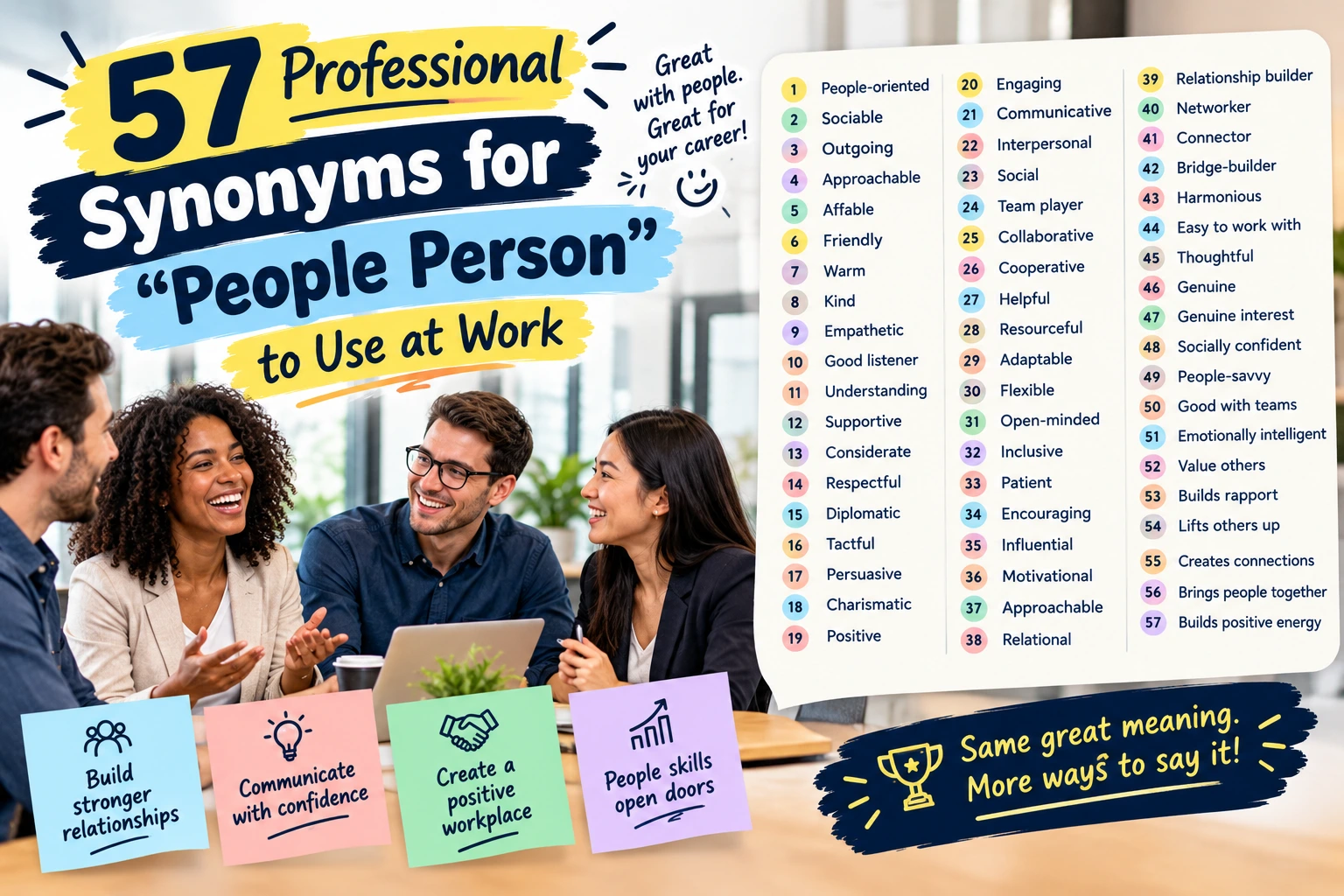
In this guide, you will discover 57 professional synonyms for “people person,” complete with simple definitions and practical examples. You will also learn which expressions work best on resumes, in interviews, and in professional conversations.
What Does “People Person” Mean?
A people person is someone who enjoys interacting with others and feels comfortable building relationships. They often communicate well, listen carefully, understand different perspectives, and help people feel welcome.
In the workplace, being a people person can mean collaborating with colleagues, handling customer concerns, resolving disagreements, supporting a team, or developing strong professional relationships.
For example, a recruiter might be a people person because they enjoy connecting with candidates. A manager might demonstrate this quality by supporting employees and encouraging teamwork. Similarly, a customer service representative needs patience, empathy, and strong communication skills.
Although “people person” is a positive phrase, it is relatively informal. On a resume or in a business conversation, a more specific expression can sound clearer and more professional.
Instead of simply saying, “I am a people person,” you could describe yourself as an effective communicator, relationship builder, collaborative professional, or customer-focused individual.
The key is to choose a phrase that reflects your actual strengths rather than relying on a general description.
The following alternatives are organized into five categories to help you find the right expression for your resume, cover letter, interview, or everyday workplace communication.
Category 1: Polite and Professional Alternatives
These expressions work well when you want to sound approachable, respectful, and professional. They are especially useful in cover letters, LinkedIn summaries, and workplace introductions.
1. Effective Communicator
An effective communicator expresses ideas clearly, listens to others, and adapts their communication style to different situations.
Example: “I am an effective communicator who works well with colleagues, clients, and stakeholders.”
2. Strong Interpersonal Skills
This phrase describes the ability to interact respectfully and build positive working relationships.
Example: “My strong interpersonal skills help me collaborate with people from different professional backgrounds.”
3. Relationship Builder
A relationship builder develops trust and maintains meaningful connections with colleagues, clients, and business partners.
Example: “I am a relationship builder who values trust, consistency, and open communication.”
4. Approachable Professional
An approachable professional makes others feel comfortable asking questions, sharing ideas, or discussing concerns.
Example: “I strive to be an approachable professional who encourages honest communication within the team.”
5. People-Oriented Professional
This expression describes someone who values human relationships and considers people’s needs when making decisions.
Example: “As a people-oriented professional, I prioritize collaboration and positive workplace relationships.”
6. Skilled Communicator
A skilled communicator understands how to share information clearly and respond appropriately in different situations.
Example: “I am a skilled communicator with experience coordinating tasks across different teams.”
7. Personable Individual
A personable individual is friendly, pleasant, and easy to interact with.
Example: “My personable nature helps me establish positive relationships with clients and colleagues.”
8. Respectful Collaborator
A respectful collaborator values other people’s opinions and contributes constructively to shared goals.
Example: “I am a respectful collaborator who welcomes different perspectives and works toward practical solutions.”
9. Professional Relationship Manager
This expression suits people who maintain relationships with clients, partners, or stakeholders as part of their work.
Example: “I have experience as a professional relationship manager, maintaining client satisfaction and long-term partnerships.”
10. Customer-Focused Professional
A customer-focused professional pays attention to customer needs and works to deliver a positive experience.
Example: “I am a customer-focused professional committed to understanding concerns and providing helpful solutions.”
Category 2: Flirty and Playful Alternatives
Not every conversation happens in an office. Sometimes you need a lighthearted expression for a casual chat, a social introduction, or a playful conversation with someone you know.
These alternatives are less formal than the first category, so they are better suited to informal conversations than professional resumes.
11. Natural Conversationalist
A natural conversationalist can keep a discussion flowing without making it feel forced.
Example: “You always find something interesting to talk about. You’re such a natural conversationalist.”
12. Social Butterfly
A social butterfly enjoys meeting people, attending gatherings, and moving comfortably between different social groups.
Example: “You somehow know everyone at this event. You’re a real social butterfly.”
13. Charming Communicator
A charming communicator makes conversations enjoyable through warmth, confidence, and engaging communication.
Example: “You have a way of making everyone smile. You’re a charming communicator.”
14. Friendly Extrovert
A friendly extrovert gains energy from social interaction and usually enjoys meeting new people.
Example: “You’re always excited to meet someone new. You’re definitely a friendly extrovert.”
15. Conversation Starter
A conversation starter is someone who makes the first move and helps others feel comfortable joining a discussion.
Example: “I was nervous about attending the party, but you made it easy to start talking to everyone.”
16. Socially Confident Person
This expression describes someone who feels comfortable interacting with others without constantly worrying about how they are perceived.
Example: “You walked into a room full of strangers and started chatting like you’d known them for years. You’re socially confident.”
17. Warm Personality
Someone with a warm personality makes others feel welcome through friendliness, kindness, and genuine interest.
Example: “People feel comfortable around you because you have such a warm personality.”
18. Natural People Connector
A natural people connector enjoys introducing individuals and helping them discover shared interests or opportunities.
Example: “You introduced us, and now we’re working on a project together. You’re a natural people connector.”
19. Magnetic Personality
A magnetic personality naturally attracts attention and makes people interested in interacting with someone.
Example: “Everyone seems drawn to you at these events. You have a magnetic personality.”
20. Socially Savvy Individual
A socially savvy individual understands social situations and knows how to communicate appropriately with different people.
Example: “You knew exactly how to handle that awkward introduction. You’re surprisingly socially savvy.”
Category 3: Confident and Self-Assured Alternatives
These expressions are useful when you want to present yourself as capable, mature, and comfortable working with others. They can strengthen your professional profile without sounding exaggerated.
21. Strong Relationship Builder
This phrase emphasizes the ability to establish and maintain productive professional connections.
Example: “I am a strong relationship builder who develops trust with clients and colleagues.”
22. Collaborative Team Member
A collaborative team member shares ideas, supports colleagues, and contributes toward common objectives.
Example: “I am a collaborative team member who values shared responsibility and constructive feedback.”
23. Results-Oriented Communicator
This expression describes someone who communicates with a clear purpose and helps move projects toward successful outcomes.
Example: “I am a results-oriented communicator who keeps stakeholders informed and aligned with project goals.”
24. Empathetic Professional
An empathetic professional considers other people’s feelings, concerns, and perspectives before responding.
Example: “I approach workplace challenges as an empathetic professional who listens before offering solutions.”
25. People-Centered Leader
A people-centered leader considers employee well-being, development, and collaboration while working toward organizational goals.
Example: “My leadership style is people-centered, with an emphasis on trust, accountability, and employee growth.”
26. Skilled Negotiator
A skilled negotiator communicates confidently, understands different interests, and works toward mutually acceptable outcomes.
Example: “I use my negotiation skills to resolve disagreements and maintain productive business relationships.”
27. Trustworthy Professional
A trustworthy professional builds confidence through honesty, reliability, and consistent behavior.
Example: “I aim to be a trustworthy professional who follows through on commitments and communicates openly.”
28. Influential Communicator
An influential communicator presents ideas in a way that helps others understand, consider, or support them.
Example: “I am an influential communicator who can explain complex ideas to different audiences.”
29. Relationship-Driven Professional
A relationship-driven professional values long-term connections and recognizes their importance in achieving business objectives.
Example: “I am a relationship-driven professional focused on building lasting partnerships with clients.”
30. Interpersonally Skilled Individual
This phrase highlights someone’s ability to communicate, cooperate, and navigate relationships effectively.
Example: “I am an interpersonally skilled individual who works comfortably with diverse teams.”
31. Team-Oriented Professional
A team-oriented professional prioritizes cooperation and shared success rather than focusing only on individual achievements.
Example: “I am a team-oriented professional who contributes ideas, supports colleagues, and takes responsibility for shared goals.”
32. Confident Relationship Manager
This expression suits someone who can maintain professional relationships, address concerns, and communicate expectations confidently.
Example: “I am a confident relationship manager experienced in handling client expectations and resolving concerns.”
Category 4: Funny and Informal Alternatives
These phrases add personality to casual conversations, introductions, or friendly descriptions. They are not generally suitable for formal resumes, but they can make everyday communication more engaging.
33. Professional People Magnet
A professional people magnet seems to attract conversations and build connections wherever they go.
Example: “You went to get coffee and came back knowing everyone’s life story. You’re a professional people magnet.”
34. Networking Natural
A networking natural connects with people comfortably without making every interaction feel like a business transaction.
Example: “You turned a five-minute introduction into three business opportunities. You’re a networking natural.”
35. Conversation Expert
A conversation expert knows how to keep discussions interesting and make people feel involved.
Example: “Even the quietest person in the room started talking to you. You’re a conversation expert.”
36. Human Connection Specialist
This playful expression describes someone who seems especially good at creating rapport and bringing people together.
Example: “You can turn a room full of strangers into a group of friends. You’re basically a human connection specialist.”
37. Office Social Coordinator
An office social coordinator is the person who keeps workplace conversations, introductions, and informal gatherings going.
Example: “You organized the team lunch, introduced the new employees, and remembered everyone’s preferences. You’re our unofficial office social coordinator.”
38. Walking Welcome Committee
This humorous phrase describes someone who greets everyone and makes newcomers feel included.
Example: “You welcomed every new student before the lecture even started. You’re the walking welcome committee.”
39. Human LinkedIn
A human LinkedIn is someone who seems to know everyone and can connect people with useful contacts.
Example: “I needed a designer, and you immediately knew three. You’re basically human LinkedIn.”
40. Social Problem Solver
A social problem solver uses communication and people skills to help resolve awkward situations or misunderstandings.
Example: “You managed to settle the disagreement without anyone getting upset. You’re the team’s social problem solver.”
41. Chief of First Impressions
This playful title describes someone who is particularly good at making positive first impressions.
Example: “You greeted the clients, introduced the team, and made everyone comfortable. You’re officially chief of first impressions.”
42. Friendship Architect
A friendship architect is someone who brings people together and helps connections grow.
Example: “You introduced two people who are now best friends. You’re a friendship architect.”
These informal alternatives work best when humor fits the relationship. For a job application or formal business document, choose a more conventional expression.
Category 5: Curious, Thoughtful, and Mature Alternatives
These expressions emphasize emotional intelligence, active listening, understanding, and the ability to work thoughtfully with others. They are especially useful in leadership, human resources, education, counseling, and client-facing roles.
43. Emotionally Intelligent Professional
An emotionally intelligent professional recognizes emotions, manages reactions, and responds thoughtfully to other people’s needs.
Example: “I bring emotional intelligence to team discussions, particularly when handling disagreements or sensitive feedback.”
44. Active Listener
An active listener gives others their attention, asks relevant questions, and makes an effort to understand what they are saying.
Example: “I am an active listener who takes time to understand client concerns before recommending a solution.”
45. Empathetic Communicator
An empathetic communicator combines clear communication with an understanding of other people’s feelings and perspectives.
Example: “I use an empathetic communication style to handle difficult conversations with respect.”
46. Interpersonal Relationship Specialist
This expression is suitable for roles that involve developing, maintaining, or improving relationships between people.
Example: “As an interpersonal relationship specialist, I focus on communication, cooperation, and constructive conflict resolution.”
47. Diplomatic Professional
A diplomatic professional handles sensitive matters tactfully and considers different viewpoints before responding.
Example: “I take a diplomatic approach to workplace disagreements and look for solutions that respect everyone’s concerns.”
48. Conflict Resolution Specialist
A conflict resolution specialist helps people address disagreements and find workable solutions.
Example: “My conflict resolution skills help teams discuss difficult issues and move forward constructively.”
49. Community-Oriented Individual
A community-oriented individual values belonging, participation, and positive relationships within a group.
Example: “I am a community-oriented individual who enjoys organizing activities that bring people together.”
50. Supportive Team Member
A supportive team member helps colleagues, shares knowledge, and contributes to a positive working environment.
Example: “I am a supportive team member who offers assistance when colleagues face challenges.”
51. People Development Professional
A people development professional focuses on helping individuals improve their skills, confidence, and performance.
Example: “I am interested in people development and enjoy helping team members identify opportunities for growth.”
52. Stakeholder Engagement Specialist
A stakeholder engagement specialist builds relationships with people who influence or are affected by a project, service, or organization.
Example: “I have strong stakeholder engagement skills and can communicate project updates to different groups.”
53. Client Relations Professional
A client relations professional maintains positive customer relationships and helps address their needs throughout the business relationship.
Example: “I am a client relations professional who focuses on responsiveness, trust, and long-term satisfaction.”
54. Cross-Functional Collaborator
A cross-functional collaborator works effectively with people from different departments, specialties, or professional backgrounds.
Example: “I work well as a cross-functional collaborator, coordinating with design, marketing, and development teams.”
55. Relationship Management Specialist
A relationship management specialist develops strategies and practices for maintaining strong professional or client relationships.
Example: “My experience in relationship management helps me maintain client engagement and identify opportunities for collaboration.”
56. Culturally Aware Communicator
A culturally aware communicator recognizes that people may have different backgrounds, communication styles, and expectations.
Example: “I am a culturally aware communicator who adapts my approach when working with international teams.”
57. People-Focused Professional
A people-focused professional considers human needs, communication, and relationships when approaching workplace responsibilities.
Example: “I am a people-focused professional who values teamwork, mutual respect, and meaningful professional connections.”
Which Professional Synonym Should You Choose?
Not every synonym communicates the same strength. Some focus on communication, while others highlight leadership, customer relationships, or emotional intelligence.
Use this quick comparison to select the most appropriate phrase.
| Your goal | Best synonym |
|---|---|
| Improve your resume | Strong interpersonal skills |
| Describe your communication ability | Effective communicator |
| Highlight teamwork | Collaborative team member |
| Emphasize client relationships | Relationship builder |
| Show leadership ability | People-centered leader |
| Demonstrate empathy | Empathetic professional |
| Highlight customer service | Customer-focused professional |
| Describe networking skills | Skilled relationship builder |
| Show conflict management | Conflict resolution specialist |
| Emphasize working across departments | Cross-functional collaborator |
| Highlight cultural awareness | Culturally aware communicator |
| Describe a friendly personality | Personable individual |
Remember that a specific phrase is usually more convincing than a broad label. For example, “effective communicator with experience coordinating cross-functional teams” tells an employer more than simply saying “I am a people person.”
How to Use These Synonyms in Real Life
Choosing the right expression is only half the task. You also need to know how to use it naturally in different professional situations.
1. When Writing Your Resume
A resume should communicate your skills clearly and connect them to the role you want.
Instead of writing:
“I am a people person who enjoys working with others.”
Try:
“I have strong interpersonal skills and experience collaborating with diverse teams to achieve shared objectives.”
This version sounds more professional because it identifies a specific ability and connects it to workplace performance.
2. When Writing a Cover Letter
A cover letter gives you an opportunity to explain how your personality and skills would benefit an organization.
For example:
“I am a relationship-focused professional who values clear communication, teamwork, and building trust with clients.”
This sentence is particularly useful for roles in sales, recruitment, customer success, public relations, and account management.
3. During a Job Interview
Interviewers may ask about your strengths or how you work with other people. A specific example is often more persuasive than a simple self-description.
You could say:
“One of my strengths is effective communication. I listen carefully, clarify expectations, and work with others to resolve problems before they affect a project.”
If possible, follow this statement with a real example from a previous job, university project, internship, or volunteer experience.
4. When Updating Your LinkedIn Profile
Your LinkedIn summary should communicate your professional strengths without sounding like a list of generic personality traits.
For example:
“I am a collaborative professional with strong interpersonal skills and an interest in building meaningful relationships across teams.”
You can make this statement more compelling by mentioning the industries, projects, or people you have worked with.
5. When Describing a Colleague
If you want to describe someone positively at work, choose a phrase that reflects their behavior.
For example:
“She’s an approachable professional who makes new team members feel welcome.”
Or:
“He’s an effective communicator who keeps everyone informed and helps the team stay aligned.”
These descriptions are more meaningful than simply calling someone a people person because they explain what makes that person effective.
Common Mistakes to Avoid
Even a good synonym can sound awkward if you use it in the wrong context. Keep these common mistakes in mind.
1. Using Casual Expressions on a Formal Resume
Phrases such as “social butterfly,” “human LinkedIn,” and “walking welcome committee” may be funny, but they do not belong in most professional applications.
Choose alternatives such as “effective communicator,” “relationship builder,” or “collaborative team member.”
2. Choosing Words That Do Not Match Your Experience
Calling yourself a “skilled negotiator” or “relationship management specialist” creates certain expectations.
Only use these descriptions if your experience, skills, or relevant examples support them.
3. Using Too Many Synonyms Together
Writing “I am personable, approachable, empathetic, collaborative, and people-oriented” can make your resume feel repetitive.
Choose one or two relevant strengths and demonstrate them with evidence.
4. Confusing Being Friendly With Being Professionally Skilled
Being friendly is valuable, but professional people skills also involve listening, handling disagreements, respecting boundaries, and communicating clearly.
Choose language that reflects the specific abilities required for your role.
5. Ignoring the Job Description
A customer service position may value customer-focused communication, while a management position may require relationship building and conflict resolution.
Read the job description and use the terminology that genuinely matches the employer’s requirements.
6. Forgetting to Provide Evidence
Anyone can claim to be an effective communicator. A concrete example makes the claim more believable.
Instead of writing, “I have excellent interpersonal skills,” explain how you coordinated a group project, helped resolve a disagreement, or communicated with clients.
Pro Tips for Choosing the Best Alternative
Tip 1: Match the wording to your goal. If you are applying for a job, use professional language. If you are describing your personality in a casual conversation, a warmer expression may be more natural.
Tip 2: Focus on the skill behind the phrase. Ask yourself what makes you a people person. Is it your ability to listen, lead, negotiate, support others, or build trust? Choose the synonym that describes that strength most accurately.
Tip 3: Support your words with examples. A phrase becomes more powerful when you demonstrate it. Mention a successful collaboration, a positive client interaction, or a situation in which your communication skills helped solve a problem.
The goal is not to sound impressive at all costs. It is to describe your strengths clearly and honestly.
Bonus: 10 Quick Professional Alternatives
If you need a short expression for a resume, email, introduction, or professional profile, these options are a useful starting point.
- Effective communicator
- Strong interpersonal skills
- Relationship builder
- Collaborative professional
- Approachable individual
- People-oriented professional
- Skilled communicator
- Empathetic professional
- Customer-focused individual
- Team-oriented professional
These expressions are concise, versatile, and suitable for many workplace situations. Select the one that best describes the quality you want to emphasize.
Conclusion
Being a people person is about more than enjoying conversations. It involves building trust, communicating clearly, understanding different perspectives, and working effectively with others.
The right professional synonym helps you express these qualities with greater clarity. Whether you choose “effective communicator,” “relationship builder,” “empathetic professional,” or “collaborative team member,” make sure the phrase reflects your actual strengths and the situation in which you are using it.
If you are updating your resume, preparing for an interview, or improving your professional profile, start with one relevant expression and support it with a real example.
The strongest professional impression comes not from the words you choose, but from the way you put those qualities into practice.
Discover more
formal synonyms for just in case