

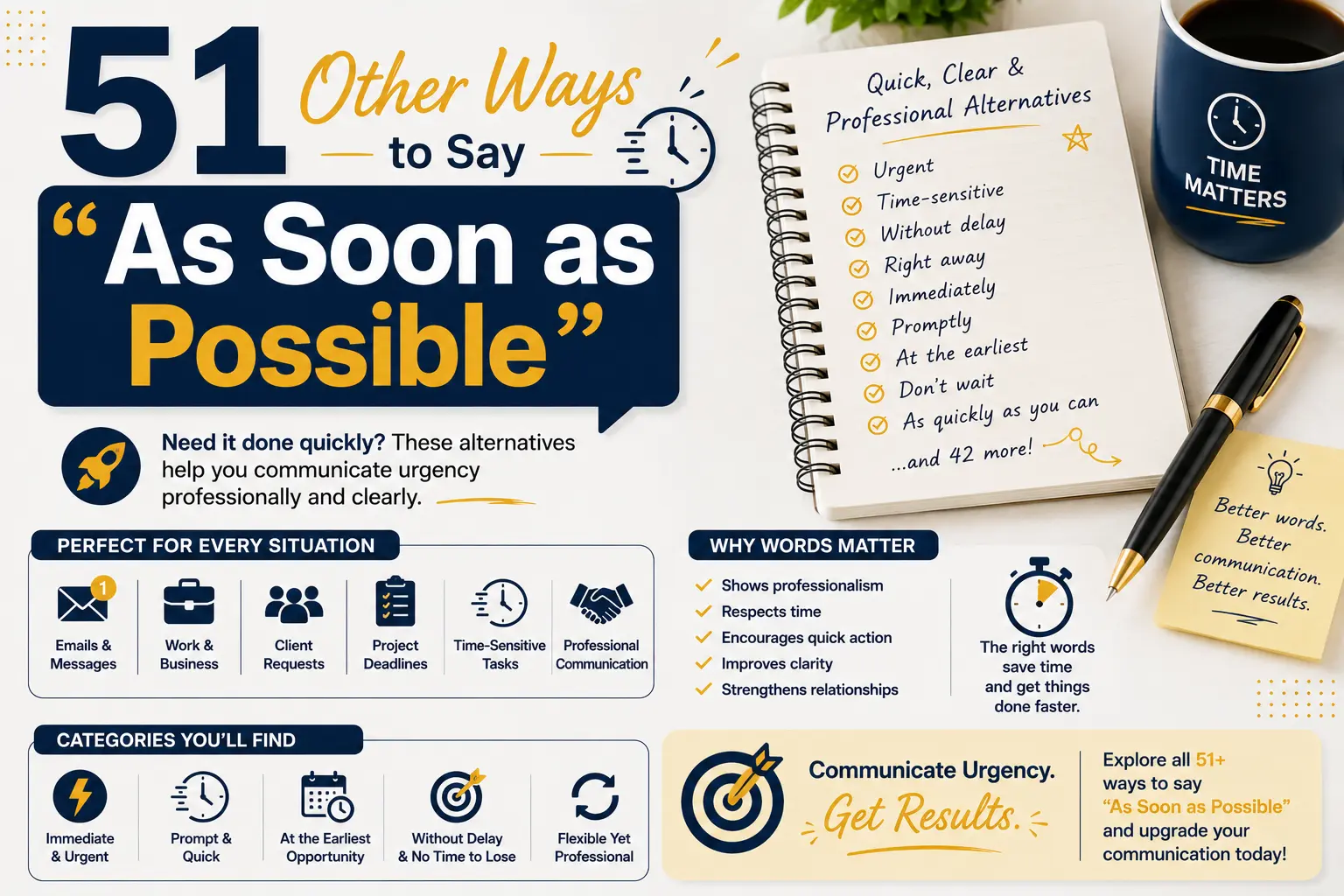
Sometimes, “as soon as possible” is exactly what you need to say. But when you use it repeatedly in emails, messages, or workplace conversations, it can start to feel a little generic. Worse, depending on the situation, it can sound either too demanding or too vague.
That is why having a few natural alternatives can make a real difference. You might want to sound professional when asking a colleague to complete a task, warm when requesting help from a friend, or firm when something genuinely cannot wait. The right wording helps communicate urgency without creating unnecessary pressure.
Whether you are writing a work email, sending a quick text, following up on an important request, or asking someone to meet a deadline, these alternatives give you more ways to express the same idea. Here are 51 useful options, organized by tone and situation.
What Does “As Soon as Possible” Mean?
“As soon as possible” means as quickly as someone reasonably can or at the earliest practical opportunity.
It is commonly used when something is important or time-sensitive, but there may not be a specific deadline.
For example:
“Please send me the documents as soon as possible.”
This tells the recipient that you would like the documents quickly.
The phrase can work in both professional and casual communication, but its tone depends on the context. In a workplace, it can communicate urgency. In a text to a friend, it may simply mean “when you get a chance, but preferably soon.”
Sometimes, however, being more specific is better. If you actually need something by Friday at 3 p.m., saying that directly is clearer than simply saying “as soon as possible.”
Polite and Appreciative
These alternatives are ideal when you want to communicate urgency while remaining courteous and considerate.
1. “At your earliest convenience”
Reply: “Could you send the document at your earliest convenience?”
Example: You need a colleague to review a document but do not want your request to sound demanding.
This is a polished and respectful alternative, especially for professional emails.
2. “When you have a chance”
Reply: “Please send me the details when you have a chance.”
Example: You need some information from a coworker, but the matter is not an emergency.
This sounds relaxed and friendly.
3. “At the earliest opportunity”
Reply: “Please let me know at the earliest opportunity.”
Example: You are waiting for an important update from a professional contact.
It communicates urgency while maintaining a formal tone.
4. “As quickly as you can”
Reply: “Please complete the form as quickly as you can.”
Example: You need someone to finish a form soon.
This is straightforward and natural without being overly formal.
5. “When possible”
Reply: “Please send the revised version when possible.”
Example: You are requesting a file from a colleague.
This is useful when you want to sound flexible.
6. “When you get a moment”
Reply: “Could you give this a quick review when you get a moment?”
Example: You need feedback from someone who is currently busy.
It sounds considerate and low-pressure.
7. “At your earliest opportunity”
Reply: “Please respond at your earliest opportunity.”
Example: You are waiting for an important professional response.
This is formal, courteous, and appropriate for business correspondence.
8. “Whenever you can”
Reply: “Send me the information whenever you can.”
Example: You are asking a friend for some information.
It sounds warm and flexible.
9. “When you’re able”
Reply: “Please send the documents when you’re able.”
Example: You need documents but understand the other person may be occupied.
This shows consideration while still making the request clear.
10. “As promptly as possible”
Reply: “Please address the issue as promptly as possible.”
Example: You are asking a team member to resolve a work-related problem.
It sounds professional and emphasizes timely action.
Flirty and Playful
These options are best for casual conversations. They add personality without taking the request too seriously.
11. “Whenever you stop being busy”
Reply: “Send it whenever you stop being busy.”
Example: Your friend has been busy all day and promised to send you something.
It is playful and works well with people you know closely.
12. “When you get a spare second”
Reply: “Call me when you get a spare second.”
Example: You want to hear from someone who has had a busy day.
It sounds casual and natural.
13. “When the stars align”
Reply: “Send me the pictures when the stars align.”
Example: Your friend has been promising to send you photos for days.
This is a humorous way to express that you are waiting.
14. “Whenever you decide to bless me with it”
Reply: “Send me the playlist whenever you decide to bless me with it.”
Example: A friend has been teasing you about a playlist they made.
This works when your relationship is already playful.
15. “Before I grow old waiting”
Reply: “Please send me the details before I grow old waiting.”
Example: Your friend keeps forgetting to send you something.
It exaggerates the urgency for comedic effect.
16. “The sooner, the better”
Reply: “Let me know the details; the sooner, the better.”
Example: You are making plans with someone and want an answer quickly.
This is casual but still clear.
17. “Whenever you can work your magic”
Reply: “Send me the file whenever you can work your magic.”
Example: You are asking a friend who is good at editing something.
It adds a little personality to a simple request.
18. “When you get around to it, preferably today”
Reply: “Send me the pictures when you get around to it, preferably today.”
Example: You want to tease a friend while still making your deadline clear.
It balances humor with directness.
19. “Before I have to send a search party”
Reply: “Come back as soon as you can, before I have to send a search party.”
Example: A friend has disappeared from a group chat for hours.
It is playful rather than genuinely urgent.
20. “Whenever you’re ready, but preferably soon”
Reply: “Let me know whenever you’re ready, but preferably soon.”
Example: You are waiting for someone to confirm plans.
This gives the other person flexibility while making your preference obvious.
Confident and Direct
Sometimes you do not need to soften the message. These alternatives communicate urgency clearly and professionally.
21. “As soon as you’re able”
Reply: “Please send the final version as soon as you’re able.”
Example: A project is approaching its deadline and you need the final file.
It is direct without sounding aggressive.
22. “Without delay”
Reply: “Please address this matter without delay.”
Example: You are communicating about an issue that requires immediate attention.
This is formal and considerably stronger than “when possible.”
23. “As promptly as possible”
Reply: “Please respond as promptly as possible.”
Example: You need a response to keep a project moving.
It sounds professional and focused.
24. “At the earliest possible time”
Reply: “Please contact me at the earliest possible time.”
Example: You need to speak with someone about an important issue.
This is formal and emphasizes urgency.
25. “At the first opportunity”
Reply: “Please review the document at the first opportunity.”
Example: You need a colleague to look over an important document.
It is concise and professional.
26. “With minimal delay”
Reply: “Please submit the paperwork with minimal delay.”
Example: You are explaining that paperwork needs to be completed quickly.
This sounds formal and precise.
27. “As a priority”
Reply: “Please treat this request as a priority.”
Example: A task has become more urgent because of a deadline.
This is stronger than a casual request and works well in professional settings.
28. “At the earliest possible opportunity”
Reply: “Please provide the information at the earliest possible opportunity.”
Example: You need information before another part of a project can begin.
It communicates urgency in a polished way.
29. “As soon as practicable”
Reply: “Please provide the documents as soon as practicable.”
Example: You are writing a formal professional message.
This phrase is particularly useful in formal or administrative communication.
30. “As a matter of urgency”
Reply: “Please address this as a matter of urgency.”
Example: A serious work issue needs attention immediately.
This should be reserved for situations that genuinely require quick action.
Funny and Savage
These options are intentionally humorous. They are better suited to friends, family, and casual conversations than formal emails.
31. “Before the next century”
Reply: “Send it before the next century, please.”
Example: Your friend has promised to send you a file for several days.
The exaggeration makes the reminder funny.
32. “Before I forget what I asked for”
Reply: “Send it before I forget what I asked for.”
Example: Someone keeps delaying a simple request.
It is a playful way to communicate mild impatience.
33. “Yesterday would have been ideal”
Reply: “Can you send it soon? Yesterday would have been ideal.”
Example: You are jokingly reminding a friend who is taking too long.
The humor comes from the obviously impossible deadline.
34. “Before my patience runs out”
Reply: “Please send it before my patience runs out.”
Example: A close friend keeps postponing something.
Use it only when the relationship makes the teasing obvious.
35. “Before we both forget about it”
Reply: “Let’s finish this before we both forget about it.”
Example: You and a friend keep postponing a shared plan.
It is humorous but still practical.
36. “Before the deadline starts laughing at us”
Reply: “We need to finish this before the deadline starts laughing at us.”
Example: You and a classmate are rushing to complete an assignment.
It turns deadline pressure into a joke.
37. “Preferably before I have to ask again”
Reply: “Send it preferably before I have to ask again.”
Example: A friend has ignored your previous request.
It is slightly cheeky and works best with someone you know well.
38. “Before this becomes a historical event”
Reply: “Please send the photos before this becomes a historical event.”
Example: Someone has been promising to send photos for weeks.
The exaggerated wording keeps the reminder light.
39. “Whenever the universe permits”
Reply: “Send it whenever the universe permits.”
Example: You are waiting for a friend to send something that keeps getting delayed.
It is intentionally dramatic and playful.
40. “Before I start writing a missing-person report”
Reply: “Call me before I start writing a missing-person report.”
Example: A friend has gone unusually quiet.
This is clearly humorous and should be used only in appropriate casual situations.
Curious, Thoughtful, and Mature
These alternatives are useful when you want to communicate urgency while showing awareness of the other person’s situation.
41. “When would be the earliest you could manage?”
Reply: “When would be the earliest you could manage?”
Example: You need a document but want to understand the other person’s schedule.
This is considerate and encourages an honest timeline.
42. “Could you let me know when you expect to have this ready?”
Reply: “Could you let me know when you expect to have this ready?”
Example: You are waiting for a project update from a colleague.
This is often better than simply saying “ASAP” because it asks for a concrete expectation.
43. “Would you be able to prioritize this?”
Reply: “Would you be able to prioritize this?”
Example: You need a task completed sooner because another deadline depends on it.
It communicates importance without issuing a blunt command.
44. “Could you get back to me at your earliest opportunity?”
Reply: “Could you get back to me at your earliest opportunity?”
Example: You need an answer before making a decision.
It is polite, professional, and clear.
45. “When can I expect to hear from you?”
Reply: “When can I expect to hear from you?”
Example: You are waiting for confirmation about an application or project.
This is especially useful when you need a specific timeframe.
46. “Could you let me know when this might be available?”
Reply: “Could you let me know when this might be available?”
Example: You are waiting for a document or service.
It sounds patient and professional.
47. “I’d appreciate it if you could prioritize this.”
Reply: “I’d appreciate it if you could prioritize this.”
Example: A work task needs to be completed before other tasks.
This is firm but remains courteous.
48. “Please let me know as soon as you’re able.”
Reply: “Please let me know as soon as you’re able.”
Example: You need an answer but understand the person may currently be busy.
It balances urgency with consideration.
49. “Could we move this forward at the earliest opportunity?”
Reply: “Could we move this forward at the earliest opportunity?”
Example: You want a team to begin the next stage of a project.
This sounds collaborative rather than demanding.
50. “I’d be grateful if you could respond at your earliest convenience.”
Reply: “I’d be grateful if you could respond at your earliest convenience.”
Example: You are requesting an important response in a formal email.
It is courteous and appropriate for professional communication.
51. “Please let me know what timeline works for you.”
Reply: “Please let me know what timeline works for you.”
Example: You need something completed but want to agree on a realistic deadline.
This is a mature alternative because it encourages collaboration rather than simply demanding speed.
Real-Life Situations: Which Phrase Should You Use?
When You Are Emailing a Manager
Avoid sounding overly casual or impatient.
Best option:
“Could you let me know when you expect to have this ready?”
It gives your manager a clear opportunity to provide a timeline.
When a Friend Is Taking Too Long
You can make the message much more relaxed.
Best option:
“Please send it before this becomes a historical event.”
It keeps the reminder humorous.
When You Have an Important Deadline
Be direct rather than vague.
Best option:
“I’d appreciate it if you could prioritize this.”
This clearly communicates that the matter needs attention.
When You Are Asking Someone Who Is Already Busy
Avoid making them feel pressured.
Best option:
“Please let me know as soon as you’re able.”
It communicates urgency while acknowledging their circumstances.
When You Actually Need a Specific Time
Instead of saying “ASAP,” ask for a timeline.
Best option:
“When can I expect to hear from you?”
This is much more useful when planning depends on their response.
What to Avoid When Saying “As Soon as Possible”
1. Do Not Use “ASAP” for Everything
If every request is urgent, people may eventually stop treating your urgent requests as urgent.
2. Avoid Being Vague When a Deadline Exists
If you need something by 5 p.m. tomorrow, say so. A specific deadline is usually more helpful than “as soon as possible.”
3. Do Not Confuse Urgency With Pressure
You can communicate that something matters without making the other person feel attacked.
4. Avoid Overly Formal Language in Casual Conversations
Saying “at your earliest possible opportunity” to your best friend may sound unnecessarily stiff.
5. Do Not Use Humor in Serious Situations
Funny alternatives are great for friends, but not every situation needs a joke.
6. Consider the Recipient’s Workload
If someone is already dealing with several priorities, asking when they can realistically complete the task may be more effective than simply demanding speed.
Pro Tips for Using Alternatives Naturally
1. Match the Phrase to the Urgency
Use “when you have a chance” for low-pressure requests and “as a matter of urgency” when something genuinely needs immediate attention.
2. Be Specific Whenever Possible
Instead of:
“Please send this ASAP.”
Try:
“Could you send this by Thursday afternoon?”
Specific requests reduce confusion and make it easier for people to prioritize.
3. Think About Your Relationship
A professional email requires different language from a group chat with your closest friends. Choose wording that fits the relationship rather than simply choosing the most impressive-sounding phrase.
Bonus: Quick One-Liner Alternatives
For fast use, here are some simple options:
- “When you get a chance.”
- “At your earliest convenience.”
- “As soon as you’re able.”
- “As promptly as possible.”
- “When possible.”
- “At the earliest opportunity.”
- “The sooner, the better.”
- “When you have a moment.”
- “As a priority.”
- “At your earliest convenience, please.”
- “When can I expect it?”
- “Could you prioritize this?”
- “Whenever you can.”
- “Without delay.”
- “At the first opportunity.”
Conclusion
“As soon as possible” is useful, but having alternatives lets you communicate urgency with much more precision. You can sound polite with “at your earliest convenience,” confident with “as a priority,” thoughtful with “when would be the earliest you could manage?” or playful with “before this becomes a historical event.”
The important thing is to consider the situation before choosing your words. A good alternative does more than replace a phrase; it communicates your urgency, respect, and expectations clearly.
Choose the wording that matches the moment, and let clarity do the talking.
Discover more
other ways to say i just wanted to follow up