
Have you ever noticed how often you use the phrase “when it comes to” in everyday conversations, emails, or essays? It is a natural expression, but using it repeatedly can make your writing feel a little repetitive. Whether you are preparing a professional email, writing an academic assignment, creating blog content, or simply trying to express yourself more clearly, having a few alternatives can make a real difference.
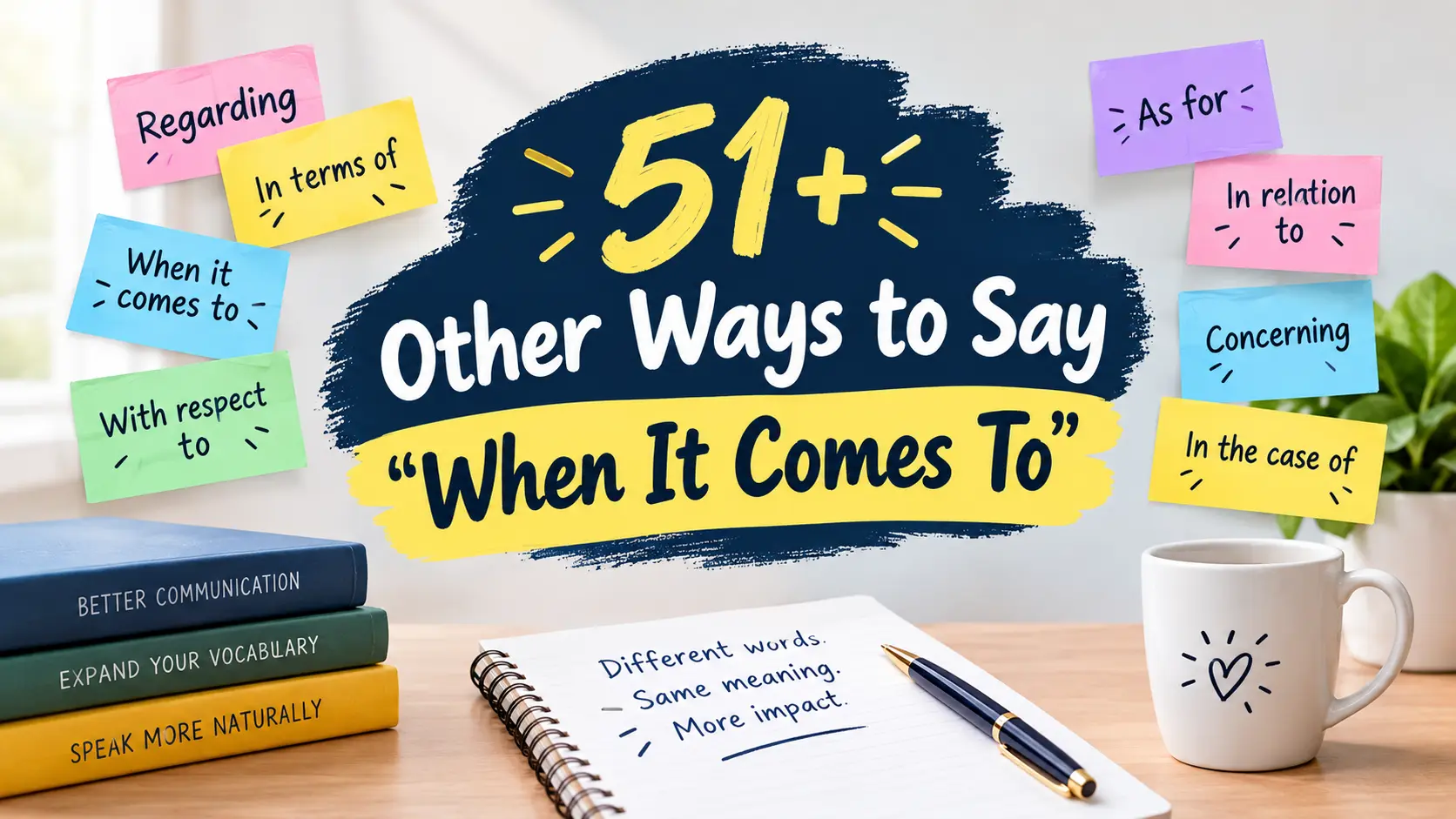
The good news is that you do not need complicated vocabulary to sound more articulate. Simple expressions such as “regarding,” “in terms of,” and “as far as … is concerned” can make your sentences flow more smoothly. Some alternatives are suitable for formal writing, while others work better in casual conversations. In this guide, you will discover 51 useful ways to replace “when it comes to,” along with practical examples to help you choose the right expression.
2. What Does “When It Comes To” Mean?
“When it comes to” is a common English expression used to introduce a particular subject, topic, or area of interest. It helps narrow a conversation to something specific.
For example:
- “When it comes to communication, honesty matters.”
- “When it comes to fashion, she has her own style.”
- “When it comes to studying, consistency is important.”
In each sentence, the phrase introduces the subject being discussed.
People use it in everyday conversations, professional writing, presentations, essays, and social media posts. Although it is grammatically correct, repeating it can make writing less varied.
Depending on the context, you can replace it with expressions such as “regarding,” “in matters of,” “as for,” or “with respect to.” The important thing is to choose an alternative that preserves the original meaning and fits the tone of your sentence.
Category 1: Polite and Appreciative
These alternatives are particularly useful in professional emails, academic writing, business discussions, and respectful conversations.
1. Regarding
Reply: “Regarding your performance, I think you’ve made excellent progress.”
Example: Your manager is giving you feedback after a project. Instead of repeating “when it comes to,” they use “regarding” to introduce their observations professionally.
2. In Terms Of
Reply: “In terms of customer service, our team has improved significantly.”
Example: During a business meeting, your colleague discusses the company’s recent progress and highlights improvements in customer service.
3. With Respect To
Reply: “With respect to your proposal, we appreciate the effort you’ve put into it.”
Example: A client submits a detailed proposal, and you want to acknowledge their work while discussing specific points.
4. As For
Reply: “As for your application, we’ll get back to you by Friday.”
Example: A recruiter is discussing several applications and uses this expression to move the conversation to yours.
5. In Relation To
Reply: “In relation to your question, we’ve already contacted the relevant department.”
Example: A customer asks about a delayed order. You respond politely and explain the steps already taken.
6. Concerning
Reply: “Concerning your request, we have made the necessary arrangements.”
Example: You are writing a formal email to confirm that a colleague’s request has been handled.
7. In Regard To
Reply: “In regard to your recent feedback, we’ve updated the document.”
Example: Your supervisor suggests several changes to a report, and you send an email explaining that you’ve incorporated them.
8. As Regards
Reply: “As regards the upcoming event, everything is progressing smoothly.”
Example: A client asks for an update on an event you’re organizing. You provide a concise and professional response.
9. When Discussing
Reply: “When discussing employee satisfaction, we should consider more than salaries.”
Example: During a team meeting, you want to remind everyone that employee satisfaction also depends on recognition and working conditions.
10. With Regard To
Reply: “With regard to your concerns, we’re happy to arrange another meeting.”
Example: A customer raises concerns about a service, and you offer a follow-up meeting to address them.
Category 2: Flirty and Playful
These alternatives work well in casual conversations, texting, and lighthearted discussions. Some are expressions rather than exact grammatical replacements, so use them according to the sentence.
11. Speaking Of
Reply: “Speaking of movies, you still owe me a movie night.”
Example: You’re texting someone you like about your weekend plans. You use the phrase to bring up a movie date playfully.
12. As Far As … Goes
Reply: “As far as romance goes, I’m a little old-fashioned.”
Example: Someone you’re interested in asks whether you prefer casual dating or serious relationships. You share your preference in a relaxed way.
13. If We’re Talking About
Reply: “If we’re talking about great company, you’re hard to beat.”
Example: Your crush asks what makes a perfect evening. You give a playful answer that includes a subtle compliment.
14. On the Subject Of
Reply: “On the subject of compliments, you look amazing today.”
Example: You’re chatting with someone special, and you use the topic of compliments as a playful way to make them smile.
15. Talking About
Reply: “Talking about good taste, I think you have excellent taste in music.”
Example: A friend shares a playlist with you. You compliment their music choices and keep the conversation light.
16. As For
Reply: “As for my favorite person to talk to, I think you already know.”
Example: Someone asks who you enjoy talking to the most. You respond flirtatiously without being overly direct.
17. On That Note
Reply: “On that note, when are you finally taking me out?”
Example: Your crush mentions a restaurant they love. You use the moment to jokingly suggest going there together.
18. If It’s About
Reply: “If it’s about making me smile, you’re doing a pretty good job.”
Example: Someone you’re dating sends you a funny message. You respond with a playful compliment.
19. As Far As I’m Concerned
Reply: “As far as I’m concerned, you’re already winning.”
Example: Your crush jokes that they’re trying to impress you. You give them a confident, teasing response.
20. Now That You Mention It
Reply: “Now that you mention it, we really should plan that coffee date.”
Example: Someone brings up coffee during a conversation. You take the opportunity to suggest meeting in person.
Category 3: Confident and Self-Respecting
These alternatives are useful when you want to express an opinion clearly, set expectations, or make a strong point without sounding unnecessarily aggressive.
21. In My Experience
Reply: “In my experience, consistency matters more than motivation.”
Example: A friend asks how you stay productive. You share what has worked for you without presenting your experience as a universal rule.
22. As Far As I’m Concerned
Reply: “As far as I’m concerned, respect should never be optional.”
Example: Someone asks what matters most to you in a friendship. You explain your expectations clearly.
23. When It Involves
Reply: “When it involves my career, I prefer to make informed decisions.”
Example: A relative asks why you are taking your time choosing a job. You explain that you want to consider your options carefully.
24. In Matters Of
Reply: “In matters of personal growth, patience is essential.”
Example: You’re discussing self-improvement with a friend and explain why meaningful progress takes time.
25. As Far As … Is Concerned
Reply: “As far as my future is concerned, I’m focused on building a stable career.”
Example: Someone asks about your long-term plans. You answer confidently without feeling pressured to justify your choices.
26. From My Perspective
Reply: “From my perspective, clear communication solves many problems.”
Example: During a group discussion, you offer your opinion about how to prevent misunderstandings.
27. In My View
Reply: “In my view, effort should be matched by opportunity.”
Example: You’re discussing professional development with a colleague and share your perspective on career advancement.
28. When Dealing With
Reply: “When dealing with difficult situations, I prefer to stay calm.”
Example: A friend asks how you handle disagreements. You explain your approach to challenging conversations.
29. As I See It
Reply: “As I see it, personal growth begins with taking responsibility.”
Example: You’re having a serious conversation with a friend about making better decisions and share your point of view.
30. In My Book
Reply: “In my book, honesty is more important than popularity.”
Example: Your friends are discussing what makes someone trustworthy. You share your opinion in a confident, conversational way.
Category 4: Funny and Savage
These expressions are suitable for informal conversations, humorous writing, and playful opinions. They are not always direct replacements, so make sure they fit your intended meaning.
31. Speaking Of Trouble
Reply: “Speaking of trouble, guess who just walked into the room.”
Example: Your friend arrives late to a gathering after causing a little chaos in the group chat. You greet them with a playful comment.
32. If We’re Being Honest
Reply: “If we’re being honest, my cooking skills need serious improvement.”
Example: Your friend asks whether you can cook. You admit that your culinary skills are still a work in progress.
33. Let’s Talk About
Reply: “Let’s talk about your ability to turn five-minute tasks into two-hour projects.”
Example: Your coworker spends ages completing a simple task. You tease them about it when you both have time to laugh.
34. On the Topic Of
Reply: “On the topic of bad decisions, remember your haircut last summer?”
Example: Your friend brings up an embarrassing old photo. You jokingly remind them of another memorable moment.
35. If There’s One Thing About
Reply: “If there’s one thing about me, it’s that I never forget good food.”
Example: Your friends are deciding where to eat. You jokingly make it clear that food will influence your vote.
36. When We’re Talking About
Reply: “When we’re talking about procrastination, I might deserve an award.”
Example: Your classmate asks whether you’ve finished your assignment. You admit that you’ve been putting it off.
37. Let’s Be Real
Reply: “Let’s be real, nobody enjoys Monday mornings.”
Example: Your coworker complains about waking up early on Monday. You agree with a little humor.
38. To Be Fair
Reply: “To be fair, my alarm and I have never had a healthy relationship.”
Example: Your friend asks why you were late. You jokingly blame your ongoing struggle with early mornings.
39. Here’s the Thing About
Reply: “Here’s the thing about online shopping: one item somehow becomes ten.”
Example: Your friend asks how you managed to spend so much on a shopping app. You laugh about how quickly small purchases add up.
40. Let’s Not Forget
Reply: “Let’s not forget who said this assignment would be easy.”
Example: Your classmate complains about a difficult assignment after confidently predicting it would take only ten minutes.
Category 5: Curious, Thoughtful, and Mature
These expressions help introduce ideas, explain complex subjects, and make writing sound more thoughtful.
41. In the Case Of
Reply: “In the case of online learning, flexibility can make a real difference.”
Example: You’re writing an essay comparing online and classroom education. You use this expression to focus on one particular aspect.
42. As It Relates To
Reply: “As it relates to mental well-being, a healthy routine can be valuable.”
Example: During a discussion about student life, you explain how daily habits can affect well-being.
43. In the Context Of
Reply: “In the context of education, practical experience is just as valuable as theory.”
Example: You’re participating in a classroom discussion about whether students should focus on theoretical knowledge or practical skills.
44. From the Standpoint Of
Reply: “From the standpoint of a small business, customer loyalty is extremely important.”
Example: You’re discussing business strategies with a classmate and explain why returning customers matter.
45. In the Area Of
Reply: “In the area of digital marketing, creativity can set a brand apart.”
Example: You’re advising a friend who wants to start a digital marketing career and explain why creative thinking matters.
46. With Respect To
Reply: “With respect to academic success, regular practice can be more effective than last-minute studying.”
Example: A student asks how to prepare for upcoming exams. You explain why consistent revision is useful.
47. When Considering
Reply: “When considering a career change, it’s important to evaluate your long-term goals.”
Example: Your friend is thinking about leaving their current job. You encourage them to consider their interests and future plans.
48. In Connection With
Reply: “In connection with the new project, we need to review the available resources.”
Example: Your team is preparing to begin a new project, and you suggest reviewing the budget and available staff.
49. As It Concerns
Reply: “As it concerns public safety, careful planning is essential.”
Example: You’re writing a report about public transport and explain why safety should be considered during planning.
50. In the Realm Of
Reply: “In the realm of technology, innovation continues to change how we work.”
Example: You’re writing a blog post about artificial intelligence and introduce its growing influence on modern workplaces.
51. Where … Is Concerned
Reply: “Where creativity is concerned, everyone brings something different to the table.”
Example: You’re leading a group project and want to highlight the different ideas and strengths each member contributes.
4. Real-Life Situations: Which Alternative Should You Use?
The best alternative depends on what you’re writing and who you’re speaking to. Here are a few common situations.
When You’re Writing a Professional Email
Professional emails benefit from clear, direct language. You don’t need to make every sentence sound formal, but expressions such as “regarding” and “with respect to” can help.
Best example: “Regarding the upcoming presentation, I’ve attached the revised slides.”
This is direct, polite, and easy to understand.
When You’re Writing an Academic Essay
Academic writing often requires precise language. Choose alternatives that introduce a specific subject without making the sentence unnecessarily complicated.
Best example: “In the context of higher education, practical experience can complement theoretical knowledge.”
This makes the subject clear and gives the sentence an academic tone.
When You’re Talking to Your Crush
In a personal conversation, natural expressions usually work better than formal alternatives. You can use “speaking of” or “now that you mention it” to keep things flowing.
Best example: “Speaking of coffee, we should finally try that café you told me about.”
It sounds relaxed and creates an opportunity to continue the conversation.
When You’re Sharing Your Opinion
If you want to sound confident without appearing confrontational, phrases such as “from my perspective” and “in my view” can help.
Best example: “From my perspective, honesty is the foundation of any strong friendship.”
This communicates your opinion clearly while leaving room for others to have different views.
When You’re Writing a Blog Post
Blog writing should be easy to follow. Short, natural expressions such as “when discussing,” “in the case of,” and “as for” can prevent repetitive sentences.
Best example: “When discussing healthy habits, sleep deserves as much attention as exercise.”
This introduces a topic naturally and keeps the sentence readable.
5. What to Avoid When Replacing “When It Comes To”
Choosing an alternative is not simply about finding a different phrase. It is also about preserving meaning and making your writing easier to understand.
1. Using overly complicated expressions
Words such as “in the realm of” can be useful, but they may sound unnecessarily formal in an everyday email. Choose simple language whenever possible.
2. Replacing the phrase without checking the grammar
Not every alternative fits every sentence. For example, “regarding” works well before a noun, while “when discussing” generally introduces a subject or activity.
3. Repeating the same alternative
Replacing every instance of “when it comes to” with “in terms of” does not solve the problem. Vary your wording naturally and rewrite sentences when necessary.
4. Using informal expressions in formal writing
Phrases such as “let’s be real” and “in my book” work well in casual conversations, but they may not suit academic papers or formal business reports.
5. Making sentences unnecessarily long
An alternative should improve clarity, not make your sentence harder to understand. Sometimes the best choice is to remove the phrase entirely.
For example:
Instead of: “When it comes to improving communication, regular practice is important.”
Try: “Regular practice improves communication.”
The second sentence is shorter and communicates the same basic idea.
6. Ignoring the original meaning
Some expressions introduce a topic, while others introduce an opinion or explain a situation. Choose an alternative that matches the role of the original phrase.
6. Pro Tips for Using These Alternatives
1. Choose clarity over complexity.
A simple phrase such as “about” or “regarding” is often more effective than a complicated expression. Your reader should understand your point immediately.
2. Match the expression to your audience.
Use professional alternatives in reports and emails, conversational expressions with friends, and precise language in academic writing. The same phrase will not work equally well everywhere.
3. Read your sentences aloud.
If an alternative makes a sentence sound awkward, try another one. Reading aloud helps you identify unnecessary words and improve the natural flow of your writing.
7. Bonus: 10 Quick Alternatives to “When It Comes To”
If you need a quick replacement, these expressions are useful in many situations:
- Regarding
- About
- As for
- In terms of
- With regard to
- When discussing
- Concerning
- In relation to
- In the case of
- From my perspective
Remember that these expressions are not interchangeable in every sentence. Always check whether the replacement fits your meaning and grammar.
8. Conclusion
Using “when it comes to” is perfectly natural, but relying on it too often can make your writing repetitive. Alternatives such as “regarding,” “in terms of,” “as for,” and “when discussing” can help you express the same ideas with greater variety.
The best expression depends on your audience, tone, and purpose. A professional email may need a formal alternative, while a conversation with a friend might benefit from something more relaxed.
You don’t need complicated vocabulary to become a better writer. Focus on choosing clear, natural expressions that communicate exactly what you mean. Good writing isn’t about using more words; it’s about choosing the right ones.
Discover more
other ways to say long time no see