
Finding the right words to appreciate someone’s writing is not always easy. You might read an impressive article, receive a thoughtful email, or come across a beautifully written story and want to express how much you enjoyed it. Saying “well written” is perfectly fine, but using the same phrase every time can make your feedback sound a little repetitive.
The good news is that there are plenty of other ways to say well written, depending on the situation and the impression you want to create. Some expressions sound more professional, while others feel warm, creative, or playful. Whether you’re complimenting a colleague, appreciating a friend’s work, responding to a thoughtful message, or writing a review, these alternatives will help you express yourself naturally and confidently.
What Does Well Written Mean?
The phrase “well written” describes something that has been written clearly, effectively, and thoughtfully. It usually means the writer has done a good job of organizing ideas, choosing the right words, and communicating a message in an interesting or understandable way.
People commonly use this expression when appreciating articles, essays, emails, reports, books, stories, and other written content.
For example, if your colleague sends you a detailed report that is easy to understand, you might say, “Your report is very well written.”
However, you can make your feedback more specific by saying “beautifully expressed,” “clear and engaging,” or “exceptionally structured.” These alternatives help explain exactly what makes the writing impressive.
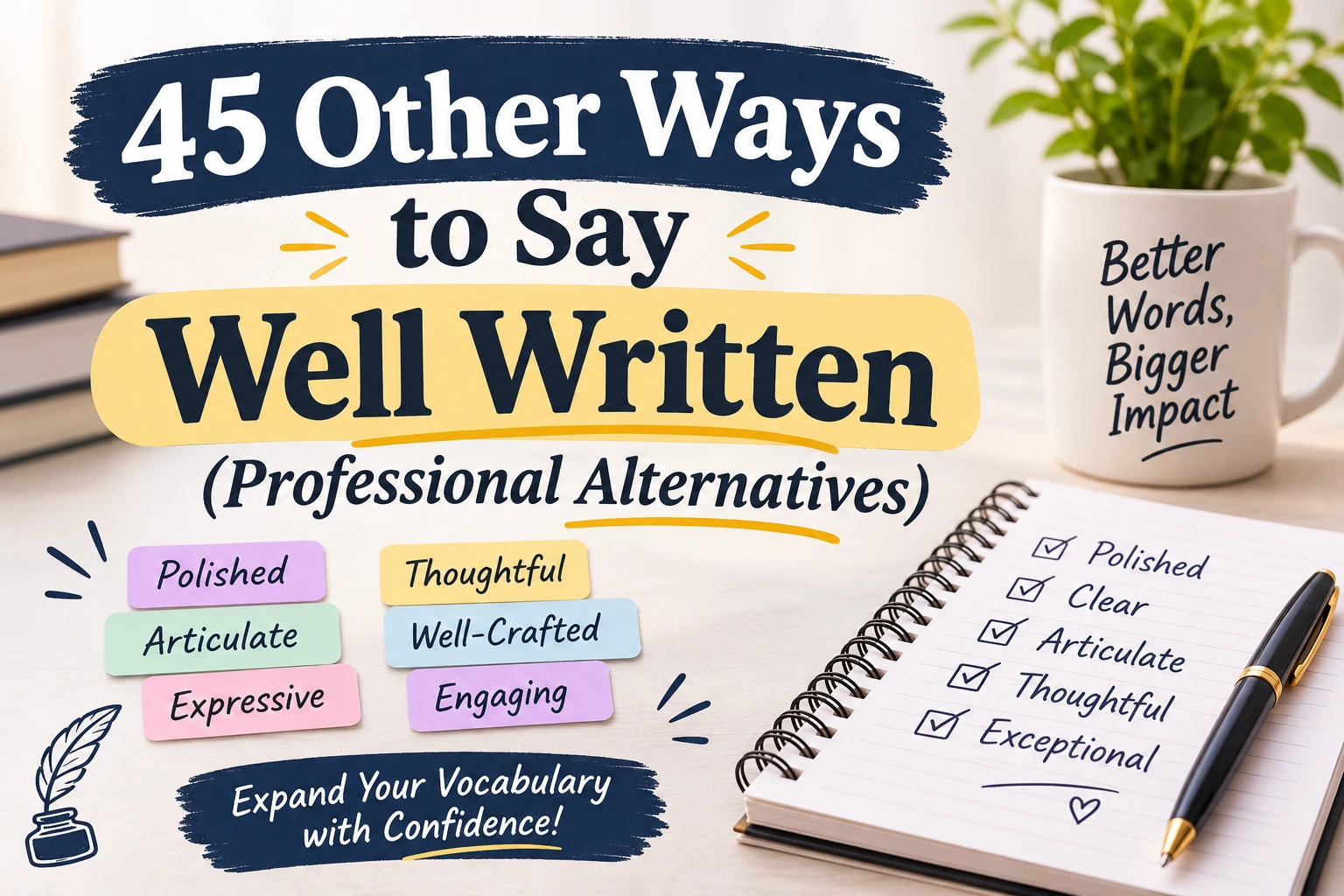
Here are 45 useful alternatives for different situations, from professional compliments to friendly and creative expressions. Each phrase includes a realistic example to help you understand how to use it.
1. Polite and Appreciative Ways to Say Well Written
These expressions are perfect when you want to appreciate someone’s effort without sounding overly formal. They work well in everyday conversations, emails, academic settings, and professional feedback.
1. Beautifully Written
Example: Your friend shares a personal essay about an important life experience.
You: “This is beautifully written. I really enjoyed reading it.”
2. Very Well Expressed
Example: Your colleague writes an email explaining a complicated situation.
You: “Your thoughts are very well expressed. Everything is easy to understand.”
3. Nicely Put Together
Example: A classmate submits an organized assignment.
You: “Your assignment is nicely put together. Great work!”
4. Clearly Written
Example: Your teacher shares study notes that explain a difficult topic.
You: “These notes are clearly written and really helpful.”
5. Thoughtfully Written
Example: Someone writes a heartfelt message for a special occasion.
You: “That was thoughtfully written. You can really feel the sincerity behind it.”
6. Exceptionally Expressed
Example: Your friend writes a meaningful paragraph about friendship.
You: “Your feelings are exceptionally expressed in this paragraph.”
7. Pleasant to Read
Example: You finish reading a friend’s blog post.
You: “Your article was genuinely pleasant to read.”
8. Written with Care
Example: Your colleague prepares a detailed presentation document.
You: “It’s clear that this report was written with care.”
9. A Lovely Piece of Writing
Example: Someone shares a short story that leaves a positive impression on you.
You: “This is a lovely piece of writing. Keep sharing your work!”
2. Flirty and Playful Ways to Say Well Written
Sometimes, a simple compliment can become more interesting with a little charm. These expressions are suitable for lighthearted conversations, friendly teasing, or complimenting someone whose writing genuinely impresses you.
10. You’ve Got a Way with Words
Example: Your crush sends you a beautifully written message.
You: “You’ve really got a way with words. I wasn’t expecting that!”
11. Words Never Looked So Good
Example: Someone shares a romantic poem with you.
You: “Words never looked so good. Did you write this yourself?”
12. A Masterpiece in Words
Example: Your partner writes you a heartfelt letter.
You: “This is a masterpiece in words. You’re seriously talented.”
13. You Make Writing Look Easy
Example: Your friend finishes an impressive article in a short time.
You: “You make writing look so easy. What’s your secret?”
14. Smooth from Start to Finish
Example: Someone sends you a long message that flows naturally.
You: “That was smooth from start to finish. I loved every part of it.”
15. You’ve Got a Gift for Writing
Example: Your crush shares a short story online.
You: “You’ve definitely got a gift for writing. This is impressive.”
16. Words Are Your Superpower
Example: Your friend writes an amazing birthday message.
You: “Words are clearly your superpower. That message was perfect.”
17. Effortlessly Impressive
Example: Someone writes a clever and interesting caption.
You: “That caption is effortlessly impressive. I love how you put it together.”
18. You Know How to Make Words Shine
Example: Your partner writes a sweet paragraph about your relationship.
You: “You really know how to make words shine. That was so sweet.”
3. Confident and Professional Ways to Say Well Written
When you’re communicating in a workplace, academic environment, or formal setting, your compliments should sound clear and meaningful. These alternatives help you appreciate someone’s writing while maintaining a professional tone.
19. Articulately Written
Example: Your manager prepares a detailed business proposal.
You: “The proposal is articulately written and communicates the main points effectively.”
20. Professionally Presented
Example: A colleague submits a well-organized business report.
You: “The report is professionally presented and easy to follow.”
21. Exceptionally Well-Structured
Example: A student submits an essay with a clear introduction and logical arguments.
You: “Your essay is exceptionally well-structured. Each section connects naturally.”
22. Clear and Concise
Example: Your teammate writes a short project update.
You: “Your update is clear and concise. It covers everything we need to know.”
23. Compellingly Written
Example: Your colleague creates an article that keeps readers interested.
You: “This is compellingly written and does a great job of holding the reader’s attention.”
24. Well-Articulated
Example: Someone explains a complicated idea in a written report.
You: “Your explanation is well-articulated and easy to understand.”
25. Skillfully Crafted
Example: A writer submits a detailed research article.
You: “This is a skillfully crafted article with strong supporting arguments.”
26. Coherently Presented
Example: Your classmate explains different ideas in an organized essay.
You: “Your arguments are coherently presented throughout the essay.”
27. Excellent Command of Language
Example: Your professor appreciates a student’s academic writing.
You: “You demonstrate an excellent command of language in this assignment.”
4. Funny and Savage Ways to Say Well Written
If you have a playful relationship with the writer, a funny compliment can make your appreciation more memorable. These expressions add personality while still recognizing someone’s talent.
28. You Understood the Assignment
Example: Your friend writes an impressive social media caption.
You: “You understood the assignment. This caption is perfect!”
29. Not a Single Word Wasted
Example: Your colleague sends a short but powerful email.
You: “Not a single word wasted. That’s how you write an email.”
30. Shakespeare Would Be Impressed
Example: Your friend shares a dramatic and beautifully written poem.
You: “Shakespeare would probably be impressed with this one.”
31. Someone Give This Person a Pen Award
Example: Your classmate writes an outstanding essay.
You: “Someone give this person a pen award. This essay is brilliant!”
32. Words Are Clearly Working Overtime
Example: Your friend writes a long, detailed story full of creative ideas.
You: “Your words are clearly working overtime. I love this!”
33. Grammar Is Grateful for You
Example: Someone shares a perfectly edited paragraph.
You: “Grammar is grateful for you. Not a mistake in sight!”
34. That’s Some Serious Word Magic
Example: Your friend turns a boring topic into an interesting blog post.
You: “That’s some serious word magic. How did you make this topic so interesting?”
35. The Dictionary Called. It’s Impressed.
Example: Your colleague uses impressive vocabulary in a presentation.
You: “The dictionary called. It’s impressed with your vocabulary.”
36. Pulitzer-Worthy Stuff
Example: Your friend writes a particularly impressive opinion piece.
You: “Pulitzer-worthy stuff. You really outdid yourself!”
5. Curious, Thoughtful, and Mature Ways to Say Well Written
Sometimes, you want to offer more than a basic compliment. These expressions recognize the writer’s effort, creativity, and ability to communicate meaningful ideas.
37. Engaging from Beginning to End
Example: You finish reading a long article that keeps your attention.
You: “Your article was engaging from beginning to end. I didn’t lose interest once.”
38. A Powerful Use of Language
Example: Someone writes an emotional paragraph about an important social issue.
You: “That’s a powerful use of language. Your message really stays with the reader.”
39. Beautifully Articulated Thoughts
Example: Your friend writes a thoughtful post about personal growth.
You: “These are beautifully articulated thoughts. I appreciate your perspective.”
40. A Compelling Piece of Work
Example: Your colleague publishes an insightful research article.
You: “This is a compelling piece of work. Your arguments are particularly interesting.”
41. Rich in Detail and Meaning
Example: Someone writes a detailed travel experience.
You: “Your story is rich in detail and meaning. It almost feels like being there.”
42. Thought-Provoking and Engaging
Example: Your classmate writes an essay about modern education.
You: “Your essay is thought-provoking and engaging. It made me consider a different perspective.”
43. An Impressive Flow of Ideas
Example: A student connects several complex arguments in an essay.
You: “There’s an impressive flow of ideas throughout your writing.”
44. A Strong Piece of Communication
Example: Your colleague writes an important announcement for the team.
You: “This is a strong piece of communication. The message is clear and effective.”
45. A Refreshing Perspective
Example: Someone writes an article presenting a different view on a familiar subject.
You: “I really enjoyed reading this. It’s a refreshing perspective, expressed beautifully.”
Real-Life Situations: Which Alternative Should You Use?
Knowing different expressions is helpful, but choosing the right one depends on the person and situation. Here are a few everyday examples.
1. When Your Crush Writes Something Impressive
Your crush sends you a thoughtful paragraph or a beautifully written message. You want to compliment them without sounding too formal.
Best reply: “You’ve really got a way with words. I loved reading this.”
It’s warm, natural, and adds a little charm.
2. When a Friend Shares an Article
Your friend publishes a blog post and asks what you think about it.
Best reply: “This is beautifully written and genuinely engaging from beginning to end.”
It shows that you actually read and appreciated their work.
3. When Your Colleague Sends a Professional Email
A coworker sends a detailed email explaining a project update.
Best reply: “Your email is clear and concise. Everything is communicated perfectly.”
This sounds professional without being unnecessarily complicated.
4. When Someone Shares an Academic Essay
Your classmate submits an essay with strong arguments and an organized structure.
Best reply: “Your essay is exceptionally well-structured and coherently presented.”
This gives specific appreciation for the quality of the writing.
5. When You Want to Make Someone Laugh
Your friend shares an impressive caption or creative paragraph.
Best reply: “The dictionary called. It’s impressed.”
It’s a funny way to recognize their writing skills without making the compliment feel too serious.
What to Avoid When Complimenting Someone’s Writing
A good compliment should feel genuine. Even when you have the right words, a few common mistakes can make your feedback less meaningful.
1. Using the same compliment repeatedly
Saying “well written” every time can make your feedback sound automatic. Try choosing an expression that describes what you actually liked.
2. Giving compliments without meaning them
Don’t call something brilliant just to make someone happy. Genuine appreciation is more valuable than exaggerated praise.
3. Sounding unnecessarily formal
Not every conversation needs professional vocabulary. A simple “You’ve got a way with words” can work better than a complicated expression.
4. Ignoring the actual writing
Instead of giving a general compliment, mention something specific, such as the structure, vocabulary, storytelling, or clarity.
5. Using humor in the wrong situation
Funny expressions are great with friends, but they may not be appropriate when reviewing an academic paper or professional report.
6. Making the compliment about yourself
Keep the attention on the writer and their work. A compliment should make the other person feel appreciated.
Pro Tips for Complimenting Writing Naturally
1. Be specific about what impressed you.
Instead of simply saying something is well written, mention its strongest quality. For example, “Your introduction immediately caught my attention” feels more personal and meaningful.
2. Match your language to the relationship.
Use professional expressions with colleagues and teachers. Choose playful or creative alternatives when talking to friends or someone you’re close to.
3. Keep your compliments natural.
You don’t need complicated vocabulary to sound impressive. A short, sincere compliment often creates a stronger impression than a long explanation.
Bonus: 8 Quick Alternatives to Well Written
Need a short compliment for a text message, email, comment, or social media post? Here are eight easy options:
- “Beautifully expressed.”
- “A brilliant piece of writing.”
- “Incredibly engaging.”
- “Words put together perfectly.”
- “A pleasure to read.”
- “Exceptionally well-crafted.”
- “Clear, thoughtful, and impressive.”
- “You’ve nailed the art of writing.”
Conclusion
Finding other ways to say well written can make your compliments more meaningful, natural, and memorable. Whether you’re appreciating a friend’s creative work, responding to a professional email, or praising someone’s storytelling skills, the right expression helps you communicate exactly what you admire.
Remember, a great compliment doesn’t have to sound complicated. It just needs to feel genuine and match the situation.
The best way to appreciate good writing is to make your own words count, too.
Discover more
other ways to say problem solving skills