

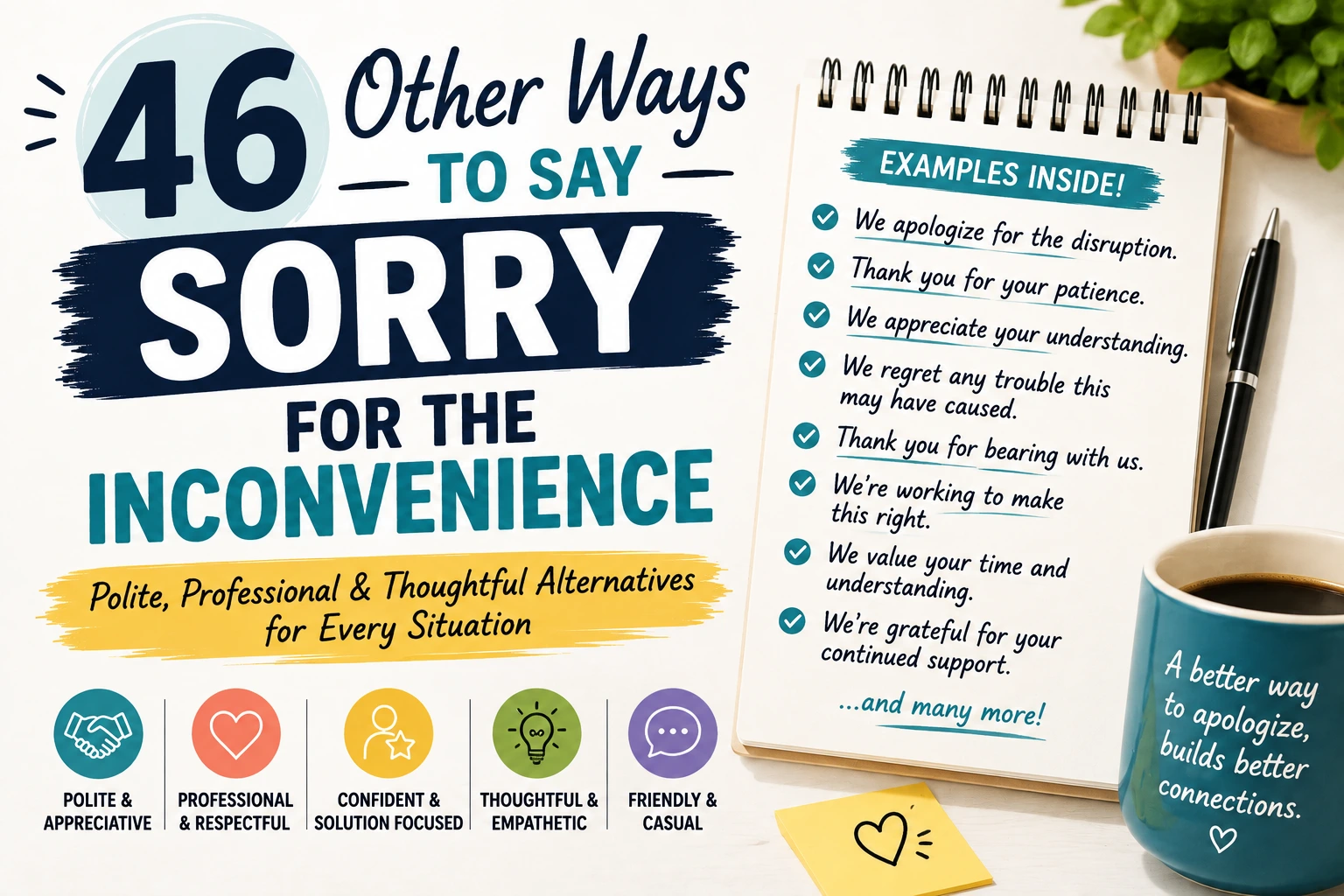
Few phrases are more common in customer service, workplace emails, and everyday professional communication than “sorry for the inconvenience.” It is polite, but when you use it repeatedly, it can start to sound generic or impersonal. The good news is that there are many better ways to acknowledge a problem while still sounding sincere, professional, and human.
Choosing the right alternative depends on what actually happened. Sometimes you need to apologize for a delay. Other times, you may want to acknowledge someone’s frustration, thank them for their patience, or explain that you are actively working on a solution. A thoughtful apology can make a difficult situation feel much easier to handle. Whether you are writing an email, responding to a customer, messaging a colleague, or speaking professionally, these alternatives can help you communicate with greater clarity and warmth.
What Does “Other Ways to Say Sorry for the Inconvenience” Mean?
“Sorry for the inconvenience” is a polite expression used when something has caused another person difficulty, frustration, delay, or extra effort.
For example, a company might use it when a website is temporarily unavailable, an order is delayed, or an appointment needs to be rescheduled.
Although the phrase is perfectly acceptable, it can sometimes feel overly standard. In professional communication, a more specific apology often sounds more genuine.
Instead of simply saying:
“Sorry for the inconvenience.”
You could say:
“We apologize for the delay and appreciate your patience while we resolve the issue.”
The second version acknowledges the specific problem and reassures the reader that something is being done about it.
Polite and Appreciative Alternatives
These phrases work well in emails, customer service, workplace conversations, announcements, and other situations where you want to sound respectful and sincere.
1. We Apologize for the Disruption
Reply: “We apologize for the disruption.”
Example:
A company experiences a temporary service outage and sends customers an update saying, “We apologize for the disruption and are working to restore normal service.”
Why It Works:
It sounds professional and acknowledges that the situation interrupted someone’s plans.
2. We’re Sorry for the Trouble This Has Caused
Reply: “We’re sorry for the trouble this has caused.”
Example:
A customer receives the wrong item, and the support representative responds, “We’re sorry for the trouble this has caused. We’ll arrange a replacement.”
Why It Works:
It feels warmer and more personal than a generic apology.
3. Thank You for Your Patience
Reply: “Thank you for your patience.”
Example:
A software update takes longer than expected, so the company writes, “Thank you for your patience while we complete the update.”
Why It Works:
Instead of focusing entirely on the problem, it recognizes the other person’s cooperation.
4. We Appreciate Your Understanding
Reply: “We appreciate your understanding.”
Example:
A meeting needs to be postponed because of an unexpected issue. The organizer says, “We appreciate your understanding and apologize for the change in schedule.”
Why It Works:
Respectful and suitable for professional communication.
5. Please Accept Our Sincere Apologies
Reply: “Please accept our sincere apologies.”
Example:
A business sends a formal notice after an unexpected service problem.
Why It Works:
This is appropriate when the situation is serious and requires a formal tone.
6. We Regret Any Difficulty This May Have Caused
Reply: “We regret any difficulty this may have caused.”
Example:
A company informs customers that a payment system was temporarily unavailable.
Why It Works:
Polished and formal without sounding overly dramatic.
7. Thank You for Bearing With Us
Reply: “Thank you for bearing with us.”
Example:
A website is undergoing maintenance, and the team tells users, “Thank you for bearing with us while we work through these updates.”
Why It Works:
Friendly and appreciative, especially for ongoing issues.
8. We’re Grateful for Your Patience During This Time
Reply: “We’re grateful for your patience during this time.”
Example:
A customer service team is handling an unusually high number of requests.
Why It Works:
Adds warmth and appreciation to a professional apology.
9. We Understand This May Have Been Frustrating
Reply: “We understand this may have been frustrating.”
Example:
A customer has been waiting several days for a response.
Why It Works:
Acknowledges the person’s feelings instead of treating the issue as purely procedural.
10. Thank You for Your Understanding as We Resolve This
Reply: “Thank you for your understanding as we resolve this.”
Example:
A service provider experiences a technical problem and needs additional time to fix it.
Why It Works:
It combines appreciation with reassurance that action is being taken.
Flirty and Playful Alternatives
These expressions are more suitable for friends, casual conversations, or situations where you want to apologize without making the interaction overly serious.
11. Sorry for the Little Detour
Reply: “Sorry for the little detour.”
Example:
You arrive late because you took the wrong route and tell your friend, “Sorry for the little detour. I’m finally here.”
Why It Works:
Lighthearted and casual.
12. My Bad for Making Things Complicated
Reply: “My bad for making things complicated.”
Example:
You accidentally give your friend confusing directions and then realize your mistake.
Why It Works:
Casual and self aware without sounding overly formal.
13. Sorry for the Unexpected Plot Twist
Reply: “Sorry for the unexpected plot twist.”
Example:
Your plans suddenly change because the restaurant closes early.
Why It Works:
Turns an annoying situation into something playful.
14. Sorry for Making This More Complicated Than It Needed to Be
Reply: “Sorry for making this more complicated than it needed to be.”
Example:
You accidentally create confusion while organizing plans with your friends.
Why It Works:
Acknowledges your part in the situation while keeping the mood relaxed.
15. Sorry About the Chaos
Reply: “Sorry about the chaos.”
Example:
You invite friends over while your schedule is completely disorganized and say, “Sorry about the chaos. I promise it wasn’t intentional.”
Why It Works:
Simple, friendly, and natural.
16. Thanks for Surviving That With Me
Reply: “Thanks for surviving that with me.”
Example:
You and your friend spend an hour dealing with a complicated booking problem.
Why It Works:
Turns an apology into a shared joke.
17. Sorry for the Bumpy Ride
Reply: “Sorry for the bumpy ride.”
Example:
A group project has several unexpected problems, and you joke with your teammates, “Sorry for the bumpy ride.”
Why It Works:
Playful and appropriate when everyone is already comfortable with each other.
18. My Apologies for the Mini Disaster
Reply: “My apologies for the mini disaster.”
Example:
You accidentally send the wrong meeting time to your friends.
Why It Works:
The exaggerated wording makes a small mistake feel humorous rather than stressful.
Confident and Self Respecting Alternatives
These phrases work when you want to acknowledge a problem without sounding excessively apologetic or taking responsibility for something that was outside your control.
19. Thank You for Your Flexibility
Reply: “Thank you for your flexibility.”
Example:
You need to move a meeting because of an unexpected scheduling conflict.
Why It Works:
Focuses on appreciation rather than repeatedly apologizing.
20. I Appreciate Your Patience While We Sort This Out
Reply: “I appreciate your patience while we sort this out.”
Example:
A colleague is waiting for information that requires additional time to confirm.
Why It Works:
Professional, confident, and solution focused.
21. Thank You for Working With Us on This
Reply: “Thank you for working with us on this.”
Example:
A customer needs to provide additional information before an issue can be resolved.
Why It Works:
Creates a cooperative tone rather than placing all attention on the mistake.
22. We Recognize the Impact This Has Had
Reply: “We recognize the impact this has had.”
Example:
A service interruption affects customers who were relying on the platform.
Why It Works:
Shows accountability without using an overly emotional apology.
23. We Take Responsibility for the Disruption
Reply: “We take responsibility for the disruption.”
Example:
A business makes an error that affects a scheduled service.
Why It Works:
Strong and accountable, particularly when the organization is clearly responsible.
24. We Understand the Impact of the Delay
Reply: “We understand the impact of the delay.”
Example:
A delivery arrives later than originally promised.
Why It Works:
Acknowledges the practical effect rather than using a vague apology.
25. We’re Taking Steps to Prevent This From Happening Again
Reply: “We’re taking steps to prevent this from happening again.”
Example:
A company responds after a recurring technical issue.
Why It Works:
Shows that the focus is not only on apologizing but also on improving the situation.
26. We’re Working to Put Things Right
Reply: “We’re working to put things right.”
Example:
A customer reports an issue with their order, and the support team explains that a solution is already underway.
Why It Works:
Confident, reassuring, and action oriented.
27. We’ll Do Our Best to Resolve This Promptly
Reply: “We’ll do our best to resolve this promptly.”
Example:
A customer reports a problem that requires investigation.
Why It Works:
Sets a constructive tone and shows commitment to finding a solution.
Funny and Savage Alternatives
These options are best for casual conversations, close friends, and low stakes situations. They should generally be avoided in serious customer complaints or formal workplace communication.
28. Well, That Could Have Gone Better
Reply: “Well, that could have gone better.”
Example:
You accidentally send the wrong file to a friend and immediately realize your mistake.
Why It Works:
Self aware and humorous without being overly apologetic.
29. I’d Like to Blame Technology, but This One’s on Me
Reply: “I’d like to blame technology, but this one’s on me.”
Example:
You forget to send an important message and jokingly admit your mistake.
Why It Works:
Funny while still taking responsibility.
30. Please Accept My Formal Apology for This Tiny Disaster
Reply: “Please accept my formal apology for this tiny disaster.”
Example:
You accidentally change the group dinner reservation to the wrong time.
Why It Works:
The unnecessarily formal wording makes the situation humorous.
31. Sorry for the Chaos I Somehow Created
Reply: “Sorry for the chaos I somehow created.”
Example:
You make a simple plan much more complicated than necessary.
Why It Works:
Self deprecating without being too serious.
32. My Bad. That Was Definitely Not the Plan
Reply: “My bad. That was definitely not the plan.”
Example:
You accidentally send your friend to the wrong meeting location.
Why It Works:
Short, casual, and honest.
33. I Regret to Inform You That I Made Things Worse
Reply: “I regret to inform you that I made things worse.”
Example:
You try to fix a small problem and accidentally create another one.
Why It Works:
The dramatic wording makes an ordinary mistake funny.
34. Sorry, We Took the Scenic Route to Getting This Fixed
Reply: “Sorry, we took the scenic route to getting this fixed.”
Example:
A minor issue takes much longer to resolve than expected.
Why It Works:
Turns an awkward delay into a playful comment.
35. That Was Not Exactly My Finest Moment
Reply: “That was not exactly my finest moment.”
Example:
You forget something important and immediately recognize the mistake.
Why It Works:
Humorous, honest, and self aware.
Curious, Thoughtful, and Mature Alternatives
These phrases are useful when you want to acknowledge someone’s frustration while keeping the conversation respectful and solution focused.
36. I Understand This Has Been Frustrating
Reply: “I understand this has been frustrating.”
Example:
A customer has experienced repeated delays, and you acknowledge their frustration before explaining the next step.
Why It Works:
Shows empathy rather than offering a generic apology.
37. I Can See How This Has Caused Difficulty
Reply: “I can see how this has caused difficulty.”
Example:
Someone has had to rearrange their schedule because of a last minute change.
Why It Works:
Specific and empathetic.
38. I’m Sorry This Has Added Extra Work for You
Reply: “I’m sorry this has added extra work for you.”
Example:
A colleague has to repeat part of a task because information was missing.
Why It Works:
Acknowledges the actual inconvenience instead of using a vague phrase.
39. I Understand This Wasn’t What You Expected
Reply: “I understand this wasn’t what you expected.”
Example:
A customer receives a service that differs from what was originally promised.
Why It Works:
Validates their expectations without becoming overly defensive.
40. I’m Sorry We Put You in This Position
Reply: “I’m sorry we put you in this position.”
Example:
A scheduling error forces someone to make last minute arrangements.
Why It Works:
Personal, sincere, and appropriate when your actions directly caused the problem.
41. I Appreciate You Bringing This to Our Attention
Reply: “I appreciate you bringing this to our attention.”
Example:
A customer reports an issue that the company was unaware of.
Why It Works:
Shows gratitude and shifts the conversation toward solving the problem.
42. We Understand That This Has Been Disappointing
Reply: “We understand that this has been disappointing.”
Example:
An event is canceled after people have already made plans to attend.
Why It Works:
Recognizes the emotional impact of the situation.
43. We’re Sorry This Did Not Go as Expected
Reply: “We’re sorry this did not go as expected.”
Example:
A customer receives a service that falls short of what was promised.
Why It Works:
Natural, sincere, and more specific than simply saying “sorry for the inconvenience.”
44. We Regret That This Experience Fell Short
Reply: “We regret that this experience fell short of expectations.”
Example:
A business responds to a customer who was dissatisfied with their service.
Why It Works:
Professional and appropriate for formal customer communication.
45. We’re Sorry for the Extra Effort This Required
Reply: “We’re sorry for the extra effort this required.”
Example:
A customer has to contact support twice to resolve the same problem.
Why It Works:
Specifically recognizes the additional work placed on the other person.
46. Thank You for Giving Us the Opportunity to Make This Right
Reply: “Thank you for giving us the opportunity to make this right.”
Example:
After a customer reports a service issue, the representative explains how the problem will be corrected.
Why It Works:
Ends the apology on a constructive and reassuring note.
Real Life Situations
When a Customer Is Upset
If a customer has experienced a genuine problem, avoid giving them a vague apology and immediately moving on.
Best Reply:
“We understand this has been frustrating, and we’re taking steps to resolve the issue as quickly as possible.”
This acknowledges their experience while showing that action is being taken.
When a Meeting Has to Be Rescheduled
You do not need an overly dramatic apology for a simple schedule change.
Best Reply:
“Thank you for your flexibility. I apologize for the change and appreciate your understanding.”
It sounds professional without making the situation seem bigger than it is.
When You Made a Mistake at Work
Take responsibility clearly rather than hiding behind a generic phrase.
Best Reply:
“I’m sorry for the extra work this caused. I’ll make sure the corrected version is sent today.”
This works because it combines accountability with a practical solution.
When a Friend Is Waiting for You
A casual apology is more appropriate than formal business language.
Best Reply:
“Sorry about the delay. I know that was annoying.”
It sounds genuine and conversational.
When the Problem Was Outside Your Control
You can acknowledge the person’s inconvenience without pretending you caused the original issue.
Best Reply:
“I understand this has been frustrating, and I appreciate your patience while we work through it.”
This keeps the tone empathetic without accepting unnecessary blame.
What to Avoid
1. Repeating “Sorry” Without Offering a Solution
An apology is more meaningful when it is followed by an explanation or practical next step.
2. Using a Generic Apology for Every Situation
“Sorry for the inconvenience” may be appropriate, but specific language often sounds more sincere.
3. Over Apologizing
Repeating apologies several times can make you sound uncertain. One clear apology is usually enough.
4. Apologizing Without Taking Action
If you can fix the problem, explain what you are doing about it. People generally want a solution as much as they want an apology.
5. Blaming the Other Person
Avoid phrases such as “Sorry you misunderstood” when the real issue is unclear communication. This can make an apology sound defensive.
6. Being Too Casual in Serious Situations
Funny alternatives can work with friends, but serious complaints and professional situations require empathy and accountability.
Pro Tips
Be Specific
Instead of saying only “Sorry for the inconvenience,” identify what happened. Saying “We’re sorry for the delay in processing your order” sounds more attentive and sincere.
Pair the Apology With Action
A strong professional response often follows this structure:
Acknowledge the issue + apologize + explain the next step.
For example: “We’re sorry for the delay. Your order is now being processed, and we expect it to ship tomorrow.”
Match the Tone to the Situation
A customer complaint needs empathy. A workplace email needs professionalism. A message to a friend can be much more relaxed. The best apology is not always the most formal one. It is the one that fits the situation.
Bonus: Quick One Line Alternatives
For situations where you need a short and natural response, try these:
- “We apologize for the disruption.”
- “Thank you for your patience.”
- “We appreciate your understanding.”
- “I’m sorry for the delay.”
- “Thanks for bearing with us.”
- “We regret the difficulty this caused.”
- “I appreciate your flexibility.”
- “We’re sorry this caused extra work.”
- “Thank you for giving us the chance to fix this.”
- “We’re working to make this right.”
Conclusion
“Sorry for the inconvenience” is a useful phrase, but it does not have to be your only option. Choosing a more specific alternative can make your apology sound sincere, thoughtful, and appropriate for the situation. Whether you are responding to a customer, writing to a colleague, rescheduling plans, or apologizing to a friend, the right words can make a noticeable difference.
The strongest apologies do more than acknowledge a problem. They show understanding, take responsibility when appropriate, and point toward a solution. Choose your words with intention, and let your apology sound like a genuine human response rather than a standard script.
Discover more