
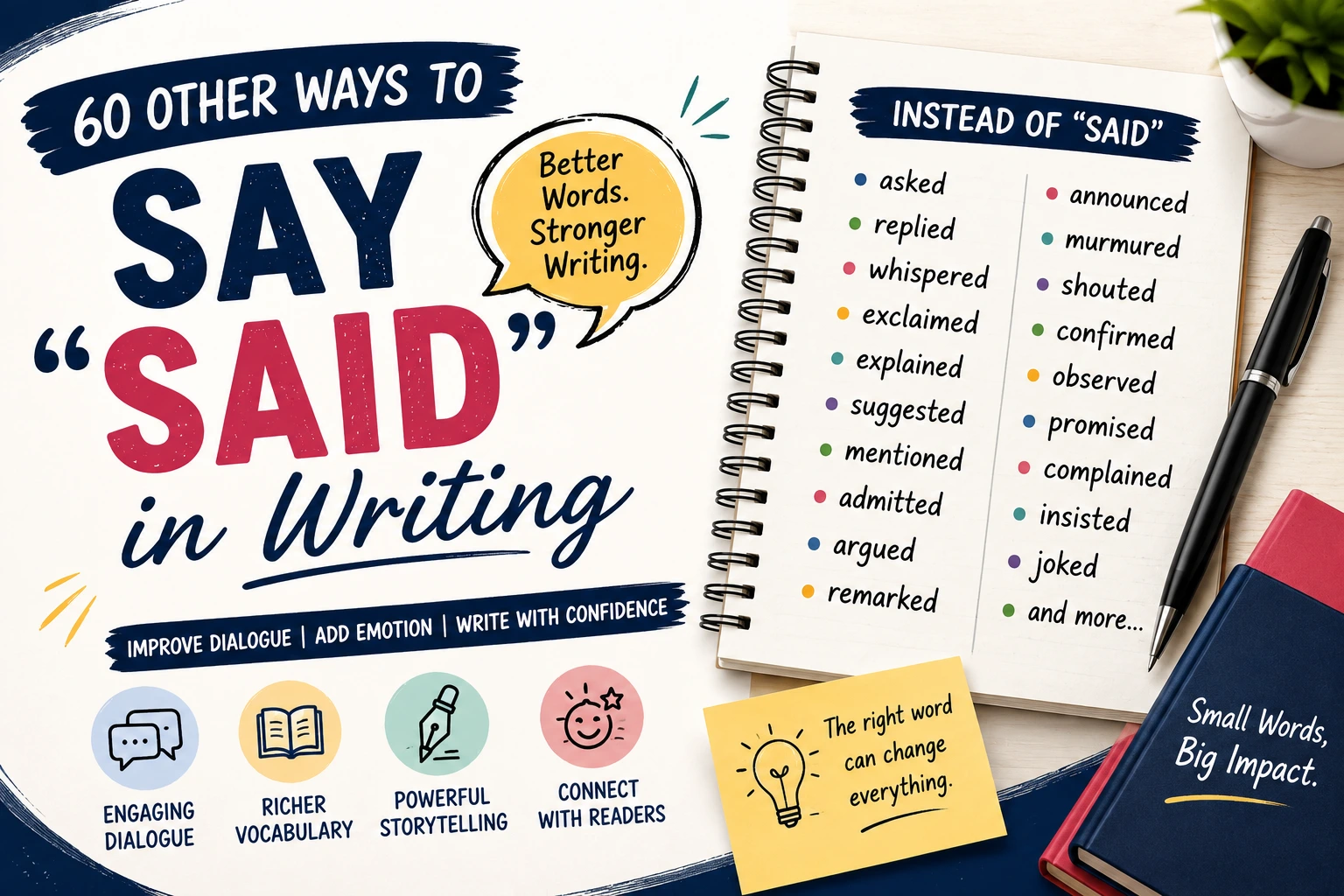
Have you ever finished writing a story, essay, or blog post only to notice that you’ve used the word “said” over and over again? You’re not alone. Many writers search for other ways to say “said” because repeating the same dialogue tag can make writing feel flat or repetitive. The good news is that there are plenty of natural alternatives that can add emotion, clarity, and personality to your sentences.
Whether you’re writing fiction, school assignments, business content, or creative stories, choosing the right dialogue tag helps readers better understand how a character speaks and feels. In this guide, you’ll discover 60 effective alternatives to “said”, along with real-life examples showing when to use each one. By the end, you’ll have a richer vocabulary that makes your writing more engaging without sounding forced.
What Does “Other Ways to Say Said” Mean?
“Other ways to say said” refers to alternative words that replace said when introducing dialogue or quotations.
Instead of writing:
“I’m so excited,” Sarah said.
You could write:
“I’m so excited,” Sarah exclaimed.
or
“I’m so excited,” Sarah whispered.
Different dialogue tags help readers understand emotions, tone, volume, or intention without needing extra explanation. They make conversations feel more vivid and realistic while keeping your writing interesting.
However, it’s important not to replace every said. Sometimes, said is still the best and most natural choice. The key is knowing when another word adds value.
Polite & Appreciative Alternatives
1. Asked
Reply: “Asked”
Example:
“Are you joining us for dinner?” Emma asked before leaving the office.
Why it works: Perfect whenever someone is asking a question instead of making a statement.
2. Replied
Reply: “Replied”
Example:
“Yes, I’ll be there at seven,” David replied with a smile.
Why it works: Shows that someone is responding to another person naturally.
3. Answered
Reply: “Answered”
Example:
“The meeting starts at nine,” the manager answered.
Why it works: Best used when responding directly to a question.
4. Added
Reply: “Added”
Example:
“Don’t forget to bring your laptop,” she added before ending the call.
Why it works: Indicates that someone included extra information after speaking.
5. Mentioned
Reply: “Mentioned”
Example:
“I might be travelling next month,” James mentioned during lunch.
Why it works: Useful for casual or passing remarks.
6. Explained
Reply: “Explained”
Example:
“The software needs updating before it will work properly,” the technician explained.
Why it works: Ideal when someone is clarifying or teaching something.
7. Shared
Reply: “Shared”
Example:
“I’ve been learning Spanish this year,” Mia shared with her classmates.
Why it works: Gives dialogue a warm, personal tone.
8. Commented
Reply: “Commented”
Example:
“The weather has been unusually warm lately,” Oliver commented.
Why it works: Works well for observations or casual opinions.
9. Observed
Reply: “Observed”
Example:
“Everyone seems happier today,” Lily observed while looking around the room.
Why it works: Suggests thoughtful noticing rather than casual speaking.
10. Remarked
Reply: “Remarked”
Example:
“That’s an impressive presentation,” the client remarked.
Why it works: Adds a slightly more polished tone to dialogue.
11. Suggested
Reply: “Suggested”
Example:
“Maybe we should leave a little earlier,” Noah suggested.
Why it works: Perfect when offering ideas instead of giving instructions.
12. Recommended
Reply: “Recommended”
Example:
“I’d recommend reading that book first,” the teacher recommended.
Why it works: Useful when giving advice or guidance.
13. Confirmed
Reply: “Confirmed”
Example:
“Your reservation has been booked,” the receptionist confirmed.
Why it works: Shows certainty and verification.
14. Agreed
Reply: “Agreed”
Example:
“You’re absolutely right,” Sophia agreed.
Why it works: Clearly indicates support for another person’s opinion.
15. Acknowledged
Reply: “Acknowledged”
Example:
“I understand your concern,” the supervisor acknowledged.
Why it works: Conveys understanding and respect, especially in professional or emotional conversations.
Confident & Descriptive Alternatives
16. Declared
Reply: “Declared”
Example:
“This is the best decision we’ve made all year,” Marcus declared.
Why it works: Use declared when the speaker makes a bold or confident statement.
17. Announced
Reply: “Announced”
Example:
“The winners will be revealed tomorrow morning,” the host announced.
Why it works: Ideal for formal announcements or important news.
18. Stated
Reply: “Stated”
Example:
“All applications must be submitted by Friday,” the notice stated.
Why it works: Common in formal, academic, and business writing where clarity is important.
19. Asserted
Reply: “Asserted”
Example:
“I know this plan will succeed,” Rachel asserted.
Why it works: Shows confidence and determination in the speaker’s words.
20. Insisted
Reply: “Insisted”
Example:
“I’m paying for dinner tonight,” James insisted.
Why it works: Suggests the speaker refuses to change their position.
21. Emphasized
Reply: “Emphasized”
Example:
“Teamwork is our greatest strength,” the coach emphasized.
Why it works: Highlights the importance of a specific point.
22. Pointed Out
Reply: “Pointed out”
Example:
“We still have enough time to finish the project,” Amelia pointed out.
Why it works: Useful when drawing attention to an overlooked fact.
23. Noted
Reply: “Noted”
Example:
“Customer satisfaction has improved this quarter,” the report noted.
Why it works: Frequently used in reports, articles, and professional writing.
24. Clarified
Reply: “Clarified”
Example:
“The deadline applies only to new applicants,” the organiser clarified.
Why it works: Perfect when removing confusion or correcting misunderstandings.
25. Assured
Reply: “Assured”
Example:
“Everything will be ready before the event,” the planner assured the client.
Why it works: Conveys confidence while reassuring someone.
26. Promised
Reply: “Promised”
Example:
“I’ll call you as soon as I arrive,” Hannah promised.
Why it works: Indicates commitment and trustworthiness.
27. Declared Firmly
Reply: “Declared firmly”
Example:
“I’m not giving up,” Ethan declared firmly.
Why it works: Adds strength and determination to dialogue.
28. Confirmed Again
Reply: “Confirmed again”
Example:
“Yes, the tickets have already been booked,” she confirmed again.
Why it works: Reinforces certainty when repeating important information.
29. Reassured
Reply: “Reassured”
Example:
“There’s nothing to worry about,” the doctor reassured the patient.
Why it works: Shows kindness and helps calm someone’s concerns.
30. Concluded
Reply: “Concluded”
Example:
“Based on the evidence, this is our final recommendation,” the consultant concluded.
Why it works: Excellent for ending discussions, reports, or presentations with authority.
Expressive & Emotional Alternatives
31. Whispered
Reply: “Whispered”
Example:
“Don’t wake the baby,” Olivia whispered as she closed the door.
Why it works: Indicates the speaker is talking very quietly, often to avoid being overheard.
32. Muttered
Reply: “Muttered”
Example:
“I knew this would happen,” Ben muttered under his breath.
Why it works: Suggests quiet speech that may express annoyance, frustration, or uncertainty.
33. Murmured
Reply: “Murmured”
Example:
“Thank you for everything,” she murmured softly.
Why it works: Creates a gentle, intimate tone in dialogue.
34. Exclaimed
Reply: “Exclaimed”
Example:
“This is incredible!” Lily exclaimed as she opened the gift.
Why it works: Shows excitement, surprise, or strong emotion.
35. Shouted
Reply: “Shouted”
Example:
“Watch out!” Daniel shouted from across the street.
Why it works: Perfect when the speaker raises their voice to be heard.
36. Yelled
Reply: “Yelled”
Example:
“We’re going to miss the train!” Emma yelled while running.
Why it works: Similar to shouted, but often suggests greater urgency or emotion.
37. Cried
Reply: “Cried”
Example:
“We finally did it!” Noah cried with excitement.
Why it works: Can express joy, fear, excitement, or distress depending on the context.
38. Gasped
Reply: “Gasped”
Example:
“I can’t believe you remembered my birthday,” Ava gasped.
Why it works: Conveys surprise or shock naturally.
39. Sighed
Reply: “Sighed”
Example:
“It’s been a long day,” Michael sighed.
Why it works: Shows tiredness, relief, disappointment, or acceptance.
40. Laughed
Reply: “Laughed”
Example:
“You actually believed that?” Sophie laughed.
Why it works: Helps readers picture a cheerful, humorous moment.
41. Joked
Reply: “Joked”
Example:
“I’m accepting awards after lunch,” Ethan joked.
Why it works: Clearly tells readers the speaker isn’t being serious.
42. Teased
Reply: “Teased”
Example:
“You’re only early because there’s free food,” Mia teased.
Why it works: Perfect for playful conversations between friends.
43. Complained
Reply: “Complained”
Example:
“This queue never seems to move,” Jack complained.
Why it works: Shows dissatisfaction without needing additional explanation.
44. Grumbled
Reply: “Grumbled”
Example:
“Why does Monday always come so quickly?” Oliver grumbled.
Why it works: Suggests quiet complaining or irritation.
45. Wondered
Reply: “Wondered”
Example:
“I wonder where everyone went,” Chloe wondered aloud.
Why it works: Expresses curiosity or thoughtful reflection while keeping dialogue natural.
More Powerful Alternatives to “Said”
46. Admitted
Reply: “Admitted”
Example:
“I completely forgot about the meeting,” Alex admitted.
Why it works: Shows honesty, especially when confessing a mistake or secret.
47. Confessed
Reply: “Confessed”
Example:
“I ate the last slice of cake,” Lily confessed with a grin.
Why it works: Best for revealing something personal or slightly embarrassing.
48. Encouraged
Reply: “Encouraged”
Example:
“Keep going—you’ve almost finished,” the coach encouraged.
Why it works: Adds positivity and support to dialogue.
49. Warned
Reply: “Warned”
Example:
“The road gets slippery after dark,” the guide warned.
Why it works: Clearly communicates caution or danger.
50. Urged
Reply: “Urged”
Example:
“You should submit your application today,” the advisor urged.
Why it works: Suggests strong encouragement without sounding aggressive.
51. Questioned
Reply: “Questioned”
Example:
“Are we certain that’s the best solution?” Maya questioned.
Why it works: Ideal when expressing doubt or inviting discussion.
52. Repeated
Reply: “Repeated”
Example:
“Please remember to lock the door,” Dad repeated.
Why it works: Indicates that something has been said more than once.
53. Interrupted
Reply: “Interrupted”
Example:
“Wait, that’s not what I meant,” Ben interrupted.
Why it works: Shows dialogue being cut into naturally.
54. Argued
Reply: “Argued”
Example:
“We need a different strategy,” Olivia argued.
Why it works: Best when someone strongly defends an opinion.
55. Boasted
Reply: “Boasted”
Example:
“I’ve never missed a deadline,” Ryan boasted.
Why it works: Suggests pride or overconfidence.
56. Praised
Reply: “Praised”
Example:
“You handled that situation brilliantly,” the manager praised.
Why it works: Adds warmth and appreciation to dialogue.
57. Apologized
Reply: “Apologized”
Example:
“I’m sorry for being late,” Emma apologized.
Why it works: Clearly expresses regret.
58. Encouraged Again
Reply: “Encouraged again”
Example:
“Don’t give up—you’ve come too far,” Sarah encouraged again.
Why it works: Reinforces motivation in longer conversations.
59. Responded
Reply: “Responded”
Example:
“I’ll review the document this afternoon,” Jacob responded.
Why it works: A versatile alternative that fits both formal and informal writing.
60. Concluded
Reply: “Concluded”
Example:
“That’s everything we needed to discuss today,” the chairperson concluded.
Why it works: Perfect for ending conversations, speeches, or meetings.
Real-Life Situations
1. Writing a Novel
Situation: Two characters are having an emotional conversation.
Best Choices: Whispered, Murmured, Sighed, Exclaimed
These words reveal emotion without adding lengthy descriptions.
2. Writing a School Essay
Situation: You’re quoting research or an expert.
Best Choices: Stated, Explained, Noted, Confirmed
These alternatives sound formal and academic.
3. Writing a Business Email
Situation: Referring to what a colleague communicated.
Best Choices: Mentioned, Clarified, Confirmed, Explained
These keep your writing professional and easy to understand.
4. Writing a News Article
Situation: Reporting official information.
Best Choices: Announced, Reported, Confirmed, Stated
These verbs add authority and credibility.
5. Writing Dialogue Between Friends
Situation: Creating natural, engaging conversations.
Best Choices: Joked, Laughed, Teased, Asked, Replied
These help conversations feel authentic and lively.
What to Avoid
When replacing said, keep these common mistakes in mind:
- Don’t replace said in every sentence. Sometimes it’s the best choice because readers barely notice it.
- Avoid using dramatic words like shrieked, bellowed, or roared unless the situation truly calls for them.
- Don’t use dialogue tags that don’t match the emotion of the sentence.
- Avoid repeating the same alternative over and over.
- Don’t choose complicated words just to sound impressive.
- Remember that strong dialogue often needs fewer dialogue tags, not more.
Pro Tips
Match the Emotion
Choose a dialogue tag that reflects how the speaker actually feels. A whispered secret and an excited announcement shouldn’t use the same verb.
Keep It Natural
Simple words like asked, replied, answered, and explained often work better than uncommon alternatives.
Let the Dialogue Do the Work
Well-written dialogue usually communicates emotion on its own. Use dialogue tags to support the conversation, not replace good writing.
Conclusion
Finding other ways to say “said” can make your writing more expressive, engaging, and enjoyable to read. Whether you’re crafting dialogue for a novel, writing a school assignment, creating blog content, or preparing business documents, the right dialogue tag helps readers understand the speaker’s tone and intention. While said remains one of the strongest and most natural dialogue tags, using thoughtful alternatives like explained, whispered, remarked, or suggested at the right moments can add depth without overwhelming your writing. Build your vocabulary gradually, choose words that fit the context, and remember that clarity is always more important than variety.
Discover more