
Sometimes, “I would love to” is exactly what you want to say, but using the same phrase repeatedly can make your messages sound predictable. Whether you are accepting an invitation, agreeing to help, responding to a suggestion, or showing genuine enthusiasm, having a few alternatives can make your communication feel more natural.
The best expression depends on the situation. A professional email may need a polished response, while a text to a friend can be relaxed and playful. In some situations, you may want to sound enthusiastic; in others, warm and thoughtful.
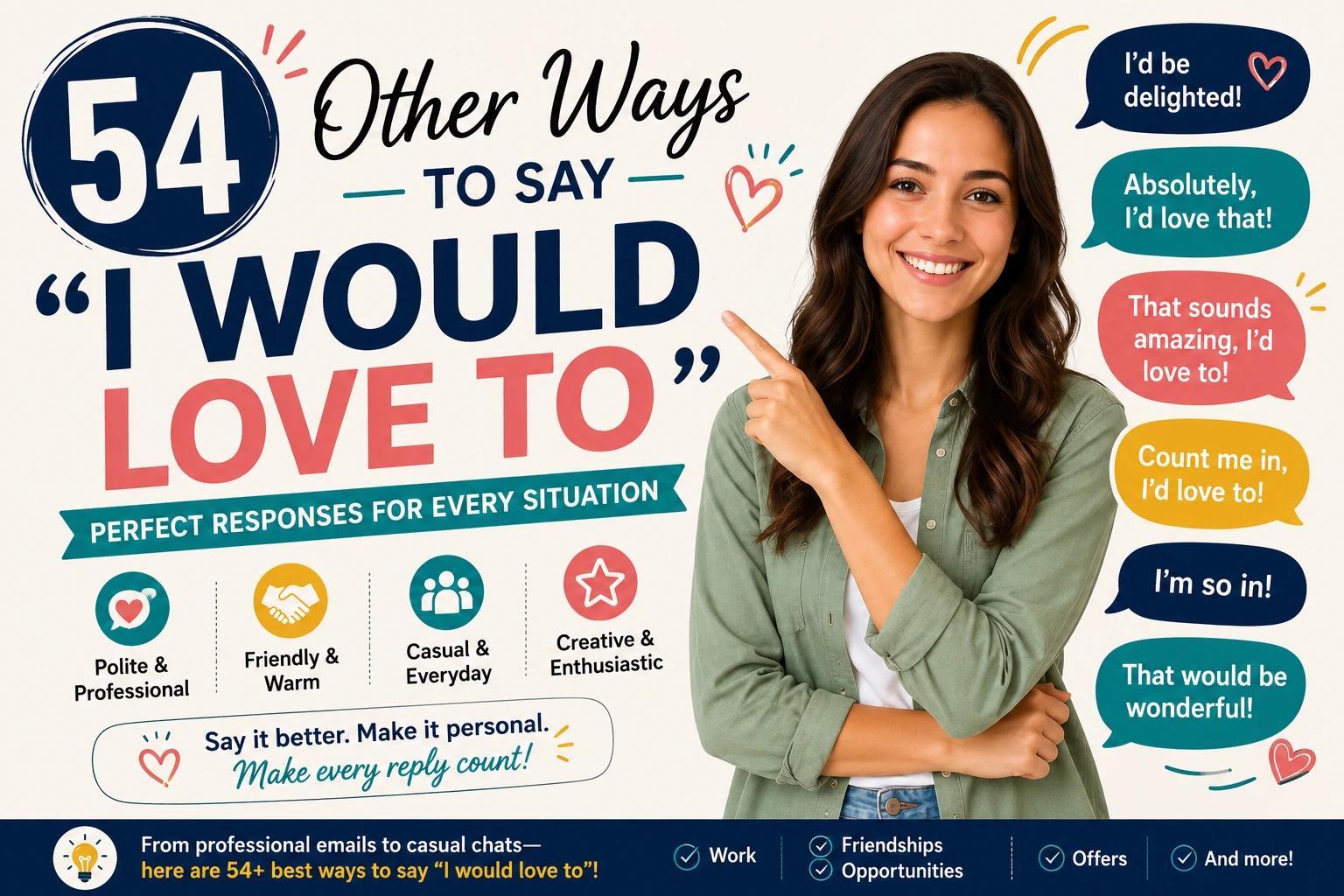
This guide explores 54+ other ways to say “I would love to,” with simple explanations and realistic examples. These alternatives can help you communicate interest, appreciation, excitement, and willingness without sounding repetitive.
What Does “I Would Love To” Mean?
“I would love to” is a polite and enthusiastic way to express that you are very willing or happy to do something.
For example:
“Would you like to join us for dinner?”
“I would love to.”
The phrase usually sounds warmer than simply saying “yes.” It shows genuine interest while remaining polite.
You can use it when accepting an invitation, agreeing to help someone, showing interest in an opportunity, or responding positively to a suggestion.
For example:
- “I would love to help with the project.”
- “I would love to visit someday.”
- “I would love to hear more about it.”
- “I would love to join you.”
The tone is generally positive, friendly, and enthusiastic.
Polite and Appreciative Alternatives
These expressions work well when you want to sound respectful, warm, and sincere.
1. I’d be delighted to
Meaning: You would be very happy to do something.
Tone: Polite and professional
“I’d be delighted to attend the meeting.”
This is a strong choice for formal invitations and professional communication.
2. I’d be happy to
Meaning: You are willing and pleased to help or participate.
Tone: Friendly and professional
“I’d be happy to help you with the presentation.”
It is simple, natural, and suitable for workplace conversations.
3. I’d be glad to
Meaning: You are willing to do something with pleasure.
Tone: Polite and warm
“I’d be glad to answer any questions.”
Use it when you want to sound helpful without being overly formal.
4. It would be my pleasure
Meaning: You would be genuinely pleased to do something.
Tone: Formal and courteous
“It would be my pleasure to assist you.”
This works especially well in customer service and formal correspondence.
5. I’d be pleased to
Meaning: You would be happy to participate or assist.
Tone: Formal
“I’d be pleased to discuss the proposal further.”
It is particularly useful in professional emails.
6. I’d gladly do that
Meaning: You are willingly offering to do something.
Tone: Friendly and sincere
“I’d gladly review your draft before you submit it.”
This sounds natural when offering support.
7. I’d be more than happy to
Meaning: You are especially willing to help or participate.
Tone: Warm and enthusiastic
“I’d be more than happy to explain how it works.”
It adds extra warmth to an ordinary “I’d be happy to.”
8. I’d certainly be interested
Meaning: You are genuinely interested in the opportunity.
Tone: Professional and measured
“I’d certainly be interested in discussing the position.”
Use it when you want to show enthusiasm without sounding overly excited.
9. Thank you, I’d be pleased to
Meaning: You appreciate the invitation and accept it.
Tone: Polite and formal
“Thank you, I’d be pleased to attend the event.”
This is ideal for professional invitations.
10. I appreciate the invitation and would be happy to join
Meaning: You are grateful for being invited and want to participate.
Tone: Respectful and professional
“I appreciate the invitation and would be happy to join the discussion.”
It combines appreciation with a clear positive response.
11. That would be wonderful
Meaning: You think the suggested opportunity sounds very appealing.
Tone: Warm and enthusiastic
“Would you like to come along?”
“That would be wonderful.”
It works especially well in casual conversations.
Flirty and Playful Alternatives
These options are best for lighthearted conversations where you already have a comfortable relationship with the other person.
12. Absolutely
Meaning: A confident and enthusiastic yes.
Tone: Confident and upbeat
“Want to grab coffee sometime?”
“Absolutely.”
It is short but communicates strong interest.
13. Count me in
Meaning: You definitely want to participate.
Tone: Casual and playful
“We’re going bowling Saturday. Count me in.”
A great option for plans with friends.
14. I’m totally up for that
Meaning: You are enthusiastic about the suggestion.
Tone: Casual and playful
“Want to check out that new café?”
“I’m totally up for that.”
It feels relaxed and conversational.
15. Sounds like a plan
Meaning: You agree with the proposed plan.
Tone: Casual and confident
“Let’s meet after class.”
“Sounds like a plan.”
Use it when the details are already clear.
16. You don’t have to ask twice
Meaning: You are very eager to agree.
Tone: Playful
“Want to come with us?”
“You don’t have to ask twice.”
It adds personality without being complicated.
17. I’m definitely in
Meaning: You strongly agree to participate.
Tone: Casual and enthusiastic
“Are you coming to the game?”
“I’m definitely in.”
It works well in texts and group chats.
18. Now you’re talking
Meaning: You really like the idea being suggested.
Tone: Playful
“How about pizza and a movie?”
“Now you’re talking.”
Use it when someone suggests something particularly appealing.
19. Say less
Meaning: You already understand and agree.
Tone: Casual and modern
“I found tickets for Saturday.”
“Say less.”
This is especially natural in informal texting.
20. I’m game
Meaning: You are willing to try or participate.
Tone: Casual and confident
“Want to try the new restaurant?”
“I’m game.”
It is short, flexible, and friendly.
21. Why not? I’m in
Meaning: You are open to the idea and willing to participate.
Tone: Casual and playful
“Want to go for a walk after dinner?”
“Why not? I’m in.”
This sounds spontaneous and relaxed.
22. That sounds tempting
Meaning: The idea sounds attractive or appealing.
Tone: Playful
“There’s a dessert place nearby.”
“That sounds tempting.”
It works when you want to show interest without giving a straightforward yes.
Confident and Self-Respecting Alternatives
These phrases communicate interest clearly while keeping your response confident and composed.
23. I’m definitely interested
Meaning: You have genuine interest in the opportunity.
Tone: Confident
“Would you be interested in collaborating?”
“I’m definitely interested.”
It is useful in professional and personal conversations.
24. I’d be interested in exploring that
Meaning: You are open to considering the idea.
Tone: Professional and thoughtful
“I’d be interested in exploring that opportunity further.”
This is useful when you want to avoid sounding rushed.
25. I’m open to it
Meaning: You are willing to consider the suggestion.
Tone: Neutral and confident
“Would you consider joining the project?”
“I’m open to it.”
It shows interest without making an immediate commitment.
26. I’d certainly consider it
Meaning: You are seriously willing to think about the opportunity.
Tone: Mature and professional
“I’d certainly consider working on something like this.”
This works well when you need time before making a decision.
27. I’m happy to take part
Meaning: You are willing to participate.
Tone: Confident and positive
“I’m happy to take part in the discussion.”
It gives a clear and direct answer.
28. I’d be glad to contribute
Meaning: You are willing to provide help or input.
Tone: Professional
“I’d be glad to contribute my ideas to the project.”
A strong option for workplace communication.
29. I’m keen to get involved
Meaning: You are genuinely interested in participating.
Tone: Enthusiastic and professional
“I’m keen to get involved with the community project.”
It communicates motivation and initiative.
30. I’m very interested in the opportunity
Meaning: You see the opportunity as valuable and appealing.
Tone: Professional
“I’m very interested in the opportunity and would like to learn more.”
This is excellent for applications and professional emails.
31. I’d welcome the opportunity
Meaning: You would appreciate the chance to participate.
Tone: Formal and confident
“I’d welcome the opportunity to discuss this further.”
It sounds polished without being overly complicated.
32. I’m certainly willing to help
Meaning: You are prepared to offer assistance.
Tone: Direct and professional
“I’m certainly willing to help with the research.”
Use it when someone needs practical support.
33. I’d be interested in taking part
Meaning: You want to participate or learn more.
Tone: Professional and measured
“I’d be interested in taking part in the upcoming workshop.”
It is useful when you want to sound interested but composed.
Funny and Savage Alternatives
These expressions are better suited to friends, casual conversations, and playful texting.
34. Well, twist my arm
Meaning: You are jokingly pretending that you need convincing.
Tone: Funny and playful
“Want to order pizza?”
“Well, twist my arm.”
The humor comes from pretending to resist something you clearly want.
35. Do I even have a choice?
Meaning: You are jokingly saying the idea is too good to refuse.
Tone: Funny
“Free dessert after dinner?”
“Do I even have a choice?”
Use it when the offer is obviously appealing.
36. Where do I sign?
Meaning: You are extremely willing to agree.
Tone: Funny and enthusiastic
“We’re going on a food tour.”
“Where do I sign?”
It makes your enthusiasm sound exaggerated for comic effect.
37. You had me at that
Meaning: The suggestion immediately convinced you.
Tone: Playful
“There’s pizza waiting for us.”
“You had me at pizza.”
Replace the final word with whatever makes the offer appealing.
38. Consider me convinced
Meaning: You have decided to agree.
Tone: Playful and confident
“The new café has amazing desserts.”
“Consider me convinced.”
It works well when someone gives you a persuasive reason.
39. I was waiting for you to ask
Meaning: You were already interested.
Tone: Playful
“Want to join us?”
“I was waiting for you to ask.”
Use this with people who understand your humor.
40. You really know how to make an offer
Meaning: The suggestion is difficult to refuse.
Tone: Humorous
“Movie night and homemade pizza?”
“You really know how to make an offer.”
It keeps the conversation light.
41. That’s an easy yes
Meaning: The decision requires almost no thought.
Tone: Casual and confident
“Want to try the new bakery?”
“That’s an easy yes.”
It is simple and naturally enthusiastic.
42. I’m not exactly going to complain
Meaning: You are happy with the suggestion.
Tone: Dry humor
“I brought extra snacks.”
“I’m not exactly going to complain.”
This works particularly well with close friends.
43. You make it very hard to say no
Meaning: The suggestion is extremely appealing.
Tone: Playful
“I got us tickets for the concert.”
“You make it very hard to say no.”
It shows appreciation while keeping the response light.
44. Well, that escalated into a yes
Meaning: You quickly went from considering the idea to agreeing.
Tone: Funny and casual
“We could get ice cream after dinner.”
“Well, that escalated into a yes.”
Use it when you want to make your agreement humorous.
Curious, Thoughtful, and Mature Alternatives
These phrases work when you want to express interest while encouraging more conversation.
45. I’d love to hear more
Meaning: You want additional information.
Tone: Warm and thoughtful
“I have an idea for the project.”
“I’d love to hear more.”
It shows interest without committing immediately.
46. That sounds interesting; tell me more
Meaning: You find the idea appealing and want details.
Tone: Curious and friendly
“I’m thinking about starting a small business.”
“That sounds interesting; tell me more.”
It keeps the conversation moving naturally.
47. I’d be interested to learn more
Meaning: You want more information before deciding.
Tone: Professional and thoughtful
“I’d be interested to learn more about the position.”
This is especially useful in professional settings.
48. I’d like to explore the idea
Meaning: You are willing to consider the suggestion in greater detail.
Tone: Mature and professional
“I’d like to explore the idea before making a final decision.”
It sounds thoughtful and avoids rushing into an answer.
49. I’d be happy to discuss it further
Meaning: You are willing to continue the conversation.
Tone: Professional
“I’d be happy to discuss it further at our next meeting.”
A polished alternative for workplace communication.
50. That’s something I’d be interested in
Meaning: The idea has caught your attention.
Tone: Thoughtful and conversational
“We’re planning a photography workshop.”
“That’s something I’d be interested in.”
It sounds natural without being overly enthusiastic.
51. I’d certainly like the opportunity
Meaning: You would appreciate the chance to participate.
Tone: Formal and sincere
“I’d certainly like the opportunity to contribute.”
It works well in applications, interviews, and formal discussions.
52. I’d be open to discussing it
Meaning: You are willing to have a conversation about the idea.
Tone: Mature and professional
“I’d be open to discussing it when you have time.”
Use this when you want to show interest without making a firm commitment.
53. I’d be happy to consider it
Meaning: You are willing to think about the suggestion.
Tone: Polite and measured
“I’d be happy to consider the proposal.”
This is useful when you need time before giving a final answer.
54. I’d welcome the chance to learn more
Meaning: You appreciate the opportunity to gain more information.
Tone: Professional and thoughtful
“I’d welcome the chance to learn more about the program.”
It communicates curiosity, openness, and genuine interest.
Real-Life Situations: Which Response Should You Use?
When someone invites you somewhere
Keep your answer warm and straightforward.
Best reply: “I’d be happy to join.”
Example:
“We’re having dinner on Friday. Want to come?”
“I’d be happy to join.”
When a friend suggests an exciting plan
You can be more casual.
Best reply: “Count me in.”
Example:
“We’re checking out that new café tomorrow.”
“Count me in.”
When someone offers a professional opportunity
Choose something confident and polished.
Best reply: “I’d welcome the opportunity to discuss it further.”
Example:
“Would you be interested in discussing the position?”
“I’d welcome the opportunity to discuss it further.”
When you need more information first
Do not feel pressured to immediately say yes.
Best reply: “I’d love to hear more.”
Example:
“I have an idea for the project.”
“I’d love to hear more before we decide.”
When you want to keep things playful
Use humor when the relationship and context allow it.
Best reply: “Where do I sign?”
Example:
“Free pizza and a movie?”
“Where do I sign?”
What to Avoid
When replacing “I would love to,” avoid these common mistakes:
- Being too formal in casual conversations
Saying “It would be my pleasure” to a close friend can sound unnecessarily stiff. - Sounding more enthusiastic than you actually feel
Choose “I’m open to it” if you are interested but still undecided. - Using slang in professional emails
Expressions such as “Say less” or “I’m game” are better suited to casual conversations. - Giving a vague response when a clear answer is needed
If you genuinely agree, a simple “Absolutely” may be more effective. - Ignoring the context
The best alternative depends on who you are speaking to and what you are agreeing to. - Overcomplicating a simple response
Sometimes “I’d be happy to” is still the most natural choice.
Pro Tips for Choosing the Right Alternative
1. Match the tone to the relationship
Use professional expressions with colleagues and casual phrases with friends. The same message can sound completely different depending on the wording.
2. Show the right level of enthusiasm
“Absolutely” sounds more energetic than “I’m open to it.” Choose an expression that honestly reflects how interested you are.
3. Let the situation guide your wording
If you are accepting an invitation, say “Count me in.” If you need more information, say “I’d love to hear more.” If you are writing a formal email, “I’d welcome the opportunity” may work better.
Conclusion
“I would love to” is a warm and useful phrase, but it is not your only option. From professional expressions such as “I’d welcome the opportunity” to casual responses like “Count me in” and “I’m game,” there are plenty of ways to communicate enthusiasm naturally.
The key is not simply replacing one phrase with another. Choose words that match your relationship, situation, and genuine level of interest. When your language fits the moment, your communication becomes clearer, more confident, and more authentic. Sometimes the best response is simple; other times, a little personality makes all the difference.
Discover more