
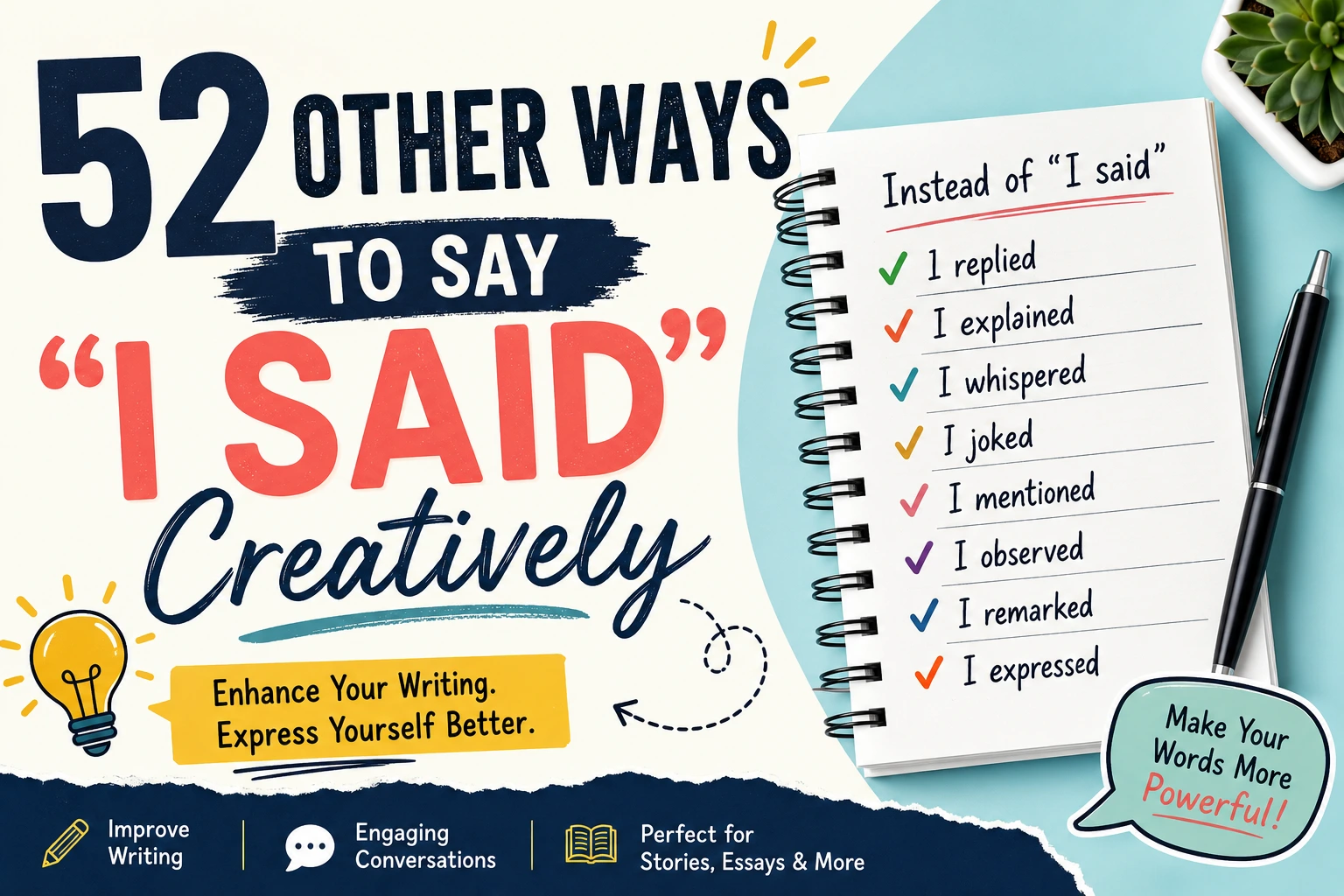
Have you ever finished writing an email, story, essay, or even a simple text message and realized you’ve used “I said” over and over again? It happens to everyone. While there’s nothing wrong with the phrase, repeating it too often can make your writing feel flat and repetitive.
That’s why so many people search for other ways to say “I said” creatively. Whether you’re writing dialogue for a novel, preparing a school assignment, creating social media content, or simply trying to improve your everyday writing, using different expressions can make your words more engaging and natural.
The good news is that you don’t need complicated vocabulary to sound like a better writer. Small changes can make a big difference. In this guide, you’ll discover creative alternatives to “I said,” along with real-life examples that show exactly when and how to use them.
What Does “Other Ways to Say I Said Creatively” Mean?
Looking for other ways to say “I said” creatively simply means finding fresh, natural alternatives to the phrase “I said.”
Instead of writing:
“I said, ‘Let’s go.'”
You might write:
“I suggested, ‘Let’s go.'”
or
“I replied, ‘Let’s go.'”
Each alternative adds a slightly different meaning. Some sound polite, some express confidence, while others show emotion, humor, or curiosity. Choosing the right word helps your writing sound more vivid and keeps readers interested.
Whether you’re writing a conversation, telling a story, or sending a message, using a variety of speaking verbs can make your communication feel more authentic.
Best Other Ways to Say “I Said” Creatively
Polite & Appreciative Alternatives
These options are perfect when you want to sound respectful, warm, or professional.
1. I replied
Reply: “I replied.”
Example:
Your coworker asks if you received their email. Instead of writing “I said yes,” you write, “I replied, ‘Yes, I received it this morning.'”
2. I responded
Reply: “I responded.”
Example:
A friend thanks you for helping them move, and you write, “I responded, ‘Anytime. I’m happy to help.'”
3. I answered
Reply: “I answered.”
Example:
During class, the teacher asks a question, and you write, “I answered, ‘The capital is Islamabad.'”
4. I explained
Reply: “I explained.”
Example:
Someone doesn’t understand why you’re late, so you write, “I explained that traffic was unusually heavy.”
5. I mentioned
Reply: “I mentioned.”
Example:
While chatting with a friend, you casually bring up your vacation plans and write, “I mentioned that I was visiting the mountains next month.”
6. I suggested
Reply: “I suggested.”
Example:
Your family can’t decide where to eat, so you write, “I suggested trying the new Italian restaurant.”
7. I assured
Reply: “I assured.”
Example:
Your younger sibling feels nervous before an exam, and you write, “I assured them everything would be okay.”
8. I reminded
Reply: “I reminded.”
Example:
Before leaving home, you tell your friend about the meeting and write, “I reminded him not to forget the documents.”
9. I added
Reply: “I added.”
Example:
During a discussion, you include one more important point and write, “I added that we should finish the project before Friday.”
10. I clarified
Reply: “I clarified.”
Example:
Someone misunderstands your comment, so you write, “I clarified that I wasn’t criticizing anyone.”
Flirty & Playful Alternatives
These expressions work well in lighthearted conversations, texting, and casual dialogue.
11. I teased
Reply: “I teased.”
Example:
Your crush says they’re always late, and you write, “I teased, ‘You’re trying to make a grand entrance every time.'”
12. I joked
Reply: “I joked.”
Example:
While chatting with friends, someone complains about Mondays, and you write, “I joked, ‘Mondays should come with a warning label.'”
13. I laughed
Reply: “I laughed.”
Example:
Your friend tells a funny story, and you write, “I laughed, ‘That sounds exactly like you!'”
14. I whispered
Reply: “I whispered.”
Example:
You’re watching a movie together, and you quietly say, “I whispered, ‘This plot twist is wild.'”
15. I smiled
Reply: “I smiled.”
Example:
Someone compliments your outfit, and you write, “I smiled, ‘Thank you. That means a lot.'”
16. I winked
Reply: “I winked.”
Example:
During playful flirting, you write, “I winked, ‘Maybe you’ll find out someday.'”
17. I hinted
Reply: “I hinted.”
Example:
Your friend asks what you want for your birthday, and you write, “I hinted that chocolate never disappoints.”
18. I admitted
Reply: “I admitted.”
Example:
Someone catches you eating the last cookie, and you write, “I admitted, ‘Okay, I couldn’t resist.'”
19. I confessed
Reply: “I confessed.”
Example:
While talking to your best friend, you write, “I confessed that I’d watched the entire series in one weekend.”
20. I grinned
Reply: “I grinned.”
Example:
Your sibling asks who finished the ice cream, and you write, “I grinned, ‘You’ll never prove it.'”
Confident & Self Respect Alternatives
These alternatives show confidence, authority, or conviction without sounding rude. They’re useful in speeches, debates, workplace conversations, and personal writing.
21. I stated
Reply: “I stated.”
Example:
During a team meeting, everyone shared their ideas. I stated that finishing quality work was more important than rushing the deadline.
22. I declared
Reply: “I declared.”
Example:
After finally completing your exams, I declared, “Vacation officially starts today!”
23. I affirmed
Reply: “I affirmed.”
Example:
Your manager asks if you can handle the project. I affirmed that I was ready for the challenge.
24. I emphasized
Reply: “I emphasized.”
Example:
While giving instructions, I emphasized the importance of arriving on time.
25. I insisted
Reply: “I insisted.”
Example:
Your friend offers to pay for dinner, but I insisted on paying my share.
26. I confirmed
Reply: “I confirmed.”
Example:
A client asks about tomorrow’s meeting, and I confirmed the appointment for 10 a.m.
27. I pointed out
Reply: “I pointed out.”
Example:
During a discussion, I pointed out that everyone deserved a chance to speak.
28. I reminded firmly
Reply: “I reminded firmly.”
Example:
Your younger brother forgets his homework again, so I reminded him firmly to pack his bag the night before.
29. I maintained
Reply: “I maintained.”
Example:
Even after hearing different opinions, I maintained that honesty was always the best policy.
30. I stood by my words
Reply: “I stood by my words.”
Example:
Someone questioned your opinion, but I stood by my words because I believed they were fair.
Funny & Savage Alternatives
These expressions add personality and humor. They’re best used with friends, in casual conversations, or on social media.
31. I blurted out
Reply: “I blurted out.”
Example:
The answer slipped out before anyone else could speak, and I blurted out the correct answer.
32. I fired back
Reply: “I fired back.”
Example:
My friend teased my cooking, so I fired back, “At least I didn’t burn water.”
33. I clapped back
Reply: “I clapped back.”
Example:
Someone joked about your outfit online, and I clapped back with a witty comment that made everyone laugh.
34. I shot back
Reply: “I shot back.”
Example:
When my cousin challenged me to a race, I shot back, “Only if you’re ready to lose.”
35. I quipped
Reply: “I quipped.”
Example:
The room went quiet, so I quipped, “Well… that wasn’t awkward at all.”
36. I joked
Reply: “I joked.”
Example:
My friend asked if I’d finished the assignment, and I joked, “Mentally? Yes. Physically? Not yet.”
37. I laughed and said
Reply: “I laughed and said.”
Example:
Someone apologized for being late, and I laughed and said, “You’re only fashionably late.”
38. I joked back
Reply: “I joked back.”
Example:
My brother called me lazy, and I joked back, “I’m just energy efficient.”
39. I joked sarcastically
Reply: “I joked sarcastically.”
Example:
After spilling coffee on my shirt, I joked sarcastically, “Exactly how I planned to start the day.”
40. I teased back
Reply: “I teased back.”
Example:
A friend joked about my hairstyle, so I teased back, “You’re just jealous.”
41. I laughed it off
Reply: “I laughed it off.”
Example:
I accidentally pronounced a word wrong during class, but I laughed it off and kept speaking.
42. I couldn’t resist saying
Reply: “I couldn’t resist saying.”
Example:
Everyone was arguing over pizza toppings, and I couldn’t resist saying, “Pineapple wins every time.”
Curious, Thoughtful, and Mature Alternatives
These alternatives are perfect when you want your writing to sound reflective, calm, or meaningful.
43. I observed
Reply: “I observed.”
Example:
During the discussion, I observed that everyone had a different perspective on the issue.
44. I reflected
Reply: “I reflected.”
Example:
Looking back on the experience, I reflected that every mistake had taught me something valuable.
45. I acknowledged
Reply: “I acknowledged.”
Example:
When my teammate pointed out my mistake, I acknowledged that they were right.
46. I noted
Reply: “I noted.”
Example:
While reviewing the report, I noted that a few important details were missing.
47. I wondered aloud
Reply: “I wondered aloud.”
Example:
Watching the sunset, I wondered aloud whether we’d ever visit this place again.
48. I questioned
Reply: “I questioned.”
Example:
During the meeting, I questioned whether the deadline was realistic.
49. I commented
Reply: “I commented.”
Example:
As we walked through the park, I commented on how peaceful the evening felt.
50. I remarked
Reply: “I remarked.”
Example:
Looking at the old photograph, I remarked that some memories never fade.
51. I shared
Reply: “I shared.”
Example:
During our conversation, I shared my thoughts about changing careers.
52. I expressed
Reply: “I expressed.”
Example:
At the end of the project, I expressed my gratitude to everyone who helped.
Real Life Situations
When You’re Writing a Story
Best Reply: “I whispered.”
Instead of writing, “I said quietly,” use “I whispered” to create a more vivid scene.
When You’re Writing an Email
Best Reply: “I explained.”
This sounds professional and clearly shows that you’re providing details.
When You’re Having a Friendly Conversation
Best Reply: “I joked.”
This keeps the conversation light and shows your playful tone.
When You’re Sharing an Opinion
Best Reply: “I stated.”
This sounds confident without appearing aggressive.
When You’re Writing About Emotions
Best Reply: “I confessed.”
This choice helps readers understand that you’re revealing something personal or meaningful.
What to Avoid
Avoid these common mistakes when replacing “I said.”
1. Using Fancy Words Just to Sound Smart
Choose words that fit the situation naturally. Overly complicated vocabulary can confuse readers.
2. Repeating the Same Alternative
Replacing “I said” with “I replied” in every sentence creates the same repetition you’re trying to avoid.
3. Choosing the Wrong Tone
Don’t use “I joked” during a serious conversation or “I declared” for a casual text message.
4. Forgetting the Context
Each alternative carries a different meaning. Make sure it matches the emotion and purpose of your sentence.
5. Overusing Dialogue Tags
Sometimes you don’t need a dialogue tag at all. If it’s already clear who’s speaking, simply write the dialogue.
Pro Tips
Match the Emotion
Think about how the speaker feels. Are they excited, nervous, confident, or thoughtful? Choose a word that reflects that emotion.
Keep It Natural
Use alternatives only when they improve the sentence. Sometimes “I said” is still the best choice.
Read It Out Loud
Reading your writing aloud helps you hear whether the dialogue flows naturally or sounds repetitive.
Bonus Quick One Liners
Here are a few quick alternatives you can use anytime.
- I replied
- I answered
- I responded
- I added
- I explained
- I suggested
- I admitted
- I remarked
- I noted
- I commented
Conclusion
Finding other ways to say “I said” creatively is one of the simplest ways to improve your writing. Whether you’re working on a novel, writing an essay, sending an email, or creating social media content, using a variety of dialogue tags keeps your writing fresh and engaging.
The key isn’t to replace every instance of “I said.” Instead, choose alternatives that match the tone, emotion, and context of your sentence. A thoughtful mix of words like “I explained,” “I joked,” “I remarked,” or “I expressed” makes your writing more descriptive without feeling forced.
The best writing sounds natural, not complicated. Focus on clarity, choose words that fit the moment, and let your personality shine through. Small changes in word choice can make a big difference in how readers experience your writing.
Discover more
other ways to say to mark your calendar