

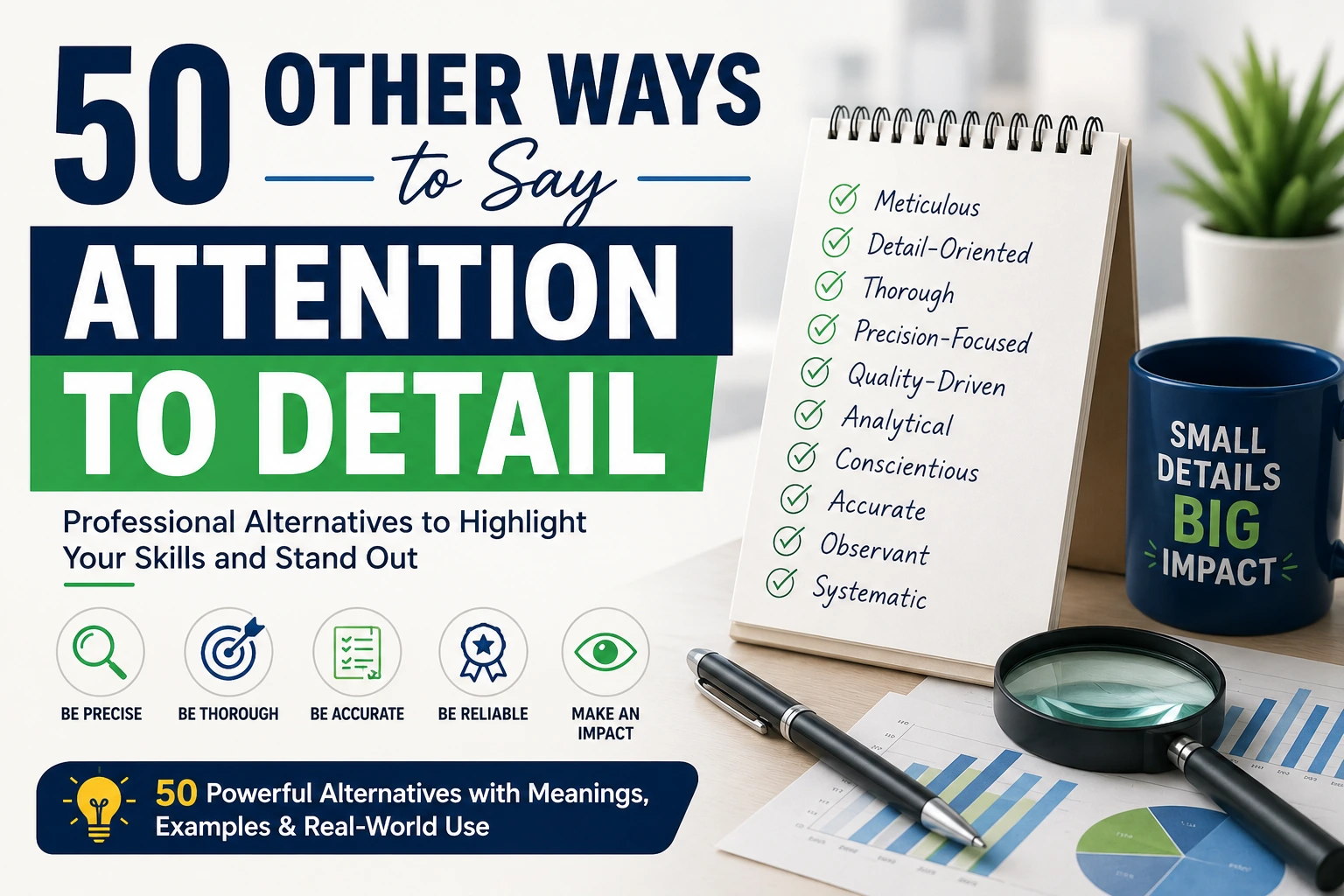
Whether you’re updating your resume, preparing for a job interview, or writing a LinkedIn profile, you’ve probably used the phrase “attention to detail.” While it’s one of the most valued workplace skills, it has also become one of the most overused. Hiring managers see it so often that it can lose its impact unless you support it with stronger, more specific language.
That’s why many professionals search for other ways to say attention to detail. Choosing a more descriptive phrase helps showcase your strengths in a way that feels authentic and memorable. Whether you’re applying for an administrative role, a marketing position, a healthcare job, or a technical career, using the right wording can make your application stand out. In this guide, you’ll discover 50 professional alternatives to “attention to detail,” complete with meanings, practical examples, and tips on when to use each one.
What Does “Other Ways to Say Attention to Detail” Mean?
The phrase “attention to detail” refers to the ability to notice small details, avoid mistakes, follow instructions carefully, and produce accurate, high-quality work.
Instead of repeatedly using this common phrase, you can choose alternatives that better describe your strengths. For example, if you’re known for spotting errors, “accuracy-focused” may fit better. If you excel at reviewing work thoroughly, “meticulous” or “thorough” might be stronger choices.
Using a variety of professional expressions not only improves your resume but also helps demonstrate your skills more effectively during interviews, performance reviews, and professional networking.
Precision & Accuracy
1. Meticulous
Meaning: Extremely careful and precise in completing tasks.
Example:
“She is meticulous when reviewing financial reports, ensuring every figure is accurate.”
Why Use It:
A strong professional word that immediately communicates precision and care.
2. Detail-Oriented
Meaning: Naturally focused on even the smallest details.
Example:
“I’m a detail-oriented project coordinator who ensures every deadline and requirement is met.”
Why Use It:
One of the most recognized alternatives for resumes and LinkedIn profiles.
3. Highly Accurate
Meaning: Producing work with very few or no errors.
Example:
“Maintained highly accurate records while processing customer information.”
Why Use It:
Shows reliability and precision, especially in administrative and financial roles.
4. Precision-Focused
Meaning: Prioritizing exactness and correctness in every task.
Example:
“Adopted a precision-focused approach when preparing technical documentation.”
Why Use It:
Perfect for engineering, design, healthcare, and technical positions.
5. Thorough
Meaning: Completing work carefully without overlooking important details.
Example:
“Conducted thorough quality checks before submitting the final report.”
Why Use It:
Simple, professional, and widely applicable.
6. Conscientious
Meaning: Responsible, careful, and committed to doing high-quality work.
Example:
“Known for being conscientious when managing confidential client information.”
Why Use It:
Highlights professionalism and integrity.
7. Quality-Focused
Meaning: Always aiming for high standards in completed work.
Example:
“Maintained a quality-focused approach throughout every stage of the production process.”
Why Use It:
Shows that excellence is your priority.
8. Methodical
Meaning: Working in an organized, systematic way.
Example:
“Used a methodical process to analyze data and identify trends.”
Why Use It:
Ideal for analytical, research, and technical careers.
9. Exacting
Meaning: Maintaining exceptionally high standards of accuracy.
Example:
“Applied exacting standards when reviewing legal documentation.”
Why Use It:
A sophisticated alternative suitable for senior-level professionals.
10. Careful and Precise
Meaning: Paying close attention while avoiding mistakes.
Example:
“Handled inventory records with a careful and precise approach.”
Why Use It:
Easy to understand while sounding polished.
Organization & Consistency
11. Organized
Meaning: Keeping work structured, orderly, and efficient.
Example:
“Stayed organized by maintaining detailed schedules and project documentation.”
Why Use It:
Employers value organized professionals who manage multiple responsibilities effectively.
12. Systematic
Meaning: Following a logical process to ensure consistent results.
Example:
“Used a systematic workflow to improve accuracy and reduce processing errors.”
Why Use It:
Excellent for operations, administration, and project management roles.
13. Analytical
Meaning: Carefully examining information before making decisions.
Example:
“Applied analytical thinking to identify inconsistencies and improve reporting accuracy.”
Why Use It:
Shows strong problem-solving skills along with careful attention to detail, making it especially valuable for finance, IT, engineering, and business positions.
Accuracy, Review & Problem-Solving
14. Observant
Meaning: Quick to notice small details, changes, or inconsistencies.
Example:
“Being observant helped me identify data entry errors before the report was finalized.”
Why Use It:
Highlights your ability to catch issues others might overlook.
15. Diligent
Meaning: Hardworking, careful, and persistent when completing tasks.
Example:
“I take a diligent approach to every project to ensure high-quality results.”
Why Use It:
Shows dedication and a strong work ethic.
16. Quality-Conscious
Meaning: Focused on maintaining high standards in every task.
Example:
“As a quality-conscious professional, I review my work before submitting it.”
Why Use It:
Emphasizes your commitment to excellence.
17. Error-Conscious
Meaning: Actively looking for mistakes and preventing them.
Example:
“My error-conscious approach has significantly reduced reporting mistakes.”
Why Use It:
Ideal for roles involving data, finance, or compliance.
18. Thorough Reviewer
Meaning: Carefully checks work before completion.
Example:
“As a thorough reviewer, I ensure documents are accurate and complete.”
Why Use It:
Perfect for editing, administration, and quality assurance roles.
19. Process-Oriented
Meaning: Following structured procedures to achieve consistent results.
Example:
“My process-oriented mindset helps maintain quality across every project.”
Why Use It:
Excellent for project management and operations positions.
20. Carefully Organized
Meaning: Maintaining order and structure in every task.
Example:
“I keep project files carefully organized to improve efficiency.”
Why Use It:
Shows strong organizational habits.
21. Consistently Accurate
Meaning: Producing dependable, error-free work over time.
Example:
“Delivered consistently accurate reports while meeting strict deadlines.”
Why Use It:
Demonstrates reliability and professionalism.
22. Inspection-Focused
Meaning: Giving close attention during reviews and quality checks.
Example:
“Maintained an inspection-focused approach during product quality assessments.”
Why Use It:
A valuable alternative for manufacturing, engineering, and quality control roles.
23. Compliance-Focused
Meaning: Ensuring work follows company policies, standards, or regulations.
Example:
“Used a compliance-focused approach when preparing financial documentation.”
Why Use It:
Especially useful for healthcare, finance, legal, and regulatory positions.
24. Reliable and Thorough
Meaning: Dependable while consistently producing complete, accurate work.
Example:
“Recognized as a reliable and thorough team member who rarely overlooked important details.”
Why Use It:
Combines trustworthiness with precision, making it an excellent phrase for resumes and performance reviews.
25. Detail-Conscious
Meaning: Naturally attentive to even the smallest aspects of a task.
Example:
“I’m detail-conscious when reviewing contracts to ensure every requirement is met.”
Why Use It:
A professional variation that avoids repeating “attention to detail.”
26. Accuracy-Driven
Meaning: Motivated to produce correct and error-free results.
Example:
“An accuracy-driven approach helped improve reporting quality and reduce mistakes.”
Why Use It:
Strong wording for resumes, LinkedIn profiles, and interviews because it emphasizes both precision and commitment to quality.
Professionalism, Reliability & Excellence
27. Detail-Focused
Meaning: Giving careful attention to every aspect of a task.
Example:
“I’m a detail-focused professional who ensures every project meets quality standards.”
Why Use It:
A polished alternative that works well on resumes, LinkedIn profiles, and cover letters.
28. Quality-Driven
Meaning: Motivated to produce work that consistently meets high standards.
Example:
“Maintained a quality-driven approach while preparing client presentations and reports.”
Why Use It:
Highlights your commitment to excellence rather than simply avoiding mistakes.
29. Attentive
Meaning: Paying close attention to instructions, details, and expectations.
Example:
“Being attentive allowed me to identify customer concerns before they became larger issues.”
Why Use It:
A versatile word suitable for almost any profession.
30. Careful Worker
Meaning: Completing tasks thoughtfully while minimizing errors.
Example:
“Known as a careful worker who consistently submits polished and accurate work.”
Why Use It:
Simple, professional, and easy for recruiters to understand.
31. Structured Thinker
Meaning: Solving problems logically while keeping track of important details.
Example:
“As a structured thinker, I organize projects efficiently and reduce unnecessary mistakes.”
Why Use It:
Excellent for management, engineering, and business roles.
32. Well-Organized
Meaning: Managing information, deadlines, and responsibilities efficiently.
Example:
“Stayed well-organized while coordinating multiple projects with overlapping deadlines.”
Why Use It:
Shows strong planning skills alongside attention to detail.
33. Carefully Analytical
Meaning: Evaluating information thoroughly before making decisions.
Example:
“Used a carefully analytical approach when reviewing financial reports.”
Why Use It:
Perfect for data analysis, accounting, finance, and research positions.
34. Focused on Accuracy
Meaning: Making accuracy the top priority during every task.
Example:
“Focused on accuracy while entering customer information into company databases.”
Why Use It:
Directly communicates precision and reliability.
35. Results-Oriented with Precision
Meaning: Achieving goals while maintaining high standards of accuracy.
Example:
“Delivered results-oriented work with precision, even under tight deadlines.”
Why Use It:
Shows you can balance speed with quality.
36. Reliable and Precise
Meaning: Dependable while consistently producing accurate work.
Example:
“Managers valued my reliable and precise approach to handling confidential documents.”
Why Use It:
Combines trustworthiness with professional accuracy.
37. Carefully Thorough
Meaning: Taking the time to complete every task completely and correctly.
Example:
“Performed carefully thorough inspections before approving final reports.”
Why Use It:
Emphasizes completeness and consistency.
38. High Standards of Accuracy
Meaning: Maintaining exceptional quality in every assignment.
Example:
“Maintained high standards of accuracy while processing payroll records.”
Why Use It:
Ideal for resumes where measurable quality matters.
39. Detail-Minded
Meaning: Naturally inclined to notice small but important details.
Example:
“I’m detail-minded when organizing documents and reviewing contracts.”
Why Use It:
A modern, resume-friendly alternative that sounds professional without being overused.
Advanced Professional Alternatives
40. Carefully Executed
Meaning: Completing every task with precision and thoughtful planning.
Example:
“The project was carefully executed, resulting in zero compliance issues.”
Why Use It:
Shows that you value quality from start to finish.
41. Precision-Oriented
Meaning: Focused on accuracy and exact results.
Example:
“I’m a precision-oriented professional with experience managing complex technical documentation.”
Why Use It:
Excellent for engineering, healthcare, finance, and technical positions.
42. Quality Assurance Mindset
Meaning: Constantly checking work to ensure it meets high standards.
Example:
“Applied a quality assurance mindset when reviewing reports before submission.”
Why Use It:
Highlights your commitment to delivering error-free work.
43. Focused on Excellence
Meaning: Always striving to produce the highest-quality work possible.
Example:
“Focused on excellence while coordinating multiple client projects.”
Why Use It:
Demonstrates pride in your work and commitment to continuous improvement.
44. Systematically Organized
Meaning: Following structured methods to stay accurate and efficient.
Example:
“Maintained systematically organized records for over 2,000 customer accounts.”
Why Use It:
Perfect for administrative and operations roles.
45. Carefully Verified
Meaning: Reviewing work thoroughly before completion.
Example:
“Every invoice was carefully verified before being approved.”
Why Use It:
Emphasizes accuracy and responsibility.
46. Exceptionally Thorough
Meaning: Going beyond basic expectations when completing tasks.
Example:
“Known for exceptionally thorough project reviews that reduced costly errors.”
Why Use It:
A powerful phrase for resumes and performance reviews.
47. Reliable Quality Control
Meaning: Consistently maintaining high standards through careful reviews.
Example:
“Provided reliable quality control throughout the product testing process.”
Why Use It:
Great for manufacturing, healthcare, logistics, and production jobs.
48. Strong Eye for Detail
Meaning: Naturally noticing small details that others may overlook.
Example:
“My strong eye for detail helped identify inconsistencies before publication.”
Why Use It:
One of the most natural alternatives that still sounds professional.
49. Committed to Accuracy
Meaning: Dedicated to producing correct, dependable work.
Example:
“I’m committed to accuracy when handling confidential financial information.”
Why Use It:
Shows integrity and accountability.
50. Detail-Driven Professional
Meaning: Someone who consistently prioritizes precision, organization, and quality.
Example:
“As a detail-driven professional, I ensure every task is completed accurately and on time.”
Why Use It:
An excellent closing alternative that combines professionalism with reliability.
Real-Life Situations
1. Updating Your Resume
Instead of writing:
Attention to Detail
Use:
- Detail-Oriented
- Precision-Focused
- Meticulous
- Quality-Driven
These alternatives sound stronger and help your resume stand out.
2. Writing a Cover Letter
Instead of saying:
“I have excellent attention to detail.”
Try:
“My meticulous approach and commitment to accuracy have helped me consistently deliver high-quality work.”
This sounds more professional and convincing.
3. Updating Your LinkedIn Profile
Instead of listing:
- Attention to Detail
Use:
- Quality Assurance Mindset
- Analytical Thinking
- Precision-Oriented
- Detail-Driven Professional
These keywords better reflect your expertise.
4. During a Job Interview
Interviewer: “What are your greatest strengths?”
Best Response:
“One of my greatest strengths is being meticulous. I naturally review my work carefully to ensure accuracy and maintain high standards.”
5. Performance Reviews
Instead of saying:
“I pay attention to detail.”
Try:
“I’ve maintained a quality-focused approach that has reduced errors and improved project accuracy.”
What to Avoid
When describing your attention to detail, avoid these common mistakes:
- Repeating the exact phrase “attention to detail” multiple times.
- Using vague words without giving examples.
- Listing skills that don’t match your actual experience.
- Ignoring measurable achievements or results.
- Using buzzwords without explaining how you’ve demonstrated them.
- Forgetting to tailor your wording to the specific job description.
Pro Tips
Be Specific
Choose alternatives that match your actual responsibilities instead of relying on generic phrases.
Support Skills with Results
Whenever possible, include measurable achievements to strengthen your resume or interview answers.
Match the Employer’s Language
Review the job description and use similar keywords naturally throughout your application.
Conclusion
Using other ways to say attention to detail helps your resume, LinkedIn profile, and professional communication sound stronger and more memorable. Instead of relying on one overused phrase, choose alternatives that accurately describe your strengths in precision, organization, quality, and reliability. The best wording is always the one that reflects your real experience. Pair these alternatives with clear examples, and you’ll make a much stronger impression on recruiters, hiring managers, and potential employers.
Discover more
other ways to say good communication skills