
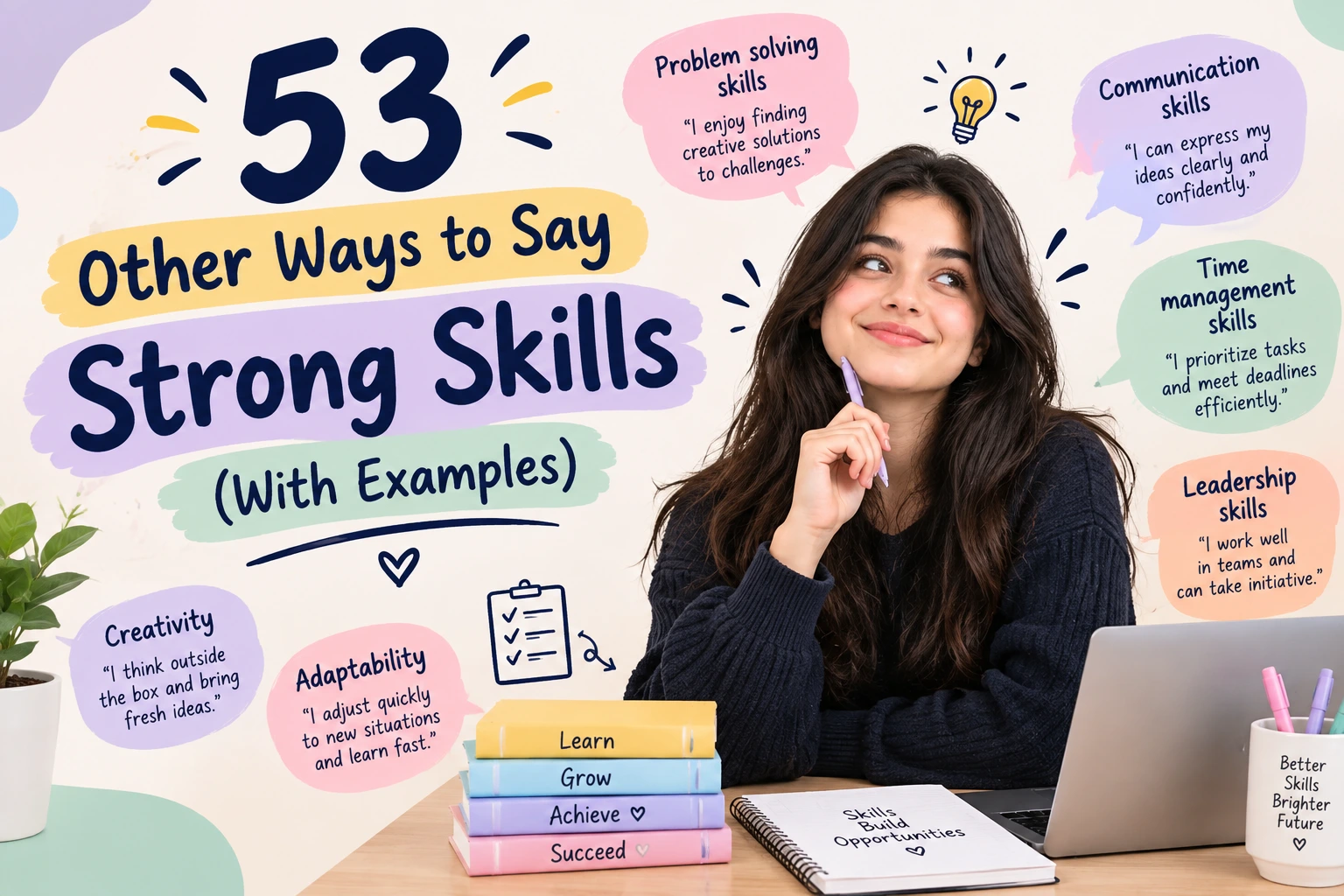
Describing your abilities can be surprisingly difficult, especially when you want to sound confident without appearing boastful. Whether you’re writing a resume, updating your LinkedIn profile, preparing for a job interview, or discussing your experience with a potential employer, choosing the right words matters. The phrase “strong skills” is useful, but repeating it can make your writing sound ordinary and unoriginal. Fortunately, there are many other ways to express the same idea while making your communication more specific and professional. Some alternatives highlight your expertise, while others emphasize practical experience, technical knowledge, or the ability to solve problems. Understanding these differences can help you present yourself more effectively in different situations. In this article, you’ll find 53 alternatives to “strong skills,” along with practical examples to help you choose wording that sounds natural, confident, and appropriate.
2. What Does “Strong Skills” Mean?
The phrase “strong skills” refers to abilities that someone has developed and can use effectively. These abilities may come from education, professional experience, personal projects, or regular practice.
For example, someone with strong communication skills can express ideas clearly, listen carefully, and interact effectively with others. Similarly, a person with strong technical skills may be comfortable using programming languages, software, or specialized tools.
People commonly use this phrase in resumes, job applications, interviews, performance reviews, and professional conversations. However, the best alternative depends on the ability being described and the context.
For instance, “proven expertise” emphasizes demonstrated knowledge, while “well-developed abilities” highlights skills that have improved through practice. Choosing a more precise expression can make your writing clearer and more convincing.
Here are 53 alternatives organized into five categories. Each includes a realistic example to help you understand how to use it naturally.
Category 1: Polite and Appreciative Alternatives
These expressions are useful when discussing someone’s abilities positively, writing professional messages, or acknowledging someone’s accomplishments.
1. Well-Developed Skills
Reply: “Well-developed skills”
Example: During a performance review, a manager might say, “You have well-developed skills in project management, and your attention to detail is appreciated.”
This phrase describes abilities that have improved through experience, practice, or training. It sounds professional without exaggerating someone’s achievements.
2. Impressive Abilities
Reply: “Impressive abilities”
Example: A colleague completes a difficult presentation successfully. You tell them, “You have impressive abilities when it comes to explaining complicated ideas.”
This expression communicates genuine admiration. It works particularly well when recognizing someone’s accomplishments or talents.
3. Excellent Capabilities
Reply: “Excellent capabilities”
Example: During a team meeting, a supervisor says, “Your excellent capabilities in problem-solving have helped us complete several challenging projects.”
This phrase highlights someone’s ability to handle responsibilities effectively. It is suitable for professional conversations and performance evaluations.
4. Valuable Expertise
Reply: “Valuable expertise”
Example: While introducing a new team member, a manager says, “We’re pleased to have someone with valuable expertise in digital marketing.”
This expression emphasizes knowledge and experience that can benefit a team or organization. It is particularly useful in professional introductions.
5. Remarkable Competencies
Reply: “Remarkable competencies”
Example: A teacher recommends a student for an internship, writing, “She has remarkable competencies in research and academic writing.”
This phrase communicates that someone’s abilities stand out. It is particularly appropriate for formal recommendations and academic applications.
6. Refined Abilities
Reply: “Refined abilities”
Example: A designer updates their portfolio after years of practice. They write, “My refined abilities in visual design allow me to create clear and engaging layouts.”
This expression suggests that someone has improved their abilities over time. It works well when describing professional growth.
7. Exceptional Talent
Reply: “Exceptional talent”
Example: After watching a colleague solve a difficult technical problem, you say, “You have exceptional talent for finding practical solutions.”
This phrase highlights a particularly impressive natural or developed ability. Use it when the person’s performance genuinely stands out.
8. Strong Professional Abilities
Reply: “Strong professional abilities”
Example: In a recommendation letter, a former manager writes, “Maria has strong professional abilities in communication, organization, and teamwork.”
This alternative is useful when describing someone’s overall performance in a workplace. It sounds formal while remaining easy to understand.
9. Impressive Competence
Reply: “Impressive competence”
Example: A project leader tells a team member, “Your impressive competence in managing deadlines has made this project much easier.”
This phrase focuses on someone’s ability to perform tasks successfully. It is appropriate for professional feedback and workplace recognition.
10. Highly Developed Expertise
Reply: “Highly developed expertise”
Example: A company introduces its senior developer by saying, “She brings highly developed expertise in software engineering to our team.”
This expression emphasizes extensive knowledge built through experience and learning. It is especially useful when describing specialized professional abilities.
Category 2: Flirty and Playful Alternatives
These alternatives are more casual and expressive. They work when talking about someone’s talents in a friendly, playful, or lighthearted conversation.
11. Impressive Talent
Reply: “Impressive talent”
Example: Your friend prepares an amazing meal for everyone. You smile and say, “You have some impressive talent in the kitchen.”
This expression makes a compliment feel warm and natural. It works well in everyday conversations when someone does something particularly well.
12. Natural Talent
Reply: “Natural talent”
Example: Your crush plays the guitar beautifully. You tell them, “You have such natural talent. How long have you been playing?”
This phrase suggests that someone seems naturally good at something. It can make a compliment feel personal without sounding overly formal.
13. Serious Talent
Reply: “Serious talent”
Example: Your friend shows you a beautifully edited video. You respond, “Okay, you have some serious talent. When did you learn to do that?”
This casual expression adds enthusiasm to a compliment. It is especially useful when you are genuinely surprised by someone’s abilities.
14. Next-Level Abilities
Reply: “Next-level abilities”
Example: Your friend wins a difficult gaming competition. You message them, “Those are some next-level abilities. I wasn’t expecting that!”
This phrase suggests that someone’s performance is unusually impressive. It is suitable for informal conversations, social media, and friendly banter.
15. Impressive Moves
Reply: “Impressive moves”
Example: Someone you’re dating shows you a new dance routine. You laugh and say, “Those are some impressive moves. You might have to teach me.”
This expression is playful and works especially well when describing physical or creative abilities.
16. Serious Expertise
Reply: “Serious expertise”
Example: Your friend repairs your laptop without any difficulty. You say, “You have some serious expertise with computers. I know who to call next time.”
This phrase combines admiration with a relaxed tone. It works when someone demonstrates considerable knowledge in a particular area.
17. A Real Knack for It
Reply: “A real knack for it”
Example: Your crush explains a complicated maths problem in a simple way. You say, “You have a real knack for explaining things. You make it look easy.”
This expression describes an ability to do something particularly well, often with apparent ease. It is a natural choice for casual compliments.
18. Quite the Talent
Reply: “Quite the talent”
Example: Your friend shares their latest painting. You reply, “Well, you’re quite the talent. I didn’t know you could paint like that.”
This expression sounds friendly and slightly playful. It is useful when you want to compliment someone without making the conversation too serious.
19. A Gift for It
Reply: “A gift for it”
Example: Someone you’re interested in gives a confident speech. You tell them, “You really have a gift for public speaking.”
This phrase suggests that someone has a special ability. It works particularly well for creative, social, and communication-related talents.
20. You’ve Got Skills
Reply: “You’ve got skills”
Example: Your friend wins a challenging chess match. You laugh and say, “You’ve got skills. I’m definitely not challenging you again.”
This short, casual expression is perfect for friendly compliments. It sounds confident, relaxed, and slightly humorous.
Category 3: Confident and Self-Respecting Alternatives
These phrases are useful for resumes, interviews, professional introductions, and situations where you need to communicate your abilities confidently.
21. Proven Expertise
Reply: “Proven expertise”
Example: In a job interview, you explain, “I bring proven expertise in managing digital marketing campaigns and analyzing performance data.”
This phrase highlights abilities supported by actual experience or measurable achievements. It is particularly effective when you can provide evidence of your work.
22. Demonstrated Proficiency
Reply: “Demonstrated proficiency”
Example: On your resume, you write, “Demonstrated proficiency in Python programming, data analysis, and debugging.”
This expression communicates that you have shown your ability to perform specific tasks. It works well in resumes, portfolios, and professional profiles.
23. Advanced Competencies
Reply: “Advanced competencies”
Example: During an interview, you say, “My advanced competencies in data visualization help me turn complex information into understandable reports.”
This phrase emphasizes a relatively high level of ability. Use it when your experience genuinely supports the description.
24. Specialized Knowledge
Reply: “Specialized knowledge”
Example: A software engineer explains, “I have specialized knowledge of database management and backend development.”
This expression is particularly useful when your abilities relate to a specific industry, subject, or technical field.
25. Extensive Experience
Reply: “Extensive experience”
Example: On a professional profile, you write, “I have extensive experience in customer service, team coordination, and client communication.”
This phrase emphasizes the amount of practical experience you have gained. It is most appropriate when you have worked in a field for a considerable period.
26. Exceptional Proficiency
Reply: “Exceptional proficiency”
Example: In a professional portfolio, you write, “I demonstrate exceptional proficiency in graphic design and visual storytelling.”
This phrase describes a particularly high level of ability. It is most effective when supported by examples of your work.
27. Technical Proficiency
Reply: “Technical proficiency”
Example: A job applicant writes, “My technical proficiency includes HTML, CSS, JavaScript, and version control.”
This expression is useful when discussing practical abilities involving software, tools, equipment, or technical processes.
28. Core Competencies
Reply: “Core competencies”
Example: On your resume, you include, “Core competencies: problem-solving, communication, research, and project management.”
This phrase refers to the main abilities that support your work. It is particularly useful for professional summaries and resumes.
29. Professional Expertise
Reply: “Professional expertise”
Example: During a networking event, you introduce yourself by saying, “My professional expertise is in content writing and search engine optimization.”
This expression highlights knowledge and experience gained in a professional setting. It is useful for interviews, introductions, and LinkedIn profiles.
30. Established Competence
Reply: “Established competence”
Example: A project manager describes a team member by saying, “She has established competence in coordinating projects and managing complex schedules.”
This phrase suggests that someone’s abilities have been demonstrated consistently. It works well in formal professional evaluations.
31. High-Level Proficiency
Reply: “High-level proficiency”
Example: In a job application, you write, “I have high-level proficiency in Microsoft Excel, including advanced formulas and data analysis.”
This expression communicates that you can perform tasks at a sophisticated level. It is especially useful when describing software or technical abilities.
32. A Strong Skill Set
Reply: “A strong skill set”
Example: During an interview, you explain, “I have a strong skill set in communication, research, and project coordination.”
This is one of the most direct alternatives to the original phrase. It is flexible enough for resumes, interviews, and professional conversations.
33. Exceptional Capability
Reply: “Exceptional capability”
Example: A team leader writes in an evaluation, “His exceptional capability in resolving technical issues has helped reduce project delays.”
This phrase highlights someone’s ability to handle challenging responsibilities. It is suitable for formal assessments and professional recommendations.
Category 4: Funny and Bold Alternatives
These expressions are suitable for informal conversations, humorous compliments, and situations where you want to sound confident without being overly serious.
34. A Skill Set That Speaks for Itself
Reply: “A skill set that speaks for itself”
Example: Your friend wins a design competition. You comment, “With a skill set that speaks for itself, you really don’t need to explain your talent.”
This expression suggests that someone’s work clearly demonstrates their abilities. It can sound playful or confidently professional, depending on the situation.
35. Top-Notch Skills
Reply: “Top-notch skills”
Example: Your colleague finishes a complicated project ahead of schedule. You say, “Those are some top-notch skills. You made that look effortless.”
This informal phrase describes abilities of a very high standard. It works well for friendly conversations and positive workplace feedback.
36. Seriously Impressive Abilities
Reply: “Seriously impressive abilities”
Example: Your friend fixes a broken computer in minutes. You respond, “Those are seriously impressive abilities. I would’ve spent the entire afternoon trying to figure it out.”
This phrase adds emphasis to a compliment. It is useful when someone’s performance genuinely surprises you.
37. A Powerful Skill Set
Reply: “A powerful skill set”
Example: A friend launches a successful online business. You tell them, “You’ve built a powerful skill set. It’s impressive how you manage everything.”
This expression highlights a combination of abilities that work well together. It is useful for discussing business, leadership, and personal accomplishments.
38. Seriously Good at What You Do
Reply: “Seriously good at what you do”
Example: After watching a friend deliver a presentation, you say, “You’re seriously good at what you do. I could never make it look that easy.”
This conversational expression offers a direct compliment without sounding overly formal. It works well in everyday interactions.
39. A Cut Above the Rest
Reply: “A cut above the rest”
Example: Your manager praises your team’s latest project, saying, “Your research and attention to detail make this work a cut above the rest.”
This idiom suggests that someone’s abilities or performance are noticeably better than the usual standard. Use it when the comparison is appropriate.
40. A Serious Set of Skills
Reply: “A serious set of skills”
Example: Your friend edits a professional-looking video using basic equipment. You tell them, “That’s a serious set of skills. You could probably teach a class.”
This phrase is casual and enthusiastic. It is a good choice when you want to recognize someone’s abilities in a relaxed way.
41. Skills That Deliver
Reply: “Skills that deliver”
Example: A colleague consistently meets challenging targets. Their supervisor says, “You have skills that deliver, especially when deadlines are tight.”
This expression focuses on practical results rather than impressive-sounding qualifications. It is useful in performance discussions.
42. A Force to Be Reckoned With
Reply: “A force to be reckoned with”
Example: Your friend wins several debating competitions. You joke, “With those debating abilities, you’re becoming a force to be reckoned with.”
This idiom describes someone whose abilities make them particularly formidable. It works in playful conversations and confident descriptions.
43. Skills on Another Level
Reply: “Skills on another level”
Example: Your friend creates an impressive website. You message them, “Your design skills are on another level. I love how everything works together.”
This casual expression communicates strong admiration. It is particularly suitable for social media, texting, and conversations with friends.
Category 5: Curious, Thoughtful, and Mature Alternatives
These phrases are useful when describing abilities thoughtfully, discussing personal development, or acknowledging the effort behind someone’s achievements.
44. Well-Honed Skills
Reply: “Well-honed skills”
Example: A mentor tells a student, “Your well-honed research skills will help you handle more demanding academic projects.”
This expression describes abilities that have been carefully developed through practice and experience. It is especially useful when recognizing long-term improvement.
45. Practical Expertise
Reply: “Practical expertise”
Example: During a job interview, you explain, “My practical expertise in web development comes from building and maintaining several websites.”
This phrase emphasizes the ability to apply knowledge in real situations. It is useful when discussing projects, internships, and hands-on experience.
46. Proven Abilities
Reply: “Proven abilities”
Example: A former supervisor writes, “Her proven abilities in communication and organization make her a dependable team member.”
This expression highlights skills that have been demonstrated through actual performance. It works well in references and professional profiles.
47. Consistent Performance
Reply: “Consistent performance”
Example: A teacher tells a student, “Your consistent performance in mathematics shows how much effort you’ve put into improving.”
This phrase emphasizes reliability and the ability to maintain a good standard over time. It is useful when discussing progress and dependability.
48. Strong Practical Abilities
Reply: “Strong practical abilities”
Example: A hiring manager says, “We’re looking for candidates with strong practical abilities in research and data collection.”
This expression focuses on skills that can be applied directly to real tasks. It is especially appropriate for technical and hands-on roles.
49. A Well-Rounded Skill Set
Reply: “A well-rounded skill set”
Example: In a job application, you write, “I offer a well-rounded skill set that includes communication, coding, and problem-solving.”
This phrase describes someone who has several complementary abilities. It is useful when your experience extends across different areas.
50. A High Degree of Competence
Reply: “A high degree of competence”
Example: A supervisor writes, “She demonstrates a high degree of competence in managing client relationships and resolving complaints.”
This formal expression communicates that someone can perform their responsibilities effectively. It is suitable for professional reports and evaluations.
51. Adaptable Skill Set
Reply: “Adaptable skill set”
Example: During an interview, you explain, “My adaptable skill set allows me to work across different projects and learn unfamiliar tools.”
This phrase emphasizes the ability to apply existing skills in different situations. It is useful when discussing flexibility and professional development.
52. A Strong Foundation of Skills
Reply: “A strong foundation of skills”
Example: A university graduate writes, “My degree has given me a strong foundation of skills in programming, mathematics, and analytical thinking.”
This expression highlights basic abilities that support further learning and development. It is particularly appropriate for students and early-career professionals.
53. A Demonstrated Ability to Excel
Reply: “A demonstrated ability to excel”
Example: In a recommendation letter, a professor writes, “She has a demonstrated ability to excel in research, independent learning, and collaborative projects.”
This phrase emphasizes a history of successful performance. It is useful when describing achievements that can be supported by specific examples.
4. Real-Life Situations: Which Alternative Should You Use?
The right expression depends on where you’re using it and what you want to communicate. Here are five common situations and suitable alternatives.
Situation 1: When Writing a Resume
Best alternative: “Demonstrated proficiency”
When writing a resume, focus on specific abilities that relate to the position. Instead of simply claiming that you have strong skills, describe what you can actually do.
Example: “Demonstrated proficiency in Python programming, data analysis, and problem-solving.”
This wording is specific and gives recruiters a clearer understanding of your abilities.
Situation 2: When Someone Compliments Your Abilities
Best alternative: “Thank you. I’ve worked hard to develop those skills.”
When someone praises your abilities, accept the compliment without dismissing your effort or exaggerating your achievements.
Example:
Friend: “You’re really good at designing websites.”
You: “Thank you. I’ve worked hard to develop those skills, and I’m still learning.”
This response sounds appreciative, confident, and genuine.
Situation 3: When Describing Your Abilities in an Interview
Best alternative: “Proven expertise”
An interview is an opportunity to explain how your abilities translate into practical results. Avoid making broad claims without supporting examples.
Example:
Interviewer: “What are your main strengths?”
You: “I have proven expertise in organizing projects and solving technical problems. I’ve applied these abilities in several academic projects.”
Whenever possible, follow your statement with a specific example.
Situation 4: When Complimenting a Friend
Best alternative: “You’ve got skills.”
A casual compliment should sound natural rather than rehearsed. Simple expressions are often more effective in everyday conversations.
Example:
Friend: “I finally finished editing that video.”
You: “You’ve got skills. The final result looks amazing.”
This response is friendly, direct, and appropriate for an informal conversation.
Situation 5: When Discussing Your Professional Growth
Best alternative: “Well-honed skills”
When discussing your development, focus on the abilities you’ve improved through practice and experience.
Example: “Over the past year, I’ve developed well-honed skills in research, communication, and project management.”
This wording communicates progress while acknowledging the effort behind your development.
5. Common Mistakes to Avoid
Choosing the right alternative is only part of effective communication. How you use it also matters. Here are six common mistakes to avoid.
1. Using Complicated Words Unnecessarily
Using elaborate expressions does not automatically make your writing sound professional. Phrases such as “advanced competencies” may be appropriate in formal documents, but they can sound unnatural in everyday conversations.
Better approach: Choose clear language that suits your audience and purpose.
2. Repeating the Same Phrase
Using “strong skills” several times in the same paragraph can make your writing repetitive. However, replacing every occurrence with an unusual synonym can make it harder to read.
Better approach: Use natural variations such as “technical proficiency,” “practical expertise,” and “well-developed abilities” where appropriate.
3. Exaggerating Your Abilities
Describing yourself as an expert when you have only basic experience can damage your credibility. Employers and colleagues may expect you to demonstrate the level of expertise you claim.
Better approach: Be honest about your current abilities and provide examples of what you can do.
4. Ignoring the Context
A phrase that sounds appropriate on a resume might feel awkward in a text message. Similarly, playful expressions may not suit a formal recommendation letter.
Better approach: Consider your audience, the situation, and the level of formality before choosing an alternative.
5. Using Vague Descriptions
Statements such as “I have excellent abilities” do not explain what you can actually accomplish.
Better approach: Mention specific abilities, such as programming, communication, research, or problem-solving. Whenever possible, include a real example.
6. Confusing Experience With Ability
Having extensive experience does not necessarily mean someone has mastered every aspect of a field. Likewise, someone can develop impressive abilities through personal projects without years of professional experience.
Better approach: Use “extensive experience” when describing time spent in a field and “demonstrated proficiency” when discussing abilities you have actually shown.
6. Pro Tips for Choosing the Right Alternative
Small changes in wording can make your communication clearer and more effective. Keep these three tips in mind.
1. Match Your Words to Your Audience
For resumes and professional profiles, expressions such as “proven expertise,” “technical proficiency,” and “core competencies” are generally appropriate. For conversations with friends, “you’ve got skills” or “natural talent” sounds more relaxed.
Think about how your audience normally communicates before choosing a phrase.
2. Support Your Claims With Examples
Instead of saying that you have strong problem-solving skills, explain how you used those abilities to complete a project or resolve a difficult issue.
For example, “I used my problem-solving skills to identify and fix errors in a web application” provides more useful information than a general statement.
Specific examples make your claims easier to understand and evaluate.
3. Be Confident Without Overdoing It
Confidence comes from describing your abilities honestly. You don’t need exaggerated adjectives to make your experience sound valuable.
Choose expressions that accurately reflect your level of knowledge. If you’re still learning, phrases such as “developing technical proficiency” or “building practical expertise” can communicate your progress honestly.
7. Bonus: 10 Quick Alternatives to “Strong Skills”
If you need a short expression for a resume, message, or conversation, these alternatives can help.
- Excellent abilities: A simple way to describe impressive capabilities.
- Proven expertise: Useful when you have evidence of your knowledge.
- Technical proficiency: Ideal for technical and software-related abilities.
- Top-notch skills: A casual way to describe excellent performance.
- Core competencies: Suitable for resumes and professional profiles.
- Natural talent: Useful when someone seems naturally gifted.
- Practical expertise: Emphasizes the ability to apply knowledge.
- Well-developed abilities: Highlights improvement through practice.
- Advanced competencies: Appropriate for higher-level professional abilities.
- A well-rounded skill set: Describes a combination of complementary abilities.
8. Conclusion
Finding other ways to say “strong skills” can make your writing more specific, engaging, and professional. Whether you’re preparing a resume, answering an interview question, complimenting a friend, or describing your personal growth, the right expression helps you communicate your abilities clearly.
Remember that the most effective phrase is not necessarily the most complicated one. Choose words that match your experience, audience, and purpose. Whenever possible, support your claims with real examples rather than relying on impressive adjectives alone.
Your skills deserve to be described accurately. Let your words reflect what you can genuinely do.
Discover more
other ways to say technical skills