

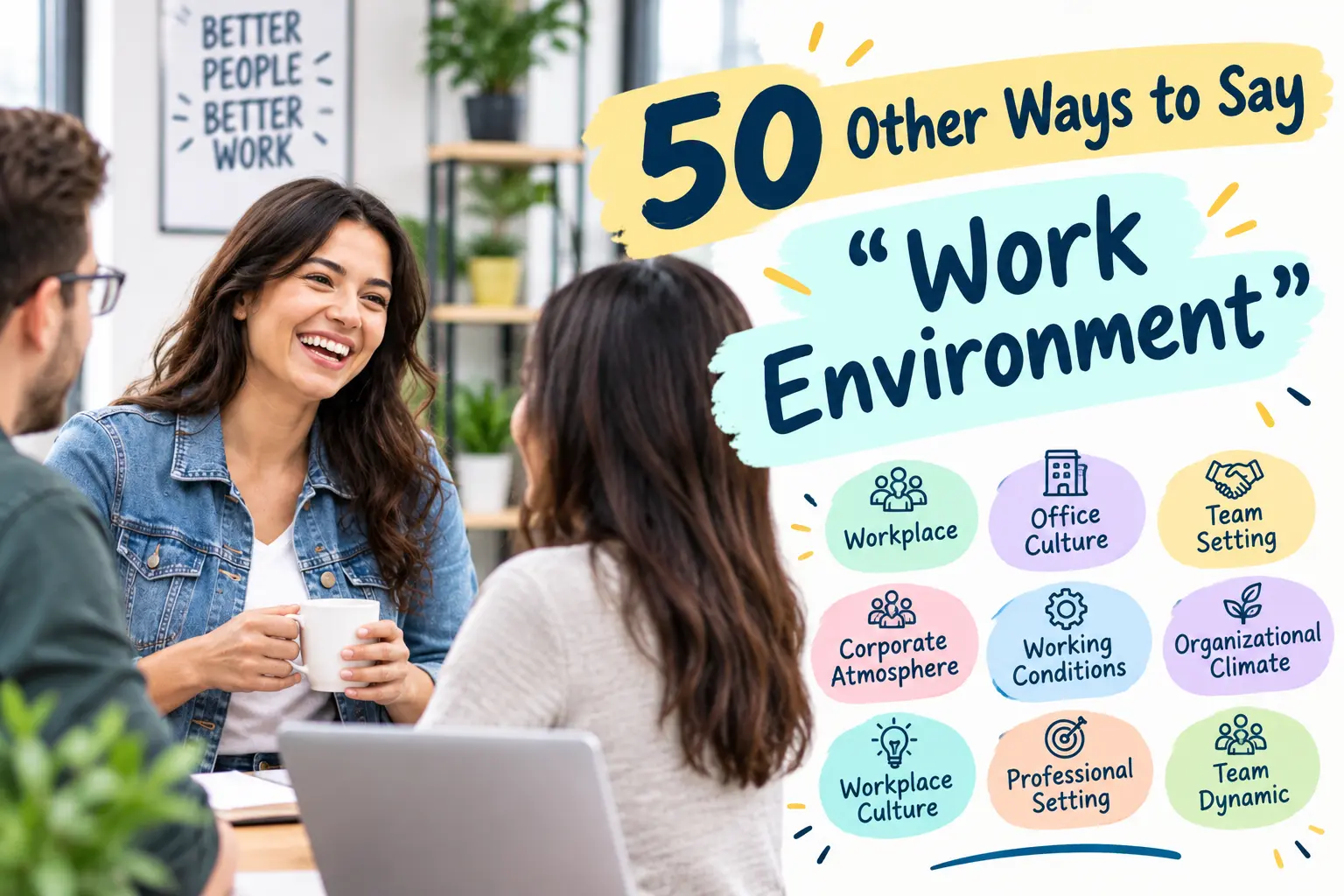
The words you use to describe your workplace can say a lot about how you feel about your job. Maybe you are writing a resume, preparing for an interview, describing your company to a friend, or simply trying to explain what it is like to work somewhere. Saying “work environment” every time can start to sound repetitive.
That is why knowing different ways to say “work environment” can make your writing and conversations sound more natural. Depending on the situation, you might want to describe the atmosphere, company culture, workplace setting, team dynamic, or overall experience.
In this guide, you will find 50 useful alternatives to “work environment,” ranging from professional and polished to casual, confident, funny, and thoughtful. You will also see real-life examples so you can choose the right phrase without sounding forced.
2. What Does “Work Environment” Mean?
“Work environment” refers to the conditions, atmosphere, culture, and relationships that surround people while they are doing their jobs.
It can include everything from the physical workplace and office setup to communication, teamwork, management style, company values, employee relationships, and overall workplace atmosphere.
For example, someone might say:
“I really enjoy the work environment at my company.”
This could mean they like their coworkers, feel respected by management, enjoy the office atmosphere, or simply feel comfortable and motivated at work.
Depending on what you specifically want to describe, alternatives such as “workplace culture,” “office atmosphere,” “team dynamic,” or “professional setting” may communicate your meaning more clearly.
Polite and Appreciative
1. Workplace Atmosphere
Reply: “I really appreciate the positive workplace atmosphere.”
Example:
During an interview, the hiring manager asks what matters most to you at work. You explain that a supportive workplace atmosphere helps you perform your best.
2. Professional Environment
Reply: “It’s a very professional environment.”
Example:
A friend asks about your new company, and you tell them that everyone communicates respectfully and takes their responsibilities seriously.
3. Workplace Culture
Reply: “The workplace culture here is genuinely supportive.”
Example:
You are talking to a former classmate about your job and explain that employees are encouraged to collaborate and share ideas.
4. Positive Work Atmosphere
Reply: “We have a really positive work atmosphere.”
Example:
A colleague asks why you seem happier at your new job. You mention that people are friendly and managers actually listen.
5. Supportive Workplace
Reply: “It’s a very supportive workplace.”
Example:
Someone asks whether your new team has helped you settle in. You say that everyone has been willing to guide you when needed.
6. Collaborative Workplace
Reply: “It’s a highly collaborative workplace.”
Example:
During an interview, you describe a company where employees regularly work together instead of handling every task individually.
7. Healthy Work Culture
Reply: “The company has a healthy work culture.”
Example:
Your friend asks whether employees are treated fairly. You explain that communication is open and people respect each other’s boundaries.
8. Respectful Workplace
Reply: “It’s a respectful workplace where everyone gets heard.”
Example:
You describe your team to someone considering applying for a position at your company.
9. Welcoming Workplace
Reply: “It’s a very welcoming workplace.”
Example:
After your first week, someone asks how you are adjusting. You tell them that your coworkers made you feel comfortable almost immediately.
10. Encouraging Work Setting
Reply: “It’s an encouraging work setting.”
Example:
You explain to a potential employer that you enjoy workplaces where employees receive constructive feedback and opportunities to improve.
Flirty and Playful
These options work better in casual conversations, especially when you are talking about work with someone you like. They are not ideal for formal emails or interviews.
11. A Workplace With Good Energy
Reply: “Honestly, my workplace has pretty good energy.”
Example:
Your crush asks whether you like your job. You smile and say that the people make going to work much more enjoyable.
12. A Fun Place to Work
Reply: “It’s actually a pretty fun place to work.”
Example:
Someone you are texting asks whether your job is boring. You tell them your coworkers make even busy days entertaining.
13. A Place With Great Vibes
Reply: “My office has surprisingly great vibes.”
Example:
Your crush asks what your office is like, and you joke that the atmosphere is much better than you expected.
14. A Happy Little Workplace
Reply: “It’s basically a happy little workplace.”
Example:
A friend asks why you always seem relaxed after work. You tell them that your team gets along unusually well.
15. A Pretty Chill Workplace
Reply: “It’s a pretty chill workplace, honestly.”
Example:
Someone asks whether your manager is strict. You explain that everyone works hard but the atmosphere is relaxed.
16. A Workplace I Actually Enjoy
Reply: “It’s one of those rare workplaces I actually enjoy.”
Example:
Your crush asks whether you hate Mondays. You laugh and say that your current job has made Mondays less painful.
17. A Team With Good Vibes
Reply: “I ended up with a team that has really good vibes.”
Example:
You are telling someone about your first month at a new company and mention how naturally everyone gets along.
18. My Happy Place at Work
Reply: “At this point, my office is basically my happy place.”
Example:
A close friend teases you for talking about your coworkers so much, and you jokingly defend your favorite team.
19. A Surprisingly Fun Crowd
Reply: “I work with a surprisingly fun crowd.”
Example:
Someone asks what your coworkers are like, and you explain that they keep the workplace lively without becoming unprofessional.
20. Work, But Make It Enjoyable
Reply: “It’s work, but somehow they make it enjoyable.”
Example:
Your crush asks why you don’t complain about work as much anymore. You say that having good people around changes everything.
Confident and Self-Respecting
These phrases are useful when you want to communicate your expectations, standards, and professional values clearly.
21. A Professional Setting
Reply: “I prefer working in a professional setting.”
Example:
During an interview, you explain that clear communication and mutual respect are important to you.
22. A Respect-Driven Workplace
Reply: “I value a respect-driven workplace.”
Example:
A recruiter asks what kind of company culture you are looking for. You explain that respect should go both ways.
23. A Growth-Oriented Environment
Reply: “I thrive in a growth-oriented environment.”
Example:
You are answering an interview question about your ideal workplace and explain that you like learning new skills.
24. A Results-Focused Workplace
Reply: “I work well in a results-focused workplace.”
Example:
Your manager asks what helps you stay motivated. You explain that clear goals and measurable progress keep you focused.
25. A Culture of Accountability
Reply: “I appreciate a culture of accountability.”
Example:
During a job interview, you explain that you value teams where people take responsibility for their work.
26. An Inclusive Workplace
Reply: “I want to be part of an inclusive workplace.”
Example:
A recruiter asks what you expect from your next employer. You say you want everyone to have an opportunity to contribute.
27. A Balanced Work Setting
Reply: “I value a balanced work setting.”
Example:
You are discussing your ideal job and explain that productivity matters, but so does having reasonable boundaries.
28. A High-Performance Environment
Reply: “I perform well in a high-performance environment.”
Example:
During an interview, you explain that challenging goals motivate you to improve your skills.
29. A People-Focused Workplace
Reply: “I prefer a people-focused workplace.”
Example:
Someone asks why company culture matters to you. You explain that good results usually start with treating people well.
30. A Workplace That Supports Growth
Reply: “I want a workplace that supports growth.”
Example:
You are applying for a new position and explain that you are looking for mentorship, learning opportunities, and meaningful responsibilities.
Funny and Savage
Use these casually with friends or coworkers you know well. Some are humorous descriptions rather than professional alternatives.
31. The Daily Circus
Reply: “Our workplace is basically the daily circus.”
Example:
Your friend asks how work went. You laugh and explain that three unexpected problems appeared before lunch.
32. Controlled Chaos
Reply: “It’s controlled chaos most of the time.”
Example:
Someone asks whether your office is organized. You jokingly explain that everyone somehow knows what they are doing despite the madness.
33. Corporate Survival Mode
Reply: “We’re basically in corporate survival mode.”
Example:
Your coworker asks how the project is going, and you joke about the endless deadlines.
34. The Office Drama Department
Reply: “I work in the office drama department.”
Example:
Your friend asks why you have so many workplace stories. You joke that your coworkers provide enough drama for a television show.
35. A Beautiful Mess
Reply: “It’s a beautiful mess over there.”
Example:
Someone asks whether your workplace is organized. You explain that things are messy but the team somehow gets results.
36. Professional Chaos
Reply: “It’s professional chaos with a calendar.”
Example:
Your coworker complains about another last-minute meeting, and you joke about how unpredictable office life can be.
37. The Land of Endless Meetings
Reply: “Welcome to the land of endless meetings.”
Example:
A friend asks what you did all day. You laugh and say that half your day disappeared into meetings.
38. Corporate Jungle
Reply: “It’s basically a corporate jungle.”
Example:
You tell your friend that competition between departments can sometimes make the office feel intense.
39. Organized Panic
Reply: “We call it organized panic.”
Example:
A deadline is approaching and everyone is rushing around, but somehow the project is still moving forward.
40. The Adult Playground
Reply: “Some days, it feels like an adult playground with deadlines.”
Example:
You joke about how your team spends the morning laughing together before suddenly becoming serious about a major project.
Curious, Thoughtful, and Mature
These alternatives work well when you want to discuss workplace culture in a more thoughtful way.
41. Team Dynamic
Reply: “I really like the team dynamic here.”
Example:
Someone asks what makes your new job different. You explain that everyone communicates openly and works well together.
42. Company Culture
Reply: “The company culture is a big reason I enjoy working here.”
Example:
During a conversation about your career, you explain that the company’s values match the way you like to work.
43. Workplace Experience
Reply: “My overall workplace experience has been positive.”
Example:
Someone asks how your first few months at the company have gone, and you give them a balanced answer.
44. Professional Atmosphere
Reply: “There’s a calm and professional atmosphere here.”
Example:
You describe your office to a friend and mention that people stay focused without making the workplace feel tense.
45. Team Culture
Reply: “The team culture makes a huge difference.”
Example:
You explain to a new employee that supportive teammates can make even difficult projects easier.
46. Employee Experience
Reply: “The company seems genuinely focused on employee experience.”
Example:
You are discussing your employer’s policies and mention the flexibility and support employees receive.
47. Organizational Culture
Reply: “The organizational culture is very different from my previous company.”
Example:
During a career discussion, you explain that your current workplace encourages more collaboration and open communication.
48. Working Conditions
Reply: “The working conditions are much better than I expected.”
Example:
A friend asks about your new job, and you mention the flexible hours, comfortable workspace, and supportive management.
49. Workplace Climate
Reply: “The workplace climate feels positive and respectful.”
Example:
You are describing your department and explain that employees can raise concerns without feeling ignored.
50. Day-to-Day Work Experience
Reply: “My day-to-day work experience has been pretty rewarding.”
Example:
Someone asks whether you are happy with your career change, and you explain that your daily responsibilities feel meaningful.
4. Real-Life Situations
When Your Crush Asks What Your Job Is Like
Keep it casual rather than giving them a corporate presentation.
Best reply:
“It’s actually a pretty fun place to work. The people make it better.”
This answers their question while leaving room for the conversation to become more personal.
When a Friend Jokes About Your Workplace
If your friend already knows your office is chaotic, humor usually works best.
Best reply:
“Controlled chaos, as always.”
It is short, natural, and gives them something to joke about.
When Someone Asks During a Job Interview
This is where you should sound professional and intentional.
Best reply:
“I thrive in a collaborative and growth-oriented environment where people communicate openly.”
It shows that you understand what you need from a workplace without sounding demanding.
When You Are Talking About a New Job
You can focus on your experience rather than simply saying whether the workplace is “good” or “bad.”
Best reply:
“I’ve really enjoyed the team dynamic so far. Everyone has been supportive.”
When You Are Not Happy With Your Workplace
You do not always need to criticize your employer directly.
Best reply:
“I’m looking for a workplace with stronger communication, clearer expectations, and better opportunities for growth.”
This keeps the conversation mature and professional.
5. What to Avoid
1. Using Corporate Language Everywhere
Not every conversation needs phrases like “organizational culture” or “high-performance environment.” With friends, simpler language usually sounds more natural.
2. Making Every Workplace Sound Perfect
If someone asks about your job, you do not have to pretend everything is amazing. A balanced answer can sound more believable.
3. Using Humor at the Wrong Time
“Corporate survival mode” might make your friend laugh, but it probably does not belong in a formal interview.
4. Complaining Without Context
If you are unhappy with your workplace, explain the specific issue instead of simply saying, “My environment is terrible.”
5. Confusing Workplace Culture With Physical Workspace
A workplace can have a beautiful office but poor company culture. “Work environment” can refer to both, so choose a more specific phrase when necessary.
6. Repeating the Same Phrase
If you are writing an essay, resume, LinkedIn profile, or professional report, repeatedly using “work environment” can make your writing feel repetitive. Mix in natural alternatives where they genuinely fit.
6. Pro Tips
Match the Phrase to the Situation
Use “workplace culture” when discussing values and behavior. Use “office atmosphere” when describing the feeling of a workplace. Use “team dynamic” when focusing on coworkers and collaboration.
Think About Your Audience
A recruiter expects professional language. A friend probably prefers something simple like “It’s a pretty chill workplace.”
Be Specific When It Matters
Instead of saying, “I like the work environment,” explain why:
“I like the supportive team culture because everyone is comfortable sharing ideas.”
That sounds more genuine and gives the listener useful information.
7. Bonus: Quick One-Liner Alternatives
If you need a short phrase, try one of these:
- “A supportive workplace.”
- “A positive work culture.”
- “A collaborative environment.”
- “A professional setting.”
- “A healthy workplace.”
- “A great team dynamic.”
- “A positive office atmosphere.”
- “A growth-focused environment.”
- “A respectful workplace.”
- “A rewarding work experience.”
8. Conclusion
There is no single perfect replacement for “work environment.” The best phrase depends on what you actually want to describe: the people, atmosphere, culture, working conditions, or your overall experience.
For professional situations, phrases like “workplace culture,” “professional setting,” and “growth-oriented environment” work well. For casual conversations, “pretty chill workplace,” “good vibes,” or even “controlled chaos” can sound much more natural.
The key is not to use complicated words just to sound impressive. Choose language that fits the situation and honestly reflects what you mean.
The right words do more than describe your workplace—they show how you experience it.
Discover more
other ways to say long time no see