

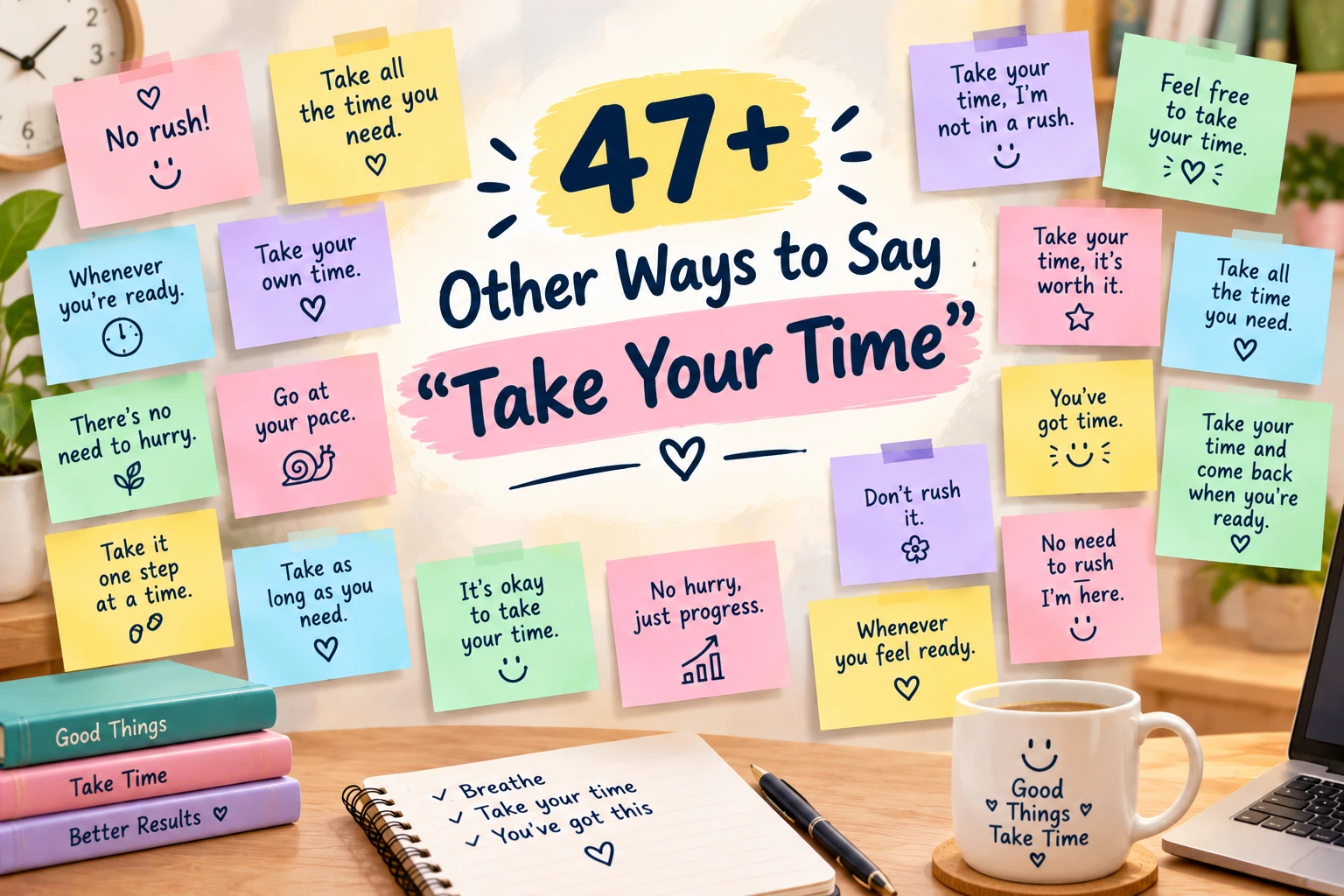
Sometimes, the best thing you can tell someone is simple: “Take your time.” It can make a stressful moment feel easier. Maybe a friend is trying to explain something, someone is getting ready to meet you, or a person needs a little space before making a decision.
But saying the same phrase again and again can feel repetitive. That is why many people look for other ways to say take your time that sound more natural, warm, confident, funny, or playful.
The right response depends on the situation. You might want to sound caring with a friend, professional at work, playful over text, or confident when someone is taking longer than expected.
Below, you’ll find 47+ natural alternatives, along with real-life examples. Whether you want to keep a conversation relaxed or show someone that there is no pressure, these phrases can help you say it in a way that actually sounds like you.
2. What Does “Take Your Time” Mean?
“Take your time” means there is no need to hurry.
When someone says it, they are usually giving you permission to slow down, think carefully, finish something properly, or respond when you are ready.
For example, if your friend is writing an important message, you might say, “Take your time. You don’t have to reply right away.”
It can also show patience and understanding. In some situations, it means, “I’m willing to wait, so don’t feel pressured.”
The tone matters, though. A warm “Take your time” sounds supportive, while a sarcastic version can sound like impatience. That is why choosing the right alternative is important.
Polite and Appreciative
1. Reply: “Of course, no rush.”
Example: Your friend is deciding what time to meet. You reply, “Of course, no rush. Just let me know when you’re free.”
This sounds relaxed, polite, and easygoing.
2. Reply: “Take all the time you need.”
Example: Someone is explaining a difficult situation. You say, “Take all the time you need. I’m listening.”
It shows patience without putting pressure on them.
3. Reply: “Whenever you’re ready.”
Example: Your friend is not ready to talk yet. You say, “Whenever you’re ready, I’m here.”
This works well when someone needs emotional or personal space.
4. Reply: “There’s no hurry.”
Example: Your classmate is finishing a group assignment. You tell them, “There’s no hurry. Send it when you’ve checked everything.”
It feels calm and reassuring.
5. Reply: “No pressure at all.”
Example: Someone is unsure whether they can attend your event. You say, “No pressure at all. Just let me know later.”
This makes the other person feel comfortable.
6. Reply: “Please don’t feel rushed.”
Example: A friend is trying to make an important decision. You say, “Please don’t feel rushed. Think about what works for you.”
It sounds thoughtful and respectful.
7. Reply: “Whenever it works for you.”
Example: You are waiting for someone to send a document. You write, “Whenever it works for you, just send it over.”
This is especially useful in polite or professional conversations.
8. Reply: “I’m happy to wait.”
Example: Your friend apologizes for taking longer than expected. You say, “Don’t worry. I’m happy to wait.”
It clearly shows that you are not bothered.
9. Reply: “No need to hurry on my account.”
Example: Someone is getting ready while you wait. You say, “No need to hurry on my account. I’m good.”
It sounds considerate without being overly formal.
10. Reply: “Do what feels comfortable for you.”
Example: Your friend is unsure when they want to discuss something personal. You say, “Do what feels comfortable for you. We can talk whenever.”
This gives them control over the timing.
Flirty and Playful
11. Reply: “I can wait for you.”
Example: Someone says they need a few more minutes before meeting you. You text, “I can wait for you. Just don’t disappear on me.”
It adds a light, playful tone.
12. Reply: “I’ll be right here.”
Example: Your crush says they need some time before answering your message. You reply, “I’ll be right here. No rush.”
It sounds warm without being too serious.
13. Reply: “Take your time, I’m not going anywhere.”
Example: Someone is choosing what to order. You joke, “Take your time, I’m not going anywhere.”
It keeps the conversation relaxed.
14. Reply: “I’ll give you a minute, superstar.”
Example: Your friend is taking forever to get ready. You text, “I’ll give you a minute, superstar. Just one.”
This works when you already have a joking relationship.
15. Reply: “Slow and steady, I suppose.”
Example: Someone takes a while to choose a movie. You say, “Slow and steady, I suppose. Pick your masterpiece.”
It turns waiting into playful teasing.
16. Reply: “I’m patient when it matters.”
Example: Someone apologizes for taking a while to respond. You reply, “Don’t worry. I’m patient when it matters.”
It sounds confident with a little playful charm.
17. Reply: “I’ll let you work your magic.”
Example: Your friend is getting ready for an event. You say, “I’ll let you work your magic. Let me know when you’re ready.”
It adds personality without creating pressure.
18. Reply: “No rush, but I’m curious.”
Example: Someone says they have a surprise to tell you later. You reply, “No rush, but I’m definitely curious now.”
It keeps the conversation fun.
19. Reply: “Take your time, I’ll try not to be impatient.”
Example: Your friend is choosing between two plans. You joke, “Take your time. I’ll try not to be impatient.”
The humor keeps the wait from sounding serious.
Confident and Self-Respecting
20. Reply: “Take the time you need. I’ll make my own plans.”
Example: Someone is unsure about meeting you. You say, “Take the time you need. I’ll make my own plans for tonight.”
It shows patience while protecting your time.
21. Reply: “Think it through and let me know.”
Example: Someone is deciding whether they want to join your project. You say, “Think it through and let me know when you’ve decided.”
It is direct without sounding demanding.
22. Reply: “You can decide when you’re ready.”
Example: A friend is unsure about a choice. You say, “You can decide when you’re ready. You don’t have to choose right now.”
This gives them space without making you responsible for their decision.
23. Reply: “I’m not in a rush.”
Example: Someone apologizes for replying late. You say, “You’re fine. I’m not in a rush.”
Short, calm, and confident.
24. Reply: “I’ll leave the decision with you.”
Example: Someone cannot decide whether to attend. You say, “I’ll leave the decision with you. Just keep me posted.”
It makes your position clear while respecting theirs.
25. Reply: “Let me know when you’re certain.”
Example: Someone keeps changing their plans. You say, “That’s fine. Let me know when you’re certain.”
This is useful when you want clarity without chasing someone.
26. Reply: “I respect your pace.”
Example: Your friend needs more time to make a personal decision. You say, “I respect your pace. Just tell me when you’re ready.”
It communicates maturity and understanding.
27. Reply: “No need to force an answer.”
Example: Someone is unsure how they feel about a situation. You say, “No need to force an answer. Take some time to think.”
It removes unnecessary pressure.
28. Reply: “I’ll give you the space you need.”
Example: Someone wants some time before discussing an issue. You say, “I’ll give you the space you need. We can talk later.”
This sounds respectful and emotionally mature.
29. Reply: “Take your time, but keep me updated.”
Example: A teammate needs more time to finish their part of a project. You say, “Take your time, but keep me updated so I know where things stand.”
It balances patience with clear communication.
Funny and Savage
30. Reply: “Take your time. I’ve got snacks.”
Example: Your friend is taking forever to get ready. You text, “Take your time. I’ve got snacks and a whole evening.”
It turns a long wait into a joke.
31. Reply: “No rush. The calendar isn’t judging you.”
Example: Your friend is stressing over a small decision. You say, “No rush. The calendar isn’t judging you.”
It gives the situation a funny twist.
32. Reply: “Take your time. Apparently, we have all day.”
Example: Someone spends ten minutes choosing a restaurant. You joke, “Take your time. Apparently, we have all day.”
It is playful sarcasm for close friends.
33. Reply: “At this point, take your time.”
Example: Your friend says they need another few minutes after already being late. You reply, “At this point, take your time.”
The humor comes from the obvious delay.
34. Reply: “No pressure. Just the entire universe is waiting.”
Example: Your friend cannot choose which photo to post. You say, “No pressure. Just the entire universe is waiting.”
It exaggerates the situation for comic effect.
35. Reply: “Take your time. I’ll age gracefully.”
Example: Someone is taking forever to reply. You joke, “Take your time. I’ll age gracefully while I wait.”
It is best used with someone who understands your humor.
36. Reply: “Sure, take your time. I clearly have nowhere to be.”
Example: Your friend keeps changing plans. You say, “Sure, take your time. I clearly have nowhere to be.”
The sarcasm makes your impatience obvious without being harsh.
37. Reply: “No hurry. We only started waiting yesterday.”
Example: Someone finally responds after a long delay. You joke, “No hurry. We only started waiting yesterday.”
This works well with close friends.
38. Reply: “Take your time. I’ll send a search party later.”
Example: Your friend disappears while getting ready. You text, “Take your time. I’ll send a search party later.”
It keeps the message silly rather than genuinely annoyed.
39. Reply: “Whenever you finish your dramatic decision-making process.”
Example: Your friend cannot choose between two outfits. You say, “Whenever you finish your dramatic decision-making process.”
It is a playful way to tease someone.
Curious, Thoughtful, and Mature
40. Reply: “What would make you feel ready?”
Example: Your friend says they need more time before making a decision. You ask, “What would make you feel ready?”
This moves the conversation toward understanding.
41. Reply: “Is there anything you need before deciding?”
Example: Someone is unsure about joining a project. You ask, “Is there anything you need before deciding?”
It shows that you care about their perspective.
42. Reply: “Would you like some space to think?”
Example: Your friend looks overwhelmed. You say, “Would you like some space to think, or would you rather talk about it?”
This gives them a choice.
43. Reply: “What’s holding you back?”
Example: Someone keeps delaying a decision. You gently ask, “What’s holding you back? Maybe we can figure it out.”
It encourages an honest conversation.
44. Reply: “Take the time to make the right choice for you.”
Example: Your friend is choosing between two opportunities. You say, “Take the time to make the right choice for you. You don’t have to decide today.”
It sounds supportive and mature.
45. Reply: “There’s nothing wrong with needing more time.”
Example: Someone feels guilty for not having an answer yet. You say, “There’s nothing wrong with needing more time.”
It reassures them without pushing.
46. Reply: “Let’s not rush something that matters.”
Example: You and a friend are discussing an important plan. You say, “Let’s not rush something that matters. We can think it through.”
This works well when the decision deserves careful thought.
47. Reply: “We can talk when you feel ready.”
Example: Someone does not want to discuss an issue immediately. You say, “That’s okay. We can talk when you feel ready.”
It shows patience and emotional awareness.
48. Reply: “Take the time you need, and we’ll figure out the rest later.”
Example: Your friend is dealing with a difficult choice. You say, “Take the time you need, and we’ll figure out the rest later.”
It provides reassurance without demanding an immediate answer.
4. Real-Life Situations
When Your Crush Says “Take Your Time”
If someone you like says this while you are deciding what to say or do, you can keep things light.
Best reply: “I appreciate that. I’ll let you know when I’m ready.”
If the conversation is playful, “I’ll try not to keep you waiting too long” can also work.
When a Friend Says It as a Joke
If your friend says “take your time” after you have taken ages to decide, humor usually works best.
Best reply: “Thanks for your endless patience. I’m almost done.”
It acknowledges the joke without making things awkward.
When Someone Says It Too Early
Sometimes someone tells you to take your time before you have even started thinking about something.
Best reply: “I appreciate that. I’ll let you know once I’ve had a chance to think.”
This keeps things polite and gives you room to decide.
When You Are Not Interested
If someone is waiting for your answer and you are not interested, avoid giving them false hope.
Best reply: “I appreciate your patience. I’ll be honest once I’ve made up my mind.”
If you already know your answer, being clear is usually kinder than delaying the conversation.
When Someone Is Taking Too Long
If you are genuinely waiting and need an update, you do not have to keep saying “take your time.”
Best reply: “No pressure, but could you let me know when you have an update?”
This is polite while still respecting your own time.
5. What to Avoid
1. Do not sound passive-aggressive.
Saying “Take your time” with an obviously annoyed tone can create tension.
2. Do not use sarcasm with everyone.
Funny replies work best with people who understand your humor.
3. Do not pressure someone after saying there is no pressure.
If you tell someone to take their time, give them the space you promised.
4. Do not over-explain.
A simple “Whenever you’re ready” can be more effective than a long message.
5. Do not ignore your own time.
Being patient does not mean you have to wait forever without asking for an update.
6. Do not use flirty replies when the situation is serious.
Read the mood first. A playful response can feel inappropriate during an emotional conversation.
6. Pro Tips
Match the tone to the relationship.
Use polite phrases with coworkers, warm phrases with friends, and playful ones with people who already enjoy that style of conversation.
Be patient without becoming passive.
Giving someone time is healthy. So is asking for clarity when you need it.
Pay attention to timing.
“Whenever you’re ready” feels supportive at the right moment. In a time-sensitive situation, “Take your time” may not be practical.
The goal is not to find the fanciest alternative. It is to choose the phrase that sounds natural coming from you.
7. Conclusion
There are plenty of other ways to say take your time, but the best one depends on what you want the other person to feel.
You can sound warm with “Whenever you’re ready,” confident with “Think it through and let me know,” thoughtful with “Would you like some space to think?” or funny with “I’ve got snacks.”
The key is simple: give people room without losing your own voice.
Be patient, stay genuine, and let your words match the moment.
Discover more