
Have you ever listened to someone explain something and thought, “Wait… what?” You understand every individual word, but somehow the whole idea still doesn’t add up. Saying “that doesn’t make sense” is perfectly normal, but sometimes you need a softer, smarter, funnier, or more professional way to express the same thought.
The best alternative depends on the situation. You may want to disagree politely at work, question something without sounding rude, or tell a friend that their story is completely confusing. In other situations, you may want to sound confident and direct rather than overly diplomatic.
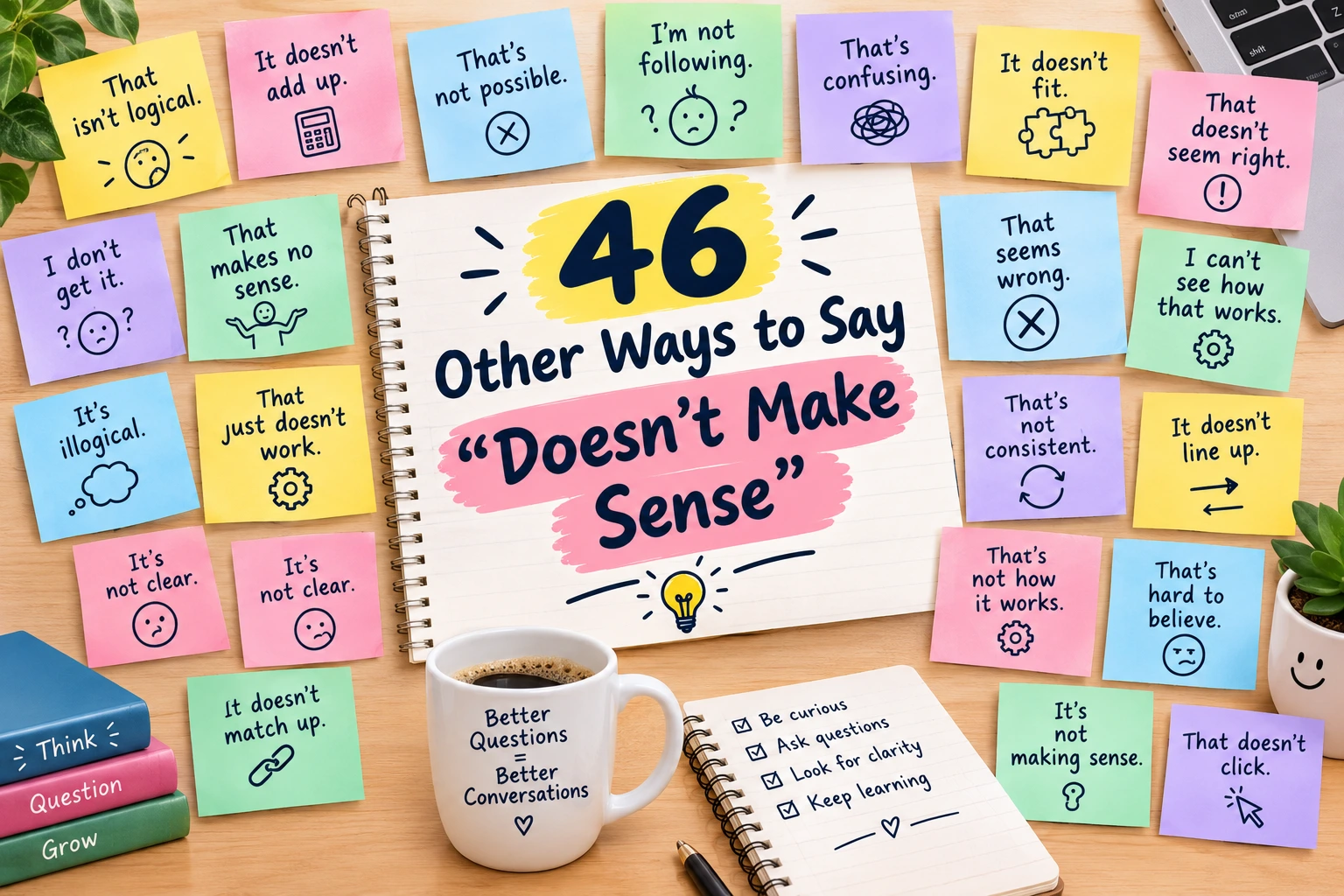
Below, you’ll find 46 other ways to say “doesn’t make sense,” with realistic examples to help you choose the right expression. Whether you’re texting a friend, discussing an idea, asking for clarification, or handling a difficult conversation, there’s an option that fits.
What Does “Doesn’t Make Sense” Mean?
“Doesn’t make sense” means that something is difficult to understand, illogical, unclear, inconsistent, or doesn’t seem reasonable.
For example, if someone gives you an explanation that contradicts what they said earlier, you might say:
“That doesn’t make sense to me.”
The phrase can refer to many things. An explanation may be confusing, an argument may be illogical, or someone’s actions may not match their words.
The tone depends heavily on how you say it. A calm “Could you explain that another way?” sounds polite, while “That makes absolutely no sense” is much more direct.
Polite and Appreciative
These alternatives are useful when you want to question an idea without making the other person feel embarrassed or attacked.
1. “I’m not quite following.”
Reply: “I’m not quite following.”
Example:
Your coworker explains a complicated process, but you’re still unsure what happens next. You say, “I’m not quite following. Could you walk me through that last part?”
This is a gentle way to admit that you need more explanation.
2. “Could you clarify that for me?”
Reply: “Could you clarify that for me?”
Example:
A teacher gives an instruction that seems unclear, so you ask, “Could you clarify that for me before I start?”
It focuses on getting information rather than criticizing the person.
3. “I’m having trouble understanding that.”
Reply: “I’m having trouble understanding that.”
Example:
“I’m having trouble understanding that part of the proposal. Could you explain what you mean?”
This sounds respectful and works well in professional situations.
4. “I’m not sure I understand the connection.”
Reply: “I’m not sure I understand the connection.”
Example:
“You mentioned the deadline and then brought up the budget. I’m not sure I understand the connection.”
Use this when two ideas don’t seem related.
5. “That’s a little unclear to me.”
Reply: “That’s a little unclear to me.”
Example:
“The first part is clear, but the final step is a little unclear to me.”
This is softer than directly saying something makes no sense.
6. “Could you explain that another way?”
Reply: “Could you explain that another way?”
Example:
“I understand the general idea, but could you explain that another way?”
It is simple, polite, and useful in almost any situation.
7. “I may be missing something here.”
Reply: “I may be missing something here.”
Example:
“I may be missing something here, but how does this solve the original problem?”
This avoids immediately placing the blame on the other person.
8. “I’m not seeing how that works.”
Reply: “I’m not seeing how that works.”
Example:
“You want to finish everything today, but I’m not seeing how that works with the current schedule.”
This is especially useful when discussing plans or practical decisions.
9. “I’m not sure that follows.”
Reply: “I’m not sure that follows.”
Example:
“You said sales increased, so I’m not sure that follows from the numbers you just showed us.”
A thoughtful option for discussions and debates.
Flirty and Playful
These alternatives work when you want to point out confusion without making the conversation feel serious or tense.
10. “Wait, my brain needs a minute.”
Reply: “Wait, my brain needs a minute.”
Example:
Your friend gives you a complicated explanation and you reply, “Wait, my brain needs a minute. Start from the beginning.”
It keeps the situation light and humorous.
11. “Okay, I’m officially confused.”
Reply: “Okay, I’m officially confused.”
Example:
“You said you weren’t going, then you said you already went. Okay, I’m officially confused.”
A casual way to ask someone to explain themselves.
12. “You lost me somewhere along the way.”
Reply: “You lost me somewhere along the way.”
Example:
“I understood the first five minutes, but you lost me somewhere along the way.”
This works particularly well in friendly conversations.
13. “My brain has left the chat.”
Reply: “My brain has left the chat.”
Example:
“Wait, you’re explaining calculus again. My brain has left the chat.”
A humorous option for casual texting.
14. “I’m going to need subtitles for this.”
Reply: “I’m going to need subtitles for this.”
Example:
“You’re using way too much technical language. I’m going to need subtitles for this.”
Use it when someone is explaining something in an unnecessarily complicated way.
15. “Hold on, what just happened?”
Reply: “Hold on, what just happened?”
Example:
“You were agreeing with me five minutes ago. Hold on, what just happened?”
This is natural when a conversation suddenly takes an unexpected turn.
16. “That explanation took me on a journey.”
Reply: “That explanation took me on a journey.”
Example:
“I’m still trying to understand how we got from the original topic to this. That explanation took me on a journey.”
A playful way to point out a confusing explanation.
17. “I need a map for that explanation.”
Reply: “I need a map for that explanation.”
Example:
“You jumped between five different topics. I need a map for that explanation.”
This adds humor while still making your point.
18. “You’re going to have to rewind that one.”
Reply: “You’re going to have to rewind that one.”
Example:
“Wait, you lost me at the second part. You’re going to have to rewind that one.”
Perfect for casual conversations where you want clarification without sounding annoyed.
Confident and Self-Respecting
These phrases are useful when something genuinely seems illogical and you want to communicate your position clearly.
19. “That doesn’t add up.”
Reply: “That doesn’t add up.”
Example:
“You said the package was delivered yesterday, but the tracking information says it hasn’t shipped. That doesn’t add up.”
This is direct and confident.
20. “I don’t see the logic in that.”
Reply: “I don’t see the logic in that.”
Example:
“If the goal is to save time, adding another unnecessary step doesn’t seem helpful. I don’t see the logic in that.”
Use this when you want to challenge someone’s reasoning.
21. “That doesn’t seem consistent.”
Reply: “That doesn’t seem consistent.”
Example:
“You said attendance is optional, but now you’re saying everyone must attend. That doesn’t seem consistent.”
This works well when someone’s statements contradict each other.
22. “The reasoning doesn’t quite hold up.”
Reply: “The reasoning doesn’t quite hold up.”
Example:
“I understand the argument, but the reasoning doesn’t quite hold up when we look at the actual numbers.”
A stronger and more analytical alternative.
23. “I’m not convinced by that explanation.”
Reply: “I’m not convinced by that explanation.”
Example:
“I’ve heard your reasoning, but I’m not convinced by that explanation.”
This clearly communicates disagreement without being insulting.
24. “That doesn’t seem reasonable.”
Reply: “That doesn’t seem reasonable.”
Example:
“Expecting everyone to complete the entire project overnight doesn’t seem reasonable.”
Useful when the issue is practicality rather than pure logic.
25. “There seems to be a contradiction here.”
Reply: “There seems to be a contradiction here.”
Example:
“You said the product is unavailable, but the next slide says it’s ready to ship. There seems to be a contradiction here.”
A strong choice for formal discussions.
26. “I don’t think those points line up.”
Reply: “I don’t think those points line up.”
Example:
“You’re saying the plan will reduce costs, but you’re also adding three new expenses. I don’t think those points line up.”
This clearly identifies a problem without becoming aggressive.
27. “That conclusion doesn’t follow from the evidence.”
Reply: “That conclusion doesn’t follow from the evidence.”
Example:
“We only have one example, so that conclusion doesn’t follow from the evidence.”
This is especially useful in academic or analytical conversations.
28. “I see a gap in the reasoning.”
Reply: “I see a gap in the reasoning.”
Example:
“The idea is interesting, but I see a gap in the reasoning between these two steps.”
This sounds mature and constructive.
Funny and Savage
These options are best for friends and informal conversations where humor is welcome.
29. “That made less sense the more you explained it.”
Reply: “That made less sense the more you explained it.”
Example:
“Honestly, I understood it at first, but that made less sense the more you explained it.”
A funny but slightly savage response.
30. “I have more questions than answers now.”
Reply: “I have more questions than answers now.”
Example:
“You explained the whole situation, and somehow I have more questions than answers now.”
Great for joking about a confusing story.
31. “I’m going to pretend I understood that.”
Reply: “I’m going to pretend I understood that.”
Example:
“Sure, sure. I’m going to pretend I understood that.”
Use this when you want to move past a confusing explanation humorously.
32. “That explanation needs an explanation.”
Reply: “That explanation needs an explanation.”
Example:
“You somehow made the simple part complicated. That explanation needs an explanation.”
A short, witty response.
33. “My confusion just got promoted.”
Reply: “My confusion just got promoted.”
Example:
“I was only slightly confused before. My confusion just got promoted.”
This works well in playful texting.
34. “You lost me and then lost yourself.”
Reply: “You lost me and then lost yourself.”
Example:
“You started explaining the plan and then forgot what you were talking about. You lost me and then lost yourself.”
A more savage option for close friends.
35. “That sounds like a plot twist.”
Reply: “That sounds like a plot twist.”
Example:
“You said you hated the idea yesterday and now you’re leading it? That sounds like a plot twist.”
It keeps your response humorous rather than confrontational.
36. “I’m going to need a documentary about this.”
Reply: “I’m going to need a documentary about this.”
Example:
“Your explanation has too many details. I’m going to need a documentary about this.”
A dramatic and funny way to express confusion.
Curious, Thoughtful, and Mature
These responses focus on understanding rather than immediately rejecting someone’s idea.
37. “Can you walk me through your reasoning?”
Reply: “Can you walk me through your reasoning?”
Example:
“I understand the conclusion, but can you walk me through your reasoning?”
This invites the other person to explain their thought process.
38. “What led you to that conclusion?”
Reply: “What led you to that conclusion?”
Example:
“You believe the project should be delayed. What led you to that conclusion?”
A thoughtful alternative for serious conversations.
39. “Could you help me understand your perspective?”
Reply: “Could you help me understand your perspective?”
Example:
“I see it differently, but could you help me understand your perspective?”
This is respectful and useful during disagreements.
40. “I’m struggling to see the connection.”
Reply: “I’m struggling to see the connection.”
Example:
“You mentioned the budget and then moved to employee performance. I’m struggling to see the connection.”
A calm way to identify confusion.
41. “Could we go back to the main point?”
Reply: “Could we go back to the main point?”
Example:
“We’ve covered several different issues. Could we go back to the main point?”
Useful when a conversation has become complicated or distracted.
42. “I think there may be a missing piece here.”
Reply: “I think there may be a missing piece here.”
Example:
“The numbers aren’t matching, so I think there may be a missing piece here.”
This assumes there may be information you don’t have rather than immediately blaming someone.
43. “I’d like to understand how you got there.”
Reply: “I’d like to understand how you got there.”
Example:
“I see your conclusion, but I’d like to understand how you got there.”
This encourages a deeper explanation.
44. “Something about this feels inconsistent.”
Reply: “Something about this feels inconsistent.”
Example:
“Your first explanation sounded different from the second one. Something about this feels inconsistent.”
A mature way to raise a concern.
45. “I’m not seeing the bigger picture yet.”
Reply: “I’m not seeing the bigger picture yet.”
Example:
“I understand each individual step, but I’m not seeing the bigger picture yet.”
This is particularly useful when discussing complicated plans.
46. “I think we may need to look at this from another angle.”
Reply: “I think we may need to look at this from another angle.”
Example:
“The current approach isn’t solving the problem. I think we may need to look at this from another angle.”
This turns disagreement into a constructive suggestion.
Real-Life Situations
When your crush says something confusing
Instead of immediately saying “That makes no sense,” keep the conversation relaxed.
Best reply:
“Wait, I’m not following you. Explain that again.”
It sounds curious rather than judgmental.
When a friend tells you a ridiculous story
You can use humor to show that you’re confused.
Best reply:
“I have more questions than answers now.”
It keeps the exchange entertaining.
When someone changes their story
A more direct response is appropriate.
Best reply:
“That doesn’t add up. Can you help me understand what changed?”
This makes it clear that you’ve noticed the inconsistency.
When you’re discussing something at school or work
Avoid sounding unnecessarily harsh.
Best reply:
“I may be missing something here. Could you walk me through that part?”
It shows that you’re trying to understand before disagreeing.
When you’re simply not convinced
You don’t have to pretend to agree.
Best reply:
“I understand your point, but I’m not convinced by that explanation.”
It’s honest, confident, and respectful.
What to Avoid
1. Don’t attack the person
Saying “You’re making no sense” can sound like a personal insult. Focus on the idea instead.
2. Don’t dismiss something before understanding it
Sometimes an explanation sounds confusing because you’re missing important context.
3. Don’t use sarcasm in serious situations
A funny response can work with friends, but it may damage a professional or emotional conversation.
4. Don’t repeat “that doesn’t make sense” constantly
Using different phrases makes your communication more precise and helps explain what exactly is confusing.
5. Don’t pretend to understand
If something genuinely isn’t clear, ask a question. Clear communication is better than quietly making assumptions.
6. Don’t turn every disagreement into an argument
Something can make sense from another person’s perspective even if you don’t agree with it.
Pro Tips
Be specific about the problem.
Instead of simply saying “That doesn’t make sense,” explain what is confusing. Say, “I’m not seeing how the first point connects to the conclusion.”
Choose your tone carefully.
A gentle phrase can prevent unnecessary tension, while a direct phrase can help when you need to set a clear boundary.
Ask before assuming.
Sometimes what appears illogical is simply incomplete. One good question can clear up an entire misunderstanding.
Bonus: Quick One-Liners
- “I’m not following.”
- “That doesn’t add up.”
- “Wait, what?”
- “I’m confused.”
- “Can you explain that again?”
- “I’m not seeing the connection.”
- “That seems inconsistent.”
- “You lost me there.”
- “I think we’re missing something.”
- “Help me understand that.”
Conclusion
There are many better ways to say “doesn’t make sense,” and the best one depends on what you actually want to communicate. If you’re confused, ask for clarification. If you disagree, explain your reasoning. If you’re talking to a friend, a little humor can make the moment lighter.
Good communication isn’t about finding the harshest way to point out a problem. It’s about making your meaning clear while respecting the person you’re speaking to.
When something doesn’t make sense, don’t just shut down the conversation. Ask the question that makes it clearer.
Discover more