

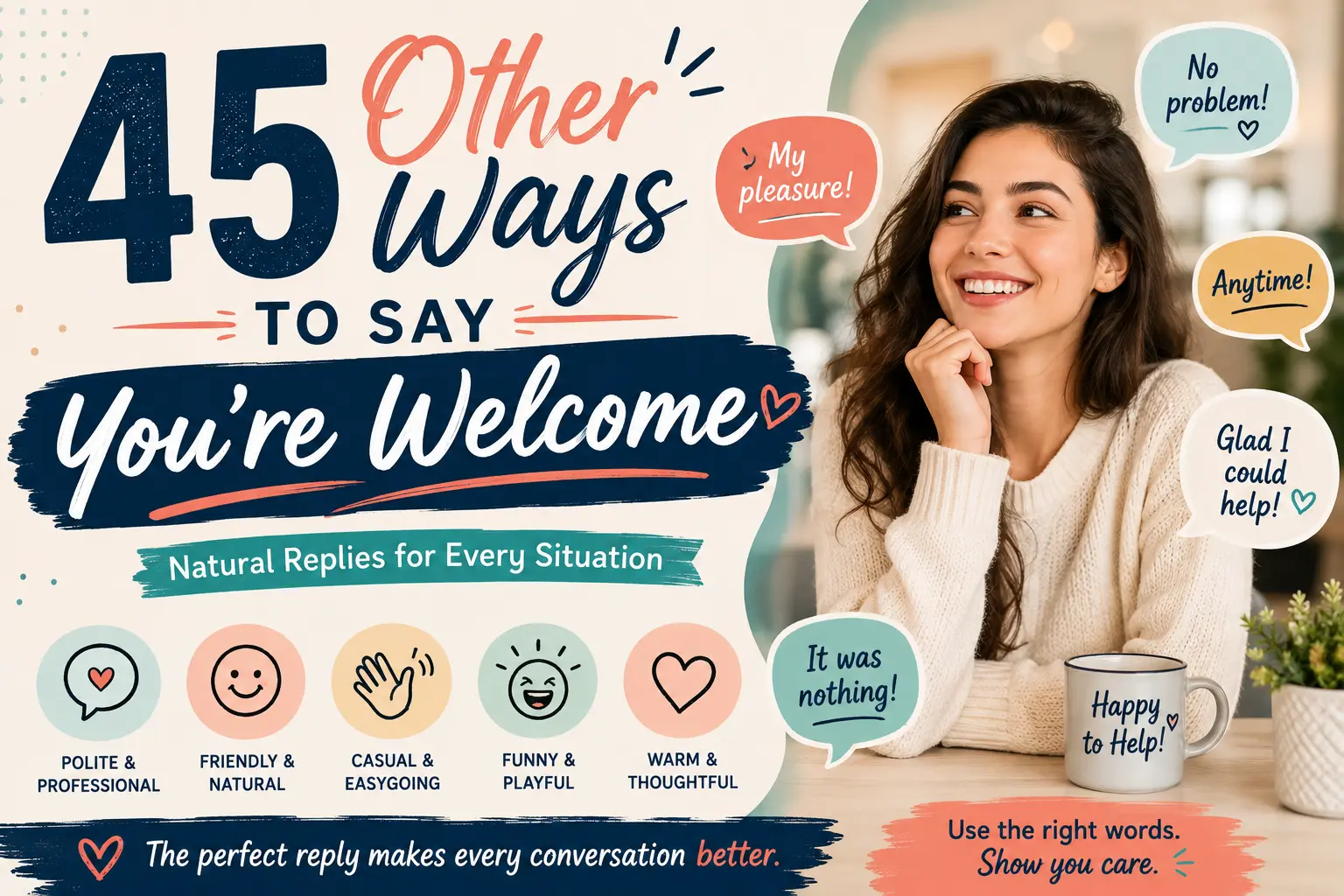
Someone says “thank you,” and suddenly you are stuck choosing between the usual “you’re welcome,” “no problem,” or “anytime.” There is nothing wrong with those responses, but sometimes they simply do not match the moment.
The right reply can sound warmer, more confident, playful, professional, or even a little flirty, depending on who you are talking to. That is why people search for other ways to say “you’re welcome”: they want their response to feel natural instead of automatic.
Whether you are replying to a friend, responding to someone you like, talking to a coworker, or simply trying to sound more thoughtful, having a few alternatives ready can make conversations smoother.
Below are 45 natural replies, organized by mood and personality, with real-life examples to help you choose the right one.
2. What Does “You’re Welcome” Mean?
“You’re welcome” is a polite response to someone who has thanked you.
It essentially means, “I’m happy to have helped,” or “There is no need to thank me further.”
For example:
Friend: “Thanks for helping me with my assignment.”
You: “You’re welcome.”
The phrase is polite and universally understood, but its tone can change depending on the situation. A professional conversation might call for “My pleasure,” while a close friend might get “Anytime” or “Don’t mention it.”
Sometimes, the exact wording matters because it communicates more than simple politeness. Your response can show warmth, confidence, humor, affection, or emotional distance.
Polite and Appreciative Replies
These are ideal when you want to sound warm, respectful, and genuinely helpful.
1. “My pleasure.”
Reply: “My pleasure.”
Example:
Your coworker thanks you for helping them finish a presentation. You smile and say, “My pleasure. Glad I could help.”
Best for: Professional conversations, acquaintances, and situations where you want to sound polished.
2. “Happy to help.”
Reply: “Happy to help.”
Example:
A classmate thanks you for sharing your notes. You reply, “Happy to help. Hope they make studying a little easier.”
Best for: Friendly and professional situations.
3. “Anytime.”
Reply: “Anytime.”
Example:
Your friend thanks you for helping them move some boxes. You say, “Anytime. Seriously, don’t worry about it.”
Best for: Friends, family, and people you are comfortable with.
4. “Of course.”
Reply: “Of course.”
Example:
“Thanks for checking on me.”
“Of course. I wanted to make sure you were okay.”
Best for: Warm, everyday conversations.
5. “Glad I could help.”
Reply: “Glad I could help.”
Example:
Someone thanks you for explaining a difficult topic. You respond, “Glad I could help. It took me a while to understand it too.”
Best for: Genuine and supportive interactions.
6. “It was no trouble at all.”
Reply: “It was no trouble at all.”
Example:
“Thanks for dropping those documents off.”
“It was no trouble at all.”
Best for: Polite situations where you want to reassure someone.
7. “I’m happy I could do something.”
Reply: “I’m happy I could do something.”
Example:
Your friend thanks you for listening during a difficult day. You reply, “I’m happy I could do something. You know I’m here for you.”
Best for: Meaningful or emotional situations.
8. “You don’t have to thank me.”
Reply: “You don’t have to thank me.”
Example:
“Thank you for staying with me while I waited.”
“You don’t have to thank me. I wanted to be there.”
Best for: Close relationships and sincere moments.
9. “It’s the least I could do.”
Reply: “It’s the least I could do.”
Example:
“Thanks for helping me prepare for the interview.”
“It’s the least I could do. I hope it goes well.”
Best for: Situations where you genuinely want to emphasize that helping was natural.
Flirty and Playful Replies
These work best when there is already a comfortable, playful dynamic. Avoid using them if the other person has not shown interest in that kind of conversation.
10. “Anything for you.”
Reply: “Anything for you.”
Example:
“Thanks for bringing me my favorite snack.”
“Anything for you.”
Best for: Playful conversations with someone you already have a close connection with.
11. “You owe me one.”
Reply: “You owe me one.”
Example:
“Thanks for covering my shift.”
“You owe me one.”
Best for: Lighthearted situations where you are joking about returning the favor.
12. “You’re making me blush.”
Reply: “You’re making me blush.”
Example:
“Thank you. That was actually really sweet of you.”
“You’re making me blush.”
Best for: Playful texting when the conversation already has a warm tone.
13. “I’ll accept that thank-you.”
Reply: “I’ll accept that thank-you.”
Example:
“Thanks for helping me pick out an outfit.”
“I’ll accept that thank-you.”
Best for: Confident, teasing conversations.
14. “You’re welcome, but I was expecting applause.”
Reply: “You’re welcome, but I was expecting applause.”
Example:
“Thanks for fixing my laptop.”
“You’re welcome, but I was expecting applause.”
Best for: Playful conversations with someone who understands your humor.
15. “Keep the compliments coming.”
Reply: “Keep the compliments coming.”
Example:
“Thanks for helping me with everything today.”
“Keep the compliments coming. I’m listening.”
Best for: Teasing conversations and confident banter.
16. “I knew you’d appreciate it.”
Reply: “I knew you’d appreciate it.”
Example:
“Thanks for sending me that playlist.”
“I knew you’d appreciate it.”
Best for: Light, confident exchanges.
17. “For you? Always.”
Reply: “For you? Always.”
Example:
“Thanks for waiting for me.”
“For you? Always.”
Best for: Warm, affectionate conversations where that level of closeness is appropriate.
18. “You’re making this way too easy to be nice to you.”
Reply: “You’re making this way too easy to be nice to you.”
Example:
“Thanks for remembering my favorite snack.”
“You’re making this way too easy to be nice to you.”
Best for: Playful teasing without making the conversation overly serious.
Confident and Self-Respect Replies
These responses sound composed and secure. They are useful when you want to be kind without sounding overly eager.
19. “I’ve got you.”
Reply: “I’ve got you.”
Example:
“Thanks for helping me figure this out.”
“I’ve got you. We’ll sort it out.”
Best for: Showing confidence and reliability.
20. “No need to overthink it.”
Reply: “No need to overthink it.”
Example:
“Thanks again. I feel bad that you had to help.”
“No need to overthink it. I was happy to help.”
Best for: Reassuring someone without making a big deal out of your effort.
21. “Consider it handled.”
Reply: “Consider it handled.”
Example:
“Thanks for taking care of that.”
“Consider it handled.”
Best for: Professional or confident situations.
22. “That’s what I’m here for.”
Reply: “That’s what I’m here for.”
Example:
“Thanks for helping me with the project.”
“That’s what I’m here for.”
Best for: Work, teamwork, and supportive friendships.
23. “No worries on my end.”
Reply: “No worries on my end.”
Example:
“Sorry for asking you to help so late.”
“No worries on my end. It worked out.”
Best for: Calmly reassuring someone.
24. “You can count on me.”
Reply: “You can count on me.”
Example:
“Thanks for always being reliable.”
“You can count on me.”
Best for: Meaningful friendships and professional teamwork.
25. “Glad to have been useful.”
Reply: “Glad to have been useful.”
Example:
“Thank you for helping me solve that problem.”
“Glad to have been useful.”
Best for: Calm, mature, and slightly formal conversations.
26. “I was happy to step in.”
Reply: “I was happy to step in.”
Example:
“Thanks for helping when things got hectic.”
“I was happy to step in.”
Best for: Workplace situations and moments where you took initiative.
27. “No big deal.”
Reply: “No big deal.”
Example:
“Thanks for sending me the file.”
“No big deal. I had it open anyway.”
Best for: Casual conversations where you want to keep things relaxed.
Funny and Savage Replies
These are for people who enjoy sarcasm and playful humor. Use them carefully because humor depends heavily on the relationship.
28. “I accept payment in snacks.”
Reply: “I accept payment in snacks.”
Example:
“Thanks for helping me study.”
“I accept payment in snacks.”
Best for: Friends and casual conversations.
29. “You’re welcome. I’ll be invoicing you later.”
Reply: “You’re welcome. I’ll be invoicing you later.”
Example:
“Thanks for helping me move.”
“You’re welcome. I’ll be invoicing you later.”
Best for: Obviously joking about favors.
30. “I expect a five-star review.”
Reply: “I expect a five-star review.”
Example:
“Thanks for recommending this restaurant.”
“I expect a five-star review for my consulting services.”
Best for: Friends who appreciate exaggerated humor.
31. “Please hold your applause.”
Reply: “Please hold your applause.”
Example:
“Thanks for fixing the Wi-Fi.”
“Please hold your applause.”
Best for: Dramatic, sarcastic humor.
32. “I’ll be accepting awards later.”
Reply: “I’ll be accepting awards later.”
Example:
“Thanks for finding my missing notebook.”
“I’ll be accepting awards later.”
Best for: Playfully exaggerating a small achievement.
33. “That’ll be one million dollars.”
Reply: “That’ll be one million dollars.”
Example:
“Thanks for helping me with my homework.”
“That’ll be one million dollars.”
Best for: Obvious joking between friends.
34. “I know. I’m amazing.”
Reply: “I know. I’m amazing.”
Example:
“Thanks for remembering my birthday.”
“I know. I’m amazing.”
Best for: Confident humor with close friends.
35. “Your gratitude has been noted.”
Reply: “Your gratitude has been noted.”
Example:
“Thanks for sending me the notes.”
“Your gratitude has been noted.”
Best for: Dry humor and mock-formal texting.
36. “You may now return to your regularly scheduled life.”
Reply: “You may now return to your regularly scheduled life.”
Example:
“Thanks for helping me finish that presentation.”
“You may now return to your regularly scheduled life.”
Best for: Dramatic, absurd humor.
Curious and Thoughtful Replies
These are useful when you want to keep the conversation going instead of ending it with a simple “you’re welcome.”
37. “What made you want to thank me?”
Reply: “What made you want to thank me?”
Example:
“Thanks for being there yesterday.”
“What made you want to thank me?”
Best for: Meaningful conversations where you want to understand what the person appreciated.
38. “Did it actually help?”
Reply: “Did it actually help?”
Example:
“Thanks for explaining that.”
“Did it actually help, or should I explain it differently?”
Best for: Genuine support and thoughtful conversations.
39. “I’m glad it made a difference.”
Reply: “I’m glad it made a difference.”
Example:
“Thank you for talking me through everything.”
“I’m glad it made a difference.”
Best for: Emotional or supportive situations.
40. “What part helped the most?”
Reply: “What part helped the most?”
Example:
“Thanks for helping me prepare.”
“What part helped the most?”
Best for: Conversations where you genuinely want feedback.
41. “I’m glad you told me.”
Reply: “I’m glad you told me.”
Example:
“Thanks for listening. I really needed to say that.”
“I’m glad you told me.”
Best for: Deeper conversations and emotional moments.
42. “I appreciate you saying that.”
Reply: “I appreciate you saying that.”
Example:
“Thank you for understanding.”
“I appreciate you saying that. It means a lot.”
Best for: Mature and emotionally thoughtful conversations.
43. “That means a lot to hear.”
Reply: “That means a lot to hear.”
Example:
“Thanks for always being supportive.”
“That means a lot to hear.”
Best for: Genuine appreciation and meaningful relationships.
44. “I’m glad I could make things easier.”
Reply: “I’m glad I could make things easier.”
Example:
“Thank you for helping me organize everything.”
“I’m glad I could make things easier.”
Best for: Helpful, mature conversations.
45. “I’m just glad you’re doing better.”
Reply: “I’m just glad you’re doing better.”
Example:
“Thank you for checking on me.”
“I’m just glad you’re doing better.”
Best for: Supportive conversations where the other person’s well-being matters more than receiving thanks.
4. Real-Life Situations: What Should You Say?
When Your Crush Says “Thank You”
If the conversation already feels playful and comfortable, avoid making the response too intense.
Best reply: “For you? Always.”
Example:
“Thanks for waiting for me.”
“For you? Always.”
It is warm without turning a simple interaction into a dramatic confession.
When a Friend Jokes While Thanking You
This is your opportunity to match their humor.
Best reply: “Please hold your applause.”
Example:
“Thanks for saving me from that terrible presentation.”
“Please hold your applause.”
It keeps the interaction light and gives your friend something to laugh about.
When Someone Thanks You Too Early
Sometimes someone says thank you before you have actually finished helping.
Best reply: “Let’s not celebrate before the mission is complete.”
Example:
“Thanks for helping me fix this.”
“Hold on, we haven’t fixed it yet.”
It keeps expectations realistic while adding some humor.
When You Are Not Interested
If someone is thanking you and you do not want to encourage unnecessary closeness, keep your response polite and neutral.
Best reply: “Of course. Take care.”
Example:
“Thanks for helping me with that.”
“Of course. Take care.”
It is respectful without creating a false sense of intimacy.
When Someone Genuinely Appreciates Your Help
A sincere response usually works better than a joke.
Best reply: “I’m glad I could help.”
Example:
“Thank you for listening. I really needed that.”
“I’m glad I could help.”
Sometimes simple is more meaningful.
5. What to Avoid
1. Overusing sarcasm
A funny response can be great with friends, but sarcasm may sound dismissive when someone is genuinely expressing gratitude.
2. Using flirty replies with everyone
“Anything for you” can sound romantic or suggestive depending on the situation. Make sure the relationship supports that tone.
3. Sounding too formal in casual conversations
Replying with “Your gratitude is duly acknowledged” to your best friend might be funny once, but it can become awkward if it does not match your normal personality.
4. Making someone’s gratitude feel unimportant
If someone sincerely thanks you for something meaningful, “No big deal” may accidentally minimize what the moment means to them.
5. Trying too hard to be funny
Not every “thank you” needs a clever comeback. Sometimes “Of course” is exactly the right response.
6. Ignoring the context
The best reply depends on the person, relationship, situation, and tone. Choose accordingly.
6. Pro Tips for Choosing the Right Reply
Match Their Energy
If someone is being sincere, respond sincerely. If they are joking, you can safely be more playful.
Keep Flirting Subtle
If you are talking to someone you like, a short line such as “For you? Always” can be more effective than an overly dramatic response.
Confidence Comes From Simplicity
You do not need an elaborate comeback to sound confident. “Of course,” “Anytime,” and “I’ve got you” can be surprisingly powerful when said naturally.
Know When to Stop
A good response should keep the conversation comfortable, not force it into a direction that neither person intended.
7. Bonus: Quick One-Liner Replies
Need something short? Try these:
- “Anytime.”
- “Of course.”
- “My pleasure.”
- “Happy to help.”
- “I’ve got you.”
- “No worries.”
- “You got it.”
- “Always.”
- “Glad I could help.”
- “Don’t mention it.”
8. Conclusion
There is no single perfect alternative to “you’re welcome.” The best response depends on your relationship, the situation, and the tone you want to create.
Use warm replies when someone is genuinely grateful, playful ones with friends, confident responses when you want to keep things simple, and thoughtful replies when the moment deserves more depth.
Most importantly, do not force a personality that is not yours. The best response is the one that sounds natural coming from you.
Discover more
other ways to say happy birthday