

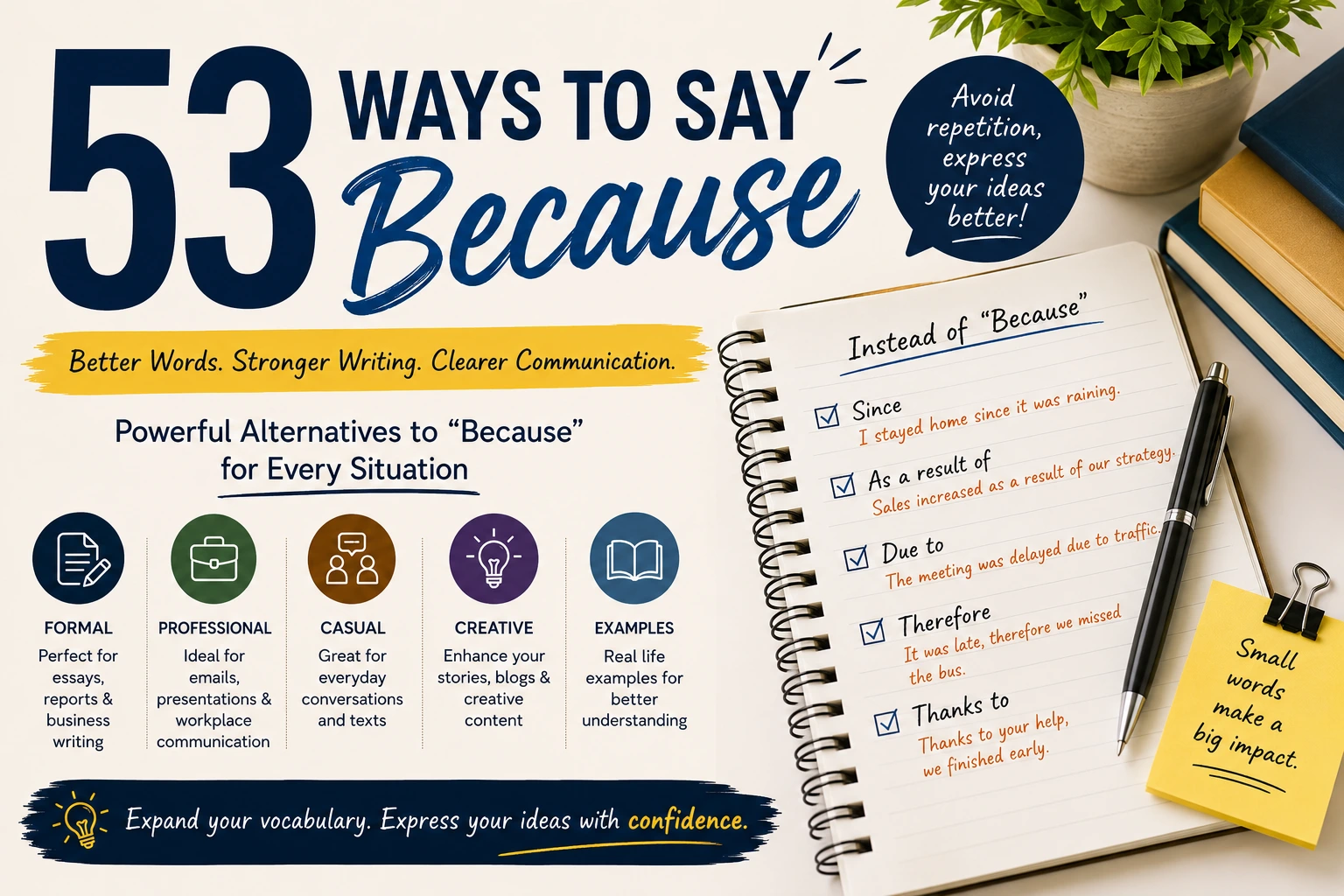
Have you ever noticed yourself using the word “because” over and over while writing an email, essay, or even a simple text message? It’s one of the most common words in the English language, but repeating it too often can make your writing sound dull and repetitive. Whether you’re a student, a professional, or someone who simply enjoys communicating clearly, learning different ways to express cause and reason can make a noticeable difference.
That’s why many people search for ways to say because. Using a variety of alternatives helps you write with more confidence, improve the flow of your sentences, and adapt your tone for different situations. Some alternatives sound more formal, while others fit casual conversations or creative writing. In this guide, you’ll discover practical substitutes for because, complete with meanings, explanations, and real life examples to help you choose the right phrase every time.
What Does “Ways to Say Because” Mean?
The phrase “ways to say because” refers to different words and expressions that explain the reason or cause behind something. While because is the most common way to introduce a reason, English offers many alternatives that can make your writing and speech sound more varied, professional, and engaging.
For example, instead of saying:
“I stayed home because it was raining.”
You could say:
“I stayed home since it was raining.”
or
“I stayed home due to the rain.”
The best alternative depends on the situation. Formal writing often calls for expressions like due to, owing to, or as a result of, while casual conversations usually sound more natural with words like since or as.
Learning these alternatives helps you avoid repetition, strengthen your vocabulary, and communicate your ideas more effectively in essays, emails, business documents, presentations, and everyday conversations.
Formal Alternatives to “Because”
1. Since
Alternative: “Since”
Example:
A manager explains a deadline change.
“Since the client requested revisions, we’ll submit the report tomorrow.”
A natural alternative that works well in both formal and casual writing.
2. As
Alternative: “As”
Example:
A teacher explains a classroom decision.
“As everyone completed the assignment early, we’ll begin the next lesson today.”
Often used in professional writing to introduce a reason smoothly.
3. Due to
Alternative: “Due to”
Example:
A company sends an announcement.
“The meeting has been postponed due to unforeseen circumstances.”
Best suited for formal documents and business communication.
4. Owing to
Alternative: “Owing to”
Example:
A travel company issues a notice.
“Flights have been delayed owing to severe weather conditions.”
A polished expression commonly found in formal writing.
5. As a result of
Alternative: “As a result of”
Example:
A report explains declining sales.
“Sales increased as a result of the new marketing campaign.”
Ideal for reports, presentations, and academic writing.
6. On account of
Alternative: “On account of”
Example:
A school announces a closure.
“Classes were canceled on account of heavy snowfall.”
A formal phrase that clearly explains a reason.
7. In light of
Alternative: “In light of”
Example:
A company updates its policy.
“In light of recent developments, we’ve revised our procedures.”
Useful when referring to new information or changing circumstances.
8. Considering
Alternative: “Considering”
Example:
A supervisor makes a recommendation.
“Considering your experience, you’d be an excellent fit for the role.”
A thoughtful way to introduce reasoning.
9. Given that
Alternative: “Given that”
Example:
A project manager explains a decision.
“Given that the deadline is approaching, we’ll prioritize the remaining tasks.”
Professional and commonly used in workplace communication.
10. Seeing that
Alternative: “Seeing that”
Example:
A parent explains a decision.
“Seeing that everyone was ready, we decided to leave early.”
More conversational while still sounding natural.
11. In view of
Alternative: “In view of”
Example:
An organization releases a statement.
“In view of current market conditions, the company will adjust its pricing strategy.”
A sophisticated alternative often used in official announcements.
Professional and Academic Alternatives
12. For the reason that
Alternative: “For the reason that”
Example:
A researcher explains the outcome of a study.
“The experiment was repeated for the reason that the initial results were inconsistent.”
A clear and formal phrase commonly used in academic or legal writing.
13. By reason of
Alternative: “By reason of”
Example:
An official report explains a delay.
“The event was postponed by reason of safety concerns.”
A highly formal expression often found in legal documents.
14. As long as
Alternative: “As long as”
Example:
A manager outlines project expectations.
“You may work remotely as long as all deadlines are met.”
Useful when the reason depends on a specific condition.
15. For
Alternative: “For”
Example:
A novel describes a character’s actions.
“She stayed indoors, for the weather had turned dangerous.”
A literary alternative that works best in formal or creative writing.
16. Inasmuch as
Alternative: “Inasmuch as”
Example:
A legal document explains an agreement.
“The proposal was accepted inasmuch as it satisfied every requirement.”
Best suited for highly formal contexts.
17. Thanks to
Alternative: “Thanks to”
Example:
A team celebrates a successful project.
“The launch succeeded thanks to everyone’s hard work.”
Perfect when the reason has a positive outcome.
18. As a consequence of
Alternative: “As a consequence of”
Example:
A business report analyzes market trends.
“Production increased as a consequence of improved efficiency.”
A professional phrase that explains results clearly.
19. In response to
Alternative: “In response to”
Example:
A company announces a policy change.
“The organization updated its guidelines in response to customer feedback.”
Ideal when explaining actions taken because of a situation.
20. On the grounds that
Alternative: “On the grounds that”
Example:
A court explains a decision.
“The request was denied on the grounds that it did not meet legal requirements.”
A formal expression frequently used in legal and official writing.
21. As prompted by
Alternative: “As prompted by”
Example:
A nonprofit launches a campaign.
“The initiative was created as prompted by community concerns.”
Useful for explaining what inspired an action.
22. In consideration of
Alternative: “In consideration of”
Example:
A company offers additional benefits.
“In consideration of your continued support, we’ve extended your membership.”
A respectful phrase suitable for business communication.
Casual and Everyday Alternatives
23. That’s why
Alternative: “That’s why”
Example:
A friend explains their decision.
“I was feeling exhausted. That’s why I went to bed early.”
One of the most natural alternatives in everyday conversation.
24. Because of that
Alternative: “Because of that”
Example:
Someone explains a missed event.
“Traffic was terrible. Because of that, I arrived late.”
Simple and conversational.
25. That’s the reason
Alternative: “That’s the reason”
Example:
A student explains a choice.
“I enjoy solving problems. That’s the reason I studied engineering.”
Adds emphasis to your explanation.
26. After all
Alternative: “After all”
Example:
A parent reassures a child.
“You don’t need to worry. After all, you’ve prepared well.”
Often used to reinforce an obvious reason.
27. With that in mind
Alternative: “With that in mind”
Example:
A team plans its next steps.
“The budget is limited. With that in mind, we’ll focus on the essentials.”
Helps connect a reason to the next action.
28. That being the case
Alternative: “That being the case”
Example:
A coworker adjusts a schedule.
“The presentation has been moved. That being the case, let’s prepare tomorrow instead.”
A smooth transition between ideas.
29. For this reason
Alternative: “For this reason”
Example:
A writer summarizes an argument.
“Regular exercise improves mental health. For this reason, it’s important to stay active.”
Excellent for essays and presentations.
30. Because of
Alternative: “Because of”
Example:
A traveler explains a delay.
“Our train was canceled because of the storm.”
A common phrase that works in almost every situation.
31. Due in part to
Alternative: “Due in part to”
Example:
A company discusses growth.
“Sales increased due in part to stronger customer engagement.”
Useful when several reasons contribute to a result.
32. Partly because
Alternative: “Partly because”
Example:
A friend explains a decision.
“I accepted the offer partly because it gave me more flexibility.”
Perfect when explaining one of several reasons.
33. For that reason
Alternative: “For that reason”
Example:
A teacher gives advice.
“Practice improves confidence. For that reason, you should review your notes every day.”
Clear, simple, and suitable for both speaking and writing.
Creative and Advanced Alternatives
34. Therefore
Alternative: “Therefore”
Example:
A manager summarizes a meeting.
“The budget was approved. Therefore, we can begin the project next week.”
Best for connecting ideas in formal writing.
35. Thus
Alternative: “Thus”
Example:
A researcher concludes a report.
“The data confirmed the hypothesis. Thus, further testing was unnecessary.”
Concise and suitable for academic writing.
36. Hence
Alternative: “Hence”
Example:
A business proposal explains a recommendation.
“Customer demand increased. Hence, production will be expanded.”
Adds a polished tone to professional documents.
37. Accordingly
Alternative: “Accordingly”
Example:
A supervisor adjusts a schedule.
“The deadline has changed. Accordingly, the timeline has been updated.”
Ideal for workplace communication.
38. Which is why
Alternative: “Which is why”
Example:
A friend explains a choice.
“I enjoy learning new skills, which is why I enrolled in the course.”
A natural transition in conversations.
39. As such
Alternative: “As such”
Example:
A report discusses company growth.
“The business has expanded rapidly. As such, additional staff will be hired.”
Professional and concise.
40. Consequently
Alternative: “Consequently”
Example:
A report explains financial results.
“Operating costs decreased. Consequently, profits improved.”
Excellent for formal writing.
41. Thereby
Alternative: “Thereby”
Example:
A company improves its workflow.
“The new system reduced delays, thereby improving customer satisfaction.”
A sophisticated alternative for reports.
42. Resulting from
Alternative: “Resulting from”
Example:
A news article explains an event.
“Several roads were closed resulting from heavy rainfall.”
Useful when describing causes.
43. In consequence of
Alternative: “In consequence of”
Example:
An official statement explains a decision.
“Services were suspended in consequence of the severe weather.”
Formal and less common.
44. On account of the fact that
Alternative: “On account of the fact that”
Example:
A legal document explains a ruling.
“The application was rejected on account of the fact that it lacked supporting documents.”
Highly formal and detailed.
45. For this cause
Alternative: “For this cause”
Example:
A historical article explains an event.
“Many people united for this cause and achieved meaningful change.”
Common in historical or literary contexts.
46. By virtue of
Alternative: “By virtue of”
Example:
An employee earns a promotion.
“She qualified by virtue of her exceptional experience.”
Professional and refined.
47. As evidenced by
Alternative: “As evidenced by”
Example:
A research paper presents findings.
“Customer satisfaction improved, as evidenced by recent survey results.”
Perfect for analytical writing.
48. Stemming from
Alternative: “Stemming from”
Example:
A report discusses ongoing issues.
“The delays were stemming from supply chain disruptions.”
Useful for explaining origins.
49. Triggered by
Alternative: “Triggered by”
Example:
A news report explains an event.
“The market changes were triggered by new government policies.”
Best when describing events caused by something specific.
50. Prompted by
Alternative: “Prompted by”
Example:
A company launches a campaign.
“The initiative was prompted by customer suggestions.”
Natural in professional writing.
51. Following
Alternative: “Following”
Example:
A business announces a policy.
“Following customer feedback, several improvements were introduced.”
A smooth transition in formal communication.
52. In view of the fact that
Alternative: “In view of the fact that”
Example:
An organization updates procedures.
“In view of the fact that demand has increased, additional resources will be allocated.”
A formal phrase commonly used in official writing.
53. For that very reason
Alternative: “For that very reason”
Example:
A speaker emphasizes a point.
“Communication builds trust. For that very reason, honesty should always come first.”
Adds emphasis while sounding natural.
Real Life Situations
Writing an Essay
Use formal alternatives like therefore, thus, for this reason, or as a result of to improve clarity and avoid repetition.
Best Alternative: For this reason
Sending a Business Email
Professional expressions make your communication more polished.
Best Alternative: Due to
Speaking in Everyday Conversations
Simple words help your message sound natural.
Best Alternative: Since
Writing a Research Paper
Academic writing benefits from precise transitions.
Best Alternative: Consequently
Creating Creative Content
Varied wording keeps readers engaged.
Best Alternative: Which is why
Common Mistakes to Avoid
1. Repeating “Because” Too Often
Using the same word repeatedly can make your writing sound repetitive.
2. Choosing Overly Formal Alternatives in Casual Conversations
Expressions like inasmuch as or by virtue of may sound unnatural in everyday speech.
3. Using Synonyms Incorrectly
Some alternatives replace because, while others function as transition words. Always check how they’re used in a sentence.
4. Ignoring the Context
A business email requires different wording than a friendly text message.
5. Overcomplicating Your Writing
Simple language is often more effective than unnecessarily complex vocabulary.
6. Forgetting Sentence Structure
Certain alternatives require small grammar changes, so read your sentence carefully after replacing because.
Pro Tips
Match the Alternative to Your Audience
Use formal phrases for professional or academic writing and simpler alternatives for conversations.
Vary Your Vocabulary Naturally
Switch between different expressions to make your writing more engaging without sounding forced.
Read Your Sentence Aloud
If an alternative sounds awkward, choose a simpler option that flows naturally.
Bonus Quick Alternatives
- Since
- As
- Due to
- Owing to
- Thanks to
- Therefore
- Thus
- Hence
- For this reason
- Which is why
Conclusion
Learning different ways to say because is one of the easiest ways to improve your writing and communication. Whether you’re working on an essay, writing a professional email, preparing a presentation, or simply having a conversation, using varied alternatives helps your ideas sound clearer, more natural, and more engaging. Instead of relying on the same word every time, choose the expression that best matches your audience and purpose. A richer vocabulary not only makes your writing stronger but also leaves a more polished and confident impression.
Discover more
ways to say i hope everything is going well