

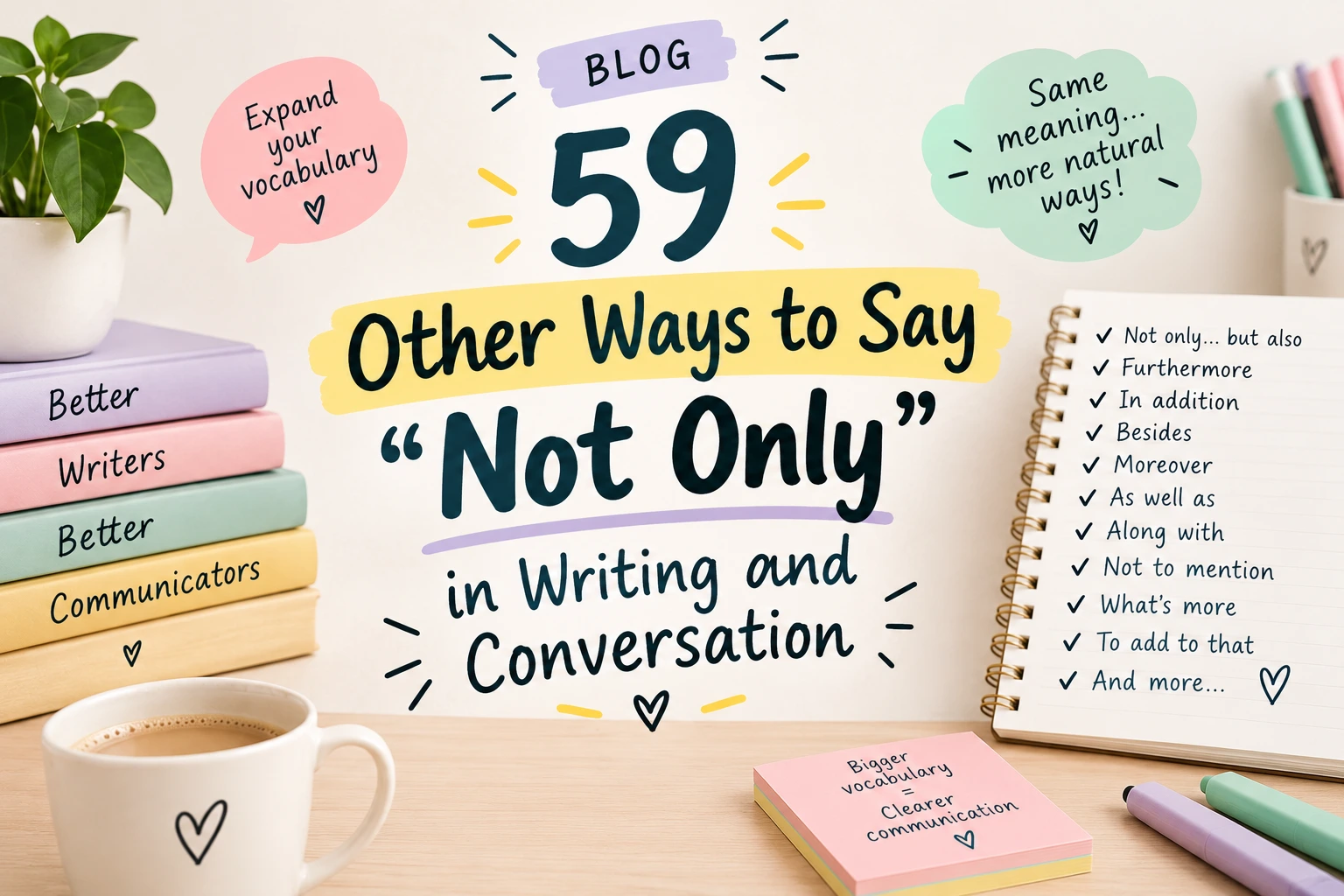
Have you ever written an essay, email, or blog post and realized you’ve used the phrase “not only” several times? It is a useful expression, but repeating it too often can make your writing sound predictable. The good news is that there are plenty of alternatives that can help you express the same idea more naturally.
Whether you’re writing an academic assignment, preparing a professional report, creating website content, or having a casual conversation, choosing the right words can make your message clearer and more engaging. Some alternatives emphasize an additional benefit, while others highlight a surprising result or show that something offers more than one advantage.
In this guide, you’ll discover 59 other ways to say “not only,” complete with simple explanations and real-life examples. You’ll also learn which expressions work best in formal writing, everyday conversations, and situations where you want to make a stronger impression.
What Does “Not Only” Mean?
The phrase “not only” emphasizes that something has an additional quality, benefit, feature, or effect beyond what has already been mentioned. It often introduces the first part of a statement that adds another important point.
For example:
- “This course is not only affordable but also practical.”
- “She is not only talented but also hardworking.”
- “Exercise not only improves fitness but also supports mental well-being.”
In each sentence, the phrase highlights more than one quality or benefit.
People use “not only” in essays, business writing, presentations, blog posts, and everyday conversations. It helps connect related ideas and shows that something has more value or importance than readers might initially expect.
However, you don’t always need to use those exact words. Depending on your sentence, expressions such as “in addition to,” “as well as,” “beyond,” and “not just” may communicate your meaning more effectively.
One important note: These alternatives are not interchangeable in every sentence. Some introduce another item, while others emphasize a contrast or an extra benefit. Always choose the phrase that fits your intended meaning.
The following expressions are divided into five categories to help you find the right alternative for your writing or conversation.
Category 1: Polite and Appreciative Alternatives
These expressions work well when you want to add information, acknowledge another quality, or explain the additional value of something.
1. Not Just
Alternative: “Not just”
Example: Instead of saying, “The workshop is not only educational,” you could write, “The workshop is not just educational; it’s also practical.”
This expression is simple and natural. It works well in everyday conversations, blog posts, and informal writing.
2. As Well As
Alternative: “As well as”
Example: “The new employee handles customer questions as well as managing the team’s schedule.”
Use this phrase when you want to mention two responsibilities, qualities, or actions in one sentence.
3. In Addition To
Alternative: “In addition to”
Example: “In addition to teaching programming, the course helps students develop problem-solving skills.”
This expression is useful in professional writing, academic assignments, and reports.
4. Along With
Alternative: “Along with”
Example: “Along with improving your grades, a consistent study routine can build confidence.”
It introduces another related benefit or feature without making the sentence sound too formal.
5. Besides
Alternative: “Besides”
Example: “Besides being affordable, this laptop has a long battery life.”
Use it to add another reason or advantage. In some contexts, “besides” can also mean “apart from,” so check that the meaning is clear.
6. What’s More
Alternative: “What’s more”
Example: “The app is easy to use. What’s more, it offers several useful free features.”
This phrase works well when you want to emphasize an additional positive point.
7. Furthermore
Alternative: “Furthermore”
Example: “The program provides practical training. Furthermore, it connects students with industry professionals.”
It is particularly useful in essays, reports, and formal presentations.
8. Moreover
Alternative: “Moreover”
Example: “The proposal could reduce costs. Moreover, it may improve the team’s overall productivity.”
Use “moreover” when you want to add a point that strengthens your previous statement.
9. Additionally
Alternative: “Additionally”
Example: “The service offers flexible scheduling. Additionally, customers can access support online.”
This is a clear, professional option for business documents and informative writing.
10. Coupled With
Alternative: “Coupled with”
Example: “Strong communication skills, coupled with technical knowledge, can help graduates succeed in the workplace.”
This expression highlights the combined effect of two related qualities or factors.
11. Together With
Alternative: “Together with”
Example: “Together with academic knowledge, practical experience prepares students for future careers.”
Use it when two elements contribute to the same outcome.
12. Not Merely
Alternative: “Not merely”
Example: “The book is not merely entertaining; it also offers valuable lessons about human behavior.”
This expression is slightly more formal than “not just.” It works well when you want to emphasize that something has a deeper purpose or value.
Category 2: Casual and Conversational Alternatives
These expressions sound natural in everyday conversations, messages, blog posts, and informal explanations.
13. More Than Just
Alternative: “More than just”
Example: “A university experience is more than just attending lectures; it’s also about building friendships and learning independence.”
This phrase emphasizes that something has a wider meaning or greater value than people may expect.
14. Not Simply
Alternative: “Not simply”
Example: “Learning a language is not simply about memorizing words; it’s about communicating with people.”
Use it to explain that a situation involves more than one basic idea.
15. On Top of That
Alternative: “On top of that”
Example: “The assignment was difficult. On top of that, we had two other deadlines that week.”
This expression is conversational and often introduces an additional fact. Depending on the context, the extra information may be positive or negative.
16. Plus
Alternative: “Plus”
Example: “The apartment is close to campus. Plus, the rent fits my budget.”
This short expression is ideal for casual speech, messages, and informal writing.
17. And Also
Alternative: “And also”
Example: “The club organizes workshops and also gives members opportunities to lead projects.”
This is a straightforward option, although removing “also” may make some sentences cleaner. For example, “The club organizes workshops and gives members opportunities to lead projects.”
18. Not to Mention
Alternative: “Not to mention”
Example: “The course improves your coding skills, not to mention your confidence when solving problems.”
Use it to introduce another relevant point, often one that strengthens the previous statement.
19. Beyond That
Alternative: “Beyond that”
Example: “The internship gives you practical experience. Beyond that, it helps you understand how professional teams work.”
This phrase introduces something that goes further than the point already discussed.
20. There’s More to It Than
Alternative: “There’s more to it than”
Example: “Good design involves more than attractive colors. There’s more to it than making a website look nice.”
This expression is useful when explaining that a subject is more complex than it first appears.
21. Not Just That, But Also
Alternative: “Not just that, but also”
Example: “The project improved my technical skills. Not just that, but it also taught me how to work with a team.”
This is conversational and emphasizes a second benefit or result. In formal writing, a simpler structure may sound smoother.
22. And That’s Not All
Alternative: “And that’s not all”
Example: “The membership includes free workshops, and that’s not all: members can also attend networking events.”
Use it when you want to build interest or introduce another feature.
23. To Make Things Even Better
Alternative: “To make things even better”
Example: “The hotel was close to the beach. To make things even better, breakfast was included.”
This works well when the second point makes an already positive situation even more appealing.
24. Not to Forget
Alternative: “Not to forget”
Example: “The role offers valuable experience, flexible hours, and, not to forget, the chance to learn from experienced professionals.”
This expression adds another detail that deserves attention. It is more natural in casual writing than in formal academic work.
Category 3: Confident and Professional Alternatives
These options can help make your writing more polished and precise, especially in business communication, academic work, and presentations.
25. In Addition
Alternative: “In addition”
Example: “The research identifies several challenges. In addition, it suggests practical ways to address them.”
This is a reliable alternative for introducing another point in formal writing.
26. Additionally to That
Alternative: “Additionally to that”
Example: Instead of writing, “Additionally to that, the policy improves safety,” write, “Additionally, the policy improves safety.”
Important: “Additionally to that” is generally awkward in standard English. Use “additionally,” “in addition,” or “in addition to that” instead.
27. Beyond Simply
Alternative: “Beyond simply”
Example: “Beyond simply reducing costs, the new system improves the accuracy of financial records.”
Use it when you want to explain that something has a purpose or effect beyond its most obvious function.
28. Not Exclusively
Alternative: “Not exclusively”
Example: “The program is not exclusively designed for experienced developers; beginners can benefit from it too.”
This expression emphasizes that something is not limited to one group, purpose, or use.
29. In Conjunction With
Alternative: “In conjunction with”
Example: “The training program works in conjunction with practical assignments to strengthen students’ skills.”
This formal expression describes two things working together. It does not always mean exactly the same thing as “not only.”
30. Complemented By
Alternative: “Complemented by”
Example: “The course combines theoretical knowledge, complemented by hands-on exercises.”
A smoother version is, “The course combines theoretical knowledge with hands-on exercises.”
Use “complemented by” when one feature adds value to another.
31. Combined With
Alternative: “Combined with”
Example: “Technical knowledge, combined with strong communication skills, can improve your career prospects.”
This phrase highlights the value of two elements working together.
32. In Addition to Being
Alternative: “In addition to being”
Example: “In addition to being affordable, the software is easy to maintain.”
It is useful when you want to add another characteristic without repeating the same sentence structure.
33. Alongside
Alternative: “Alongside”
Example: “Alongside academic qualifications, employers often value practical experience.”
This concise expression is especially useful in professional and academic writing.
34. Not Merely Limited To
Alternative: “Not merely limited to”
Example: “The benefits of volunteering are not merely limited to community service; volunteers can also develop valuable professional skills.”
This expression emphasizes that the value or scope of something extends further. A simpler alternative is “not limited to.”
35. Extending Beyond
Alternative: “Extending beyond”
Example: “The impact of good teaching extends beyond the classroom and influences how students approach lifelong learning.”
Use it to show that an effect or influence reaches further than its immediate setting.
36. In Addition to This
Alternative: “In addition to this”
Example: “The policy improves workplace safety. In addition to this, it provides clearer procedures for reporting concerns.”
This expression is suitable for reports and formal explanations, although “in addition” is often more concise.
Category 4: Creative and Engaging Alternatives
These expressions help you avoid repetitive writing while making your point more interesting. They are especially useful in blog posts, presentations, and persuasive content.
37. Not Only That
Alternative: “Not only that”
Example: “The restaurant serves excellent food. Not only that, the staff are friendly and the prices are reasonable.”
This phrase is useful in conversational storytelling when you want to add another positive or surprising detail.
38. Even More Importantly
Alternative: “Even more importantly”
Example: “The project saves time. Even more importantly, it reduces the number of errors.”
Use it when the second point deserves greater attention than the first.
39. What’s Even Better
Alternative: “What’s even better”
Example: “The course includes video lessons. What’s even better, you can access them whenever you have time.”
This phrase introduces an additional advantage in an engaging, informal way.
40. As If That Weren’t Enough
Alternative: “As if that weren’t enough”
Example: “She completed the project ahead of schedule. As if that weren’t enough, she also helped two teammates finish their tasks.”
This expression adds emphasis and often introduces an impressive extra achievement.
41. More Besides
Alternative: “More besides”
Example: “The role offers useful experience, professional contacts, and more besides.”
This is a less common expression that means there are additional things worth mentioning. In most modern writing, “and much more” sounds more natural.
42. Not Just in One Way
Alternative: “Not just in one way”
Example: “Volunteering can help students grow, not just in one way but through teamwork, communication, and practical experience.”
This phrase emphasizes that something has several effects or benefits.
43. On Another Level
Alternative: “On another level”
Example: “The new design is attractive, but its accessibility features take the user experience to another level.”
This informal expression emphasizes an additional quality or improvement. It is not a direct replacement in every sentence.
44. Beyond What You Might Expect
Alternative: “Beyond what you might expect”
Example: “The small community project had an impact beyond what we might expect, helping local families access important resources.”
Use it to emphasize that the result or value exceeds initial expectations.
45. It Goes Further Than That
Alternative: “It goes further than that”
Example: “Learning to code helps you build applications, but it goes further than that. It also teaches you how to break complex problems into smaller steps.”
This is useful when expanding on an idea during a conversation, presentation, or explanatory article.
46. There’s an Added Benefit
Alternative: “There’s an added benefit”
Example: “Working on group projects helps students understand different perspectives. There’s an added benefit: they also learn to manage disagreements.”
This phrase introduces an extra advantage in a clear and natural way.
47. Not Just for Today, but for the Future
Alternative: “Not just for today, but for the future”
Example: “Developing strong study habits helps you prepare for this exam, but the skills matter not just for today, but for the future.”
This expression works when emphasizing long-term value.
48. It Also Serves To
Alternative: “It also serves to”
Example: “The new process reduces paperwork. It also serves to make important records easier to find.”
Use it when explaining an additional purpose or function. In simpler writing, “it also helps” may be more direct.
Category 5: Thoughtful and Precise Alternatives
These phrases are especially helpful when you want to express the relationship between two ideas clearly. Some are close substitutes for “not only,” while others work best when you rewrite the sentence.
49. Both … and …
Alternative: “Both … and …”
Example: “The course develops both technical knowledge and practical problem-solving skills.”
This is one of the strongest alternatives when you want to highlight two equally important qualities or benefits.
50. As Much … As …
Alternative: “As much … as …”
Example: “The project values communication as much as technical ability.”
Use this structure when you want to emphasize that two things are equally important. It is not suitable for every sentence containing “not only.”
51. Equally Important
Alternative: “Equally important”
Example: “The software is affordable. Equally important, it is easy for beginners to use.”
This phrase highlights another point that deserves the same level of attention.
52. In the Same Way
Alternative: “In the same way”
Example: “Reading builds vocabulary. In the same way, regular writing helps you express ideas more clearly.”
This phrase introduces a related idea or comparison. It works when the relationship between the two points is similar, rather than simply additive.
53. Likewise
Alternative: “Likewise”
Example: “The first approach saves time. Likewise, the second method reduces unnecessary steps.”
Use it when the next point follows a similar pattern or offers a comparable benefit.
54. Similarly
Alternative: “Similarly”
Example: “The program supports beginners. Similarly, it offers advanced learners opportunities to develop their skills.”
This expression connects ideas that share a feature or pattern.
55. At the Same Time
Alternative: “At the same time”
Example: “The new system reduces costs. At the same time, it improves the quality of customer support.”
Use it when two things are true simultaneously or when you want to present another consideration. It may suggest contrast as well as addition.
56. Not Only … But Also …
Alternative: “Not only … but also …”
Example: “The workshop not only teaches new skills but also helps participants build confidence.”
Sometimes, the original expression is still the clearest option. This balanced structure is useful when you want to emphasize two connected points.
57. More Than One
Alternative: “More than one”
Example: “The project has more than one benefit: it improves teamwork and encourages creative thinking.”
Use this phrase when the main idea is that several benefits, reasons, or features exist.
58. In More Ways Than One
Alternative: “In more ways than one”
Example: “The experience changed my life in more ways than one, helping me develop new skills and meet people who inspired me.”
This expression emphasizes that something has several effects or meanings.
59. Not Just … Also …
Alternative: “Not just … also …”
Example: “The program is not just affordable; it also offers flexible learning options.”
This structure is a natural choice for everyday writing and conversation. For a more balanced sentence, you can also write, “The program is not just affordable but also flexible.”
Real-Life Situations: Choosing the Best Alternative
The best phrase depends on what you’re writing and how you want your message to sound. Here are four common situations to help you choose.
1. When You’re Writing an Academic Essay
In academic writing, clarity matters more than using complicated vocabulary. You want your ideas to connect logically without making your sentences difficult to read.
Best alternatives: “Furthermore,” “Moreover,” “In addition,” and “Both … and …”
Example:
Instead of writing:
“Online learning is not only convenient but also affordable.”
You could write:
“Online learning is convenient and affordable.”
Or, if you’re adding another point to a previous sentence:
“Furthermore, online learning can give students greater flexibility.”
2. When You’re Writing a Professional Email
Professional emails should sound clear, polite, and direct. Avoid using too many dramatic or conversational expressions.
Best alternatives: “In addition to,” “Additionally,” and “Alongside.”
Example:
Instead of writing:
“Our service is not only affordable but also reliable.”
You could write:
“Our service is affordable and reliable.”
If you need to introduce another feature, write:
“In addition, our team provides ongoing customer support.”
3. When You’re Writing a Blog Post
Blog writing benefits from a natural tone. You can use conversational expressions to keep readers interested, but avoid repeating the same phrase in every paragraph.
Best alternatives: “More than just,” “What’s more,” “Beyond that,” and “What’s even better.”
Example:
Instead of writing:
“Exercise is not only good for your body but also beneficial for your mind.”
You could write:
“Exercise does more than improve physical fitness. It can also support your mental well-being.”
This version sounds natural and explains the idea clearly.
4. When You’re Explaining Something in Conversation
In everyday conversations, simple phrases usually work best. You don’t need formal connectors to make a point.
Best alternatives: “Not just,” “Plus,” “Besides,” and “On top of that.”
Example:
Your friend asks why you like a particular course.
You could say:
“It’s not just useful for my degree. Plus, I’m learning skills I can use in real projects.”
The sentence sounds relaxed and easy to understand.
What to Avoid When Replacing “Not Only”
Changing a phrase can improve your writing, but only if the replacement fits the sentence. Here are six common mistakes to watch out for.
1. Using a Formal Phrase in a Casual Conversation
Words such as “furthermore” and “in conjunction with” can sound stiff in an ordinary text message.
Better approach: Use simple alternatives like “plus,” “not just,” or “besides” when speaking casually.
2. Choosing a Phrase That Changes the Meaning
“Similarly” compares related ideas, while “in addition” introduces another point. They do not always serve the same purpose.
Better approach: Decide whether you’re adding information, showing a comparison, or emphasizing a contrast before choosing a phrase.
3. Repeating the Same Alternative Too Often
Replacing every instance of “not only” with “moreover” won’t make your writing more interesting.
Better approach: Mix different sentence structures. Sometimes, using “and” or splitting one long sentence into two is the best solution.
4. Making Sentences Too Complicated
Long expressions can make a simple idea difficult to follow.
Better approach: Prefer clear sentences. For example, “The app is affordable and easy to use” is often better than a sentence filled with formal connectors.
5. Forgetting Parallel Structure
When using “not only … but also,” keep the connected parts grammatically balanced.
Incorrect: “She is not only talented but also works hard.”
Better: “She is not only talented but also hardworking.”
You could also write, “She not only has talent but also works hard.”
6. Using an Alternative That Doesn’t Fit Grammatically
Some expressions must be followed by a noun, while others work with a complete sentence or a verb ending in -ing.
Example:
Incorrect: “In addition to she studies, she works.”
Correct: “In addition to studying, she works.”
You could also write, “In addition to her studies, she works part-time.”
Pro Tips for Using Alternatives to “Not Only”
1. Focus on the Relationship Between Your Ideas
Before choosing a replacement, ask yourself what the sentence needs to communicate.
- Adding information: “Furthermore” or “in addition.”
- Highlighting two qualities: “Both … and …”
- Emphasizing extra value: “More than just.”
- Adding a casual detail: “Plus” or “on top of that.”
Choosing based on meaning makes your writing more precise.
2. Don’t Replace Every Occurrence
The phrase “not only” is perfectly correct. You don’t need to remove it whenever you see it.
If the expression fits your sentence and communicates your point clearly, keep it. Good writing is about variety and clarity, not replacing familiar words just to sound different.
3. Read Your Sentence Out Loud
A phrase may look impressive on the page but sound unnatural when you read it aloud.
For example, “The course is affordable and practical” is often smoother than “The course is not merely affordable but furthermore practical.”
Choose the version that sounds natural and makes your meaning easy to understand.
Bonus: 8 Quick Alternatives to “Not Only”
If you need a fast replacement, these expressions are a good starting point.
- “Not just”
- “As well as”
- “In addition”
- “Furthermore”
- “Moreover”
- “More than just”
- “What’s more”
- “Both … and …”
Remember that the best choice depends on your sentence. These phrases have related meanings, but they are not interchangeable in every situation.
Conclusion
Finding other ways to say “not only” can make your writing more varied, natural, and effective. Whether you’re working on an academic essay, professional email, blog post, or everyday conversation, the right alternative helps you connect ideas without repeating the same expression.
Use “furthermore” or “moreover” when you need a formal tone, “not just” or “plus” in casual writing, and “both … and …” when you want to highlight two related qualities.
Most importantly, don’t choose a phrase just because it sounds sophisticated. Choose it because it fits your meaning.
Great writing isn’t about using the fanciest words. It’s about making every word count.
Discover more
other ways to say youre hot to a guy