

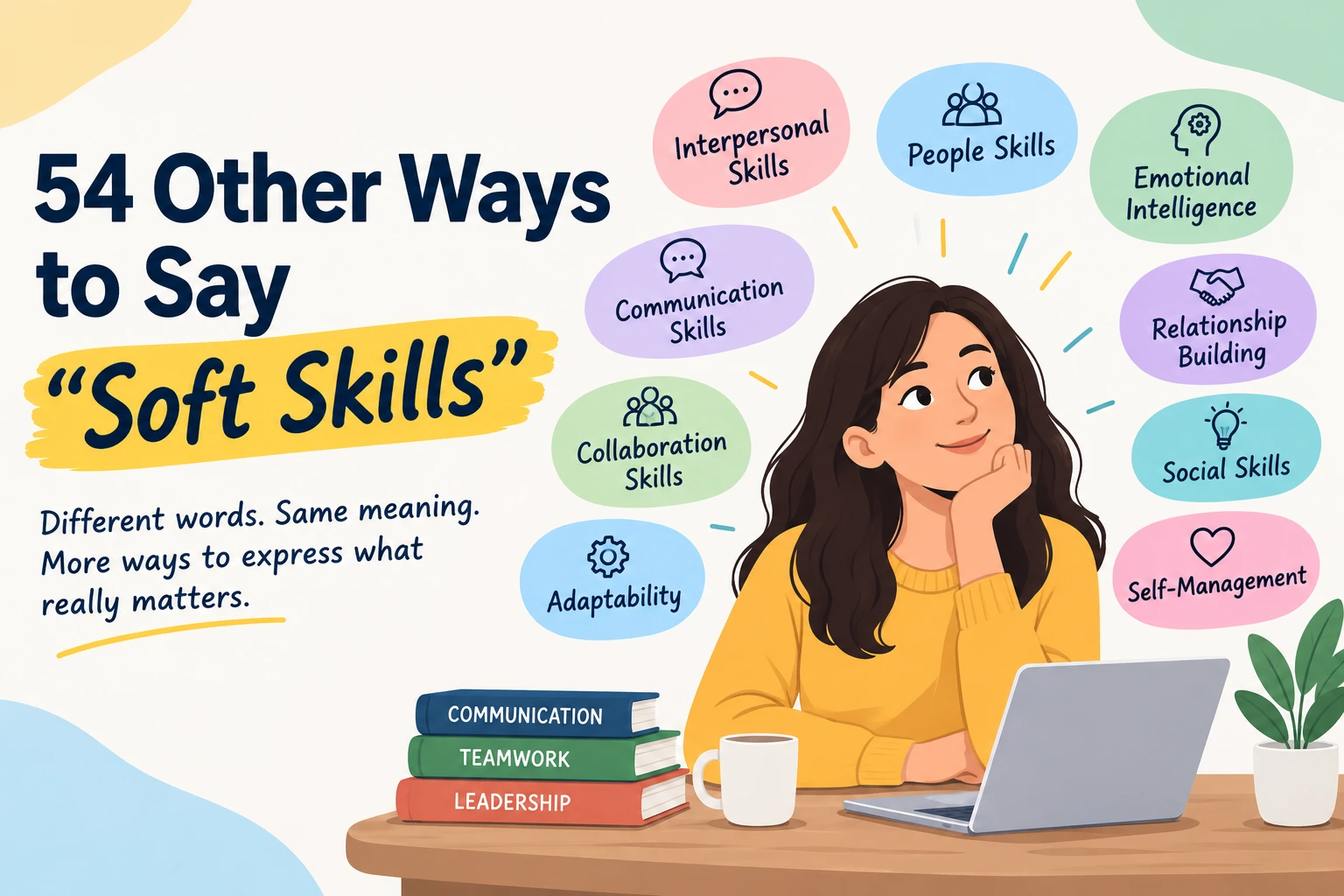
Have you ever met someone who knows their job well but struggles to work with others? Perhaps they find it hard to communicate, handle feedback, or solve problems as part of a team. On the other hand, some people make working together feel easy. They listen, adapt, and help everyone feel heard. These abilities are often called soft skills.
However, the phrase can sound a little vague, especially when you’re writing a resume, preparing for an interview, or describing your strengths. Using more specific words can help you explain what you actually bring to a team.
For example, instead of simply saying you have strong soft skills, you could highlight your communication, teamwork, or problem-solving abilities. In this guide, you’ll discover 54 alternatives to “soft skills,” with clear meanings and real-life examples to help you choose the right phrase.
What Does “Soft Skills” Mean?
Soft skills are the personal and social abilities that help people work well with others. They include communication, teamwork, time management, adaptability, leadership, and emotional awareness.
Unlike technical skills, which involve specific tools or knowledge, soft skills focus on how you approach your work and interact with people.
For example, knowing how to write code is a technical skill. Explaining your code to a teammate is a communication skill. Similarly, knowing how to use a project management tool is technical knowledge, while organizing a team and meeting deadlines involves planning and teamwork.
These abilities matter in almost every workplace. They can also help students with group assignments, job interviews, internships, and leadership roles.
Still, the phrase “soft skills” doesn’t always explain what someone can actually do. Therefore, using more specific terms can make your resume, application, or conversation clearer and more convincing.
The best alternative depends on what you want to describe. Some phrases highlight your people skills, while others focus on leadership, communication, or personal growth.
1. Polite and Professional Alternatives
These phrases work well in resumes, cover letters, interviews, and workplace conversations. They help you describe your abilities in a clear and professional way.
1. Interpersonal Skills
Interpersonal skills are the abilities you use to communicate and build relationships with other people.
Example: You’re updating your resume for a customer service position.
“I have strong interpersonal skills and enjoy building positive relationships with customers and coworkers.”
2. Communication Skills
These skills help you share ideas, listen carefully, and explain information clearly.
Example: An interviewer asks how you work with a team.
“My communication skills help me explain ideas clearly and understand different points of view.”
3. Teamwork Abilities
Teamwork means working with others toward a shared goal.
Example: You’re describing your role in a university project.
“My teamwork abilities helped our group divide tasks fairly and complete the project on time.”
4. Relationship-Building Skills
These abilities help you develop trust and maintain positive relationships.
Example: You’re applying for a role that involves working with clients.
“I use relationship-building skills to understand client needs and maintain long-term professional connections.”
5. Professional Competencies
Professional competencies are the abilities and behaviors that help you succeed at work.
Example: You’re discussing your strengths during an interview.
“My professional competencies include clear communication, teamwork, and effective time management.”
6. Workplace Communication Abilities
These skills help you share information appropriately in emails, meetings, and everyday conversations.
Example: You’re describing your experience as a student society member.
“My workplace communication abilities help me share updates, coordinate tasks, and keep everyone informed.”
7. Collaborative Skills
Collaborative skills help people share ideas, solve problems, and work toward common goals.
Example: You’re explaining how you contributed to a group assignment.
“My collaborative skills helped us combine our ideas and develop a stronger final presentation.”
8. Professional Behavior
This phrase describes the way you act at work, including your reliability, respect, and responsibility.
Example: Your supervisor asks what makes you a dependable employee.
“I believe professional behavior means being respectful, meeting deadlines, and taking responsibility for my work.”
9. People Management Skills
These skills help you guide, support, and coordinate other people.
Example: You’re applying for a team leader position.
“My people management skills help me assign tasks, support team members, and resolve everyday challenges.”
10. Workplace Effectiveness
Workplace effectiveness means using your abilities to complete tasks, work with others, and achieve goals.
Example: You’re explaining your strengths in a performance review.
“My workplace effectiveness comes from careful planning, clear communication, and consistent follow-through.”
11. Professional Interaction Skills
These skills help you communicate respectfully and appropriately with colleagues, clients, and managers.
Example: You’re applying for an office assistant role.
“My professional interaction skills help me communicate politely with clients and respond to questions clearly.”
2. Friendly and Everyday Alternatives
Sometimes, “soft skills” sounds too formal for an ordinary conversation. These alternatives are easier to understand and work well when talking with classmates, friends, or new colleagues.
12. People Skills
People skills are the abilities that help you get along with others and communicate effectively.
Example: Your friend asks why you enjoy organizing group activities.
“I think my people skills help me bring everyone together and make group work more enjoyable.”
13. Getting Along With Others
This phrase describes your ability to work and interact comfortably with different people.
Example: You’re explaining what makes you a good teammate.
“I get along with others easily because I listen to their ideas and treat everyone with respect.”
14. Working Well With People
This is a simple way to describe your ability to cooperate with others.
Example: You’re preparing a short introduction for an internship interview.
“I enjoy working well with people and helping my team reach shared goals.”
15. Listening Skills
Listening skills help you understand what other people are saying instead of focusing only on your own response.
Example: Your friend asks how you handle disagreements.
“I rely on my listening skills to understand the other person’s side before sharing my opinion.”
16. Problem-Solving Abilities
These abilities help you identify problems, consider options, and find useful solutions.
Example: Your group encounters an issue during a presentation.
“My problem-solving abilities helped us find another way to present the information before the deadline.”
17. Time Management Skills
Time management means planning your time and deciding which tasks need attention first.
Example: You’re describing how you balance university classes and society activities.
“My time management skills help me finish assignments while making time for other responsibilities.”
18. Adaptability
Adaptability is the ability to adjust when plans, tasks, or situations change.
Example: Your team changes its project topic shortly before the deadline.
“My adaptability helped me adjust to the new topic and reorganize my work.”
19. Conflict Resolution Skills
These skills help you handle disagreements and work toward a fair solution.
Example: Two classmates disagree about their project roles.
“My conflict resolution skills helped us discuss the problem calmly and divide the work again.”
20. Organizational Skills
Organizational skills help you manage tasks, information, and responsibilities in an orderly way.
Example: You’re applying for a position that involves planning events.
“My organizational skills help me track deadlines, manage schedules, and keep event details in order.”
21. Decision-Making Skills
These skills help you compare options and choose a suitable course of action.
Example: Your group must choose between two project ideas.
“My decision-making skills helped me compare both ideas and explain which one best suited our goals.”
22. Reliability
Reliability means that people can depend on you to do what you promise.
Example: Your teammate asks why they should trust you with an important task.
“I value reliability, so I communicate early if a problem might affect my deadline.”
3. Confident and Career-Focused Alternatives
If you want to sound confident in a resume, interview, or professional profile, choose words that highlight your actual strengths. These phrases are especially useful when you can support them with examples.
23. Leadership Abilities
Leadership abilities help you guide people, make decisions, and keep a team focused on its goals.
Example: You’re applying to lead a student society project.
“My leadership abilities help me organize tasks, encourage participation, and keep the team focused.”
24. Emotional Intelligence
Emotional intelligence means understanding your own emotions and recognizing how others may feel.
Example: An interviewer asks how you handle a difficult coworker.
“My emotional intelligence helps me stay calm, understand different perspectives, and respond thoughtfully.”
25. Critical Thinking Skills
Critical thinking helps you examine information, question assumptions, and reach sensible conclusions.
Example: You’re explaining how you approached a research assignment.
“My critical thinking skills helped me compare sources and develop a well-supported conclusion.”
26. Initiative
Initiative means taking action without always waiting for someone to tell you what to do.
Example: You notice that your society’s event planning lacks a clear schedule.
“I took the initiative to create a timeline so everyone could track their responsibilities.”
27. Accountability
Accountability means accepting responsibility for your actions, decisions, and results.
Example: Your team discovers an error in a report you prepared.
“I believe in accountability, so I corrected the error and explained how I would prevent it next time.”
28. Self-Management Skills
These skills help you manage your behavior, time, priorities, and responsibilities.
Example: You’re discussing how you work independently.
“My self-management skills help me stay focused, organize my workload, and meet deadlines without constant reminders.”
29. Decision-Making Abilities
This phrase highlights your ability to make informed choices when faced with different options.
Example: You’re describing how you helped plan a university event.
“My decision-making abilities helped me compare venues, consider the budget, and choose a practical option.”
30. Strategic Thinking
Strategic thinking means looking at the bigger picture and planning actions that support long-term goals.
Example: You’re discussing ways to grow a student community.
“My strategic thinking helped me plan content around our audience’s needs instead of posting without a clear goal.”
31. Influencing Skills
Influencing skills help you present ideas in ways that encourage others to consider or support them.
Example: You want your classmates to try a different approach to a project.
“My influencing skills helped me explain the benefits of the new approach and gain support from the group.”
32. Negotiation Skills
Negotiation skills help people discuss different needs and reach an agreement.
Example: You’re coordinating responsibilities with another student society.
“My negotiation skills helped both groups agree on a schedule that worked for everyone.”
33. Resilience
Resilience is the ability to recover from setbacks and continue working toward your goals.
Example: Your team receives negative feedback on its first presentation.
“My resilience helped me use the feedback to improve the next version rather than give up.”
4. Creative and Memorable Alternatives
These phrases are useful when you want to explain soft skills in a more engaging way. They work well in presentations, personal statements, and casual professional conversations.
34. The Art of Working With People
This phrase describes the ability to understand others, communicate clearly, and cooperate effectively.
Example: You’re explaining what you learned while organizing a student event.
“I’ve learned the art of working with people by listening to different ideas and finding common ground.”
35. Human-Centered Skills
These skills focus on understanding people’s needs and making decisions with them in mind.
Example: You’re discussing how to improve a website’s user experience.
“My human-centered skills help me consider what users need before deciding how a product should work.”
36. People-First Communication
This means communicating in a way that considers the other person’s needs and perspective.
Example: You’re responding to a customer who is frustrated about a delay.
“I use people-first communication to acknowledge the customer’s concern and explain the next steps clearly.”
37. The Ability to Build Trust
This phrase highlights your ability to create relationships based on honesty and dependability.
Example: You’re describing your role in a volunteer group.
“My ability to build trust helped our team communicate openly and share responsibilities.”
38. The Power to Bring People Together
This describes your ability to help people cooperate despite different ideas or backgrounds.
Example: You’re organizing an event with students from several departments.
“My ability to bring people together helped us create an event that included everyone’s ideas.”
39. Everyday Leadership
Everyday leadership means taking responsibility and helping others even when you don’t have a formal leadership title.
Example: A teammate is struggling to understand their assignment.
“I believe in everyday leadership, so I offered to explain the task and help the team move forward.”
40. People-Centered Problem-Solving
This approach focuses on finding solutions while considering the people affected by the problem.
Example: Your society members disagree about how to divide their tasks.
“My people-centered problem-solving approach helped us find a fair division of responsibilities.”
41. The Ability to Navigate Challenges
This phrase describes how you handle difficult situations and find a way forward.
Example: Your team loses access to an important resource before a deadline.
“My ability to navigate challenges helped me find an alternative resource and keep the project moving.”
42. The Skill of Reading the Room
This means noticing people’s reactions and adjusting your behavior to suit the situation.
Example: You’re leading a discussion and notice that everyone seems uncomfortable with a joke.
“The skill of reading the room helps me recognize when to change the subject or approach a conversation differently.”
43. The Ability to Turn Ideas Into Action
This describes your ability to move beyond planning and make useful progress.
Example: Your club has discussed a fundraising event for weeks.
“My ability to turn ideas into action helped us create a schedule, assign tasks, and begin organizing the event.”
5. Thoughtful and Mature Alternatives
These phrases focus on personal growth, communication, and the way you respond to challenges. They’re useful when reflecting on your strengths or explaining what you’ve learned.
44. Personal Effectiveness
Personal effectiveness means using your time, abilities, and energy to reach your goals.
Example: You’re discussing how you manage several university assignments.
“My personal effectiveness has improved because I now set priorities and break large tasks into smaller steps.”
45. Social Intelligence
Social intelligence is the ability to understand social situations and interact effectively with different people.
Example: You’re helping new members feel welcome in a student society.
“My social intelligence helps me notice when someone feels left out and find ways to include them.”
46. Empathy and Understanding
Empathy means trying to understand another person’s feelings and point of view.
Example: Your teammate misses a deadline because of an unexpected personal problem.
“I try to lead with empathy and understanding while also discussing how we can manage the remaining work.”
47. Reflective Thinking
Reflective thinking means looking back at your actions and learning from your experiences.
Example: You receive feedback after giving a presentation.
“Reflective thinking helps me identify what went well and what I should improve before my next presentation.”
48. Growth Mindset
A growth mindset means believing that you can improve through effort, learning, and practice.
Example: You struggle with a new programming concept.
“My growth mindset encourages me to practice, ask questions, and learn from mistakes.”
49. Open-Mindedness
Open-mindedness means being willing to consider ideas that differ from your own.
Example: Your project partner suggests an approach you haven’t tried before.
“My open-mindedness helps me consider new ideas before deciding which solution is best.”
50. Patience and Understanding
These qualities help you respond calmly when someone needs more time or support.
Example: You’re teaching a classmate how to use a new software tool.
“Patience and understanding help me explain difficult steps without making others feel uncomfortable.”
51. Constructive Feedback Skills
These skills help you give useful suggestions without discouraging the person receiving them.
Example: Your teammate asks you to review their presentation.
“My constructive feedback skills help me point out areas for improvement while recognizing what’s already working well.”
52. Stress Management Skills
These skills help you stay focused and make thoughtful decisions under pressure.
Example: You’re preparing for exams while working on a group assignment.
“My stress management skills help me plan my workload and stay calm when several deadlines overlap.”
53. Relationship Management
Relationship management means building and maintaining positive connections with other people.
Example: You’re coordinating a project involving several teams.
“My relationship management skills help me maintain clear communication and resolve concerns before they become bigger problems.”
54. Continuous Personal Development
This phrase describes your ongoing effort to improve your abilities and learn from experience.
Example: You’re discussing your career goals during an interview.
“I believe in continuous personal development, so I regularly seek feedback and look for opportunities to improve my communication and leadership skills.”
Real-Life Situations: Which Alternative Should You Use?
The right phrase depends on what you want to communicate. Here are five common situations and the alternatives that fit each one.
When You’re Writing a Resume
You want to describe your strengths without using a vague phrase.
Best choice: “Interpersonal and communication skills.”
Example: “Strong interpersonal and communication skills, with experience coordinating group projects and working toward shared goals.”
This wording is more useful because it names the abilities you bring to the role.
When an Interviewer Asks About Your Strengths
You want to sound confident and give a clear example.
Best choice: “Problem-solving and collaborative skills.”
Example: “My problem-solving and collaborative skills helped my university team complete a project despite an unexpected change in our plan.”
Whenever possible, explain how you used the skill rather than simply naming it.
When You’re Describing a Student Society Role
You want to explain how you work with people and manage responsibilities.
Best choice: “Leadership and organizational skills.”
Example: “I used my leadership and organizational skills to coordinate volunteers, manage deadlines, and keep everyone informed.”
This shows what you actually contributed.
When a Friend Asks What Makes Someone Good to Work With
You want to explain the idea in simple language.
Best choice: “People skills.”
Example: “Good people skills make it easier to listen, communicate, handle disagreements, and work together.”
This phrase sounds natural in everyday conversation.
When You’re Talking About Personal Growth
You want to explain which abilities you’re trying to improve.
Best choice: “Continuous personal development.”
Example: “I’m focusing on continuous personal development by asking for feedback, practicing public speaking, and learning to manage my time better.”
This shows that you’re willing to learn and improve.
Common Mistakes to Avoid
Choosing a better phrase can improve your writing. However, it’s important to use the phrase correctly.
1. Using Vague Words Without Examples
Saying you have excellent soft skills doesn’t explain what you can do.
Instead: Name two or three relevant abilities and support them with a real example.
For instance, mention how you organized a group project or handled a difficult conversation.
2. Listing Too Many Skills on Your Resume
A long list can make your strengths difficult to identify.
Instead: Choose the skills that match the job. For a customer service role, communication and conflict resolution may matter more than strategic thinking.
3. Using Fancy Words You Can’t Explain
Professional language is useful, but complicated terms can sound unnatural if you don’t understand them.
Instead: Choose simple words that describe your actual experience. Be ready to explain each skill during an interview.
4. Confusing Confidence With Leadership
Being confident doesn’t automatically mean you can lead a team.
Instead: Describe your real strengths. If you communicate well but haven’t led a team, focus on communication and collaboration.
5. Claiming Skills You Haven’t Practiced
Employers may ask for examples to support your claims.
Instead: Be honest about your abilities. If you’re still learning, explain how you’re improving through projects, courses, or feedback.
6. Forgetting the Audience
The best phrase for a resume may not suit a casual conversation.
Instead: Use professional terms in formal writing and simpler phrases when speaking with friends or classmates.
Pro Tips for Choosing the Best Alternative
You don’t need to replace “soft skills” with a complicated phrase every time. Instead, follow these three tips.
1. Be Specific About the Skill
First, decide what you actually mean. Are you describing communication, teamwork, leadership, or adaptability? Then choose the phrase that matches your strength.
For example, “collaborative skills” is more specific than “good soft skills.”
2. Match the Phrase to Your Goal
If you’re writing a resume, use clear and relevant professional terms. Meanwhile, if you’re explaining your strengths to a friend, “people skills” may sound more natural.
The best wording is the one your audience can understand easily.
3. Show Your Skills Through Actions
Whenever possible, explain how you used the skill. For example, instead of saying, “I have strong leadership abilities,” describe how you organized a team, solved a problem, or helped a project meet its deadline.
A real example is often more convincing than a long list of adjectives.
Bonus: 8 Short Alternatives to “Soft Skills”
Need a quick replacement for a resume, presentation, or conversation? Try these options:
- People skills
- Interpersonal abilities
- Communication skills
- Teamwork abilities
- Leadership qualities
- Relationship-building skills
- Personal effectiveness
- Professional competencies
Each phrase highlights a slightly different strength, so choose the one that best fits your message.
Conclusion
Finding other ways to say “soft skills” can help you describe your strengths more clearly. Whether you’re writing a resume, preparing for an interview, or discussing personal growth, specific words make your message more meaningful.
Instead of relying on a broad phrase, think about what you do well. Perhaps you communicate clearly, solve problems, support your teammates, or adapt when plans change. Then choose language that reflects those abilities.
Most importantly, remember that these skills grow through practice. Every group project, difficult conversation, and new responsibility gives you a chance to improve.
Don’t just tell people you have valuable skills. Show them through the way you work, communicate, and treat others.
Discover more
other ways to say happy thanksgiving