

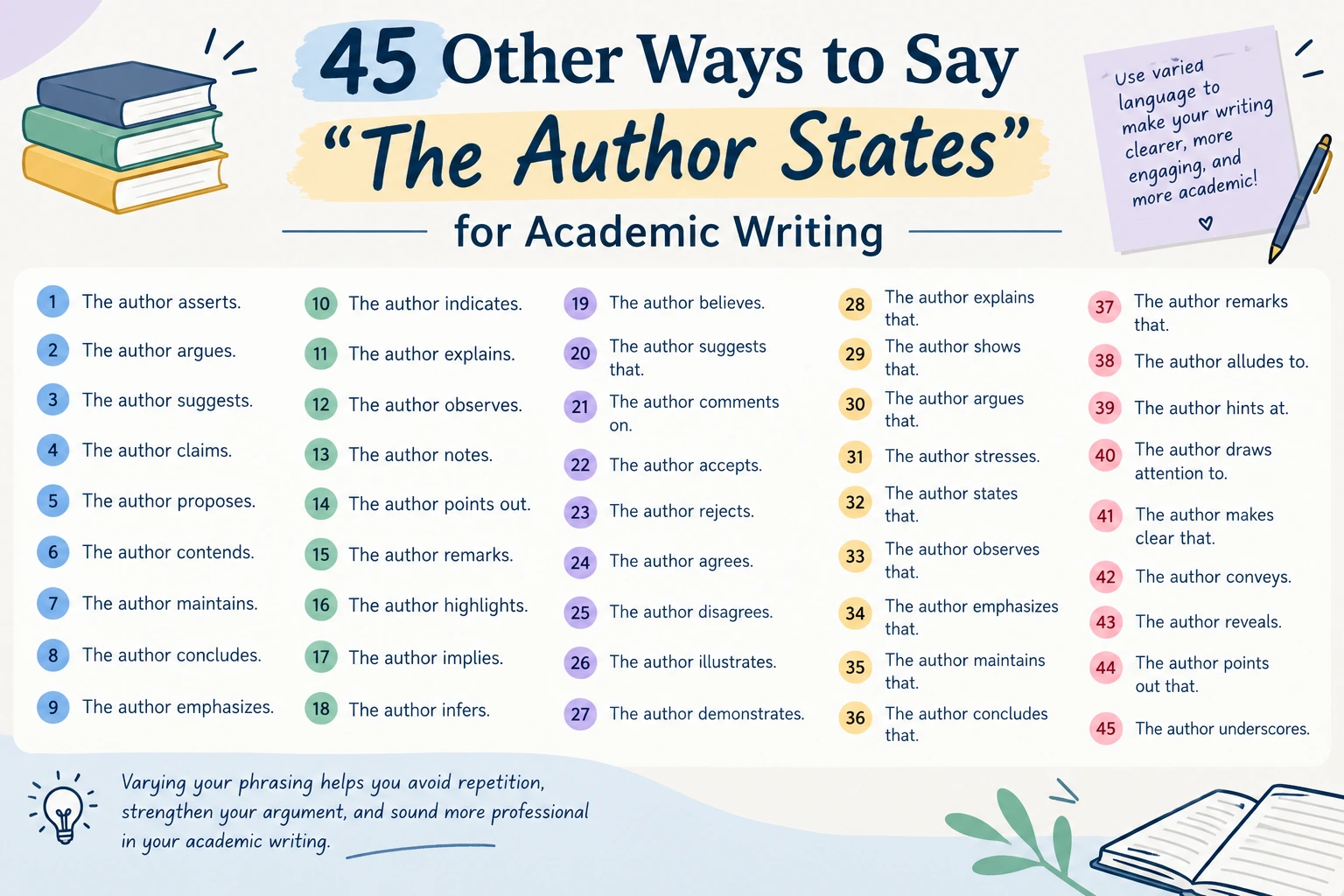
Writing an essay can be challenging enough without repeating the same phrases in every paragraph. If you frequently use “the author states” to introduce evidence, explain an argument, or summarize a source, your writing may start to sound repetitive. The good news is that a few carefully chosen alternatives can make your work clearer, more engaging, and more professional.
Whether you are writing an academic essay, a research paper, a literature review, or a critical analysis, the words you use to introduce an author’s ideas matter. Some expressions simply report information, while others show that an author argues, suggests, emphasizes, or questions a particular point. Understanding these differences helps you communicate ideas accurately and develop stronger paragraphs.
In this guide, you will discover 45 useful alternatives to “the author states,” complete with meanings, practical examples, and advice on when to use each one.
What Does “The Author States” Mean?
The phrase “the author states” means that a writer expresses or presents information, an opinion, a claim, or an idea in a written work. It is commonly used in academic writing to introduce evidence from books, articles, research papers, and other sources.
For example, consider this sentence:
“The author states that regular reading improves vocabulary.”
Here, the phrase introduces the author’s claim without necessarily agreeing or disagreeing with it.
Although the expression is correct and widely understood, using it repeatedly can make an essay feel mechanical. Alternatives such as “the author explains,” “the writer argues,” and “the researcher suggests” help you communicate the author’s purpose more precisely.
However, these phrases are not always interchangeable. “Explains” suggests clarification, while “argues” introduces a position supported by reasoning. “Suggests” often indicates a possibility or a less direct claim.
The best alternative depends on what the source actually says and how you want to present it.
The following expressions are organized into five categories to help you choose the right phrase for academic essays, research papers, formal reports, and everyday writing.
Category 1: Polite and Professional Alternatives
These expressions are clear, neutral, and suitable for most academic situations. Use them when you want to introduce information from a source without adding unnecessary interpretation.
1. The Author Explains
Meaning: The author makes an idea, process, or situation easier to understand.
Example: The author explains that regular exercise can improve both physical health and mental well-being.
When to use it: Choose this phrase when the source provides clarification, details, or reasons behind an idea. It works especially well when summarizing explanations from textbooks and informational articles.
2. The Writer Notes
Meaning: The writer draws attention to a particular fact, observation, or detail.
Example: The writer notes that students often perform better when they receive timely feedback.
When to use it: This expression is useful when introducing a relevant observation without suggesting that the writer is making a strong argument.
3. The Author Mentions
Meaning: The author refers to a subject, fact, or idea, usually without discussing it in great detail.
Example: The author mentions that access to public transportation varies between urban and rural areas.
When to use it: Use this phrase when a source briefly refers to something rather than developing it as a central argument.
4. The Writer Observes
Meaning: The writer identifies or comments on something noticed through experience, evidence, or analysis.
Example: The writer observes that communication problems often arise when expectations are unclear.
When to use it: This phrase works well when reporting an author’s observation about a situation, pattern, or behavior.
5. The Author Points Out
Meaning: The author draws attention to something important or easy to overlook.
Example: The author points out that affordable housing remains a major concern in many cities.
When to use it: Choose this expression when the source highlights a particular fact or issue that supports the discussion.
6. The Writer Highlights
Meaning: The writer emphasizes a specific point, feature, or issue.
Example: The writer highlights the importance of critical thinking in modern education.
When to use it: Use this phrase when the author gives special attention to a particular idea.
7. The Author Identifies
Meaning: The author recognizes or names a specific factor, problem, or characteristic.
Example: The author identifies poor communication as one of the main causes of workplace conflict.
When to use it: This expression is especially useful in analytical writing, research summaries, and discussions of problems or contributing factors.
8. The Writer Describes
Meaning: The writer presents details about a person, event, situation, or concept.
Example: The writer describes how economic changes affected small businesses in the region.
When to use it: Use this phrase when the source provides a description rather than making a direct argument.
9. The Author Reports
Meaning: The author presents information, findings, or events, often based on research or observation.
Example: The author reports that participation increased after the organization introduced a new training program.
When to use it: This expression is particularly appropriate for research articles, news reports, and evidence-based writing.
Category 2: Confident and Analytical Alternatives
These expressions are helpful when the author presents a position, supports a claim, or interprets evidence. They can make your academic writing more precise and persuasive.
10. The Author Argues
Meaning: The author presents a position and supports it with reasons or evidence.
Example: The author argues that governments should invest more heavily in public education.
When to use it: Choose this phrase when the source attempts to convince readers of a particular viewpoint. It is one of the strongest alternatives for argumentative essays.
11. The Writer Asserts
Meaning: The writer expresses a claim or position firmly.
Example: The writer asserts that equal access to education is essential for social progress.
When to use it: Use this expression when the author presents a clear claim. It does not automatically mean the claim is correct or supported by strong evidence.
12. The Author Emphasizes
Meaning: The author gives special importance to a particular idea or point.
Example: The author emphasizes the need for stronger environmental protection measures.
When to use it: This phrase is ideal when the source repeatedly returns to an idea or presents it as especially significant.
13. The Writer Maintains
Meaning: The writer continues to support a particular position or belief.
Example: The writer maintains that practical experience is essential for developing professional skills.
When to use it: Choose this phrase when the author consistently defends a viewpoint throughout a discussion.
14. The Author Contends
Meaning: The author argues that something is true, often in a discussion where other viewpoints may exist.
Example: The author contends that technology should support classroom learning rather than replace teachers.
When to use it: This expression suits formal essays, debates, and critical analysis, particularly when presenting a debatable claim.
15. The Writer Proposes
Meaning: The writer suggests a plan, explanation, solution, or new approach.
Example: The writer proposes a revised assessment system to encourage deeper learning.
When to use it: Use this phrase when the author recommends a course of action or introduces a new idea.
16. The Author Claims
Meaning: The author states that something is true, although the statement may require further evidence or evaluation.
Example: The author claims that remote work improves employee productivity.
When to use it: This phrase is useful when discussing a claim that you intend to examine or evaluate. It can sound skeptical in some contexts, so use it carefully.
17. The Writer Concludes
Meaning: The writer reaches a final judgment or decision after considering information or evidence.
Example: The writer concludes that long-term planning is necessary for sustainable economic growth.
When to use it: Use this expression when reporting the author’s conclusion rather than introducing a general statement from the middle of the text.
18. The Author Establishes
Meaning: The author demonstrates, sets out, or develops a particular point or foundation.
Example: The author establishes a clear connection between access to education and economic opportunity.
When to use it: This phrase works well when the writer develops a relationship, framework, or argument through evidence.
Category 3: Friendly and Accessible Alternatives
These alternatives are natural and easy to understand. They work well in school assignments, general essays, reading responses, and explanations intended for a broad audience.
19. The Author Suggests
Meaning: The author presents an idea or possibility without necessarily stating it as an absolute fact.
Example: The author suggests that regular classroom discussions may improve students’ confidence.
When to use it: Choose this expression when the source offers a possible explanation, recommendation, or interpretation rather than a definite conclusion.
20. The Writer Indicates
Meaning: The writer communicates or signals that something may be true or relevant.
Example: The writer indicates that the policy may need further review before implementation.
When to use it: This phrase is useful when the author’s wording or evidence points toward a particular conclusion.
21. The Author Reveals
Meaning: The author brings important or previously unknown information to light.
Example: The author reveals that several small changes contributed to the project’s success.
When to use it: Use this expression when the source uncovers meaningful information. Avoid it for ordinary facts that are not particularly new or surprising.
22. The Writer Demonstrates
Meaning: The writer shows that an idea is supported through evidence, examples, or reasoning.
Example: The writer demonstrates how consistent practice can improve language skills.
When to use it: Choose this phrase when the source provides convincing evidence or a clear explanation of how something works.
23. The Author Illustrates
Meaning: The author makes an idea clearer through examples, descriptions, or comparisons.
Example: The author illustrates the effects of inequality through the experiences of several families.
When to use it: This is a strong choice when a source uses examples or real-life situations to explain an abstract concept.
24. The Writer Clarifies
Meaning: The writer makes a confusing or uncertain point easier to understand.
Example: The writer clarifies the difference between economic growth and economic development.
When to use it: Use this phrase when the source explains a distinction, resolves confusion, or defines a term more precisely.
25. The Author Acknowledges
Meaning: The author recognizes that a fact, limitation, or opposing point exists.
Example: The author acknowledges that the research has limitations because the sample size was relatively small.
When to use it: This expression is particularly helpful in critical analysis when a writer recognizes complications or alternative perspectives.
26. The Writer Adds
Meaning: The writer introduces additional information to support or expand a previous point.
Example: The writer adds that community involvement can make local projects more successful.
When to use it: Choose this phrase when the author provides another detail or builds on an idea already discussed.
27. The Author Explores
Meaning: The author examines a topic, question, or possibility in detail.
Example: The author explores the relationship between social media use and self-esteem among teenagers.
When to use it: This phrase is useful when describing the purpose or scope of an article, chapter, or research paper.
Category 4: Formal and Academic Alternatives
These expressions are especially suitable for research papers, literature reviews, critical essays, and university assignments. They help you describe an author’s reasoning or interpretation with greater precision.
28. The Author Postulates
Meaning: The author proposes an idea or principle as a basis for further reasoning.
Example: The author postulates that early exposure to multiple languages may influence cognitive development.
When to use it: Use this expression when the author introduces a theoretical assumption or starting proposition. It is more specialized than “states,” so reserve it for suitable academic contexts.
29. The Writer Theorizes
Meaning: The writer develops or presents a theory to explain a phenomenon.
Example: The writer theorizes that social expectations influence how individuals make career decisions.
When to use it: This phrase is useful when discussing theoretical explanations, especially in social sciences and humanities.
30. The Author Infers
Meaning: The author reaches a conclusion based on available evidence or reasoning rather than stating it directly.
Example: The author infers that limited access to resources may contribute to the difference in outcomes.
When to use it: Use this only when the author draws an inference. It is not an accurate substitute when the source explicitly states the point.
31. The Writer Interprets
Meaning: The writer explains the meaning or significance of information, events, or evidence.
Example: The writer interprets the survey results as evidence of changing consumer preferences.
When to use it: This expression is ideal when the author explains what evidence might mean rather than merely presenting the data.
32. The Author Demonstrates That
Meaning: The author provides reasoning or evidence to support a particular conclusion.
Example: The author demonstrates that consistent feedback can improve students’ understanding of difficult concepts.
When to use it: Use this phrase when the source provides evidence that substantiates a point. Make sure the evidence genuinely supports the claim.
33. The Writer Substantiates
Meaning: The writer supports a claim with evidence, facts, or reasoning.
Example: The writer substantiates the argument with survey results and interviews.
When to use it: This is particularly useful in academic writing when describing how a source supports its argument.
34. The Author Corroborates
Meaning: The author provides additional evidence that supports an existing claim or finding.
Example: The author corroborates earlier findings by presenting data from a separate study.
When to use it: Choose this phrase when the source reinforces information already supported by other evidence.
35. The Writer Elucidates
Meaning: The writer explains a complicated idea in a clear and detailed way.
Example: The writer elucidates the relationship between public policy and economic inequality.
When to use it: This formal alternative works in advanced academic writing when a source provides a particularly clear explanation. In simpler writing, “explains” is often better.
36. The Author Expounds
Meaning: The author explains an idea in detail, often by developing its reasoning or implications.
Example: The author expounds on the ethical challenges associated with artificial intelligence.
When to use it: Use this phrase when the author develops a topic at length rather than simply mentioning it.
Category 5: Thoughtful and Critical Alternatives
These expressions help you introduce an author’s perspective, describe the structure of an argument, or communicate a more nuanced interpretation.
37. The Author Implies
Meaning: The author suggests something indirectly without expressing it explicitly.
Example: The author implies that the current approach may not adequately address students’ needs.
When to use it: Use this phrase when you are interpreting an indirect message. Make sure the implication is supported by the text rather than your own assumptions.
38. The Writer Underscores
Meaning: The writer emphasizes the importance or seriousness of an issue.
Example: The writer underscores the importance of protecting personal information online.
When to use it: This is a polished alternative to “emphasizes,” especially in formal essays and analytical reports.
39. The Author Affirms
Meaning: The author expresses strong agreement with or confidence in a particular statement or principle.
Example: The author affirms that equal opportunities are essential for a fair education system.
When to use it: Choose this expression when the author clearly reinforces a belief or principle rather than simply reporting information.
40. The Writer Challenges
Meaning: The writer questions an established idea, assumption, or commonly accepted belief.
Example: The writer challenges the assumption that economic growth always improves quality of life.
When to use it: This phrase is useful in critical analysis when a source questions existing arguments or conventional thinking.
41. The Author Questions
Meaning: The author expresses doubt about an idea or examines whether it should be accepted.
Example: The author questions whether standardized tests accurately measure students’ abilities.
When to use it: Use this phrase when the source raises doubts or invites readers to reconsider a claim.
42. The Writer Counters
Meaning: The writer responds to or challenges another argument with a different position or evidence.
Example: The writer counters the criticism by presenting evidence from a larger study.
When to use it: This expression works well when summarizing disagreements, counterarguments, and debates.
43. The Author Recommends
Meaning: The author advises that a particular action or approach should be considered.
Example: The author recommends introducing regular training sessions for new employees.
When to use it: Use this phrase when the source offers practical advice, a proposed solution, or a preferred course of action.
44. The Writer Advocates
Meaning: The writer publicly or strongly supports a particular idea, policy, or change.
Example: The writer advocates for stronger protections for vulnerable communities.
When to use it: Choose this expression when the author actively supports a position or calls for a particular change.
45. The Author Draws Attention To
Meaning: The author directs the reader’s focus toward an important point or issue.
Example: The author draws attention to the long-term consequences of excessive plastic waste.
When to use it: This phrase works well when the source highlights a relevant detail that deserves closer consideration.
How to Choose the Right Alternative
The most effective alternative depends on the author’s purpose. Before choosing a phrase, ask yourself what the writer is actually doing.
| If the author… | Try this phrase |
|---|---|
| Provides information | The author reports |
| Explains an idea | The author explains |
| Presents a strong position | The author argues |
| Offers a possibility | The author suggests |
| Highlights an important point | The writer underscores |
| Uses evidence to support a claim | The writer substantiates |
| Reaches a final judgment | The author concludes |
| Questions a common belief | The writer challenges |
| Gives advice | The author recommends |
| Refers to something briefly | The author mentions |
| Interprets evidence | The writer interprets |
| Recognizes a limitation | The author acknowledges |
One important rule: choose a reporting verb that accurately reflects the source. For example, do not write “the author proves” when the writer merely suggests an idea. Similarly, avoid using “the author implies” when the statement is directly expressed.
Tips for Using Alternatives in Academic Writing
1. Avoid repeating the same reporting verb. If every paragraph begins with “the author states,” your writing may feel repetitive. Vary your wording when it improves clarity, but do not change verbs simply for the sake of variety.
2. Match the verb to the evidence. “Argues,” “claims,” “suggests,” and “demonstrates” communicate different levels of certainty and different purposes. Select the expression that best represents the source.
3. Follow the required citation style. Whether you use APA, MLA, Chicago, or another format, make sure your paraphrases and quotations are properly cited. Changing the reporting verb does not remove the need to acknowledge the original author.
Conclusion
Finding alternatives to “the author states” can make your academic writing more varied, precise, and engaging. Expressions such as “the author explains,” “the writer argues,” “the author suggests,” and “the writer underscores” help you communicate not only what a source says but also how it develops its ideas.
The key is to use each expression thoughtfully. Choose words that match the author’s purpose, support your interpretation with evidence, and avoid unnecessary complexity. When your reporting verbs are accurate and varied, your writing becomes easier to follow and more convincing.
Strong academic writing is not about using the most complicated words. It is about expressing ideas clearly, accurately, and confidently.
Discover more
professional synonyms for people person