

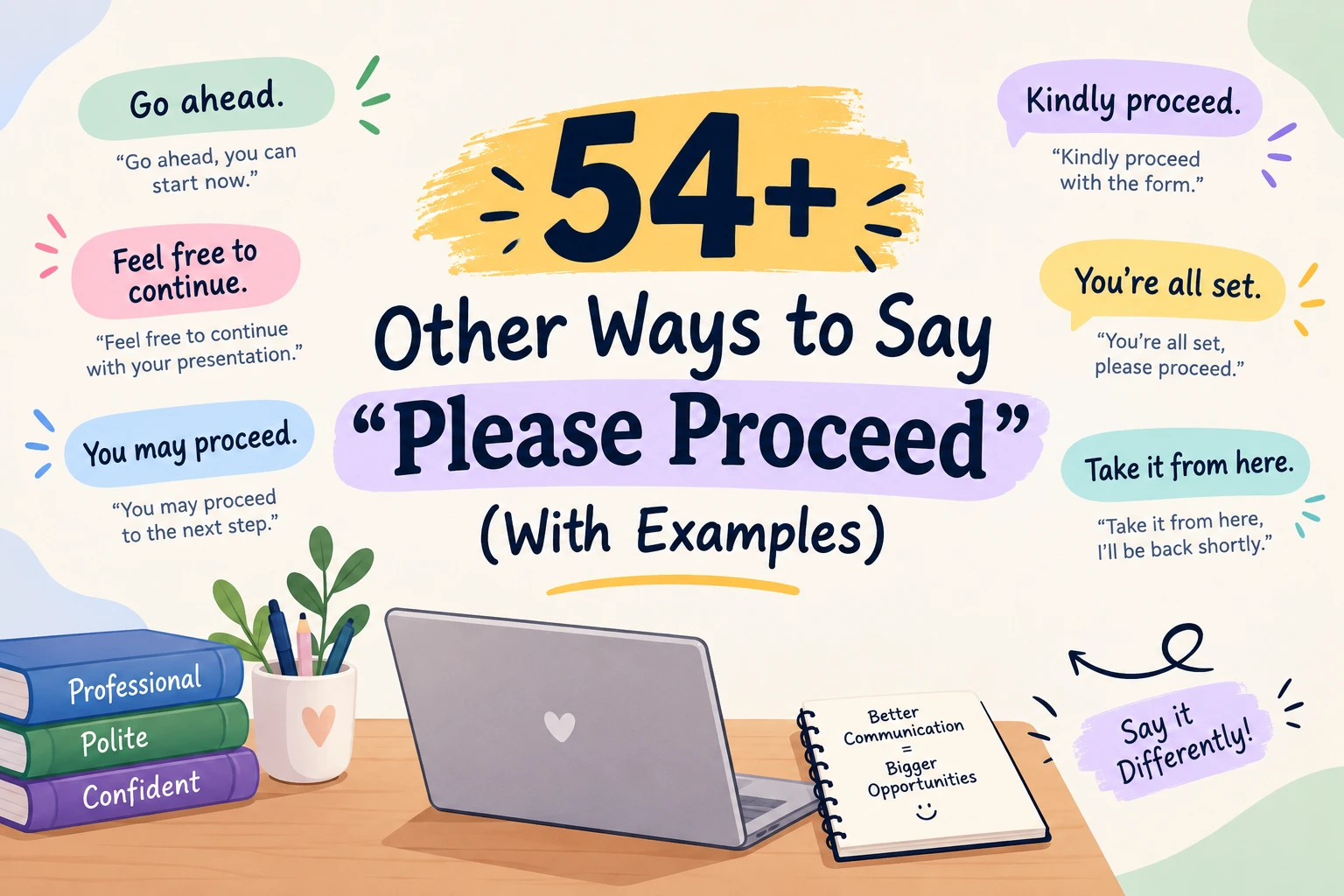
Finding the right words for a simple instruction can sometimes be harder than expected. Whether you’re replying to a business email, approving a colleague’s proposal, or encouraging someone to continue, the way you express permission matters. “Please proceed” is a polite and professional phrase, but using it too often can make your messages sound repetitive or overly formal. Fortunately, there are many alternatives that help you communicate the same message with greater warmth, clarity, and confidence. Some expressions are perfect for formal emails, while others feel more natural in everyday conversations. Knowing which phrase to use can help you avoid misunderstandings and make your communication more effective. In this guide, you’ll discover 54 alternatives to “please proceed,” complete with practical examples, common mistakes, and useful tips to help you choose the right expression for every situation.
2. What Does “Please Proceed” Mean?
“Please proceed” is a polite way of telling someone that they can continue with an activity, begin a task, or move forward with a plan. It can also communicate approval or permission, depending on the context.
For example, a manager might tell an employee, “Please proceed with the project,” after approving a proposal. Similarly, someone leading a meeting might say, “Please proceed with your presentation,” to invite a speaker to continue.
The phrase is commonly used in business emails, workplace conversations, meetings, and formal discussions. However, it can sometimes sound distant or unnecessarily formal in casual situations.
Alternatives such as “Go ahead,” “Feel free to continue,” and “Move forward with the plan” can make your message sound more natural while keeping its original meaning.
The following alternatives are divided into five categories to help you choose the right expression for professional, friendly, confident, humorous, and thoughtful conversations.
Category 1: Polite and Appreciative Alternatives
These expressions are useful for professional emails, workplace discussions, and situations where you want to sound respectful and considerate.
1. Please Go Ahead
Reply: “Please go ahead.”
Example: A colleague asks whether they can begin presenting their proposal. You respond, “Please go ahead. We’re ready to hear your ideas.”
This is a simple, polite alternative that works in almost any professional setting. It gives someone permission to continue without sounding overly formal.
2. Kindly Continue
Reply: “Kindly continue.”
Example: During a meeting, a team member pauses while explaining a new strategy. You say, “Kindly continue. I’d like to hear the remaining details.”
This expression is respectful and slightly formal. It works well in meetings, presentations, and official correspondence.
3. Feel Free to Proceed
Reply: “Feel free to proceed.”
Example: An employee asks their manager whether they can begin a new assignment. The manager replies, “Feel free to proceed with the plan we discussed.”
This phrase gives permission while making the other person feel comfortable. It is particularly useful in workplace emails.
4. Please Carry On
Reply: “Please carry on.”
Example: A colleague stops explaining a report after receiving a phone call. When they return, you say, “Please carry on. We were following your explanation.”
This phrase is polite and conversational. It is especially useful when someone has temporarily paused an activity.
5. You’re Welcome to Continue
Reply: “You’re welcome to continue.”
Example: A student asks whether they can finish explaining their answer. The teacher responds, “You’re welcome to continue. Take your time.”
This expression sounds warm and considerate. It is suitable when you want someone to feel comfortable continuing.
6. Please Move Forward
Reply: “Please move forward.”
Example: After reviewing a proposal, a supervisor tells an employee, “Everything looks good. Please move forward with the next stage.”
This alternative is clear and professional. It works well when someone needs permission to take the next step.
7. You May Continue
Reply: “You may continue.”
Example: During a presentation, a speaker asks whether they should move on to the next slide. You respond, “You may continue. The previous section is clear.”
This expression is direct yet respectful. It is useful in formal situations where someone needs clear permission.
8. Kindly Move Ahead
Reply: “Kindly move ahead.”
Example: A manager reviews an employee’s proposal and writes, “The suggested changes are acceptable. Kindly move ahead with the implementation.”
This phrase is appropriate for formal business communication. For a more conversational tone, “Please move ahead” may sound more natural.
9. Please Feel Free to Continue
Reply: “Please feel free to continue.”
Example: A client asks whether they can send the remaining documents later. You respond, “Please feel free to continue sending them whenever they’re ready.”
This expression combines politeness with flexibility. It is particularly useful in customer service and professional correspondence.
10. Go Right Ahead
Reply: “Go right ahead.”
Example: A colleague asks whether they can share a new idea during a meeting. You reply, “Go right ahead. We’d be happy to hear it.”
This phrase sounds friendly while remaining respectful. It is useful in both professional and everyday conversations.
11. You Have My Permission to Proceed
Reply: “You have my permission to proceed.”
Example: An employee asks whether they can purchase additional equipment. Their manager says, “You have my permission to proceed with the purchase.”
This expression communicates explicit authorization. It is particularly useful when someone needs formal permission before taking action.
Category 2: Flirty and Playful Alternatives
These expressions are more relaxed and lively. They work well with friends, partners, and familiar colleagues when you want to make your response sound friendly or playful.
12. Go for It
Reply: “Go for it.”
Example: Your crush tells you they’re thinking about entering a photography competition. You smile and say, “Go for it. I’d love to see what you create.”
This phrase is enthusiastic and encouraging. It works well when someone is considering an opportunity or trying something new.
13. You’re Good to Go
Reply: “You’re good to go.”
Example: Your friend asks whether everyone is ready to leave for a weekend trip. You respond, “You’re good to go. I’ve already packed everything.”
This expression communicates that everything is ready. It is especially useful in casual conversations.
14. Take It Away
Reply: “Take it away.”
Example: Your friend is about to perform a song at a small gathering. You say, “Take it away. We’re all waiting to hear you.”
This playful expression invites someone to begin. It is commonly used for performances, presentations, and demonstrations.
15. The Floor Is Yours
Reply: “The floor is yours.”
Example: Your partner wants to explain an idea during a group discussion. You smile and say, “The floor is yours. I’m listening.”
This expression gives someone the opportunity to speak. It works particularly well in group conversations and meetings.
16. Have at It
Reply: “Have at it.”
Example: Your friend asks whether they can experiment with a new recipe in your kitchen. You reply, “Have at it. I’m curious to see how it turns out.”
This is a casual way to encourage someone to begin. It is best suited to relaxed conversations with people you know well.
17. You’re All Set
Reply: “You’re all set.”
Example: Your friend asks whether they can start using the new camera. You respond, “You’re all set. The battery is charged, and everything is ready.”
This phrase reassures someone that they can begin. It sounds friendly and natural in everyday situations.
18. Let’s Do This
Reply: “Let’s do this.”
Example: Your friends are finally ready to start a long-planned road trip. You say, “We’ve got everything we need. Let’s do this.”
This expression adds excitement and enthusiasm. It is particularly useful when everyone is ready to participate.
19. Go Ahead, It’s Fine
Reply: “Go ahead, it’s fine.”
Example: Your friend asks whether they can borrow your headphones. You reply, “Go ahead, it’s fine. Just bring them back tomorrow.”
This phrase is relaxed and reassuring. It works well for simple requests between friends.
20. Make Yourself at Home
Reply: “Make yourself at home.”
Example: A friend visits your house and asks whether they can make some tea. You smile and say, “Make yourself at home. Everything you need is in the kitchen.”
This expression makes someone feel welcome. It is especially suitable for guests and informal social situations.
21. The Green Light Is Yours
Reply: “The green light is yours.”
Example: Your friend asks whether they should start planning a surprise party. You respond, “The green light is yours. Just don’t reveal the surprise.”
This playful expression means someone has permission to begin. It adds personality to a casual conversation.
22. Knock Yourself Out
Reply: “Knock yourself out.”
Example: Your friend asks whether they can use your art supplies for a project. You say, “Knock yourself out. Just make sure you put everything back.”
This is a humorous, informal way to give permission. Use it with people who understand your sense of humor, as it can sound dismissive in some situations.
Category 3: Confident and Self-Respecting Alternatives
These expressions communicate approval, authority, and clear expectations. They are especially useful for managers, team leaders, business owners, and professional communication.
23. You Have My Approval
Reply: “You have my approval.”
Example: An employee presents a marketing plan to their manager. After reviewing it, the manager says, “You have my approval. Start preparing the campaign.”
This phrase clearly communicates a decision. It is useful when someone needs formal confirmation before taking action.
24. Proceed as Planned
Reply: “Proceed as planned.”
Example: A project manager tells the team, “The schedule has been approved. Proceed as planned and keep me updated.”
This expression is direct and professional. It works particularly well when a plan has already been discussed and approved.
25. Move Forward With It
Reply: “Move forward with it.”
Example: After reviewing a colleague’s proposal, you say, “The budget looks reasonable. Move forward with it.”
This phrase communicates confidence in a decision. It is useful when you want someone to take action without unnecessary delays.
26. You Can Proceed
Reply: “You can proceed.”
Example: An employee asks whether they can publish an approved announcement. Their supervisor replies, “You can proceed. The final version has been reviewed.”
This alternative is simple and direct. It works well in professional conversations where clarity matters.
27. I Approve the Plan
Reply: “I approve the plan.”
Example: A team member submits a revised project schedule. Their manager responds, “I approve the plan. Please coordinate with the other departments.”
This phrase makes your decision clear. It is especially helpful when someone needs explicit approval.
28. Take the Next Step
Reply: “Take the next step.”
Example: A colleague completes the research stage of a project. You tell them, “Your findings look complete. Take the next step and prepare the presentation.”
This expression encourages progress while giving someone a clear direction. It is useful for professional guidance and project management.
29. Begin the Process
Reply: “Begin the process.”
Example: A supervisor tells an employee, “Your application has been approved. You can begin the process of onboarding the new staff.”
This phrase is formal and action-oriented. It is suitable for procedures that require several steps.
30. You’re Authorized to Proceed
Reply: “You’re authorized to proceed.”
Example: A department manager tells an employee, “The documents have been signed. You’re authorized to proceed with the purchase.”
This expression communicates formal permission. It is useful when responsibilities and approvals need to be clearly documented.
31. Let’s Move Ahead
Reply: “Let’s move ahead.”
Example: During a planning meeting, the team agrees on a new strategy. The leader says, “We’ve discussed the important points. Let’s move ahead with implementation.”
This phrase sounds confident and collaborative. It is particularly useful when a group has reached a decision.
32. Put the Plan Into Action
Reply: “Put the plan into action.”
Example: After approving a new project, a manager tells the team, “We’ve finalized the details. Now it’s time to put the plan into action.”
This expression emphasizes practical action rather than simple permission. It is useful when planning is complete and work needs to begin.
33. Continue With the Approved Plan
Reply: “Continue with the approved plan.”
Example: An employee asks whether a previously approved project needs more changes. Their manager responds, “Continue with the approved plan. No further revisions are necessary.”
This phrase provides clear instructions. It is especially useful for formal workplace communication.
Category 4: Funny and Savage Alternatives
These expressions add humor and personality to an ordinary instruction. They are best suited to informal conversations with friends or colleagues who appreciate playful language.
34. The Show Must Go On
Reply: “The show must go on.”
Example: Your friend forgets a line during a presentation rehearsal. You laugh and say, “The show must go on. Just pick up where you left off.”
This familiar expression encourages someone to continue despite a small problem. It adds humor while remaining supportive.
35. Permission Granted, Captain
Reply: “Permission granted, Captain.”
Example: Your friend asks whether they can choose the movie for the evening. You reply, “Permission granted, Captain. Just don’t make us watch another three-hour film.”
This playful response turns an ordinary approval into a joke. It works well with friends who enjoy lighthearted conversations.
36. Unleash Your Genius
Reply: “Unleash your genius.”
Example: Your friend wants to redesign your group’s presentation. You say, “Unleash your genius. Let’s see what you’ve come up with this time.”
This expression is humorous and encouraging. It works well when someone is about to demonstrate their creativity.
37. The Stage Is Yours
Reply: “The stage is yours.”
Example: Your friend is ready to tell a funny story at dinner. You smile and say, “The stage is yours. Let’s hear this legendary story.”
This phrase gives someone the spotlight while adding a playful touch. It is useful at social gatherings and informal presentations.
38. Do Your Thing
Reply: “Do your thing.”
Example: Your friend is preparing a creative video for social media. You tell them, “Do your thing. Your editing style always makes these videos interesting.”
This relaxed expression encourages someone to work in their own way. It is particularly useful when you trust their judgment.
39. Let the Magic Happen
Reply: “Let the magic happen.”
Example: Your friend is preparing a surprise birthday decoration. You say, “Let the magic happen. I’ll stay out of your way.”
This phrase adds enthusiasm and humor to an ordinary approval. It works well when someone is doing something creative.
40. Fire Away
Reply: “Fire away.”
Example: During a question-and-answer session, a colleague asks whether they can ask a few questions. You respond, “Fire away. I’ll answer whatever I can.”
This expression encourages someone to start speaking or asking questions. It is casual, direct, and energetic.
41. Make It Happen
Reply: “Make it happen.”
Example: Your friend wants to organize a weekend trip. You say, “Make it happen. Just let me know what time we’re leaving.”
This phrase is enthusiastic and action-oriented. It is useful when you want someone to turn an idea into reality.
42. No Need to Hold Back
Reply: “No need to hold back.”
Example: A friend hesitates before sharing their opinion about your new design. You tell them, “No need to hold back. I genuinely want your honest feedback.”
This expression encourages someone to speak freely. It works best when you’re genuinely open to their response.
43. Work Your Magic
Reply: “Go ahead and work your magic.”
Example: Your colleague offers to improve a presentation. You respond, “Go ahead and work your magic. I’m looking forward to seeing the final version.”
This phrase is playful and appreciative. It is useful when someone has a particular talent and you trust their abilities.
Category 5: Curious, Thoughtful, and Mature Alternatives
These expressions are useful when you want to encourage someone while remaining considerate, patient, and collaborative.
44. Please Continue at Your Own Pace
Reply: “Please continue at your own pace.”
Example: A colleague is explaining a complicated report and apologizes for taking too long. You reassure them, “Please continue at your own pace. I’d rather understand everything properly.”
This phrase shows patience and consideration. It is useful when someone needs extra time to complete a task or explain something.
45. Take the Time You Need
Reply: “Take the time you need.”
Example: Your teammate is preparing an important presentation and worries about the deadline. You say, “Take the time you need to review the figures carefully.”
This expression encourages someone to continue without feeling rushed. It works well when accuracy matters.
46. I’m Happy for You to Continue
Reply: “I’m happy for you to continue.”
Example: A colleague asks whether they should finish explaining their proposal. You respond, “I’m happy for you to continue. Your explanation is helping us understand the idea.”
This expression sounds considerate and welcoming. It is useful when you want someone to share more information.
47. Please Take It From Here
Reply: “Please take it from here.”
Example: A team leader finishes explaining a project and asks a colleague to manage the next phase. They say, “Please take it from here and coordinate with the design team.”
This phrase transfers responsibility to someone else. It is particularly useful during meetings and project handovers.
48. Continue When You’re Ready
Reply: “Continue when you’re ready.”
Example: A student pauses during a presentation because they have lost their place. The teacher says, “Continue when you’re ready. There’s no need to rush.”
This phrase is patient and reassuring. It works well when someone needs time to collect their thoughts.
49. Let’s Take the Next Step Together
Reply: “Let’s take the next step together.”
Example: Two colleagues finish discussing a difficult assignment. One says, “We’ve worked through the main challenges. Let’s take the next step together.”
This expression emphasizes cooperation. It is especially useful when working toward a shared goal.
50. Feel Confident Moving Forward
Reply: “Feel confident moving forward.”
Example: A mentor reviews a student’s business proposal and says, “You’ve addressed the major concerns. Feel confident moving forward with your presentation.”
This phrase offers reassurance while encouraging action. It is useful when someone is uncertain about what to do next.
51. I’m Comfortable With You Proceeding
Reply: “I’m comfortable with you proceeding.”
Example: A colleague suggests a change to the team’s workflow. After reviewing it, you say, “I’ve considered the possible issues, and I’m comfortable with you proceeding.”
This expression communicates approval in a thoughtful way. It is useful when a decision requires careful consideration.
52. You Can Take It From Here
Reply: “You can take it from here.”
Example: A manager explains the requirements for a new assignment and then says, “You understand the expectations, so you can take it from here.”
This phrase gives someone responsibility for the next part of a task. It works well when delegating work.
53. Let’s Keep Things Moving
Reply: “Let’s keep things moving.”
Example: During a meeting, the team finishes discussing one topic and is ready to address the next. The meeting leader says, “We’ve reached a decision. Let’s keep things moving.”
This expression encourages progress without sounding overly demanding. It is useful in meetings and collaborative work.
54. Go Ahead Whenever You’re Ready
Reply: “Go ahead whenever you’re ready.”
Example: A friend is preparing to share some personal news but seems hesitant. You say, “Go ahead whenever you’re ready. I’m here to listen.”
This phrase combines permission with patience. It is particularly helpful when someone needs reassurance before continuing.
4. Real-Life Situations: Which Alternative Should You Use?
The best alternative depends on the situation, your relationship with the other person, and the message you want to convey.
Situation 1: When a Colleague Asks for Permission
Best reply: “Please go ahead.”
Example:
Colleague: “I’ve finished the first part of the report. Should I start working on the next section?”
You: “Please go ahead. The current section looks good.”
This response is polite, clear, and appropriate for a professional environment.
Situation 2: When a Friend Wants to Try Something New
Best reply: “Go for it.”
Example:
Friend: “I’m thinking of starting my own YouTube channel, but I’m not sure.”
You: “Go for it. You can always improve as you learn.”
This response offers encouragement without making the conversation unnecessarily formal.
Situation 3: When Someone Needs Formal Approval
Best reply: “You have my approval.”
Example:
Employee: “Can I move forward with the revised budget?”
Manager: “You have my approval. Please send the finalized version to the finance team.”
This response makes the decision clear and gives the employee permission to act.
Situation 4: When Someone Is Hesitant to Continue
Best reply: “Take the time you need.”
Example:
Friend: “Sorry, I’m taking too long to explain everything.”
You: “Take the time you need. I want to understand what happened.”
This response shows patience and makes the other person feel comfortable.
Situation 5: When Handing Over Responsibility
Best reply: “Please take it from here.”
Example:
Team leader: “I’ve explained the project requirements and shared all the necessary documents.”
Colleague: “Understood. I’ll handle the next stage.”
Team leader: “Great. Please take it from here.”
This expression is direct and professional, making it useful when transferring responsibility.
5. What to Avoid When Saying “Please Proceed”
Choosing the right alternative is important, but knowing what to avoid can make your communication even more effective.
1. Being Too Formal in Casual Conversations
Using phrases such as “You are hereby authorized to proceed” when speaking to a friend can sound unnecessarily serious.
Better approach: Use natural expressions such as “Go ahead,” “Go for it,” or “Have at it” in informal conversations.
2. Giving Unclear Instructions
Simply saying “Continue” may not be enough when someone needs to know exactly what to do next.
Better approach: Be specific. Instead of saying “Proceed,” try “Please proceed with the second stage of the project.”
3. Sounding Too Demanding
Phrases such as “Proceed immediately” can sound harsh if urgency is unnecessary.
Better approach: Use considerate alternatives such as “Please move forward when you’re ready” when there is no strict deadline.
4. Giving Approval Without Reviewing the Details
Telling someone to proceed before understanding their proposal can lead to avoidable mistakes.
Better approach: Review important details before giving approval, especially when money, deadlines, or responsibilities are involved.
5. Using Humor in Serious Situations
Expressions such as “Knock yourself out” or “Permission granted, Captain” may be inappropriate when discussing important workplace decisions.
Better approach: Choose straightforward language when clarity and professionalism matter.
6. Confusing Encouragement With Authorization
Saying “Go for it” can express enthusiasm, but it may not provide the formal approval someone needs.
Better approach: If a task requires official permission, use an explicit phrase such as “You have my approval” or “You’re authorized to proceed.”
6. Pro Tips for Choosing the Right Alternative
A few simple habits can make your communication more effective and natural.
1. Match Your Tone to the Situation
Use “Please proceed” or “You have my approval” when formality is important. In casual conversations, “Go ahead” or “Go for it” usually feels more natural.
Your wording should reflect your relationship with the other person.
2. Be Clear About What Happens Next
If someone is waiting for permission to complete a task, tell them exactly what they can do. For example, “Please move forward with the revised proposal” is clearer than simply saying “Proceed.”
Clear instructions reduce misunderstandings and help everyone stay on the same page.
3. Combine Encouragement With Respect
Sometimes people need more than permission. They may also need reassurance that their ideas or efforts are valued.
Expressions such as “Feel free to continue” and “Take the time you need” can make conversations more comfortable while still encouraging progress.
7. Bonus: 10 Quick Alternatives to “Please Proceed”
If you need a short response for an email, text message, or everyday conversation, these one-liners are easy to remember.
- Go ahead. A simple and natural alternative for most situations.
- Please continue. A polite option for formal or professional conversations.
- Feel free. A relaxed way to give someone permission.
- Carry on. A short expression that encourages someone to continue.
- Proceed as planned. A direct choice when a plan has already been approved.
- You’re good to go. A friendly way to confirm readiness.
- Go for it. An enthusiastic way to encourage action.
- Move forward. A concise and confident professional alternative.
- Take it from here. A useful phrase when handing over responsibility.
- Let’s get started. An energetic option when you’re ready to begin together.
8. Conclusion
Finding other ways to say “please proceed” can make your communication sound more natural, thoughtful, and effective. Whether you’re writing a professional email, giving someone permission, encouraging a friend, or handing over responsibility, the right expression helps you convey your message clearly.
Remember that not every situation requires formal language. Sometimes, a simple “Go ahead” is all you need. In other situations, clear approval or a more considerate response is essential.
Choose words that fit the moment, communicate your intentions clearly, and make it easy for others to move forward.
Discover more
other ways to say strong skills