
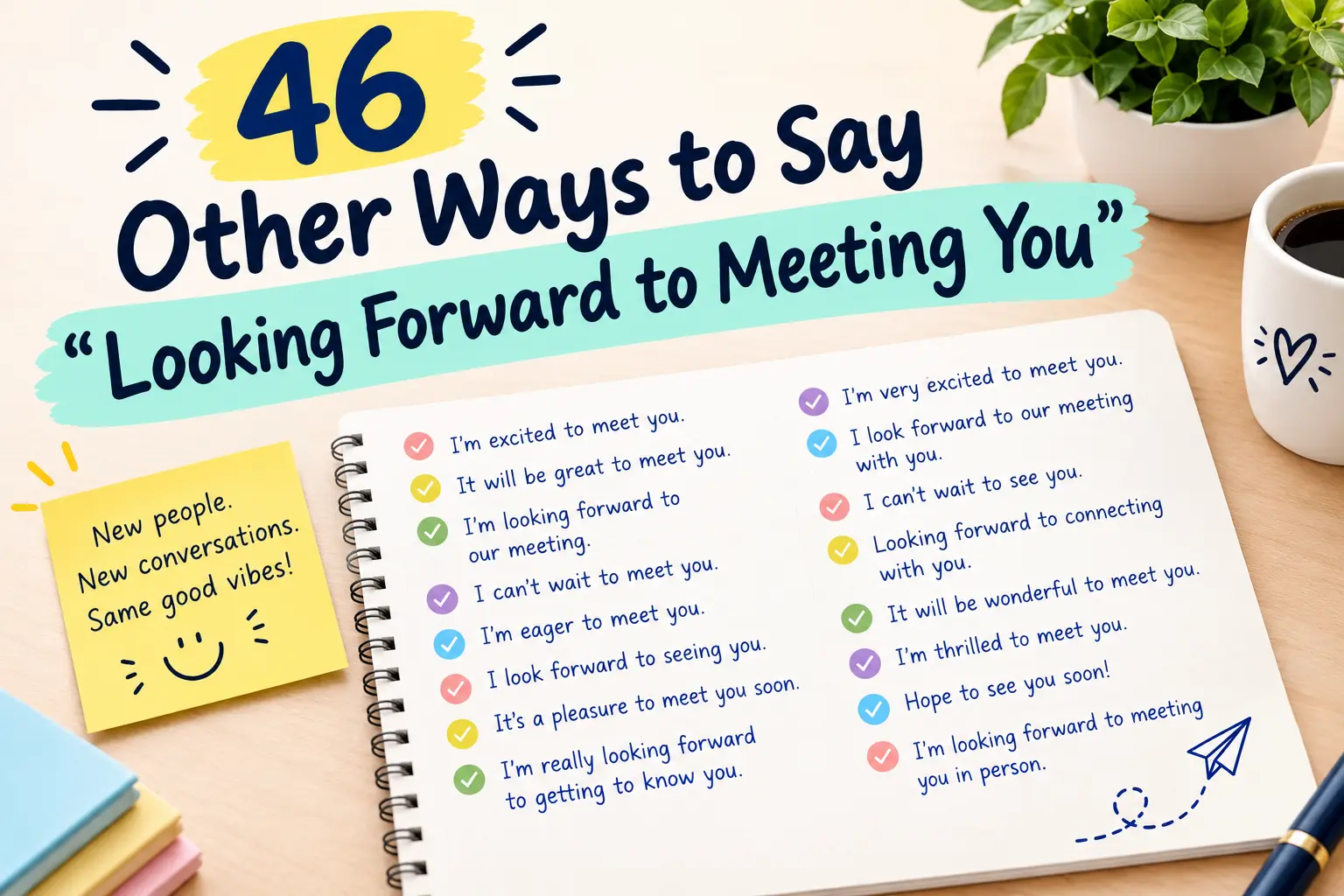
Meeting someone for the first time can be exciting, whether it is a professional contact, a new friend, or someone you have been talking to for a while. However, saying “looking forward to meeting you” repeatedly can sometimes feel predictable. Finding a more natural way to express that excitement can make your message warmer, more personal, and memorable. The right words also help you strike the right balance between friendliness and professionalism. You might want to sound polite in a business email, playful in a casual conversation, or genuinely enthusiastic when meeting someone special. Fortunately, there are plenty of ways to express the same feeling without sounding forced. In this guide, you will find 46 alternatives to “looking forward to meeting you,” complete with realistic examples to help you choose an expression that suits your personality and the situation.
What Does “Looking Forward to Meeting You” Mean?
“Looking forward to meeting you” is a polite and positive expression used to show that you are excited or pleased about meeting someone in the future. It communicates anticipation, friendliness, and interest without being overly personal.
People commonly use it before business meetings, interviews, social gatherings, dates, and other planned introductions.
For example:
“I am looking forward to meeting you at the conference tomorrow.”
The phrase is suitable for both professional and personal conversations. However, depending on your relationship with the other person, you might prefer something more enthusiastic, relaxed, humorous, or thoughtful.
Choosing an alternative can help you express your feelings more accurately while keeping your message natural.
These alternatives cover different situations, from professional introductions to playful conversations. Choose the ones that genuinely match your feelings and the relationship you have with the other person.
Category 1: Polite and Appreciative
These expressions are ideal for professional emails, interviews, formal introductions, and conversations where you want to sound respectful and welcoming.
1. “I’m excited to meet you.”
Reply: “I’m excited to meet you, too.”
Example: After arranging a meeting with a new colleague, you reply, “I’m excited to meet you, too. I’ve heard great things about the team.”
This is a warm, straightforward alternative that expresses genuine enthusiasm. It works well in both professional and personal conversations.
2. “It will be a pleasure to meet you.”
Reply: “It will be a pleasure to meet you as well.”
Example: A new business partner sends you a meeting invitation. You respond, “Thank you for arranging everything. It will be a pleasure to meet you as well.”
This expression sounds courteous and polished. It is particularly suitable for formal emails, business introductions, and professional events.
3. “I’m delighted we’ll finally meet.”
Reply: “I’m delighted we’ll finally meet in person.”
Example: After several weeks of working with someone remotely, you write, “I’m delighted we’ll finally meet in person during next week’s workshop.”
It conveys genuine happiness, especially when you have already communicated with someone before meeting them.
4. “I appreciate the opportunity to meet you.”
Reply: “I appreciate the opportunity to meet you and learn more about your work.”
Example: Before a professional networking event, you send a message saying, “Thank you for making time for me. I appreciate the opportunity to meet you.”
This is a thoughtful alternative when you want to acknowledge someone’s time or professional contribution.
5. “I’m pleased we’ll have the chance to meet.”
Reply: “I’m pleased we’ll have the chance to meet and discuss everything.”
Example: A potential client schedules a meeting with you. You reply, “I’m pleased we’ll have the chance to meet and discuss the project in more detail.”
It communicates polite enthusiasm without sounding overly excited. It is particularly useful in formal correspondence.
6. “I look forward to our meeting.”
Reply: “I look forward to our meeting next Tuesday.”
Example: After confirming a job interview, you write, “Thank you for confirming the time. I look forward to our meeting next Tuesday.”
This is a concise, professional expression that works particularly well in emails and business messages.
7. “It’ll be wonderful to meet you in person.”
Reply: “It’ll be wonderful to meet you in person.”
Example: Someone you have collaborated with online is visiting your office. You tell them, “It’ll be wonderful to meet you in person after working together for so long.”
This phrase feels friendly and appreciative while remaining appropriate for professional relationships.
8. “I’m grateful for the chance to meet you.”
Reply: “I’m grateful for the chance to meet you and hear your perspective.”
Example: You receive an invitation to speak with an experienced professional. You respond, “I’m grateful for the chance to meet you and learn from your experience.”
It is especially appropriate when the meeting is meaningful to you or involves someone whose experience you respect.
9. “I’m pleased to be meeting you soon.”
Reply: “I’m pleased to be meeting you soon.”
Example: A new colleague confirms your first team meeting. You reply, “Thanks for letting me know. I’m pleased to be meeting you soon.”
This is a simple, respectful option for introductions and professional conversations.
10. “I appreciate you making time to meet.”
Reply: “I appreciate you making time to meet, and I’m looking forward to our conversation.”
Example: A busy mentor agrees to meet you for a discussion. You send, “I appreciate you making time to meet. I’m looking forward to our conversation.”
It places emphasis on the other person’s effort and is especially useful when someone has made time for you.
Category 2: Flirty and Playful
These expressions work well when you already share a friendly connection or want to add a little personality to your conversation. Keep the tone appropriate to your relationship and the other person’s comfort.
11. “I have a feeling we’re going to get along.”
Reply: “I have a feeling we’re going to get along really well.”
Example: After chatting with someone new, you say, “I have a feeling we’re going to get along. Our conversations have already been fun.”
This adds a playful touch while expressing optimism about meeting someone.
12. “Can’t wait to put a face to the name.”
Reply: “I can’t wait to put a face to the name.”
Example: You’ve been messaging someone from another department for weeks. You tell them, “I can’t wait to put a face to the name when we finally meet.”
It is a relaxed and friendly way to express anticipation, especially when you have only communicated online.
13. “This meeting might actually be the highlight of my week.”
Reply: “This meeting might actually be the highlight of my week.”
Example: After making plans with a friend you have not seen in months, you text, “This meeting might actually be the highlight of my week.”
It adds a playful sense of excitement without making the message too serious.
14. “I’m curious to see if you’re as interesting in person.”
Reply: “I’m curious to see if you’re as interesting in person.”
Example: You’ve had several engaging conversations with someone online. You jokingly say, “I’m curious to see if you’re as interesting in person.”
This works when you already have a comfortable, teasing dynamic. It can sound challenging, so use it only when the other person appreciates that humor.
15. “Our first meeting should be interesting.”
Reply: “Our first meeting should be interesting, considering how much we’ve talked.”
Example: After exchanging plenty of messages with a new acquaintance, you say, “Our first meeting should be interesting. We already have plenty to talk about.”
It builds anticipation while keeping the conversation light and natural.
16. “I’m looking forward to seeing your personality in person.”
Reply: “I’m looking forward to seeing your personality in person.”
Example: You’ve enjoyed someone’s lively messages and want to meet them at a group event. You write, “I’m looking forward to seeing your personality in person.”
This expression is playful and personal without being overly intense.
17. “Let’s see if we click as well in person.”
Reply: “Let’s see if we click as well in person.”
Example: After a few friendly conversations, you tell someone, “Let’s see if we click as well in person when we meet this weekend.”
It conveys curiosity and a relaxed attitude toward the meeting.
18. “I’m ready for our conversation to move offline.”
Reply: “I’m ready for our conversation to move offline.”
Example: After a series of long online discussions, you say, “I’m ready for our conversation to move offline and finally meet at the café.”
This is a playful, modern expression that works particularly well when you have been communicating digitally.
19. “I think meeting you will be fun.”
Reply: “I think meeting you will be fun.”
Example: A new friend invites you to a group gathering. You respond, “I think meeting you will be fun. I’m already enjoying our conversations.”
It is simple, cheerful, and easy to use without sounding rehearsed.
Category 3: Confident and Self-Respecting
These alternatives communicate enthusiasm without making you sound overly eager. They are useful when you want to appear comfortable, direct, and confident.
20. “I’m glad we’re making this happen.”
Reply: “I’m glad we’re finally making this happen.”
Example: After rescheduling a meeting several times, you tell your colleague, “I’m glad we’re finally making this happen. It’ll be good to discuss everything in person.”
It communicates positive anticipation while keeping the focus on the shared plan.
21. “It’ll be great to connect in person.”
Reply: “It’ll be great to connect in person and exchange ideas.”
Example: Before meeting a professional contact, you write, “It’ll be great to connect in person and exchange ideas about the project.”
This is confident, polished, and particularly useful for networking.
22. “I’m ready to make our introduction official.”
Reply: “I’m ready to make our introduction official.”
Example: After exchanging messages with a new collaborator, you say, “I’m ready to make our introduction official at tomorrow’s event.”
It adds a little personality while maintaining a clear, confident tone.
23. “I’m looking forward to a great conversation.”
Reply: “I’m looking forward to a great conversation when we meet.”
Example: Before a discussion with a potential business partner, you write, “I’m looking forward to a great conversation and exploring some new ideas.”
It emphasizes the value of the interaction rather than simply the meeting itself.
24. “It’ll be good to finally meet face-to-face.”
Reply: “It’ll be good to finally meet face-to-face.”
Example: After working with a remote teammate for several months, you tell them, “It’ll be good to finally meet face-to-face during the office visit.”
This expression sounds confident, natural, and practical.
25. “I’m glad our schedules finally align.”
Reply: “I’m glad our schedules finally align. It’ll be nice to meet.”
Example: After several attempts to arrange a meeting with a colleague, you say, “I’m glad our schedules finally align. It’ll be nice to meet and catch up.”
It acknowledges the effort involved in arranging the meeting without sounding overly formal.
26. “I’m looking forward to seeing what we can accomplish.”
Reply: “I’m looking forward to seeing what we can accomplish together.”
Example: Before meeting a potential project partner, you write, “I’m looking forward to seeing what we can accomplish together.”
It is a confident choice when the meeting involves collaboration or shared goals.
27. “Let’s make this a worthwhile meeting.”
Reply: “Let’s make this a worthwhile meeting. I’m looking forward to it.”
Example: Before an important planning session, you message your colleague, “Let’s make this a worthwhile meeting. I’m looking forward to discussing our ideas.”
This expression communicates confidence and a constructive attitude.
28. “I’m glad we’ll finally have a chance to talk.”
Reply: “I’m glad we’ll finally have a chance to talk in person.”
Example: You have been trying to arrange a discussion with a university advisor. You write, “I’m glad we’ll finally have a chance to talk in person.”
It is direct, respectful, and appropriate for a wide range of situations.
29. “I’m looking forward to getting to know you.”
Reply: “I’m looking forward to getting to know you better.”
Example: After joining a new student group, you tell another member, “I’m looking forward to getting to know you better at the next gathering.”
This is a confident but approachable expression that works in social and professional settings.
Category 4: Funny and Savage
These alternatives are best for friends, familiar colleagues, or people who enjoy humor. A little wit can make your message memorable, but avoid jokes that might embarrass someone before you meet.
30. “Let’s see if you’re as cool in person.”
Reply: “Let’s see if you’re as cool in person as you are over text.”
Example: After a friend introduces you to someone through a group chat, you say, “Let’s see if you’re as cool in person as you are over text.”
It is a playful way to express curiosity without taking the meeting too seriously.
31. “The internet has done its job. Now it’s time to meet.”
Reply: “The internet has done its job. Now it’s time to meet.”
Example: After months of online collaboration, you message your teammate, “The internet has done its job. Now it’s time to meet in person.”
This works well for online friends and remote colleagues who are finally meeting.
32. “I hope you’re just as entertaining offline.”
Reply: “I hope you’re just as entertaining offline.”
Example: After exchanging funny messages with a friend, you say, “I hope you’re just as entertaining offline. I’ve got high expectations.”
It adds humor and a little friendly teasing to the conversation.
33. “Finally, a meeting that doesn’t involve a screen.”
Reply: “Finally, a meeting that doesn’t involve a screen.”
Example: After months of video calls, you tell your colleague, “Finally, a meeting that doesn’t involve a screen. It’ll be great to meet properly.”
This is a relatable joke for anyone who spends a lot of time in virtual meetings.
34. “Let’s make sure the real-life version lives up to the hype.”
Reply: “Let’s make sure the real-life version lives up to the hype.”
Example: After hearing plenty of stories about a new colleague, you joke, “Let’s make sure the real-life version lives up to the hype.”
It is a lighthearted way to express anticipation when you already have some familiarity with the person.
35. “I hope you’ve prepared some good stories.”
Reply: “I hope you’ve prepared some good stories. I’m expecting an entertaining conversation.”
Example: Before meeting a friend you have not seen in years, you text, “I hope you’ve prepared some good stories. We’ve got plenty of catching up to do.”
This is ideal for friends who enjoy joking with one another.
36. “Let’s see if we survive our first conversation.”
Reply: “Let’s see if we survive our first conversation without running out of things to say.”
Example: After a slightly awkward introduction in a group chat, you joke, “Let’s see if we survive our first conversation without running out of things to say.”
It can break the ice when both people are comfortable with self-deprecating humor.
37. “At least we’ll finally know who we’re talking to.”
Reply: “At least we’ll finally know who we’re talking to.”
Example: After several weeks of communicating through email, you tell a new teammate, “At least we’ll finally know who we’re talking to when we meet.”
It is a gentle joke that suits friendly professional relationships.
Category 5: Curious, Thoughtful, and Mature
These expressions are suitable when you want to show genuine interest, appreciate the opportunity, or communicate thoughtfully without overdoing your enthusiasm.
38. “I’m interested in hearing your perspective.”
Reply: “I’m interested in hearing your perspective when we meet.”
Example: Before meeting someone who has experience in your field, you write, “I’m interested in hearing your perspective and learning more about your work.”
This expression shows that you value the other person’s ideas and experience.
39. “I’m looking forward to a meaningful conversation.”
Reply: “I’m looking forward to a meaningful conversation when we meet.”
Example: Before meeting a mentor to discuss your career, you say, “I’m looking forward to a meaningful conversation and hearing your advice.”
It communicates a genuine interest in making the meeting worthwhile.
40. “It’ll be interesting to exchange ideas.”
Reply: “It’ll be interesting to exchange ideas when we meet.”
Example: A fellow student invites you to discuss a project. You respond, “It’ll be interesting to exchange ideas and see how we approach the topic differently.”
This is an excellent option for academic, professional, and collaborative settings.
41. “I’m curious to learn more about you.”
Reply: “I’m curious to learn more about you when we meet.”
Example: After having a few conversations with a new friend, you say, “I’m curious to learn more about you. I’m sure we’ll have plenty to discuss.”
It communicates genuine curiosity and works well when getting to know someone.
42. “I’m glad we’ll have time to connect.”
Reply: “I’m glad we’ll have time to connect and catch up.”
Example: A former classmate arranges a reunion. You write, “I’m glad we’ll have time to connect and catch up after all these years.”
It sounds thoughtful and welcoming without being overly emotional.
43. “I’m looking forward to sharing ideas.”
Reply: “I’m looking forward to sharing ideas and learning from each other.”
Example: Before a group project meeting, you message the team, “I’m looking forward to sharing ideas and learning from each other.”
This expression is particularly useful when you want to emphasize mutual learning and cooperation.
44. “It’ll be nice to put our conversations into perspective.”
Reply: “It’ll be nice to put our conversations into perspective when we finally meet.”
Example: After discussing a project extensively online, you say, “It’ll be nice to put our conversations into perspective when we finally meet and review everything together.”
It is thoughtful and works especially well when you have already discussed several topics.
45. “I’m glad we have the opportunity to connect.”
Reply: “I’m glad we have the opportunity to connect and exchange experiences.”
Example: Before meeting someone at a professional event, you write, “I’m glad we have the opportunity to connect and exchange experiences.”
It is respectful, mature, and suitable for networking or formal introductions.
46. “I’m looking forward to seeing where this conversation leads.”
Reply: “I’m looking forward to seeing where this conversation leads when we meet.”
Example: After beginning a discussion about a possible collaboration, you say, “I’m looking forward to seeing where this conversation leads when we meet next week.”
It expresses curiosity and openness without making assumptions about the outcome.
Real-Life Situations: Which Reply Should You Choose?
The best alternative depends on the person you are meeting, your relationship, and the reason for getting together. Here are some common situations and suitable responses.
1. When Someone You Like Says They’re Looking Forward to Meeting You
If someone you enjoy talking to says they are excited to meet you, respond warmly without feeling pressured to make the conversation overly romantic.
Best reply: “I’m excited to meet you, too. I think we’ll have a great time.”
This is friendly, positive, and shows genuine enthusiasm without making the interaction feel forced.
2. When a Friend Says They’re Looking Forward to Meeting You
With friends, you can be more relaxed. A little humor or a simple expression of excitement is usually enough.
Best reply: “Finally! It’s going to be great catching up.”
This sounds natural and communicates that you are happy to see your friend.
3. When Someone Says It Before You’ve Gotten to Know Them
If someone expresses excitement about meeting you before you have established much of a connection, you can respond politely without suggesting more enthusiasm than you feel.
Best reply: “Thanks! It’ll be nice to meet and get to know each other.”
This keeps the conversation welcoming while allowing you to get to know the person at your own pace.
4. When You’re Meeting Someone for Work
Professional introductions call for clear, respectful language. You do not need to be overly enthusiastic to sound approachable.
Best reply: “Thank you. I look forward to meeting you and discussing the project.”
This is polished and communicates that you value the upcoming meeting.
5. When You’re Not Particularly Interested
You can be courteous without pretending to feel excited. A neutral response is often the most appropriate choice.
Best reply: “Thank you. I appreciate the invitation.”
This acknowledges the other person’s message without creating expectations about your feelings.
What to Avoid When Responding
Even a simple message can sound awkward if the wording does not match the situation. Keep these common mistakes in mind.
- Sounding overly enthusiastic: Expressions such as “I literally cannot wait” may feel exaggerated when you barely know the other person. Match your enthusiasm to the relationship.
- Using overly formal language with friends: Phrases such as “I appreciate the opportunity to meet you” can sound unnatural in a casual conversation. Choose simpler expressions when appropriate.
- Making jokes that feel too personal: Humor can break the ice, but teasing someone you have never met may create an uncomfortable first impression.
- Repeating the same phrase: Using “looking forward to meeting you” in every email can make your writing feel predictable. Choose alternatives that suit the specific situation.
- Making promises you do not mean: Avoid suggesting that a meeting will be amazing or unforgettable if you have no reason to believe that. Keep your response sincere.
- Ignoring the other person’s tone: If someone sends a formal business message, an overly casual or sarcastic response may seem inappropriate. Consider their communication style before replying.
Pro Tips for Sounding Natural and Confident
1. Match your words to your relationship.
A professional introduction calls for polite language, while a conversation with a friend can be much more relaxed. Choose expressions that reflect how well you know the other person.
2. Keep your response short when possible.
You do not need a long message to communicate enthusiasm. A simple “It’ll be great to meet you” can feel more genuine than an elaborate response.
3. Be sincere rather than impressive.
The purpose of your response is to communicate how you feel, not to find the most sophisticated expression. Natural wording often makes a better impression than complicated vocabulary.
Bonus: 8 Quick One-Line Alternatives
If you need a short response for a text, email, or quick conversation, these options are easy to use.
- “Can’t wait to meet you!”
- “It’ll be great to connect.”
- “I’m excited about our meeting.”
- “Looking forward to putting a face to the name.”
- “It’ll be lovely to meet you.”
- “I’m glad we’re finally meeting.”
- “I’m excited to connect in person.”
- “It’ll be nice to meet and chat.”
Conclusion
Finding other ways to say “looking forward to meeting you” can make your conversations more natural, personal, and engaging. Whether you are meeting a colleague, reconnecting with a friend, or getting to know someone new, the right expression helps you communicate genuine enthusiasm without sounding repetitive. Choose polite alternatives for professional situations, playful ones for familiar conversations, and thoughtful expressions when you want to show genuine interest. Above all, let your words reflect how you actually feel. A simple, sincere message often makes the most memorable first impression.
Discover more
other ways to say i am writing to inform you