

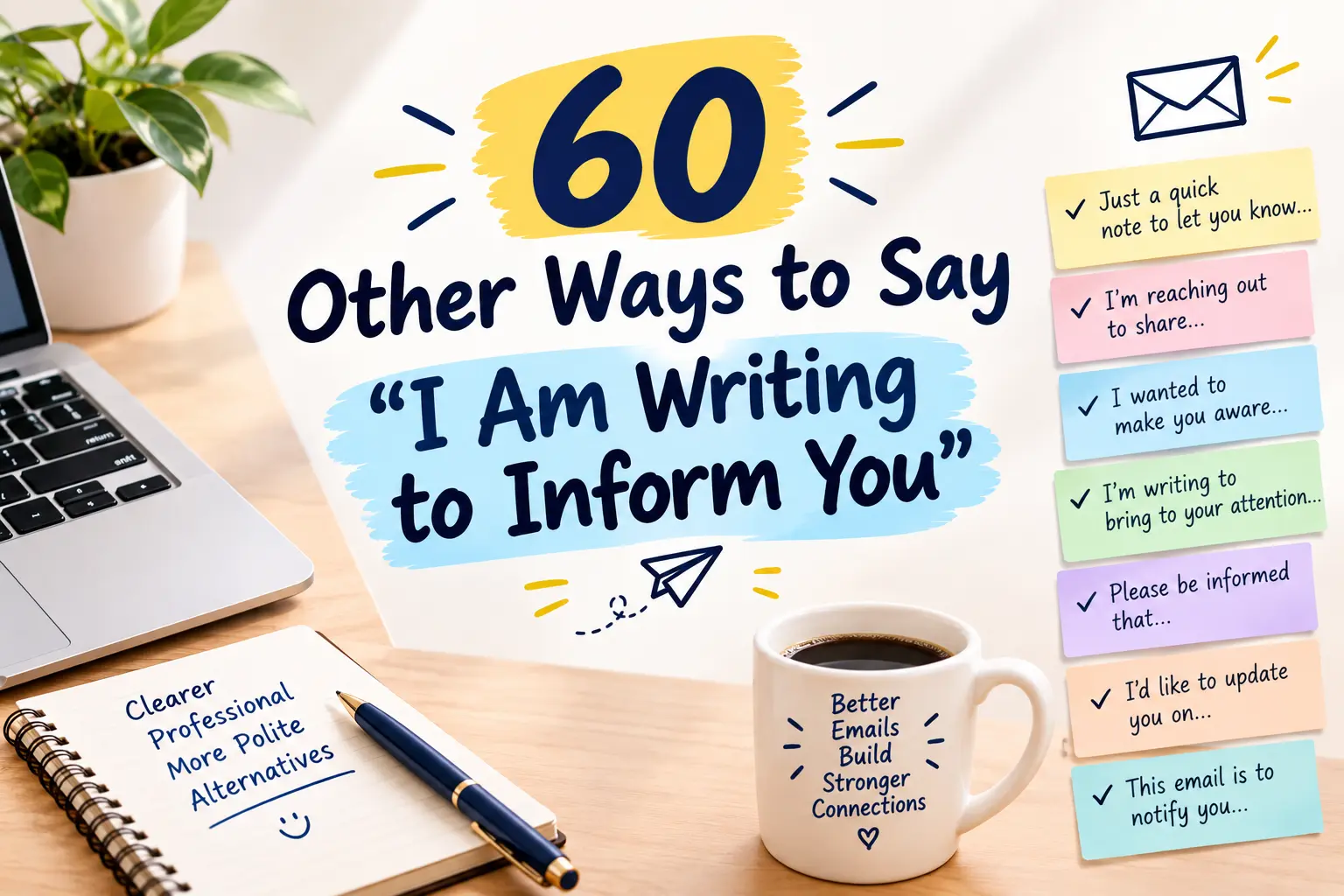
Starting a professional email can be surprisingly difficult. You know exactly what you want to communicate, but opening with “I am writing to inform you” can sometimes feel stiff, repetitive, or overly formal. While the phrase is grammatically correct, there are many more natural ways to introduce information depending on your situation, audience, and relationship with the reader.
You might be announcing an important update, explaining a change, sharing good news, providing an important reminder, or communicating a decision. In each situation, your opening line sets the tone for everything that follows.
This guide explores 60+ other ways to say “I am writing to inform you,” from polished professional expressions to friendly, confident, concise, and thoughtful alternatives. Whether you are writing to a manager, teacher, customer, colleague, client, or friend, you will find an option that fits naturally.
What Does “I Am Writing to Inform You” Mean?
“I am writing to inform you” is a formal expression used to tell someone that the purpose of your message is to give them information.
It is commonly used in emails, letters, workplace notices, official announcements, academic communication, and business correspondence.
For example:
“I am writing to inform you that the meeting has been rescheduled.”
This simply means:
“I am contacting you to let you know that the meeting has been rescheduled.”
The original phrase is polite and professional, but it can sometimes sound overly formal or repetitive, especially when used frequently.
Depending on the situation, you could say:
“I wanted to let you know that the meeting has been rescheduled.”
Or:
“Please note that the meeting has been rescheduled.”
The best alternative depends on whether you want your message to sound formal, friendly, direct, confident, or considerate.
Polite and Appreciative
1. I Wanted to Let You Know
Reply: “I wanted to let you know that the meeting has been moved to Friday.”
Example: You need to tell a colleague about a schedule change without making the email sound overly formal.
This is one of the most natural alternatives because it sounds professional while still feeling conversational.
2. I’m Reaching Out to Let You Know
Reply: “I’m reaching out to let you know about an update to your application.”
Example: A company representative emails an applicant with new information about their application.
This works particularly well in customer service, business, and professional emails.
3. I’d Like to Let You Know
Reply: “I’d like to let you know that your request has been approved.”
Example: You are responding to someone who recently submitted a formal request.
The phrase is polite, clear, and slightly more formal than “I wanted to let you know.”
4. I’m Writing to Share an Update
Reply: “I’m writing to share an update regarding the upcoming project.”
Example: A manager sends employees new information about a project.
This sounds modern and professional without feeling unnecessarily formal.
5. I’d Like to Share Some Important Information
Reply: “I’d like to share some important information regarding your appointment.”
Example: A clinic or organization needs to communicate an important change.
This works well when the information deserves the reader’s attention.
6. I Wanted to Share an Update With You
Reply: “I wanted to share an update with you regarding your application.”
Example: You are sending a follow-up email after receiving new information.
This sounds warm and personal while remaining professional.
7. I’m Reaching Out Regarding
Reply: “I’m reaching out regarding the documents you submitted last week.”
Example: You need to contact someone about a previous conversation or submission.
It is a versatile professional opening for many types of emails.
8. I’d Like to Bring This to Your Attention
Reply: “I’d like to bring this change to your attention before Friday.”
Example: You need a coworker to notice an important update.
This is especially useful when the information requires action or awareness.
9. Please Be Advised That
Reply: “Please be advised that the office will be closed on Monday.”
Example: An organization sends an official notice about a closure.
This has a formal tone and works best for announcements and official communication.
10. Please Note That
Reply: “Please note that the deadline has been extended until Friday.”
Example: A teacher sends students an important deadline update.
It is concise, professional, and direct.
11. I’m Writing to Share Some News
Reply: “I’m writing to share some news about the upcoming event.”
Example: You are contacting a group of people about an event-related development.
This sounds more approachable than the traditional phrase.
12. I Thought I’d Let You Know
Reply: “I thought I’d let you know that the schedule has changed.”
Example: You are giving a colleague a small but useful update.
This is friendly and conversational, making it suitable for people you already know.
Flirty and Playful
These alternatives are better suited to casual conversations, texting, or situations where someone is jokingly using formal language.
13. Just Thought You Should Know
Reply: “Just thought you should know that you’ve been on my mind.”
Example: You are texting someone you like and want to share something personal without making it overly serious.
It sounds casual and creates room for a playful conversation.
14. I Have an Important Announcement for You
Reply: “I have an important announcement for you: I miss talking to you.”
Example: You want to make a simple message sound dramatically official before revealing something sweet.
The contrast between formal wording and personal information makes it playful.
15. I’m Officially Letting You Know
Reply: “I’m officially letting you know that I’m looking forward to seeing you.”
Example: You are texting someone you have been getting closer to.
The word “officially” adds a playful sense of seriousness.
16. Consider Yourself Informed
Reply: “Consider yourself informed: I’m expecting a message from you later.”
Example: You are teasing someone who has been slow to reply.
This works when you want confidence and humor without sounding too serious.
17. This Is Your Official Notice
Reply: “This is your official notice that you owe me a coffee.”
Example: Your friend jokingly promises to buy you coffee but keeps forgetting.
It turns a formal expression into a playful demand.
18. I Feel It’s My Duty to Tell You
Reply: “I feel it’s my duty to tell you that you look great today.”
Example: You want to compliment someone while making the message humorous.
The exaggerated formality makes the compliment more memorable.
19. I Regret to Inform You
Reply: “I regret to inform you that I’m stealing the last slice of pizza.”
Example: You are joking with a close friend over dinner.
This is funny because the phrase usually introduces serious or disappointing news.
20. I’m Here With an Important Update
Reply: “I’m here with an important update: I have decided we need dessert.”
Example: You are joking with a friend while making plans.
The phrase makes an ordinary statement sound dramatically official.
21. You’re About to Receive Some Very Important Information
Reply: “You’re about to receive some very important information: I miss you.”
Example: You want to send a playful message to someone special.
It builds anticipation before delivering a simple emotional message.
22. Allow Me to Inform You
Reply: “Allow me to inform you that you are officially invited to dinner.”
Example: You are playfully inviting someone out.
This works best when the exaggerated formality is clearly part of the joke.
23. I Have News, and You’re the First to Know
Reply: “I have news, and you’re the first to know.”
Example: You are texting a close friend or someone you like about something exciting.
It immediately creates curiosity and encourages them to ask what happened.
24. Here’s Your Personal Update
Reply: “Here’s your personal update: I’m thinking about you.”
Example: You want to send someone a sweet but casual message.
This is especially natural in texting because it sounds spontaneous.
Confident and Self-Respecting
25. I Want to Make You Aware
Reply: “I want to make you aware of the changes before the deadline.”
Example: You are communicating an important workplace update.
This sounds confident and purposeful without being aggressive.
26. I’m Reaching Out to Clarify
Reply: “I’m reaching out to clarify the requirements for the project.”
Example: You are unsure about instructions and want to prevent a misunderstanding.
It demonstrates confidence because you are addressing uncertainty directly.
27. I’d Like to Clarify Something
Reply: “I’d like to clarify something regarding our previous discussion.”
Example: A colleague misunderstood something you said in an earlier meeting.
This is professional and direct without sounding confrontational.
28. I’m Contacting You About
Reply: “I’m contacting you about the revised schedule.”
Example: You need to discuss a specific matter with a client.
It gets straight to the purpose of the message.
29. I’m Following Up Regarding
Reply: “I’m following up regarding the application I submitted last week.”
Example: You have not received a response and want to politely check the status.
This is especially useful for professional follow-ups.
30. I’m Writing to Confirm
Reply: “I’m writing to confirm our appointment for Tuesday.”
Example: You want to make sure both sides have the same information before a meeting.
This is concise and highly practical in professional communication.
31. I’m Writing to Address
Reply: “I’m writing to address the concerns raised during our last meeting.”
Example: You need to respond to an issue in a workplace setting.
It communicates that you are prepared to deal with the matter directly.
32. I’d Like to Provide an Update
Reply: “I’d like to provide an update on the current project.”
Example: You are giving your manager a progress report.
This sounds confident, organized, and professional.
33. I’m Reaching Out With an Update
Reply: “I’m reaching out with an update on your request.”
Example: A customer is waiting for information about a service issue.
This is professional without the stiffness of traditional business language.
34. I’d Like to Make You Aware of
Reply: “I’d like to make you aware of a change to the current policy.”
Example: A manager needs to communicate a policy change to employees.
It clearly signals that the reader should pay attention.
35. I’m Contacting You to Clarify
Reply: “I’m contacting you to clarify the next steps.”
Example: You want to eliminate confusion before starting a project.
This is direct, focused, and useful in workplace communication.
36. I Want to Keep You Updated
Reply: “I want to keep you updated on the progress of your request.”
Example: You are keeping a customer informed while an issue is being resolved.
It shows responsibility and consideration for the reader.
Funny and Savage
37. Prepare Yourself for an Important Announcement
Reply: “Prepare yourself for an important announcement: I finally cleaned my room.”
Example: You are texting your friend about an unusually productive day.
The exaggerated seriousness makes the ordinary news funny.
38. I Regret to Inform You That You Were Right
Reply: “I regret to inform you that you were right.”
Example: Your friend predicted something correctly, and you reluctantly admit it.
This is a fun way to give someone credit while maintaining a teasing tone.
39. I’m Writing Under Extremely Serious Circumstances
Reply: “I’m writing under extremely serious circumstances: we have run out of snacks.”
Example: You are messaging your group chat after discovering the kitchen is empty.
The dramatic wording creates the joke.
40. Please Remain Calm While I Inform You
Reply: “Please remain calm while I inform you that I have eaten your fries.”
Example: You are teasing your sibling or close friend.
It works because the situation is obviously not serious.
41. I Have Unfortunately Been Appointed to Tell You
Reply: “I have unfortunately been appointed to tell you that we’re out of coffee.”
Example: You discover the office coffee supply has disappeared.
The fake sense of responsibility makes the message humorous.
42. This Message Contains Extremely Important Information
Reply: “This message contains extremely important information: pizza tonight?”
Example: You are trying to make dinner plans with friends.
It adds unnecessary drama to a simple question.
43. I’m Officially Filing This Information With You
Reply: “I’m officially filing this information with you: you still owe me lunch.”
Example: Your friend promised to take you out for lunch but forgot.
It turns a casual reminder into a mock-formal complaint.
44. Please Accept This Formal Notification
Reply: “Please accept this formal notification that I am taking the last cookie.”
Example: You are joking with someone while sharing snacks.
The formal wording makes the simple action sound hilariously important.
45. It Is My Unfortunate Responsibility to Inform You
Reply: “It is my unfortunate responsibility to inform you that the weekend is almost over.”
Example: You are joking with your friends on Sunday evening.
This is a fun way to dramatize an ordinary situation.
46. I’m Afraid I Have News
Reply: “I’m afraid I have news: your favorite show is almost finished.”
Example: You are teasing a friend who is emotionally invested in a television series.
The dramatic setup makes the message playful.
47. Please Direct Your Attention to This Very Serious Update
Reply: “Please direct your attention to this very serious update: I bought dessert.”
Example: You are sending a message to your family before dinner.
It is intentionally overdramatic and works well in casual chats.
48. This Is Your Official Warning
Reply: “This is your official warning: I’m going to beat you at the game tonight.”
Example: You are playfully challenging a friend to a game.
It adds confidence and humor without becoming genuinely confrontational.
Curious, Thoughtful, and Mature
49. I Wanted to Keep You Updated
Reply: “I wanted to keep you updated on how things are progressing.”
Example: You are communicating with someone who is waiting for the outcome of a project.
This feels considerate because it shows that you understand they are expecting information.
50. I Thought It Would Be Helpful to Let You Know
Reply: “I thought it would be helpful to let you know about the upcoming change.”
Example: You have information that could help a coworker prepare in advance.
This sounds thoughtful rather than abrupt.
51. I Wanted to Make Sure You Were Aware
Reply: “I wanted to make sure you were aware of the updated deadline.”
Example: You are reminding a classmate about an important submission date.
This is considerate and avoids sounding like you are simply issuing an order.
52. I Thought You Should Know
Reply: “I thought you should know that the plans have changed.”
Example: A friend is directly affected by a change in your plans.
It sounds personal and natural while still being clear.
53. I Wanted to Bring This to Your Attention
Reply: “I wanted to bring this issue to your attention before it becomes a larger problem.”
Example: You notice something at work that needs to be addressed.
This is professional and appropriately serious.
54. I’m Reaching Out to Keep You Informed
Reply: “I’m reaching out to keep you informed about the latest developments.”
Example: You are updating a client about an ongoing project.
This communicates transparency and professionalism.
55. I’d Like to Keep You in the Loop
Reply: “I’d like to keep you in the loop as we move forward.”
Example: You are working with a colleague on a project and want them to know they will receive future updates.
This is a natural business expression that sounds less stiff than traditional formal language.
56. I Wanted to Share This With You
Reply: “I wanted to share this with you before we move forward.”
Example: You have information that could influence a friend’s or colleague’s decision.
It sounds considerate and collaborative.
57. I Thought It Was Important to Tell You
Reply: “I thought it was important to tell you about the change.”
Example: You need to communicate something that could affect another person’s plans.
This emphasizes the importance of the information without sounding overly dramatic.
58. I Wanted to Make You Aware
Reply: “I wanted to make you aware of the updated requirements.”
Example: A student informs a group member about new project instructions.
It is professional and useful when the reader needs to take the information into account.
59. I’m Getting in Touch to Share Some Information
Reply: “I’m getting in touch to share some information about the upcoming event.”
Example: You are contacting an organization or group with event details.
This sounds friendly while maintaining a professional tone.
60. I’d Like to Update You on the Situation
Reply: “I’d like to update you on the situation before we make a final decision.”
Example: A team member explains recent developments before a meeting.
This is a mature and transparent way to introduce important information.
Real-Life Situations: Which Alternative Should You Use?
When You Are Writing to Your Manager
You want to sound professional without making the email unnecessarily formal.
Best choice: “I’d like to provide an update.”
Example:
“I’d like to provide an update on the project and discuss the next steps.”
This is clear, confident, and appropriate for workplace communication.
When You Are Emailing a Customer
The reader should feel informed and respected.
Best choice: “I’m reaching out to let you know.”
Example:
“I’m reaching out to let you know that your request has been successfully processed.”
It sounds professional but still human.
When You Are Following Up on an Application
You need to be polite and direct.
Best choice: “I’m following up regarding…”
Example:
“I’m following up regarding the application I submitted last week.”
It immediately tells the reader why you are contacting them.
When You Are Writing to a Friend
There is no reason to sound like an official letter.
Best choice: “I thought you should know…”
Example:
“I thought you should know that our plans have changed.”
It feels natural and personal.
When You Are Making a Serious Announcement
You want the reader to understand that the information matters.
Best choice: “I’d like to bring this to your attention.”
Example:
“I’d like to bring this issue to your attention before we proceed.”
It communicates importance without sounding unnecessarily dramatic.
What to Avoid
1. Using the Same Opening in Every Email
“I am writing to inform you” is correct, but repeating it in every message can make your writing sound formulaic.
2. Being More Formal Than Necessary
A simple update does not always need formal language. Sometimes “I wanted to let you know” is clearer and more natural.
3. Hiding the Main Point
Do not make readers work through several sentences before discovering why you contacted them. Get to the important information quickly.
4. Using Casual Language in Formal Situations
Expressions such as “Guess what?” or “Here’s the scoop” may work with friends but are usually inappropriate for official emails.
5. Overusing “Please Be Advised”
“Please be advised” is useful, but using it repeatedly can make your writing sound stiff.
6. Making Every Message Sound Urgent
Words like “important,” “urgent,” and “immediate” should be used only when they genuinely apply.
Pro Tips
1. Match the Opening to the Audience
A manager, customer, professor, friend, and family member may all need different wording. Think about the relationship before choosing your opening.
2. Put the Purpose Near the Beginning
A strong email usually tells the reader why you are contacting them within the first sentence or two. This saves time and makes your writing easier to follow.
3. Choose Natural Over Complicated
You do not need impressive vocabulary to sound professional. “I wanted to let you know” can be more effective than a complicated formal expression when the situation is straightforward.
Bonus: Quick One-Line Alternatives
- “I wanted to let you know that…”
- “I’m reaching out to share an update.”
- “I’d like to inform you that…”
- “I’m writing to share some news.”
- “Please note that…”
- “I wanted to make you aware of…”
- “I’m contacting you regarding…”
- “I’d like to provide an update.”
- “I thought you should know that…”
- “I’m reaching out to keep you informed.”
Conclusion
“I am writing to inform you” is perfectly acceptable, but it is not your only option. Choosing a more natural alternative can make your emails sound clearer, warmer, and more confident. Whether you are updating a manager, contacting a customer, following up on an application, or simply telling a friend something important, the right opening helps set the tone from the beginning. The goal is not to sound overly formal—it is to communicate clearly and naturally. Choose words that fit your audience, say what matters, and let the rest of your message do the work.
Discover more
other ways to say if i can be of any help