

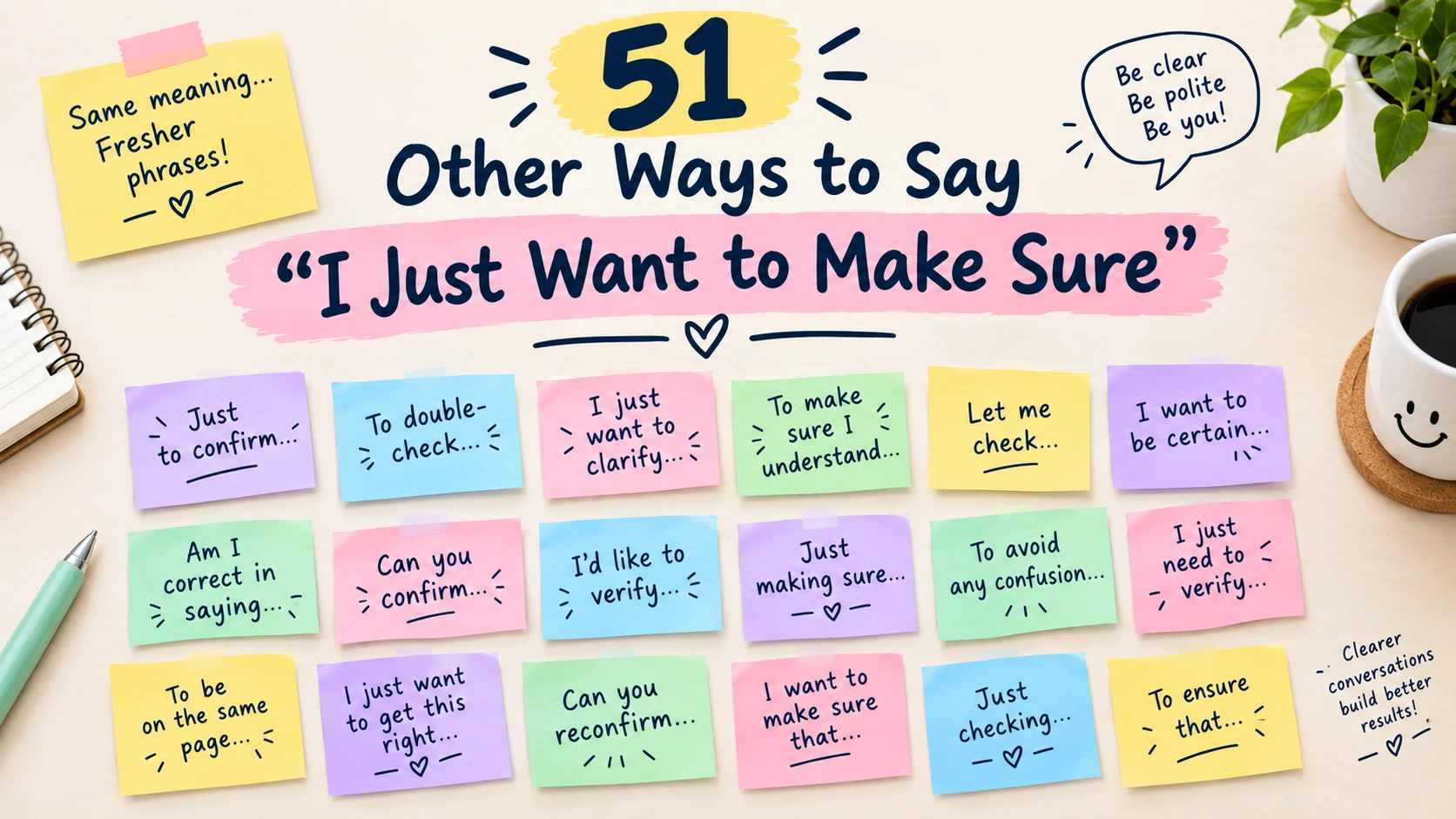
Sometimes, you want to double-check something without sounding doubtful, controlling, or overly serious. Maybe you are confirming plans with a friend, checking details with a coworker, or making sure someone understood what you meant. That is where knowing other ways to say “I just want to make sure” can make your conversations smoother.
The phrase itself is perfectly normal, but using the same wording again and again can feel repetitive. A small change in phrasing can also help you match the situation better. You might want to sound polite, confident, playful, curious, or simply thoughtful.
Below, you will find 51 natural alternatives, along with realistic examples showing how each one can work in everyday conversations.
What Does “I Just Want to Make Sure” Mean?
“I just want to make sure” means that you want to confirm something, check that everything is correct, or avoid a misunderstanding.
For example, you might say:
“I just want to make sure we’re still meeting at 7.”
Here, you are not accusing the other person of forgetting. You are simply checking the plan.
The phrase can be used in professional conversations, friendships, texting, dating, family discussions, and many other situations. Your tone usually determines how it sounds.
If you want to sound softer, you can say, “I just wanted to double-check.” If you want to sound more confident, you can say, “Let me confirm that.” If you want to keep things playful, you could say, “Just checking before I make any big assumptions.”
The best alternative depends on what you want your message to communicate.
Polite and Appreciative
These alternatives work well when you want to double-check something without sounding demanding. They are especially useful in professional conversations, friendly texts, and situations where you want to show consideration.
1. “I just wanted to double-check.”
Reply: “I just wanted to double-check.”
Example:
“Hey, I just wanted to double-check that our meeting is still scheduled for Friday.”
This is one of the most natural alternatives. It sounds polite and does not put pressure on the other person.
2. “I just wanted to confirm.”
Reply: “I just wanted to confirm.”
Example:
“I just wanted to confirm that you received the document I sent.”
It is short, clear, and professional.
3. “I wanted to make sure everything is clear.”
Reply: “I wanted to make sure everything is clear.”
Example:
“I wanted to make sure everything is clear before we move forward with the project.”
This works well when you are checking understanding rather than simply confirming a fact.
4. “I thought I’d check with you.”
Reply: “I thought I’d check with you.”
Example:
“I thought I’d check with you before changing the reservation.”
It feels friendly and considerate.
5. “I just wanted to check in.”
Reply: “I just wanted to check in.”
Example:
“I just wanted to check in and see if everything is still okay for tomorrow.”
This is especially useful when you do not want your message to sound too serious.
6. “I wanted to clarify one thing.”
Reply: “I wanted to clarify one thing.”
Example:
“I wanted to clarify one thing before we finalize the plans.”
This is useful when there is a specific detail that needs clarification.
7. “Just checking that we’re on the same page.”
Reply: “Just checking that we’re on the same page.”
Example:
“Just checking that we’re on the same page about what needs to be finished today.”
It is casual but still respectful.
8. “I appreciate your confirmation.”
Reply: “I appreciate your confirmation.”
Example:
“I believe everything is arranged, but I appreciate your confirmation before I book the tickets.”
This sounds especially polished in professional situations.
9. “I wanted to make sure I understood correctly.”
Reply: “I wanted to make sure I understood correctly.”
Example:
“So you want the final version by Monday? I wanted to make sure I understood correctly.”
This is a great choice when the issue is your own understanding.
10. “I thought it would be best to confirm.”
Reply: “I thought it would be best to confirm.”
Example:
“I thought it would be best to confirm the appointment before I made other plans.”
It sounds responsible and thoughtful.
Flirty and Playful
Sometimes “I just want to make sure” appears in a lighthearted or romantic conversation. These alternatives keep the conversation relaxed while adding a little personality.
11. “Just making sure I’m reading this right.”
Reply: “Just making sure I’m reading this right.”
Example:
“You’re actually asking me out? Just making sure I’m reading this right.”
This works well when someone sends you a surprisingly sweet message.
12. “Just checking before I get too excited.”
Reply: “Just checking before I get too excited.”
Example:
“You said dinner tonight, right? Just checking before I get too excited.”
It adds playful energy without being too serious.
13. “I just need to know I’m not imagining things.”
Reply: “I just need to know I’m not imagining things.”
Example:
“Was that a compliment? I just need to know I’m not imagining things.”
This can make a simple question feel more playful.
14. “Tell me I understood that correctly.”
Reply: “Tell me I understood that correctly.”
Example:
“You’re saying you want to see me again? Tell me I understood that correctly.”
It invites the other person to clarify while keeping the tone warm.
15. “Just checking if that was a hint.”
Reply: “Just checking if that was a hint.”
Example:
“You keep mentioning your favorite restaurant. Just checking if that was a hint.”
This is a fun option for teasing conversations.
16. “I’m just making sure I’m not getting ahead of myself.”
Reply: “I’m just making sure I’m not getting ahead of myself.”
Example:
“You mentioned next weekend. I’m just making sure I’m not getting ahead of myself.”
It sounds playful while acknowledging that you do not want to assume too much.
17. “So, should I take that as a yes?”
Reply: “So, should I take that as a yes?”
Example:
“You said you might be free Saturday. So, should I take that as a yes?”
This is direct but still playful.
18. “Just making sure I caught that little hint.”
Reply: “Just making sure I caught that little hint.”
Example:
“You said you like people who plan surprise dates. Just making sure I caught that little hint.”
It works naturally when teasing someone.
19. “I’m just checking before I start making plans.”
Reply: “I’m just checking before I start making plans.”
Example:
“You said Saturday could work, so I’m just checking before I start making plans.”
This keeps the tone light while still getting a clear answer.
20. “Just making sure we’re thinking the same thing.”
Reply: “Just making sure we’re thinking the same thing.”
Example:
“You meant this weekend, right? Just making sure we’re thinking the same thing.”
It is simple, warm, and useful in casual conversations.
Confident and Self-Respecting
These alternatives are useful when you want to ask for clarity without sounding nervous or overly dependent on someone else’s response.
21. “Let me confirm that.”
Reply: “Let me confirm that.”
Example:
“Before I rearrange my schedule, let me confirm that the event is definitely happening.”
This sounds calm and confident.
22. “I want to be clear about one thing.”
Reply: “I want to be clear about one thing.”
Example:
“I want to be clear about one thing: I need the final decision by Friday.”
It is direct without being unnecessarily aggressive.
23. “I want to make sure we have the same understanding.”
Reply: “I want to make sure we have the same understanding.”
Example:
“I want to make sure we have the same understanding about what we agreed to.”
This is strong and mature.
24. “I’d rather confirm than assume.”
Reply: “I’d rather confirm than assume.”
Example:
“I’d rather confirm than assume, so are we still meeting at 6?”
This communicates confidence and good judgment.
25. “I prefer to be clear.”
Reply: “I prefer to be clear.”
Example:
“I prefer to be clear, so are you still interested in moving forward?”
It is especially useful when you need a straightforward answer.
26. “I just want a clear answer.”
Reply: “I just want a clear answer.”
Example:
“I’m not trying to pressure you. I just want a clear answer so I know what to expect.”
This works when uncertainty has become frustrating.
27. “I want to avoid any misunderstanding.”
Reply: “I want to avoid any misunderstanding.”
Example:
“I want to avoid any misunderstanding, so let me explain what I meant.”
It sounds mature and responsible.
28. “I need to know where we stand.”
Reply: “I need to know where we stand.”
Example:
“I respect your decision, but I need to know where we stand before I make my plans.”
This is useful when clarity matters.
29. “I want to make sure we’re aligned.”
Reply: “I want to make sure we’re aligned.”
Example:
“Before we start the project, I want to make sure we’re aligned on the deadline.”
It sounds confident and works well professionally.
30. “I’m checking so I can plan accordingly.”
Reply: “I’m checking so I can plan accordingly.”
Example:
“Can you let me know if you’re coming? I’m checking so I can plan accordingly.”
This makes it clear that you are asking because the answer affects your own plans.
Funny and Savage
These alternatives work when the conversation is casual and you want to add humor. They are best used with people who understand your sense of humor.
31. “Just checking before I make a fool of myself.”
Reply: “Just checking before I make a fool of myself.”
Example:
“You actually want me to bring snacks for everyone, right? Just checking before I make a fool of myself.”
It adds humor to an ordinary confirmation.
32. “Just checking before I start celebrating.”
Reply: “Just checking before I start celebrating.”
Example:
“You passed the exam? Just checking before I start celebrating too early.”
This makes the message energetic and playful.
33. “I’m checking because my assumptions have betrayed me before.”
Reply: “I’m checking because my assumptions have betrayed me before.”
Example:
“You said you might come tonight. I’m checking because my assumptions have betrayed me before.”
It works best in relaxed conversations with friends.
34. “Just making sure I didn’t invent that conversation.”
Reply: “Just making sure I didn’t invent that conversation.”
Example:
“You said you would send it yesterday. Just making sure I didn’t invent that conversation.”
This can be funny when someone genuinely forgot something.
35. “Quick reality check.”
Reply: “Quick reality check.”
Example:
“Quick reality check: are we actually meeting at 8, or did I completely misunderstand?”
It is short, casual, and humorous.
36. “Just checking before my brain creates a whole story.”
Reply: “Just checking before my brain creates a whole story.”
Example:
“You haven’t replied because you’re busy, right? Just checking before my brain creates a whole story.”
It adds humor while admitting that you want clarity.
37. “Let me verify before I embarrass myself.”
Reply: “Let me verify before I embarrass myself.”
Example:
“You said the event starts at 7, right? Let me verify before I embarrass myself.”
This is a funny way to ask for confirmation.
38. “I’m just checking before I confidently get it wrong.”
Reply: “I’m just checking before I confidently get it wrong.”
Example:
“This is the right building, correct? I’m just checking before I confidently get it wrong.”
It works especially well with friends.
39. “I would like to avoid unnecessary chaos.”
Reply: “I would like to avoid unnecessary chaos.”
Example:
“Are we ordering the food now? I would like to avoid unnecessary chaos later.”
It gives a simple question a humorous twist.
40. “Just confirming before things get unnecessarily dramatic.”
Reply: “Just confirming before things get unnecessarily dramatic.”
Example:
“We’re still going together, right? Just confirming before things get unnecessarily dramatic.”
This is playful without being harsh.
Curious and Thoughtful
These alternatives are best when you genuinely want to understand something. They work particularly well in serious conversations, friendships, and situations where you want to avoid assumptions.
41. “Can I clarify something?”
Reply: “Can I clarify something?”
Example:
“Can I clarify something? When you said you needed space, what did you mean?”
It opens the conversation without sounding confrontational.
42. “Can I make sure I understood you?”
Reply: “Can I make sure I understood you?”
Example:
“Can I make sure I understood you? You want to postpone the meeting until next week?”
This shows that you are listening carefully.
43. “Could you clarify that for me?”
Reply: “Could you clarify that for me?”
Example:
“You mentioned changing the plan. Could you clarify that for me?”
It is polite and straightforward.
44. “Can we make sure we’re on the same page?”
Reply: “Can we make sure we’re on the same page?”
Example:
“Before we continue, can we make sure we’re on the same page about the deadline?”
It encourages mutual understanding.
45. “I want to understand what you mean.”
Reply: “I want to understand what you mean.”
Example:
“I’m not upset. I just want to understand what you mean by that.”
This sounds thoughtful rather than defensive.
46. “Can you help me understand?”
Reply: “Can you help me understand?”
Example:
“Can you help me understand why the plan changed?”
It invites explanation instead of creating conflict.
47. “I want to be certain I have this right.”
Reply: “I want to be certain I have this right.”
Example:
“I want to be certain I have this right: we’re submitting everything on Monday?”
This is a polished way to double-check information.
48. “Let me make sure I’ve got this straight.”
Reply: “Let me make sure I’ve got this straight.”
Example:
“Let me make sure I’ve got this straight. You want me to handle the first part and you’ll handle the rest?”
It sounds natural and conversational.
49. “I’d like to understand this correctly.”
Reply: “I’d like to understand this correctly.”
Example:
“I’d like to understand this correctly before I give you an answer.”
It shows that you care about getting the details right.
50. “Before I assume anything, can I ask?”
Reply: “Before I assume anything, can I ask?”
Example:
“Before I assume anything, can I ask if you’re still interested in joining us?”
This is a respectful way to avoid jumping to conclusions.
51. “I just want to make sure we understand each other.”
Reply: “I just want to make sure we understand each other.”
Example:
“I’m not trying to argue. I just want to make sure we understand each other before we move on.”
This is one of the best options for a meaningful or potentially sensitive conversation.
Real-Life Situations
When Your Crush Says Something Unexpected
If someone you like says something that could be interpreted as flirting, you may want to clarify without making the conversation awkward.
Best reply:
“Just checking if that was a hint.”
This keeps the conversation playful while giving them a chance to explain.
When a Friend Makes a Joke
If your friend says something ridiculous and you are not sure whether they are serious, keep your response casual.
Best reply:
“Quick reality check. Are you actually serious?”
It sounds natural and gives them room to explain.
When Someone Makes Plans Too Early
If someone makes plans without clearly confirming the details, do not feel pressured to guess.
Best reply:
“I’d rather confirm than assume. What time are we meeting?”
You are being clear without sounding difficult.
When You Are Not Interested
If someone is expecting something from you and you do not want to give them the wrong idea, direct communication is better than vague hints.
Best reply:
“I want to be clear about where I stand.”
It is respectful and avoids unnecessary confusion.
When You Are Checking a Professional Detail
For work, school, or formal communication, keep your wording simple and neutral.
Best reply:
“I just wanted to confirm that we’re still working with the original deadline.”
This sounds professional without being overly formal.
What to Avoid
1. Asking the Same Question Repeatedly
If someone has already answered clearly, repeatedly asking for confirmation can make the conversation uncomfortable.
2. Making Your Question Sound Like an Accusation
There is a difference between “Can I clarify something?” and “Are you sure you actually said that?” Choose wording that matches your relationship.
3. Overexplaining
You usually do not need a long explanation for why you are asking. A short question can be much more effective.
4. Using Humor at the Wrong Time
Funny replies can work with friends, but serious conversations often need a calmer tone.
5. Assuming Instead of Asking
If something genuinely matters, do not build your response around a guess. Ask for clarification directly.
6. Sounding Too Apologetic
You do not need to apologize repeatedly for asking a reasonable question. Wanting clarity is normal.
Pro Tips
Match the Tone to the Situation
Use “I just wanted to confirm” in professional settings, “Just checking” with friends, and playful versions when the conversation already has a light tone.
Be Clear Instead of Overthinking
If you need an answer, ask for it. The right wording does not need to be complicated.
Confidence Comes From Calmness
You can ask for clarification without sounding insecure. Keep your message short, respectful, and direct.
Conclusion
Knowing other ways to say “I just want to make sure” gives you more control over how your message sounds. Sometimes you need a polite confirmation. Other times, you want to sound confident, playful, thoughtful, or direct.
The key is not to memorize every alternative. Choose the one that fits the situation and sounds natural coming from you.
Clear communication does not mean asking too much. It means making sure you understand each other before moving forward.
When in doubt, ask clearly, speak calmly, and never be afraid to seek clarity.
Discover more
other ways to say looking forward to your call