
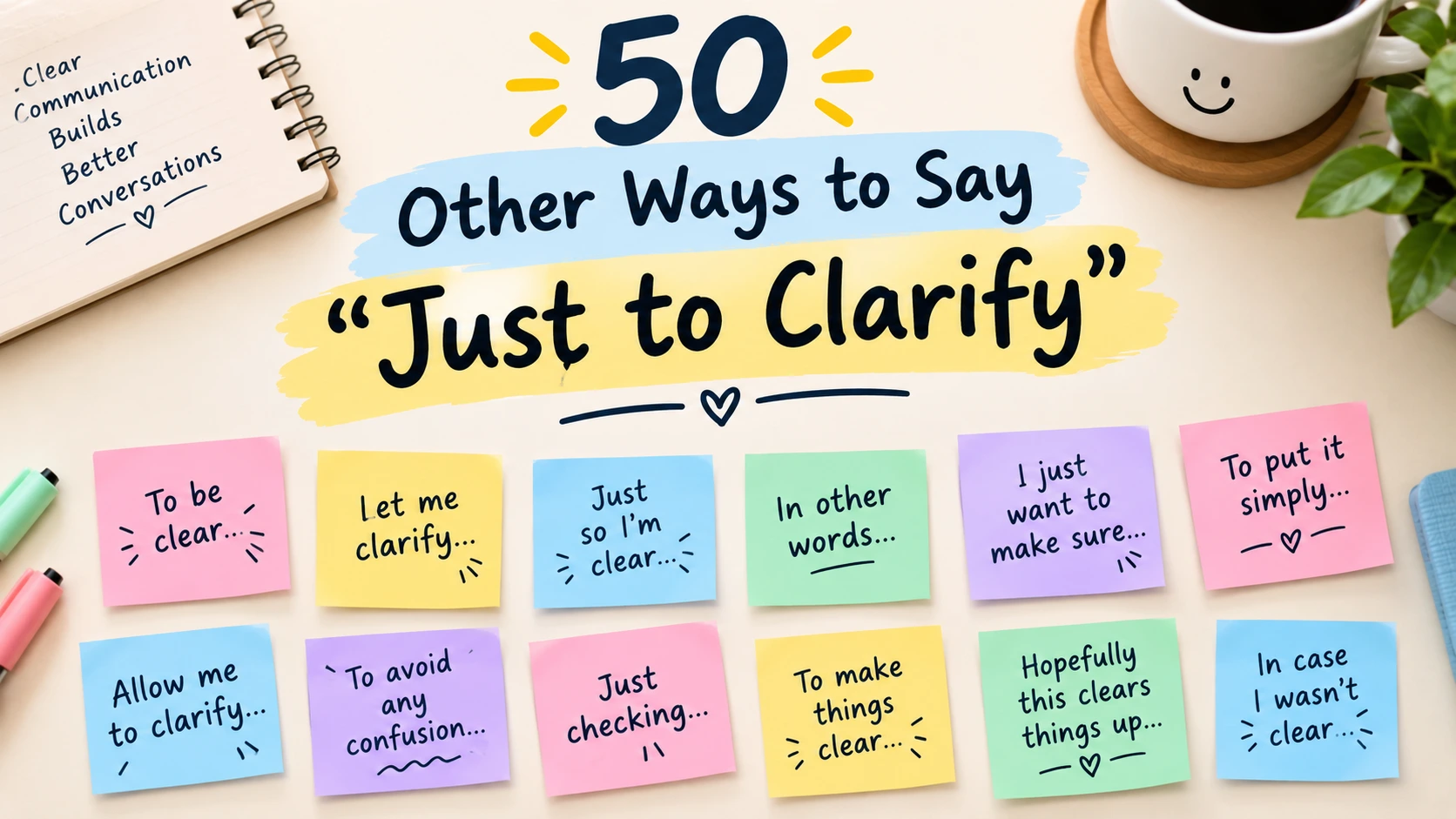
Misunderstandings can happen easily, especially when a message is short, a conversation moves quickly, or two people interpret the same words differently. That is why phrases like “just to clarify” are so useful. They give you a simple way to check the details without making the other person feel like they are being questioned.
Still, using the same phrase repeatedly can make your emails, texts, and conversations sound predictable. Having a few alternatives allows you to adjust your tone depending on the situation. You might want to sound polite when speaking with a colleague, direct when discussing plans with a friend, or thoughtful when dealing with a sensitive topic.
From professional expressions such as “I’d like to confirm” to casual options like “Just making sure,” the right wording can make your communication clearer, smoother, and more natural.
What Does “Just to Clarify” Mean?
“Just to clarify” means that you want to make sure you correctly understand something or that you want to make a point clearer.
It is often used before asking a question or confirming information.
For example:
“Just to clarify, are we meeting at 3 p.m. or 4 p.m.?”
The speaker is not necessarily challenging the other person. They simply want to avoid confusion.
The phrase is common in emails, workplace discussions, group chats, academic conversations, and everyday situations. It can also be useful when plans have changed or when someone’s message was not completely clear.
Depending on your wording, the same idea can sound formal, friendly, firm, curious, or even playful.
Polite and Appreciative
These alternatives are ideal when you want to ask for clarification while keeping your tone respectful and considerate.
1. “Just to make sure I understand correctly”
Reply: “Just to make sure I understand correctly, the deadline is Friday, right?”
Example: Your manager explains a new project deadline during a meeting, and you want to confirm the date before starting your work.
2. “I just wanted to confirm”
Reply: “I just wanted to confirm that our meeting is still scheduled for tomorrow.”
Example: You are checking with a colleague because you have not received a recent update about the meeting.
3. “Could I confirm one detail?”
Reply: “Could I confirm one detail before we move forward?”
Example: You are working on an assignment and want to verify one requirement with your teacher.
4. “I’d like to make sure I have this right”
Reply: “I’d like to make sure I have this right before I submit the report.”
Example: You have understood the instructions but want to double-check an important detail.
5. “May I confirm something?”
Reply: “May I confirm something regarding tomorrow’s schedule?”
Example: You are speaking with a coworker and want to verify a change in the work schedule.
6. “I appreciate the information. I just want to confirm one thing.”
Reply: “I appreciate the information. I just want to confirm one thing before we proceed.”
Example: Someone gives you several details about an event, but one point remains unclear.
7. “Could you please confirm?”
Reply: “Could you please confirm whether the documents were submitted?”
Example: You are following up on an important task and need confirmation.
8. “I want to make sure we’re on the same page.”
Reply: “I want to make sure we’re on the same page about the project requirements.”
Example: You and your teammate are dividing responsibilities and want to avoid confusion.
9. “For my understanding, could you confirm?”
Reply: “For my understanding, could you confirm which version we should use?”
Example: Your team has multiple versions of a document, and you want to know which one is final.
10. “Before we continue, could I check one thing?”
Reply: “Before we continue, could I check one thing about the schedule?”
Example: You notice a possible issue during a meeting and want to address it before moving forward.
Flirty and Playful
These responses work best in relaxed conversations where you already have a friendly relationship with the other person.
11. “Just making sure I heard you right.”
Reply: “Just making sure I heard you right. Did you really just say that?”
Example: Someone you like makes an unexpected compliment, and you playfully ask them to repeat it.
12. “Wait, did you really mean that?”
Reply: “Wait, did you really mean that?”
Example: Your crush sends you a surprisingly sweet message, and you want to tease them a little.
13. “Hold on, I need clarification from you.”
Reply: “Hold on, I need clarification from you. Was that actually a compliment?”
Example: A friend says something that sounds both funny and flattering.
14. “Let me make sure I’m not imagining things.”
Reply: “Let me make sure I’m not imagining things. Are you actually inviting me?”
Example: Someone you like casually asks you to join them for an outing.
15. “So, are we really doing this?”
Reply: “So, are we really doing this?”
Example: Your friend suggests an exciting last-minute plan, and you want to make sure they are serious.
16. “Wait, I need the full story.”
Reply: “Wait, I need the full story before I make any assumptions.”
Example: Your friend sends a mysterious message without explaining what happened.
17. “Okay, now I need you to explain yourself.”
Reply: “Okay, now I need you to explain yourself.”
Example: Your friend unexpectedly cancels plans and then posts pictures from somewhere else.
18. “Just checking because that sounds interesting.”
Reply: “Just checking because that sounds interesting. What exactly did you mean?”
Example: Someone mentions a surprise plan and catches your attention.
19. “I have one tiny question.”
Reply: “I have one tiny question. Are you actually serious?”
Example: Your friend makes an unbelievable claim during a casual conversation.
20. “Before I get excited, is that what you meant?”
Reply: “Before I get excited, is that what you meant?”
Example: Someone you like hints that they might want to spend the weekend with you.
Confident and Self-Respect
These alternatives are useful when you want clarity without sounding uncertain, apologetic, or overly dependent on someone else’s response.
21. “Let’s be clear about one thing.”
Reply: “Let’s be clear about one thing before we move forward.”
Example: A disagreement has created confusion, so you calmly establish the main point.
22. “I want to be clear about this.”
Reply: “I want to be clear about this before we make a decision.”
Example: You want everyone involved in a project to understand an important responsibility.
23. “I’d like a clear answer on this.”
Reply: “I’d like a clear answer on this so I can plan accordingly.”
Example: Someone keeps giving you uncertain answers about an upcoming event.
24. “Let’s make sure there’s no misunderstanding.”
Reply: “Let’s make sure there’s no misunderstanding about what we agreed on.”
Example: You and a friend remember a previous conversation differently.
25. “I want to confirm the details.”
Reply: “I want to confirm the details before I make any arrangements.”
Example: You are organizing travel plans and need accurate information first.
26. “Here’s what I understood.”
Reply: “Here’s what I understood from our conversation. Please correct me if I missed anything.”
Example: After a meeting, you summarize the agreed tasks for everyone.
27. “Let’s establish what we agreed on.”
Reply: “Let’s establish what we agreed on before making any changes.”
Example: A group project has several different interpretations of the original plan.
28. “I need to verify one point.”
Reply: “I need to verify one point before I give you my final answer.”
Example: You want to check a piece of information before making a commitment.
29. “I want to avoid any confusion.”
Reply: “I want to avoid any confusion, so let’s confirm the deadline.”
Example: You are coordinating several people for an important task.
30. “Let’s get the facts straight.”
Reply: “Let’s get the facts straight before we draw any conclusions.”
Example: Several people are sharing different versions of what happened.
Funny and Savage
These alternatives are best for friends and casual conversations where sarcasm or humor is already part of the relationship.
31. “Just checking before I make a terrible assumption.”
Reply: “Just checking before I make a terrible assumption. Is that actually what happened?”
Example: Your friend sends you a vague message that could easily be misunderstood.
32. “Wait, what exactly are we talking about here?”
Reply: “Wait, what exactly are we talking about here?”
Example: Your friends suddenly change the topic and you have no idea what they mean.
33. “Let’s rewind for a second.”
Reply: “Let’s rewind for a second because I definitely missed something.”
Example: Your friend explains a complicated story too quickly.
34. “I need the subtitles for this conversation.”
Reply: “I need the subtitles for this conversation. What exactly do you mean?”
Example: Someone gives you an extremely vague explanation.
35. “Let me make sure I’m following your logic.”
Reply: “Let me make sure I’m following your logic here.”
Example: Your friend makes an unusual argument during a playful debate.
36. “I’m going to need some context.”
Reply: “I’m going to need some context before I react to that.”
Example: Someone sends you a shocking screenshot without explaining where it came from.
37. “That sounded suspiciously unclear.”
Reply: “That sounded suspiciously unclear. Care to explain?”
Example: Your friend gives you a very vague excuse for missing an event.
38. “Let’s clear that little mystery up.”
Reply: “Let’s clear that little mystery up. What actually happened?”
Example: You suspect your friend has left out an important part of the story.
39. “I’m confused, but I’m listening.”
Reply: “I’m confused, but I’m listening. Keep going.”
Example: Your friend starts explaining a complicated situation involving several people.
40. “That needs a little more explanation.”
Reply: “That needs a little more explanation because I’m lost.”
Example: Someone gives you a short answer that raises even more questions.
Curious and Thoughtful
These responses are useful when your goal is understanding rather than simply correcting someone.
41. “Could you explain what you mean?”
Reply: “Could you explain what you mean by that?”
Example: A colleague uses an unfamiliar term during a meeting.
42. “Can you elaborate on that?”
Reply: “Can you elaborate on that point?”
Example: Someone shares an interesting idea during a discussion, and you want to hear more.
43. “Could you give me a little more context?”
Reply: “Could you give me a little more context before I respond?”
Example: A friend asks for your opinion but has not explained the situation fully.
44. “How should I understand that?”
Reply: “How should I understand what you just said?”
Example: Someone makes a comment that could have several meanings.
45. “What exactly do you mean?”
Reply: “What exactly do you mean by ‘later’?”
Example: Someone tells you they will complete a task later, but you need a clearer timeframe.
46. “Could you clarify that point?”
Reply: “Could you clarify that point for me?”
Example: A coworker explains a new process, but one step is unclear.
47. “Can you help me understand?”
Reply: “Can you help me understand why the plan changed?”
Example: Your team changes a project decision without explaining the reason.
48. “What’s your intention here?”
Reply: “What’s your intention here? I want to make sure I understand.”
Example: Someone makes an unexpected suggestion, and you want to understand their reasoning.
49. “What did you mean by that?”
Reply: “What did you mean by that comment?”
Example: A friend makes an unusual remark that catches you off guard.
50. “Could we go over that once more?”
Reply: “Could we go over that once more? I want to make sure I understood everything.”
Example: Your manager explains several instructions during a fast-paced meeting.
Real-Life Situations
When Your Crush Says Something Unclear
When someone you like says something that could have a hidden meaning, avoid immediately assuming what they mean.
Best reply: “Wait, did you really mean that?”
This keeps things playful while giving them an opportunity to explain.
When a Friend Makes a Confusing Joke
Friends often make jokes that only make sense after you know the context.
Best reply: “I need the subtitles for this conversation. What do you mean?”
It keeps the mood light while asking for clarification.
When Someone Gives You Important Information Too Quickly
If you are discussing work, school, travel, or plans, guessing is rarely worth the risk.
Best reply: “Just to make sure I understand correctly, could you confirm the details?”
This is polite and reduces the chance of a misunderstanding.
When Someone Is Being Vague
If someone repeatedly avoids giving you a clear answer, you can be more direct.
Best reply: “I’d like a clear answer on this so I know how to plan.”
This communicates self-respect without being unnecessarily aggressive.
When You Are Not Interested in Continuing the Conversation
You can ask for clarification without opening the door to a long discussion.
Best reply: “I understand what you mean. I just wanted to confirm the details.”
This keeps your response brief and respectful.
What to Avoid
1. Do not make every clarification sound like a correction
“Just to clarify” should not become a way to prove that someone else is wrong.
2. Avoid an unnecessarily defensive tone
If you need information, simply ask for it. There is no need to sound irritated.
3. Do not over-explain simple questions
A short question is often more effective than a long paragraph.
4. Avoid sarcasm in professional settings
Funny responses can work with friends but may sound disrespectful in an email or workplace conversation.
5. Do not assume you know what someone meant
If a message is unclear, ask rather than guessing.
6. Do not repeat the same phrase constantly
Using different expressions can make your communication sound more natural and flexible.
Pro Tips
Match the tone to the relationship
A phrase such as “Could you clarify that point?” works well at work, while “Wait, what do you mean?” sounds more natural with friends.
Ask for exactly what you need
If you need a date, ask for the date. If you need an explanation, ask for context. Specific questions usually get better answers.
Keep your confidence
Asking someone to clarify something does not make you difficult or uncertain. Clear communication is a strength.
Bonus: Quick One-Liner Replies
- “Just making sure I understood.”
- “Can you clarify that?”
- “What exactly do you mean?”
- “Could you explain that?”
- “Just checking the details.”
- “Let’s make sure we’re on the same page.”
- “Can you give me some context?”
- “I want to make sure I have this right.”
- “Wait, what do you mean?”
- “Could you confirm that for me?”
Conclusion
Knowing other ways to say “just to clarify” can make everyday communication smoother and more effective. Whether you are writing a professional email, texting a friend, discussing plans, or handling a misunderstanding, the right expression helps you ask questions without creating unnecessary tension.
The best alternative depends on your tone and situation. Choose polite wording when professionalism matters, playful language with close friends, and confident expressions when you need a clear answer.
Clear communication does not have to sound complicated. Sometimes, the simplest question is the one that prevents the biggest misunderstanding.
Discover more
other ways to say looking forward to your feedback