
Age can be a surprisingly sensitive topic. Sometimes you simply want to describe something from the past. Other times, you want to talk about someone’s age without sounding rude, awkward, or disrespectful. The word “old” is simple, but it does not always have the right tone.
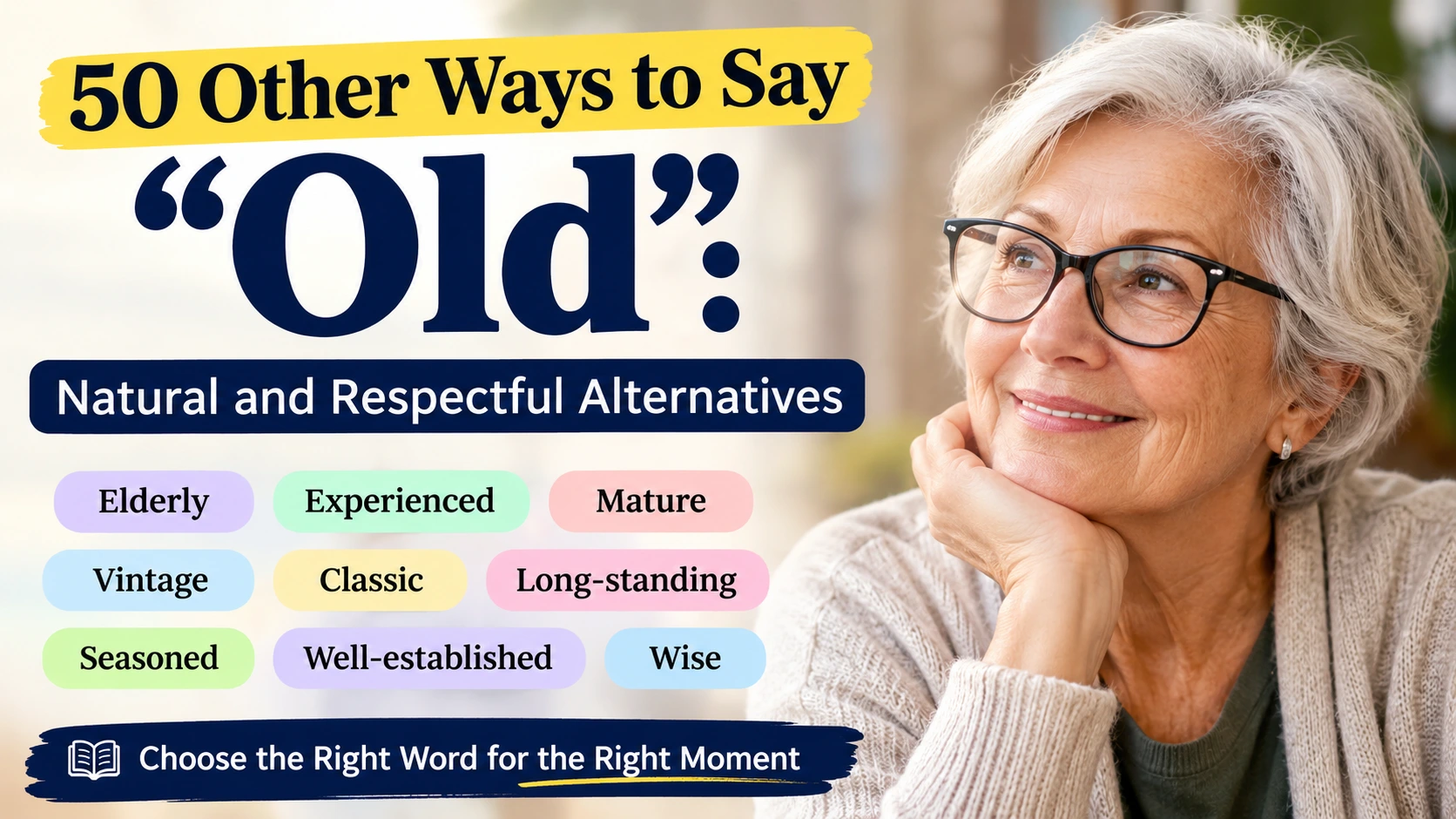
That is why people search for other ways to say old. The right alternative can make a big difference. You might use “experienced” in a professional setting, “well-established” for a business, or “vintage” for an item. In casual conversations, phrases such as “from another era” or “a classic” can sound much warmer.
This guide covers 50 natural alternatives to “old.” Each one includes a simple explanation and a realistic example. You will also learn which expressions work best in professional, casual, funny, and thoughtful situations.
What Does “Other Ways to Say Old” Mean?
The phrase “other ways to say old” refers to alternative words and expressions that describe someone or something as having existed for a long time.
The meaning can change depending on what you are describing.
For a person, “old” may refer to age:
“My grandfather is quite old.”
For an object, it may describe something that has been around for many years:
“This is an old building.”
For an idea or tradition, it may mean something that has existed for a long time:
“That is an old tradition.”
The tone also matters. Saying someone is “elderly” can sound respectful in some situations, while “experienced” focuses on knowledge rather than age. Similarly, “vintage” can make an old item sound valuable or stylish.
So, the best alternative depends on the person, object, context, and tone.
1. Polite and Appreciative Alternatives
These expressions are useful when you want to sound respectful and considerate. They are especially helpful when talking about people, traditions, businesses, or objects with a long history.
1. “Elderly”
Reply: “Elderly”
Example:
You are describing a person respectfully in a formal conversation.
“The center provides support for elderly members of the community.”
“Elderly” is more respectful than simply saying “old” in many formal contexts. However, it is usually better to use it only when age is relevant.
2. “Older”
Reply: “Older”
Example:
You are comparing two people without wanting to sound harsh.
“My older brother works in another city.”
“Older” is often softer and more neutral than “old.”
3. “Mature”
Reply: “Mature”
Example:
You are talking about someone’s attitude rather than their exact age.
“She has a very mature approach to difficult situations.”
This focuses on behavior, judgment, and emotional development.
4. “Experienced”
Reply: “Experienced”
Example:
You are talking about someone who has worked in a field for many years.
“We hired an experienced manager to lead the team.”
This is an excellent choice in professional settings because it highlights knowledge rather than age.
5. “Well-established”
Reply: “Well-established”
Example:
You are describing a company that has operated for decades.
“It is a well-established business with a strong reputation.”
Use this for organizations, businesses, systems, or practices rather than people.
6. “Long-standing”
Reply: “Long-standing”
Example:
You are discussing a tradition that has existed for many years.
“The school has a long-standing tradition of academic excellence.”
This sounds polished and respectful.
7. “Seasoned”
Reply: “Seasoned”
Example:
You are describing a professional with years of experience.
“She is a seasoned journalist with years of experience.”
It emphasizes expertise rather than age.
8. “Distinguished”
Reply: “Distinguished”
Example:
You are describing someone with a long and respected career.
“He is a distinguished professor with decades of academic experience.”
This is a strong choice for formal writing.
9. “Well-preserved”
Reply: “Well-preserved”
Example:
You are talking about an old building.
“The historic house is remarkably well-preserved.”
Use this for objects, buildings, artwork, documents, and similar things.
10. “From an earlier generation”
Reply: “From an earlier generation”
Example:
You are talking about an older piece of technology.
“This camera is from an earlier generation, but it still works perfectly.”
It is neutral and avoids making “old” sound negative.
2. Flirty and Playful Alternatives
These expressions are best for light conversations. They can make a comment about age sound warmer or more humorous. Still, use them only when you know the person will appreciate the joke.
11. “A classic”
Reply: “You’re a classic.”
Example:
Your friend has a timeless sense of humor.
“You’re a classic. Your jokes never change.”
It turns the idea of age into something positive.
12. “A timeless classic”
Reply: “You’re a timeless classic.”
Example:
You are joking with someone who has a long-standing style.
“That style never goes out of fashion. You’re a timeless classic.”
It sounds playful and complimentary.
13. “Vintage”
Reply: “You’re going vintage.”
Example:
Your friend wears a retro outfit.
“That jacket is giving serious vintage energy.”
“Vintage” is usually more suitable for clothing, objects, and styles than for someone’s age.
14. “From another era”
Reply: “You’re from another era.”
Example:
Your friend loves old music and traditional movies.
“You know every classic song. You’re definitely from another era.”
It can be a fun way to tease someone about their tastes.
15. “Old-school”
Reply: “You’re wonderfully old-school.”
Example:
Your friend prefers handwritten notes over texting.
“You still write thank-you notes? You’re wonderfully old-school.”
This can sound affectionate when used correctly.
16. “A timeless soul”
Reply: “You have a timeless soul.”
Example:
You are complimenting someone’s love for classic books and music.
“Your taste in music is incredible. You have a timeless soul.”
This focuses on personality rather than age.
17. “A living classic”
Reply: “You’re basically a living classic.”
Example:
Your friend has been telling the same stories for years.
“I have heard this story five times. You’re basically a living classic.”
This is best reserved for close friends.
18. “A little retro”
Reply: “You’re a little retro.”
Example:
Someone loves vintage fashion.
“Your whole style is a little retro, and honestly, it works.”
It is playful and often positive.
19. “From the good old days”
Reply: “You’re from the good old days.”
Example:
You are teasing a friend who loves older movies.
“You still watch movies on DVDs? You’re from the good old days.”
It gives the phrase a nostalgic feel.
20. “A timeless favorite”
Reply: “You’re a timeless favorite.”
Example:
You are joking with a close friend who has been part of your life for years.
“Everyone knows you around here. You’re a timeless favorite.”
This is warm, playful, and positive.
3. Confident and Self-Respecting Alternatives
Sometimes, you want to describe age without making it sound negative. These phrases focus on experience, history, maturity, and value.
21. “Wise”
Reply: “Wise”
Example:
You are talking about someone who has learned from many life experiences.
“She is wise and always gives thoughtful advice.”
This shifts the focus from age to knowledge.
22. “Experienced”
Reply: “Experienced”
Example:
You are introducing a professional at a meeting.
“He is an experienced engineer with a strong background in the field.”
It sounds confident and professional.
23. “Seasoned”
Reply: “Seasoned”
Example:
You are describing someone who has spent many years in their career.
“We need a seasoned professional for this role.”
This emphasizes expertise and confidence.
24. “Well-seasoned”
Reply: “Well-seasoned”
Example:
You are describing someone with a broad range of life or professional experience.
“She is a well-seasoned leader who knows how to handle pressure.”
It gives age a positive connection to experience.
25. “Mature”
Reply: “Mature”
Example:
You are praising someone’s behavior.
“He handled the disagreement in a mature way.”
This is useful when age itself is not important.
26. “Established”
Reply: “Established”
Example:
You are discussing someone with a successful career.
“She is an established writer with several published books.”
This focuses on achievement and reputation.
27. “Well-respected”
Reply: “Well-respected”
Example:
You are describing someone who has earned respect over many years.
“He is a well-respected member of the community.”
It is polite and positive.
28. “Accomplished”
Reply: “Accomplished”
Example:
You are introducing an experienced professional.
“She is an accomplished researcher with years of experience.”
This focuses on achievements rather than age.
29. “Distinguished”
Reply: “Distinguished”
Example:
You are introducing a senior professional at an event.
“We are pleased to welcome our distinguished guest.”
It is especially suitable for formal situations.
30. “Rich in experience”
Reply: “Rich in experience”
Example:
You are describing someone who has learned from many years of work.
“He is rich in experience and has helped many young professionals.”
This makes experience sound like an asset.
4. Funny and Savage Alternatives
These phrases are intended for humor. Use them with people who understand your personality and are comfortable joking about age.
31. “A certified classic”
Reply: “You’re a certified classic.”
Example:
Your friend keeps using an old phrase that nobody else understands.
“Nobody says that anymore. You’re a certified classic.”
It is playful rather than directly calling someone old.
32. “Old-school legend”
Reply: “You’re an old-school legend.”
Example:
Your friend knows every classic song from decades ago.
“You know every song from that era. You’re an old-school legend.”
The word “legend” makes the phrase more positive.
33. “A walking history lesson”
Reply: “You’re basically a walking history lesson.”
Example:
Your friend knows a surprising amount about the past.
“How do you know all of this? You’re basically a walking history lesson.”
This works best as friendly teasing.
34. “From the archives”
Reply: “You’re straight from the archives.”
Example:
Your friend brings out an old fashion trend.
“Those sunglasses are straight from the archives.”
This is more suitable for someone’s style or belongings.
35. “A historical artifact”
Reply: “You’re becoming a historical artifact.”
Example:
Your close friend keeps telling stories from years ago.
“I have heard this story so many times. You’re becoming a historical artifact.”
This is deliberately exaggerated, so use it only with close friends.
36. “A museum piece”
Reply: “You’re practically a museum piece.”
Example:
Your friend owns an extremely old gadget.
“That phone is ancient. It belongs in a museum.”
This is better for objects than people.
37. “A relic”
Reply: “That thing is a relic.”
Example:
You find an old computer in storage.
“Does this still work? That thing is a relic.”
Use “relic” for objects, traditions, or ideas rather than using it to label a person.
38. “From the dinosaur era”
Reply: “That feels like it’s from the dinosaur era.”
Example:
Your friend shows you an extremely outdated computer.
“You still use that software? It feels like it’s from the dinosaur era.”
This is humorous and exaggerated.
39. “Vintage edition”
Reply: “You’re the vintage edition.”
Example:
Your close friend is celebrating another birthday.
“Another birthday already? Welcome to the vintage edition.”
Keep this playful and friendly.
40. “A throwback”
Reply: “You’re such a throwback.”
Example:
Your friend loves old fashion trends.
“You still dress like that? You’re such a throwback.”
It can be teasing while still sounding lighthearted.
5. Curious, Thoughtful, and Mature Alternatives
These options work well when you want to talk about age, history, or experience without making the conversation feel negative.
41. “From a different generation”
Reply: “From a different generation”
Example:
You are explaining why someone has different preferences.
“He comes from a different generation, so his approach is a little different.”
This is neutral and respectful.
42. “From an earlier time”
Reply: “From an earlier time”
Example:
You are describing a traditional custom.
“This tradition comes from an earlier time.”
It sounds thoughtful and neutral.
43. “Long-established”
Reply: “Long-established”
Example:
You are describing a business with decades of history.
“It is a long-established family business.”
This works well in formal writing.
44. “Historic”
Reply: “Historic”
Example:
You are describing a building with cultural importance.
“The city is famous for its historic buildings.”
“Historic” suggests importance rather than simply age.
45. “Time-honored”
Reply: “Time-honored”
Example:
You are describing a tradition that has continued for generations.
“The ceremony follows a time-honored tradition.”
This is a respectful and elegant alternative.
46. “Traditional”
Reply: “Traditional”
Example:
You are talking about an old method that is still used today.
“They still use traditional methods to make the product.”
It focuses on continuity rather than age.
47. “From a bygone era”
Reply: “From a bygone era”
Example:
You are describing an old-fashioned building or style.
“The house looks like it came from a bygone era.”
This has a nostalgic and literary tone.
48. “Generations old”
Reply: “Generations old”
Example:
You are talking about a family tradition.
“The recipe is generations old and has been passed down through the family.”
It emphasizes history and heritage.
49. “With a long history”
Reply: “With a long history”
Example:
You are describing an organization.
“The university has a long history of academic achievement.”
It is simple, respectful, and easy to understand.
50. “Well-preserved with age”
Reply: “Well-preserved with age”
Example:
You are describing a historic object.
“The painting is well-preserved despite its age.”
This is useful when discussing antiques, artwork, buildings, and other objects.
Real-Life Situations: Which Alternative Should You Use?
The best expression depends on who you are talking about and why you are mentioning age.
When You Are Talking About an Older Person Respectfully
If age is relevant, choose a neutral or respectful expression.
Best choice: “Older” or “elderly”
Example:
“The program provides transportation for older adults.”
This sounds more considerate than using “old” without context.
When You Are Talking About Someone’s Experience
If the person’s knowledge matters more than their age, focus on experience.
Best choice: “Experienced”
Example:
“We need someone experienced to lead the project.”
This keeps the focus on ability.
When a Friend Jokes About Being Old
A playful response can keep the conversation light.
Best choice: “You’re a certified classic.”
Example:
“Another birthday? Relax. You’re a certified classic.”
This works well when the friendship already includes this kind of humor.
When You Are Describing an Old Object
Choose a word that reflects its condition or value.
Best choice: “Vintage,” “antique,” or “well-preserved”
Example:
“She has a beautiful vintage camera from the 1960s.”
This sounds much more descriptive than simply calling it “old.”
When You Are Writing Formally
A professional context calls for precise language.
Best choice: “Long-standing,” “well-established,” or “historic”
Example:
“The organization has a long-standing relationship with local communities.”
This sounds polished and professional.
What to Avoid When Using Alternatives to “Old”
Using a softer phrase is not always enough. Context still matters.
1. Do Not Use “Old” as an Insult
Calling someone “old” to embarrass them can quickly make a conversation uncomfortable.
If age is not relevant, there may be no reason to mention it.
2. Avoid Unnecessary Age Labels
You do not always need to describe someone by age.
Instead of:
“The old manager helped us.”
Consider:
“The experienced manager helped us.”
The second sentence gives the reader useful information.
3. Do Not Use “Elderly” for Everyone
“Elderly” can sound formal and may not fit every person or situation.
When appropriate, “older adult” can be a more neutral choice.
4. Be Careful With Humor
Terms such as “relic” or “museum piece” can be funny among close friends. However, they can sound disrespectful in other situations.
Know your audience first.
5. Do Not Use a Fancy Word Without Checking Its Meaning
“Vintage,” “antique,” “historic,” and “experienced” do not mean exactly the same thing.
Choose the word that matches your intended meaning.
6. Do Not Assume Age Means Lack of Ability
Someone’s age does not automatically tell you anything about their skills, intelligence, or energy.
Focus on the quality that actually matters.
Pro Tips for Talking About Age
Choose the Quality You Really Mean
Before replacing “old,” ask yourself what you actually want to describe.
Do you mean:
- Age?
- Experience?
- History?
- Tradition?
- Style?
- Maturity?
- Value?
Once you know the meaning, the right word becomes much easier to choose.
Keep Your Tone in Mind
A professional email may need “experienced” or “long-standing.” A conversation with a close friend may allow something playful like “certified classic.”
The same idea can sound completely different depending on your wording.
When in Doubt, Be Neutral
If you are unsure whether a phrase could offend someone, choose a simple and respectful option.
“Older,” “experienced,” and “well-established” are often safer choices than exaggerated jokes.
Bonus: Quick Alternatives to “Old”
Need a short replacement? Here are 10 options you can use quickly:
- Older
- Elderly
- Mature
- Experienced
- Seasoned
- Vintage
- Classic
- Historic
- Traditional
- Long-standing
Conclusion
There are many other ways to say old, but the best choice depends on what you actually mean. If you are talking about a person, words such as “older,” “experienced,” and “mature” can sound more respectful. For objects, “vintage,” “classic,” or “well-preserved” may be more descriptive. Meanwhile, “long-standing” and “well-established” work well for businesses, traditions, and organizations.
Most importantly, think about your audience before choosing your words. A phrase that makes a close friend laugh may not belong in a professional conversation.
Discover more
other ways to say don’t get me wrong synonyms