
Sometimes you want to disagree with someone without making them think you are attacking their opinion. You may like an idea but still have a concern. You may appreciate someone while pointing out a flaw. Or, you may simply want to make your real opinion clear before adding a different perspective.
That is where “don’t get me wrong” comes in. It helps soften a statement and shows that your next point may not be as negative as it first sounds. However, using the same phrase repeatedly can make your conversations feel predictable.
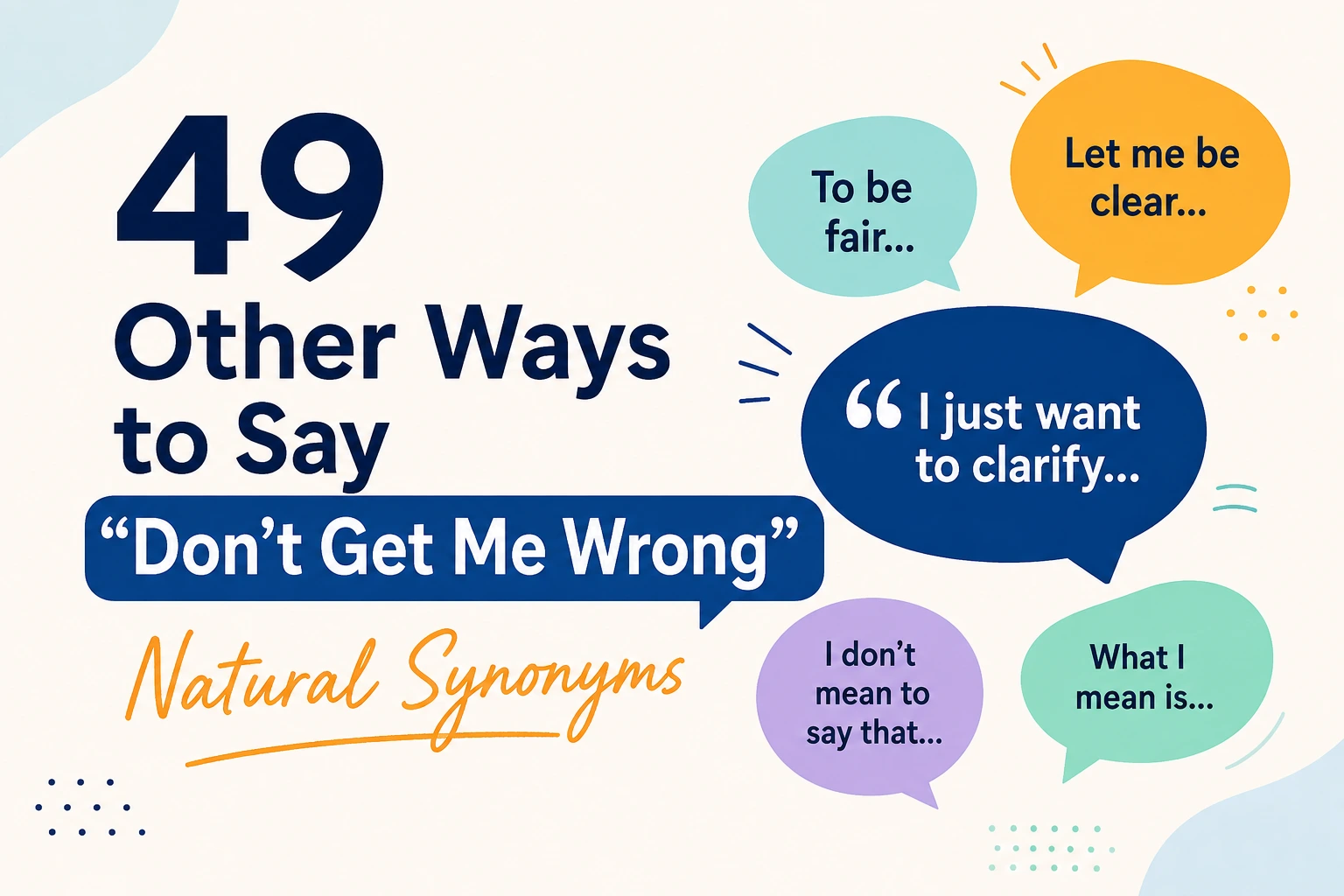
Fortunately, there are many natural alternatives. Some sound polite and thoughtful, while others are confident, casual, funny, or more professional. In this guide, you will find 49 other ways to say “don’t get me wrong”, with realistic examples to help you choose the right expression for every situation.
What Does “Don’t Get Me Wrong” Mean?
“Don’t get me wrong” is used when you want to clarify your true meaning before making a statement that could be misunderstood.
It often means:
- “Please understand what I really mean.”
- “I am not saying the opposite.”
- “I want to make one thing clear.”
- “I agree with you to some extent, but…”
For example:
“Don’t get me wrong, I love working from home, but sometimes I miss talking to people in person.”
The speaker is not rejecting remote work. Instead, they are adding a different perspective.
The phrase is common in everyday conversations, texts, debates, social media posts, and informal writing. However, it may sound too casual in some professional situations. In those cases, alternatives such as “To clarify,” “That said,” or “I want to make it clear that” may work better.
1. Polite and Appreciative Alternatives
These phrases are useful when you want to express a different opinion without sounding rude or dismissive.
1. “Please don’t misunderstand me.”
Reply: “Please don’t misunderstand me.”
Example:
You appreciate your friend’s advice but disagree with one part of it.
“Please don’t misunderstand me. I really appreciate your advice, but I think I need to try a different approach.”
This is a polite way to prevent your words from being taken the wrong way.
2. “I don’t mean to sound negative.”
Reply: “I don’t mean to sound negative.”
Example:
You are giving feedback about a new project.
“I don’t mean to sound negative, but I think we should review the budget once more.”
It softens criticism without hiding your point.
3. “I hope you understand what I mean.”
Reply: “I hope you understand what I mean.”
Example:
You are explaining why you cannot accept an invitation.
“I really want to come. I hope you understand what I mean, but I have too much work this week.”
This sounds considerate and sincere.
4. “That’s not to say that…”
Reply: “That’s not to say that…”
Example:
You are discussing the disadvantages of online learning.
“Online classes can be convenient. That’s not to say that they are perfect for everyone.”
It clearly separates your main point from a possible misunderstanding.
5. “I’m not saying that…”
Reply: “I’m not saying that…”
Example:
You disagree with a friend’s opinion but still respect it.
“I’m not saying that your idea is bad. I just think there may be another option.”
This is natural and easy to use.
6. “I hope that doesn’t come across the wrong way.”
Reply: “I hope that doesn’t come across the wrong way.”
Example:
You want to give honest feedback about someone’s presentation.
“Your presentation was strong. I hope that doesn’t come across the wrong way, but I think the introduction could be shorter.”
It is useful when your comment could sound critical.
7. “With all due respect…”
Reply: “With all due respect…”
Example:
You disagree with someone’s decision during a discussion.
“With all due respect, I think we should consider the other proposal as well.”
This sounds respectful, although it can feel formal or slightly firm.
8. “I mean this constructively.”
Reply: “I mean this constructively.”
Example:
You are giving feedback to a teammate.
“I mean this constructively. I think we could make the report much clearer.”
This tells the listener that your goal is improvement, not criticism.
9. “I say this with respect.”
Reply: “I say this with respect.”
Example:
You disagree with someone’s approach.
“I say this with respect, but I think we may be overlooking an important detail.”
It keeps the conversation respectful while allowing you to be honest.
10. “I hope you see where I’m coming from.”
Reply: “I hope you see where I’m coming from.”
Example:
You explain why you made a difficult decision.
“I know this was not the outcome you wanted. I hope you see where I’m coming from.”
This works especially well during emotional or personal conversations.
2. Flirty and Playful Alternatives
These expressions work well in casual conversations when you want to disagree, tease, or add a different perspective without making things too serious.
11. “Hear me out.”
Reply: “Hear me out.”
Example:
Your friend thinks your weekend plan sounds terrible.
“Hear me out. I know the idea sounds strange, but it could actually be fun.”
It creates curiosity and invites the other person to listen.
12. “Okay, but let me explain.”
Reply: “Okay, but let me explain.”
Example:
Your crush misunderstands your message.
“Okay, but let me explain. That is definitely not what I meant.”
It sounds casual and conversational.
13. “Before you judge me…”
Reply: “Before you judge me…”
Example:
You tell your friends about an unusual food combination you enjoy.
“Before you judge me, you need to try it first.”
This adds humor and makes the conversation playful.
14. “Hear me out before you disagree.”
Reply: “Hear me out before you disagree.”
Example:
You suggest an unexpected movie for movie night.
“Hear me out before you disagree. I think this might actually be the best choice.”
It works well when you expect some resistance.
15. “Trust me on this one.”
Reply: “Trust me on this one.”
Example:
You recommend a restaurant your friend has never tried.
“Trust me on this one. Their food is incredible.”
It sounds confident and friendly.
16. “Just hear me out for a second.”
Reply: “Just hear me out for a second.”
Example:
Your friend immediately rejects your suggestion.
“Just hear me out for a second. I promise there is a reason behind this.”
It helps keep the conversation open.
17. “I know how that sounds.”
Reply: “I know how that sounds.”
Example:
You explain why you changed your plans at the last minute.
“I know how that sounds, but there was actually a good reason.”
This acknowledges how your statement might appear.
18. “It sounds bad, but…”
Reply: “It sounds bad, but…”
Example:
You explain why you skipped an event.
“It sounds bad, but I really needed a quiet evening to myself.”
This works best in relaxed conversations.
19. “Okay, that came out wrong.”
Reply: “Okay, that came out wrong.”
Example:
You say something that your friend interprets differently than you intended.
“Okay, that came out wrong. Let me explain what I actually meant.”
It is a natural way to correct yourself.
20. “Let me put that another way.”
Reply: “Let me put that another way.”
Example:
Someone looks confused by your comment.
“Let me put that another way. I agree with the idea, but I would change how we approach it.”
This is useful when you want to clarify without becoming defensive.
3. Confident and Self-Respecting Alternatives
These phrases help you stand by your opinion while making your position clear. They work well when you want to sound calm and confident.
21. “To be clear…”
Reply: “To be clear…”
Example:
You want to make your position unmistakable.
“To be clear, I support the project. I simply think the deadline needs to change.”
It is direct and confident.
22. “Let me be clear.”
Reply: “Let me be clear.”
Example:
You want to correct a misunderstanding.
“Let me be clear. I respect your decision, but I do not agree with it.”
This sounds firm and self-assured.
23. “For clarity…”
Reply: “For clarity…”
Example:
You are discussing responsibilities with your team.
“For clarity, I am not questioning the team’s effort. I am suggesting a different process.”
This works especially well in professional communication.
24. “That said…”
Reply: “That said…”
Example:
You have just mentioned something positive about a product.
“The phone has an excellent camera. That said, the battery life could be better.”
It introduces a contrasting point smoothly.
25. “Having said that…”
Reply: “Having said that…”
Example:
You have praised a new restaurant but want to mention one weakness.
“The food was excellent. Having said that, the service was slower than expected.”
It is a polished way to introduce a different perspective.
26. “At the same time…”
Reply: “At the same time…”
Example:
You are discussing the advantages and disadvantages of remote work.
“Remote work gives employees more flexibility. At the same time, it can make teamwork more difficult.”
It works well when two ideas can both be true.
27. “To put things in perspective…”
Reply: “To put things in perspective…”
Example:
You are discussing a small mistake someone made.
“The mistake was frustrating. To put things in perspective, the rest of the project went extremely well.”
This helps balance a negative point.
28. “I see it differently.”
Reply: “I see it differently.”
Example:
A friend strongly disagrees with your opinion.
“I understand your point, but I see it differently. I think the problem started earlier.”
It is direct without being aggressive.
29. “I have a slightly different view.”
Reply: “I have a slightly different view.”
Example:
You are participating in a group discussion.
“I have a slightly different view. I think the second option would be more practical.”
It sounds calm and respectful.
30. “My point is simply that…”
Reply: “My point is simply that…”
Example:
Someone misunderstands your criticism.
“My point is simply that we should give everyone more time to prepare.”
This brings the conversation back to your actual message.
4. Funny and Savage Alternatives
These expressions are more casual. They work best with friends or people who understand your sense of humor.
31. “Don’t cancel me yet.”
Reply: “Don’t cancel me yet.”
Example:
You are about to give an unpopular opinion in a group chat.
“Don’t cancel me yet, but I actually liked the ending.”
It makes an unusual opinion sound playful.
32. “Before everyone comes for me…”
Reply: “Before everyone comes for me…”
Example:
You are sharing a controversial opinion about a popular movie.
“Before everyone comes for me, I actually think the sequel was better.”
This is humorous and casual.
33. “I know I’m about to get judged.”
Reply: “I know I’m about to get judged.”
Example:
You tell your friends about an unusual habit.
“I know I’m about to get judged, but I actually enjoy pineapple on pizza.”
It invites a playful reaction.
34. “Don’t come for me.”
Reply: “Don’t come for me.”
Example:
You share an unpopular opinion in a group chat.
“Don’t come for me, but I think the old version was better.”
This is informal and humorous.
35. “Hear me before you roast me.”
Reply: “Hear me before you roast me.”
Example:
Your friends are already making jokes about your suggestion.
“Hear me before you roast me. I actually have a plan.”
It works well with close friends.
36. “I promise I’m not trying to start a fight.”
Reply: “I promise I’m not trying to start a fight.”
Example:
You are about to disagree with a friend about a favorite sports team.
“I promise I’m not trying to start a fight, but your team was terrible today.”
The humor keeps the disagreement light.
37. “Let me survive this opinion first.”
Reply: “Let me survive this opinion first.”
Example:
You are about to say something unpopular in a group conversation.
“Let me survive this opinion first: I think the original movie was overrated.”
It adds a playful dramatic touch.
38. “I come in peace, but…”
Reply: “I come in peace, but…”
Example:
You are about to disagree with a friend’s favorite celebrity.
“I come in peace, but I really do not understand the hype.”
It makes the disagreement feel less serious.
39. “Don’t throw anything at me, but…”
Reply: “Don’t throw anything at me, but…”
Example:
You are sharing an unpopular food opinion.
“Don’t throw anything at me, but I think that restaurant is overrated.”
This works when you know your opinion may get a strong reaction.
40. “I know this is going to cause problems.”
Reply: “I know this is going to cause problems.”
Example:
Your friends are debating which movie franchise is best.
“I know this is going to cause problems, but I prefer the second one.”
It adds humor before an unpopular opinion.
5. Curious, Thoughtful, and Mature Alternatives
These phrases are useful when you want to communicate disagreement or clarification in a calm and thoughtful way.
41. “I understand your point, but…”
Reply: “I understand your point, but…”
Example:
Your coworker suggests a solution you do not fully support.
“I understand your point, but I think we should consider the long-term effects as well.”
It acknowledges the other person’s perspective before giving your own.
42. “I can see why you think that.”
Reply: “I can see why you think that.”
Example:
A friend explains an opinion you do not completely share.
“I can see why you think that. From my perspective, though, there is another side to consider.”
This encourages respectful discussion.
43. “I agree to an extent.”
Reply: “I agree to an extent.”
Example:
You agree with part of an argument but not all of it.
“I agree to an extent, but I think the situation is more complicated than that.”
It allows you to show partial agreement.
44. “There’s some truth to that, but…”
Reply: “There’s some truth to that, but…”
Example:
Your friend makes a broad statement about social media.
“There’s some truth to that, but I think it depends on how people use it.”
This creates room for a balanced response.
45. “I appreciate that perspective.”
Reply: “I appreciate that perspective.”
Example:
Someone shares an opinion during a discussion.
“I appreciate that perspective. I have a slightly different view, though.”
It keeps the conversation respectful.
46. “I see where you’re coming from.”
Reply: “I see where you’re coming from.”
Example:
Your friend explains why they made a particular choice.
“I see where you’re coming from. I just think I would have handled it differently.”
This shows understanding without requiring agreement.
47. “There’s another side to this.”
Reply: “There’s another side to this.”
Example:
You are discussing a controversial topic.
“There’s another side to this that we should consider before making a decision.”
It encourages a broader discussion.
48. “I’d look at it a little differently.”
Reply: “I’d look at it a little differently.”
Example:
Your teammate suggests a particular strategy.
“I’d look at it a little differently. I think customer feedback should come first.”
It sounds calm and professional.
49. “I agree with the idea, but not necessarily the approach.”
Reply: “I agree with the idea, but not necessarily the approach.”
Example:
Your team agrees on a goal but disagrees about how to achieve it.
“I agree with the idea, but not necessarily the approach. There may be a more efficient way to do it.”
This is especially useful in professional or mature discussions.
Real-Life Situations: Which Alternative Should You Use?
The same message can sound completely different depending on your choice of words. Here are some common situations.
When Your Crush Misunderstands Your Message
You made a joke, but your crush took it seriously.
Best reply:
“Okay, that came out wrong. Let me explain what I actually meant.”
This clears up the misunderstanding without making the conversation awkward.
When a Friend Shares an Unpopular Opinion
Your friend says something you strongly disagree with.
Best reply:
“I see where you’re coming from, but I see it differently.”
This keeps the conversation respectful while allowing you to stand by your opinion.
When Someone Says Something Too Early
Someone makes a strong assumption about you after barely knowing you.
Best reply:
“I hope you understand what I mean, but I think it’s a little early to make that assumption.”
This sets a boundary without being unnecessarily harsh.
When You Are Not Interested in an Argument
Someone tries to pull you into a heated discussion.
Best reply:
“I understand your point, but I don’t think we need to agree on everything.”
It keeps the conversation calm and protects your boundaries.
When You Are Giving Professional Feedback
A coworker has done good work, but you have one concern.
Best reply:
“The overall work is strong. That said, I think we could improve the introduction.”
This is constructive and professional.
What to Avoid When Using “Don’t Get Me Wrong” Alternatives
Choosing a better phrase is helpful, but delivery matters too. Keep these mistakes in mind.
1. Do Not Use a Softener to Hide an Insult
Saying “Don’t get me wrong” does not make a rude comment automatically polite.
Be honest, but remain respectful.
2. Do Not Overuse Formal Expressions
Words such as “to put things in perspective” can sound unnatural in casual texting.
Match the phrase to the setting.
3. Avoid Sounding Defensive
If you constantly say “I’m not saying that” or “Please don’t misunderstand me,” the other person may feel that you are preparing for an argument.
Keep your explanation simple.
4. Do Not Ignore the Other Person’s Point
A good disagreement starts with understanding.
Try phrases such as:
“I see where you’re coming from, but…”
This shows that you have actually listened.
5. Do Not Use Humor at the Wrong Time
Funny alternatives are great with friends. However, they may not work during serious conversations or professional disagreements.
6. Do Not Overcomplicate Your Message
The purpose of these alternatives is clarity.
If “That said” works perfectly, there is no need to use a complicated phrase.
Pro Tips for Using These Alternatives
1. Match Your Words to the Situation
Use “That said” or “to clarify” in professional conversations.
Use “hear me out” with friends.
Use “I see where you’re coming from” when you want to have a thoughtful discussion.
The right phrase should feel natural for the setting.
2. Acknowledge Before You Disagree
If you disagree with someone, briefly recognize their perspective first.
For example:
“I understand your point. However, I see it differently.”
This often sounds much better than immediately saying, “You are wrong.”
3. Say What You Mean
Do not use a softer expression simply to avoid being honest.
You can be kind and direct at the same time. In fact, clear communication usually creates fewer misunderstandings.
Bonus: Quick One-Liners for “Don’t Get Me Wrong”
Need a short alternative for texting or everyday conversation?
- “Hear me out.”
- “That said…”
- “To be clear…”
- “I see your point, but…”
- “I understand where you’re coming from.”
- “Having said that…”
- “Let me explain.”
- “I see it differently.”
- “There’s another side to this.”
- “I know how that sounds, but…”
Conclusion
“Don’t get me wrong” is useful when you want to clarify your intentions before sharing a different opinion. Still, you do not have to rely on the same phrase every time. Alternatives such as “that said,” “hear me out,” “to be clear,” “I see where you’re coming from,” and “there’s another side to this” can make your communication more natural and precise.
The most important thing is to match your words to the situation. A casual conversation may need a playful phrase, while a professional discussion may call for something more polished.
Discover more