

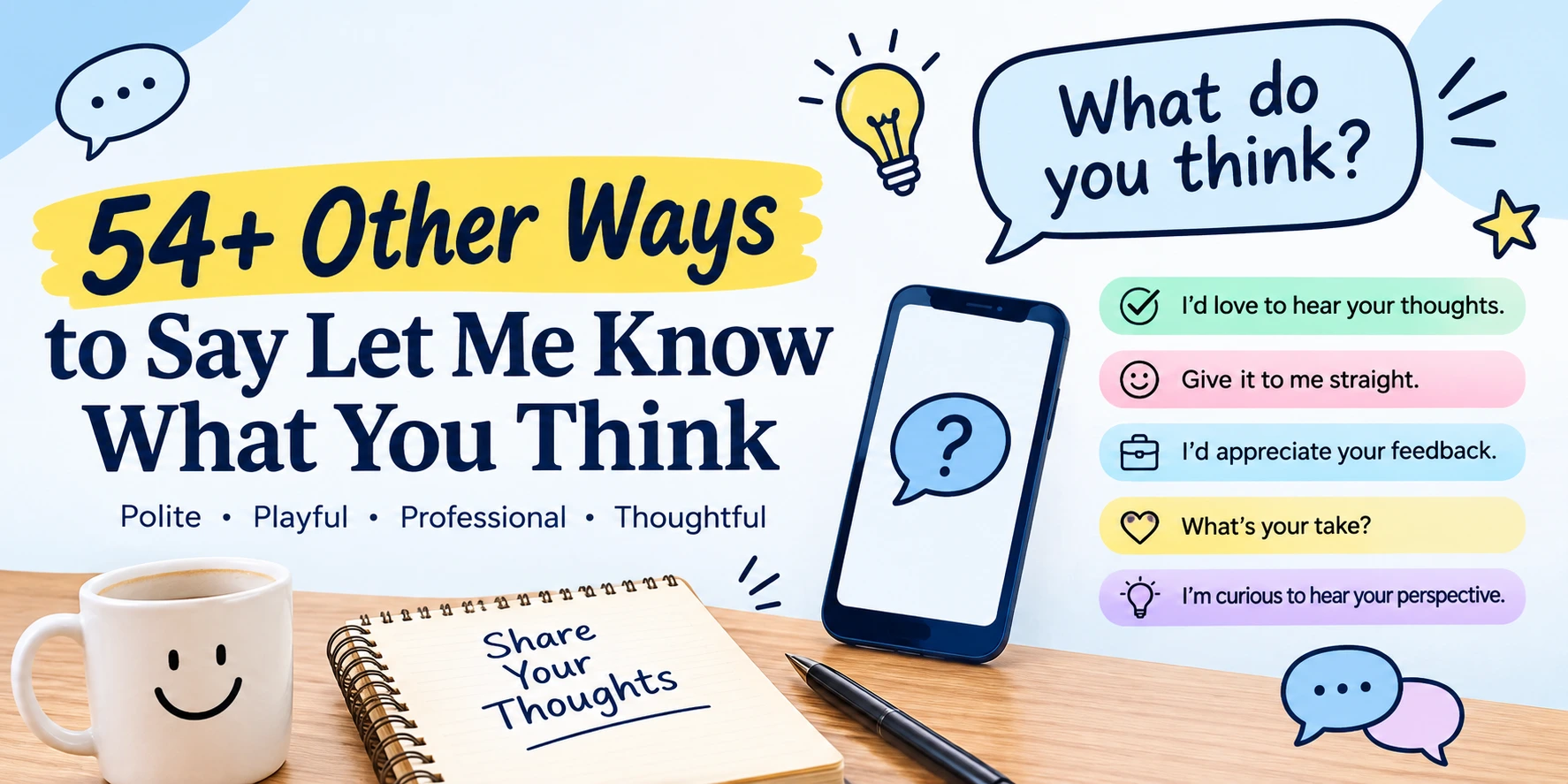
You have just sent someone an idea, shared your work, or finished writing an important message. Then comes the hardest part: asking for their opinion without sounding repetitive. “Let me know what you think” is perfectly natural, but using the same sentence every time can make your messages feel predictable.
That is why people often search for other ways to say let me know what you think.
The good news is that there are plenty of alternatives. You can sound professional in an email, relaxed with a friend, confident when sharing your work, or playful when texting someone you like. The right wording can also encourage people to give more useful feedback instead of simply saying, “Looks good.”
In this guide, you will find 47 natural alternatives, complete with realistic examples and tips for choosing the right one.
What Does “Let Me Know What You Think” Mean?
“Let me know what you think” is a polite way to ask someone for their opinion, reaction, or feedback.
You might use it after sharing an idea, photo, project, article, plan, design, message, or personal decision.
For example:
“I just finished the presentation. Let me know what you think.”
Here, you are inviting the other person to share their honest opinion.
The phrase is flexible and works in both casual and professional communication. However, the best alternative depends on what kind of response you actually want.
If you want honest feedback, you might say:
“I’d really value your feedback.”
If you want a quick reaction:
“What do you think?”
If you want detailed criticism:
“I’d appreciate your thoughts on what I could improve.”
Choosing the right phrase makes your request clearer and can lead to a much better conversation.
1. Polite and Appreciative Alternatives
These phrases are ideal when you want to sound respectful, warm, and considerate. They work particularly well in emails, school projects, workplace conversations, and professional messages.
1. “I’d love to hear your thoughts.”
Reply: “I’d love to hear your thoughts.”
Example:
You send your friend the first draft of your personal statement and write, “I’d love to hear your thoughts when you get a chance.”
Why use it:
This sounds friendly without putting pressure on the person to respond immediately.
2. “I’d appreciate your feedback.”
Reply: “I’d appreciate your feedback.”
Example:
After finishing a project at work, you message your colleague: “I’ve attached the updated version. I’d appreciate your feedback.”
Why use it:
This is a polished choice for professional emails and workplace communication.
3. “I’d value your opinion.”
Reply: “I’d value your opinion.”
Example:
“I’m considering these two university options, and I’d value your opinion before making a decision.”
Why use it:
It shows that you genuinely respect the person’s judgment.
4. “I’d be interested to hear your thoughts.”
Reply: “I’d be interested to hear your thoughts.”
Example:
“I’ve changed the layout of the website. I’d be interested to hear your thoughts on it.”
Why use it:
This feels professional while still sounding approachable.
5. “I’d be grateful for your feedback.”
Reply: “I’d be grateful for your feedback.”
Example:
“I’ve attached my draft proposal. I’d be grateful for your feedback when you have time.”
Why use it:
This works especially well when speaking to someone with more experience or expertise.
6. “Please share your thoughts.”
Reply: “Please share your thoughts.”
Example:
“We are considering a few changes to the event schedule. Please share your thoughts.”
Why use it:
It is direct, polite, and useful in group discussions.
7. “I’d love your input.”
Reply: “I’d love your input.”
Example:
“I’m trying to choose between these two designs. I’d love your input.”
Why use it:
This is a natural way to invite someone into a decision.
8. “Your feedback would mean a lot.”
Reply: “Your feedback would mean a lot.”
Example:
“I’ve worked on this essay for weeks, so your feedback would mean a lot to me.”
Why use it:
It feels more personal and sincere than a standard request for feedback.
9. “I’m curious to hear your perspective.”
Reply: “I’m curious to hear your perspective.”
Example:
“We have very different experiences with this topic, so I’m curious to hear your perspective.”
Why use it:
Choose this when you are genuinely interested in how someone sees an issue.
2. Flirty and Playful Alternatives
Sometimes you want someone’s opinion but do not want your message to sound overly serious. These options work well with close friends, playful conversations, and someone you already have a comfortable connection with.
10. “Okay, your turn. What do you think?”
Reply: “Okay, your turn. What do you think?”
Example:
You send someone a photo of your new outfit and add, “Okay, your turn. What do you think?”
Why use it:
It feels natural and invites a response without sounding formal.
11. “Be honest. How did I do?”
Reply: “Be honest. How did I do?”
Example:
After sending your crush a photo of your new haircut, you ask, “Be honest. How did I do?”
Why use it:
It adds a playful challenge and can make the conversation more engaging.
12. “I’m waiting for your expert opinion.”
Reply: “I’m waiting for your expert opinion.”
Example:
You send your friend two movie choices and say, “I’m waiting for your expert opinion.”
Why use it:
The exaggerated “expert” label adds a little humor.
13. “Your verdict?”
Reply: “Your verdict?”
Example:
You show your friend your new room setup and simply ask, “Your verdict?”
Why use it:
It is short, confident, and playful.
14. “So, are we impressed?”
Reply: “So, are we impressed?”
Example:
After finishing a new design, you send it to someone you like and ask, “So, are we impressed?”
Why use it:
It keeps the conversation light while still asking for an opinion.
15. “Tell me if I nailed it.”
Reply: “Tell me if I nailed it.”
Example:
“I tried making that recipe you recommended. Tell me if I nailed it.”
Why use it:
This works well when you want feedback without making the request sound formal.
16. “I need your brutally honest opinion.”
Reply: “I need your brutally honest opinion.”
Example:
“I’m thinking about sending this message. I need your brutally honest opinion first.”
Why use it:
Use this with someone you trust to be honest rather than simply supportive.
17. “Okay, judge me.”
Reply: “Okay, judge me.”
Example:
You send your friend a photo of your unusual outfit and write, “Okay, judge me.”
Why use it:
This is a playful way to invite a reaction.
18. “Give me the real review.”
Reply: “Give me the real review.”
Example:
“Forget being nice. Give me the real review of my presentation.”
Why use it:
It encourages honest feedback and makes the conversation more casual.
3. Confident and Self-Respect Alternatives
These alternatives are useful when you want to ask for feedback without sounding insecure or desperate for approval. They work especially well when sharing your work, ideas, decisions, or opinions.
19. “What’s your take?”
Reply: “What’s your take?”
Example:
“I’m leaning toward the second option. What’s your take?”
Why use it:
This sounds confident and conversational.
20. “I’m interested in your perspective.”
Reply: “I’m interested in your perspective.”
Example:
“I have my own opinion on the proposal, but I’m interested in your perspective.”
Why use it:
It shows confidence while making room for another person’s view.
21. “How does this look to you?”
Reply: “How does this look to you?”
Example:
“I’ve changed the homepage layout. How does this look to you?”
Why use it:
This is straightforward and works well when asking about something visual.
22. “What would you change?”
Reply: “What would you change?”
Example:
“I’m happy with the draft so far. What would you change?”
Why use it:
This is more specific than asking for general feedback.
23. “What stands out to you?”
Reply: “What stands out to you?”
Example:
“Take a look at the new logo. What stands out to you first?”
Why use it:
It encourages the person to give a more detailed response.
24. “I’m open to your suggestions.”
Reply: “I’m open to your suggestions.”
Example:
“This is my first version of the presentation, and I’m open to your suggestions.”
Why use it:
It communicates confidence while showing that you are willing to improve.
25. “I’d like your honest assessment.”
Reply: “I’d like your honest assessment.”
Example:
“Before I submit the proposal, I’d like your honest assessment.”
Why use it:
This sounds mature and professional.
26. “What would you do differently?”
Reply: “What would you do differently?”
Example:
“If you were presenting this, what would you do differently?”
Why use it:
This can produce practical advice rather than a vague opinion.
27. “Tell me what works and what doesn’t.”
Reply: “Tell me what works and what doesn’t.”
Example:
“Here’s the first draft. Tell me what works and what doesn’t.”
Why use it:
It makes your feedback request clear and specific.
4. Funny and Savage Alternatives
If your relationship allows for humor, these alternatives can turn an ordinary feedback request into something memorable.
28. “Give it to me straight.”
Reply: “Give it to me straight.”
Example:
“I’ve finished the presentation. Give it to me straight.”
Why use it:
It signals that you want honesty, even if the feedback is critical.
29. “Hit me with the criticism.”
Reply: “Hit me with the criticism.”
Example:
“Okay, I’ve sent you the draft. Hit me with the criticism.”
Why use it:
This works when you want to make honest feedback feel less intimidating.
30. “Destroy it if necessary.”
Reply: “Destroy it if necessary.”
Example:
“I know it needs work, so destroy it if necessary.”
Why use it:
It is a humorous way to show that you can handle constructive criticism.
31. “Tell me if this is genius or a disaster.”
Reply: “Tell me if this is genius or a disaster.”
Example:
“I created a completely different layout. Tell me if this is genius or a disaster.”
Why use it:
The contrast makes the request funny while still asking for an honest reaction.
32. “Rate my life choices.”
Reply: “Rate my life choices.”
Example:
You send your friend a photo of an expensive pair of shoes and write, “Rate my life choices.”
Why use it:
Perfect for casual situations where you are joking about your decision.
33. “Prepare your judgment.”
Reply: “Prepare your judgment.”
Example:
“I’m about to show you my new haircut. Prepare your judgment.”
Why use it:
It adds drama and humor to an otherwise simple request.
34. “I’m ready for the roast.”
Reply: “I’m ready for the roast.”
Example:
“I finally finished my first drawing. I’m ready for the roast.”
Why use it:
Use this with friends who enjoy teasing and playful criticism.
35. “Be nice. Or don’t.”
Reply: “Be nice. Or don’t.”
Example:
“I’ve sent you the draft. Be nice. Or don’t.”
Why use it:
It has a dry, confident tone and works well in casual chats.
36. “Let the judging begin.”
Reply: “Let the judging begin.”
Example:
“I’m sending you three outfit options. Let the judging begin.”
Why use it:
This creates a playful atmosphere around the feedback.
37. “I have submitted myself for review.”
Reply: “I have submitted myself for review.”
Example:
You send your new profile picture to your best friend and write, “I have submitted myself for review.”
Why use it:
The mock-official tone makes the message funny.
5. Curious, Thoughtful, and Mature Alternatives
These phrases are useful when you want a deeper conversation. They encourage people to explain their opinions instead of giving a simple yes or no.
38. “What are your initial thoughts?”
Reply: “What are your initial thoughts?”
Example:
“I’ve shared the proposal with you. What are your initial thoughts?”
Why use it:
This is useful when you want someone’s immediate reaction.
39. “What was your first impression?”
Reply: “What was your first impression?”
Example:
“I changed the opening of the presentation. What was your first impression?”
Why use it:
It helps you understand how something feels to someone seeing it for the first time.
40. “How did it come across to you?”
Reply: “How did it come across to you?”
Example:
“I tried to make the email sound confident. How did it come across to you?”
Why use it:
This is especially helpful when discussing tone and communication.
41. “Did anything stand out to you?”
Reply: “Did anything stand out to you?”
Example:
“After reading the article, did anything stand out to you?”
Why use it:
It encourages the person to identify specific details.
42. “What are your honest thoughts?”
Reply: “What are your honest thoughts?”
Example:
“I’ve been thinking about changing my career path. What are your honest thoughts?”
Why use it:
This is a sincere way to invite a meaningful response.
43. “What would you recommend?”
Reply: “What would you recommend?”
Example:
“I’m choosing between these two courses. What would you recommend?”
Why use it:
Use this when you want advice rather than a general opinion.
44. “Is there anything you’d improve?”
Reply: “Is there anything you’d improve?”
Example:
“I’m almost finished with the design. Is there anything you’d improve?”
Why use it:
This focuses the conversation on useful, actionable feedback.
45. “Does this make sense to you?”
Reply: “Does this make sense to you?”
Example:
“I’ve explained the plan in the document. Does this make sense to you?”
Why use it:
This is helpful when you want to check clarity rather than simply ask whether someone likes something.
46. “How do you feel about it?”
Reply: “How do you feel about it?”
Example:
“I’m thinking about accepting the offer. How do you feel about it?”
Why use it:
This sounds personal and works well when discussing decisions or emotional topics.
47. “What’s your honest take on this?”
Reply: “What’s your honest take on this?”
Example:
“I’ve been considering this idea for a while. What’s your honest take on this?”
Why use it:
It feels direct, mature, and conversational while encouraging genuine feedback.
Real-Life Situations: Which Reply Should You Use?
The same phrase does not work for every situation. Here are a few examples to help you choose naturally.
When You Send Something to Your Crush
You probably do not want to sound like you are submitting a formal report.
Best reply:
“Be honest. How did I do?”
Example:
You send your crush a photo of something you worked on and ask, “Be honest. How did I do?”
It creates an easy opening for them to respond.
When a Friend Is Known for Brutal Honesty
You already know they will tell you exactly what they think.
Best reply:
“Give it to me straight.”
Example:
You send your friend your new profile picture and say, “Give it to me straight.”
This makes it clear that you want their genuine opinion.
When You Are Sharing Work With a Teacher or Manager
Professional situations call for respectful language.
Best reply:
“I’d appreciate your feedback.”
Example:
“I’ve completed the first draft. I’d appreciate your feedback before I finalize it.”
It sounds professional without being stiff.
When Someone’s Opinion Really Matters to You
Maybe you are making an important decision and genuinely trust their judgment.
Best reply:
“I’d really value your perspective.”
Example:
“I’m not sure which option to choose, and I’d really value your perspective.”
This makes the person feel that their opinion matters.
When You Are Not Interested in a Long Conversation
Sometimes you only need a quick reaction.
Best reply:
“What do you think?”
Example:
You send two photos and simply write, “What do you think?”
It is short, natural, and gets straight to the point.
What to Avoid When Asking for Someone’s Opinion
1. Do Not Ask for “Honest Feedback” If You Do Not Want It
If you ask someone to be honest, be prepared to hear something you may not like.
Feedback is useful only when you are willing to consider it.
2. Avoid Sounding Desperate for Approval
There is a difference between asking for an opinion and needing someone to validate your decision.
Instead of repeatedly asking, “Do you like it? Are you sure? Really?” ask one clear question.
3. Do Not Be Too Vague
“Thoughts?” can work, but sometimes it gives the other person no direction.
If you need feedback on the writing, ask:
“What do you think of the opening?”
That makes the response much easier.
4. Do Not Use Humor in Every Situation
Funny lines are great with friends. They may not be appropriate when asking your manager to review an important project.
Consider the relationship first.
5. Do Not Ignore the Feedback
If someone takes time to give you a thoughtful opinion, acknowledge it.
A simple “That’s helpful, thank you” can keep the conversation positive.
6. Do Not Ask Questions That You Do Not Actually Care About
If you already made up your mind, do not pretend to want feedback.
People can usually tell when their opinion is not genuinely wanted.
Pro Tips for Asking “What Do You Think?”
1. Ask Specific Questions
The more specific your question, the more useful the answer will be.
Instead of:
“Let me know what you think.”
Try:
“Does the introduction feel clear?”
or:
“Which version feels stronger to you?”
Specific questions make it easier for people to respond.
2. Match Your Tone to the Person
Use “I’d appreciate your feedback” with a professional contact.
Use “Give it to me straight” with a close friend.
Use “Your verdict?” when the conversation is playful.
The right phrase should feel natural coming from you.
3. Give People Room to Be Honest
If you genuinely want feedback, make that clear.
You could say:
“Feel free to point out anything that could be improved.”
This tells the other person that you are interested in useful criticism, not just compliments.
Bonus: Quick One-Liner Alternatives
Need something short for a text or chat? Try these:
- “What’s your take?”
- “Thoughts?”
- “Your verdict?”
- “How does it look?”
- “Be honest.”
- “What stands out?”
- “What would you change?”
- “Give me your opinion.”
- “What’s your first impression?”
- “Does this work for you?”
Conclusion
There are many natural other ways to say let me know what you think, and each one can create a slightly different feeling. A polite phrase can make a professional message sound polished, while a playful line can make texting a friend more fun. More specific questions can also help you get useful feedback instead of a simple “Looks good.”
The most important thing is to choose words that fit the person and situation. You do not need to sound overly formal or clever. Just be clear, genuine, and confident.
Discover more