

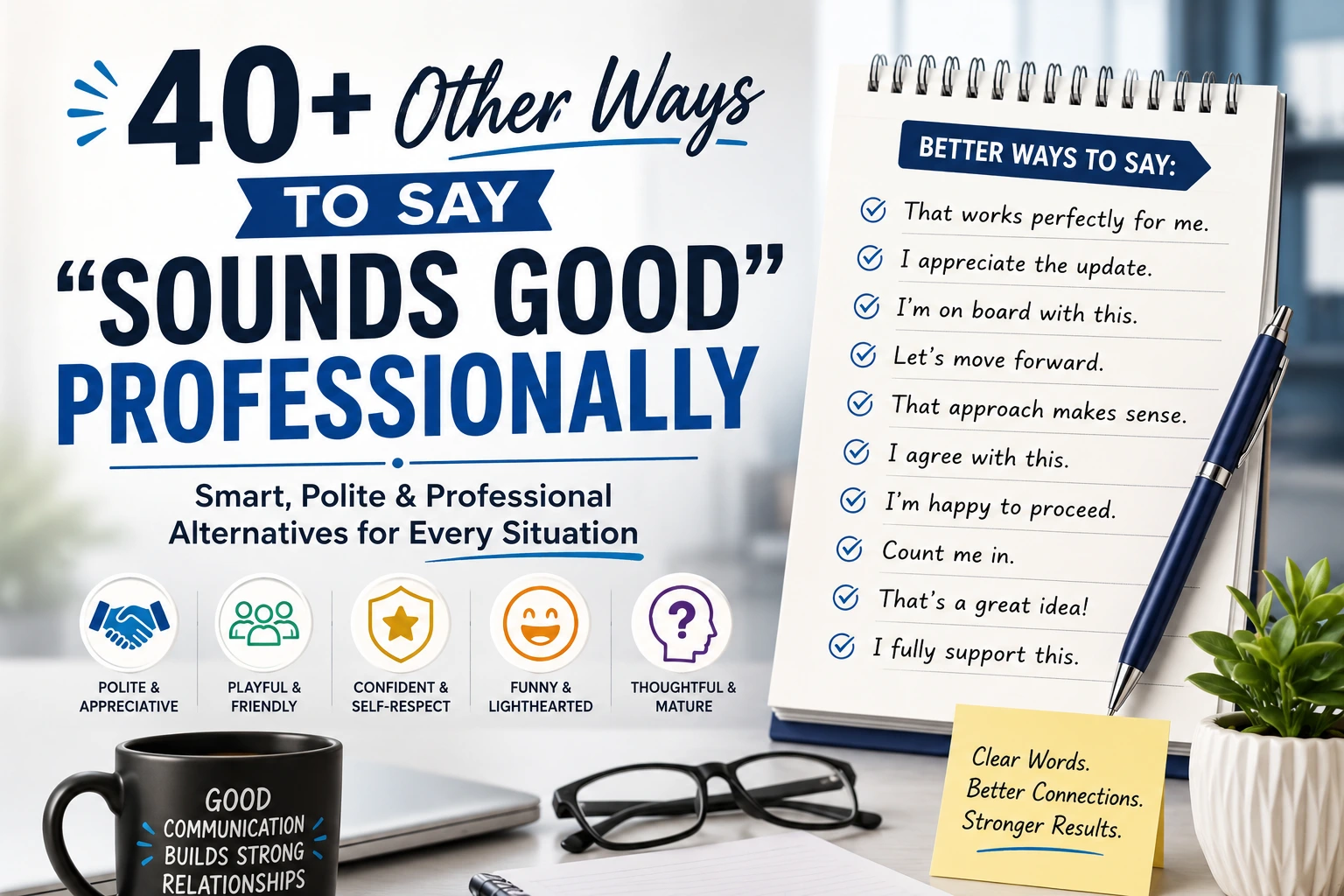
Have you ever typed “Sounds good” in an email or work chat and then wondered if it sounded a little too plain? You’re not alone. Whether you’re replying to a manager, client, coworker, or business partner, using the same phrase repeatedly can make your communication feel repetitive and less polished.
That is why many professionals search for other ways to say “sounds good” professionally. A thoughtful response can make you appear more confident, respectful, and articulate while keeping the conversation natural. The good news is that you do not have to use formal language that feels stiff or robotic. Small changes in wording can leave a strong impression without sounding forced.
In this guide, you’ll discover 40 professional alternatives to “sounds good,” organized by different tones, along with real life examples to help you use each one naturally in emails, meetings, text messages, and everyday conversations.
What Does “Other Ways to Say Sounds Good Professionally” Mean?
Looking for other ways to say “sounds good” professionally means finding better alternatives that fit workplace conversations, emails, meetings, and business communication.
Instead of replying with the same phrase every time, you can choose words that sound more polished, respectful, or confident depending on the situation.
For example:
- A client may expect a more professional acknowledgment.
- A manager may appreciate a clear and confident response.
- A coworker might prefer a friendly but respectful reply.
- In emails, using varied expressions makes your writing feel more natural and engaging.
The goal is to communicate agreement while maintaining professionalism and building positive relationships.
40 Best Professional Alternatives to “Sounds Good”
Polite and Appreciative Responses
1. That works perfectly for me.
Reply: “That works perfectly for me.”
Example:
Your manager schedules a meeting for Friday afternoon, and you confirm that the timing suits you.
2. I appreciate the update.
Reply: “I appreciate the update.”
Example:
A client shares revised project details, and you acknowledge the information professionally.
3. Thank you. That works well.
Reply: “Thank you. That works well.”
Example:
A coworker offers to adjust the meeting time to fit your schedule.
4. That sounds like a great plan.
Reply: “That sounds like a great plan.”
Example:
Your team proposes a new workflow during a project discussion.
5. I’m happy to move forward with that.
Reply: “I’m happy to move forward with that.”
Example:
A client approves your proposal, and you confirm the next steps.
6. That approach makes sense.
Reply: “That approach makes sense.”
Example:
Your supervisor explains a new process for handling customer requests.
7. I completely agree.
Reply: “I completely agree.”
Example:
A colleague suggests prioritizing an urgent task before the others.
8. Thank you for the clarification.
Reply: “Thank you for the clarification.”
Example:
A client answers your questions about a project requirement.
Friendly and Playful Responses
1. Count me in.
Reply: “Count me in.”
Example:
A coworker invites everyone to a casual team lunch after work.
2. I’m on board.
Reply: “I’m on board.”
Example:
Your teammate shares an idea during a brainstorming session.
3. Let’s do it.
Reply: “Let’s do it.”
Example:
A friend suggests starting a side project together.
4. Looking forward to it.
Reply: “Looking forward to it.”
Example:
A colleague schedules a networking event for next week.
5. That should be fun.
Reply: “That should be fun.”
Example:
Your office plans a team building activity.
6. Sounds like a plan.
Reply: “Sounds like a plan.”
Example:
A friend finalizes dinner plans for the weekend.
7. I’m excited about it.
Reply: “I’m excited about it.”
Example:
Your manager announces a new learning opportunity.
8. Let’s make it happen.
Reply: “Let’s make it happen.”
Example:
Your business partner agrees on launching a new campaign.
Confident and Self Respect Responses
1. I support this decision.
Reply: “I support this decision.”
Example:
Your leadership team chooses a strategy after discussing several options.
2. I’m comfortable with this approach.
Reply: “I’m comfortable with this approach.”
Example:
A client recommends a project timeline that meets your expectations.
3. Let’s proceed.
Reply: “Let’s proceed.”
Example:
The final proposal has been approved.
4. That aligns with our goals.
Reply: “That aligns with our goals.”
Example:
Your team discusses quarterly business objectives.
5. I see no issues moving forward.
Reply: “I see no issues moving forward.”
Example:
You review the final contract before signing.
6. This is the right direction.
Reply: “This is the right direction.”
Example:
Your department decides on a new marketing strategy.
7. I’m confident this will work.
Reply: “I’m confident this will work.”
Example:
A client asks whether the proposed solution is reliable.
8. Let’s move ahead with confidence.
Reply: “Let’s move ahead with confidence.”
Example:
Your team completes the planning phase and begins execution.
Funny and Lighthearted Responses
1. You had me at the first sentence.
Reply: “You had me at the first sentence.”
Example:
A coworker suggests ordering pizza during overtime.
2. No objections from me.
Reply: “No objections from me.”
Example:
Friends decide on the movie for the evening.
3. I can definitely live with that.
Reply: “I can definitely live with that.”
Example:
Your teammate suggests finishing work early on Friday.
4. That gets my vote.
Reply: “That gets my vote.”
Example:
The team chooses between two presentation ideas.
5. Approved by me.
Reply: “Approved by me.”
Example:
A friend asks if everyone agrees on the restaurant.
6. You won’t hear me complain.
Reply: “You won’t hear me complain.”
Example:
Your boss announces an early finish before the holidays.
7. That’s a win in my book.
Reply: “That’s a win in my book.”
Example:
Your coworker solves a difficult problem quickly.
8. Works for me without a doubt.
Reply: “Works for me without a doubt.”
Example:
Your friend changes the meeting location to somewhere closer.
Thoughtful and Mature Responses
1. I think that’s the best option.
Reply: “I think that’s the best option.”
Example:
Your team evaluates several business strategies.
2. That seems like a practical solution.
Reply: “That seems like a practical solution.”
Example:
A colleague suggests simplifying a complex workflow.
3. I appreciate your perspective.
Reply: “I appreciate your perspective.”
Example:
Someone offers valuable feedback during a discussion.
4. That sounds reasonable.
Reply: “That sounds reasonable.”
Example:
Your manager adjusts a project deadline.
5. I’m glad we reached an agreement.
Reply: “I’m glad we reached an agreement.”
Example:
A client and your team finalize contract details.
6. That addresses my concerns.
Reply: “That addresses my concerns.”
Example:
A supplier explains how delivery delays will be avoided.
7. I believe we’re on the same page.
Reply: “I believe we’re on the same page.”
Example:
You summarize a meeting before ending the call.
8. That gives us a clear path forward.
Reply: “That gives us a clear path forward.”
Example:
Your team agrees on the final project roadmap.
Real Life Situations
When your manager suggests a meeting time
Best Reply:
“That works perfectly for me.”
When a client approves your proposal
Best Reply:
“I’m happy to move forward with that.”
When a coworker suggests a new idea
Best Reply:
“That approach makes sense.”
When a friend jokingly makes plans
Best Reply:
“Count me in.”
When you do not fully agree
Best Reply:
“That sounds reasonable. Let me review the details first.”
Common Mistakes to Avoid
- Replying with “Sounds good” in every email.
- Using overly casual language with clients or senior managers.
- Choosing phrases that sound robotic or unnatural.
- Agreeing before fully understanding the proposal.
- Forgetting to match your tone to the relationship.
- Writing responses that are too vague and provide no confirmation.
Pro Tips
- Match your response to the situation. Formal emails deserve polished language, while internal chats can be slightly more relaxed.
- Keep your reply concise. Professional communication is often more effective when it is clear and direct.
- When appropriate, add the next step after your confirmation. For example, “That works perfectly for me. I’ll send the documents this afternoon.”
Bonus: Quick Professional Alternatives
- Absolutely.
- Certainly.
- Agreed.
- That works well.
- Happy to proceed.
- Consider it confirmed.
- I support that.
- Let’s move forward.
- I’m in agreement.
- That fits perfectly.
Conclusion
Using professional alternatives to “sounds good” helps your communication feel more polished, confident, and engaging. Whether you’re replying to a client, manager, coworker, or business partner, choosing the right phrase shows attention to detail and strengthens your professional image.
The best response is one that matches the situation, sounds natural, and communicates your agreement clearly. By adding a few of these alternatives to your daily conversations, you’ll avoid repetition while making every message feel more thoughtful and professional.
The right words may seem small, but they often leave the biggest impression.
Discover more