

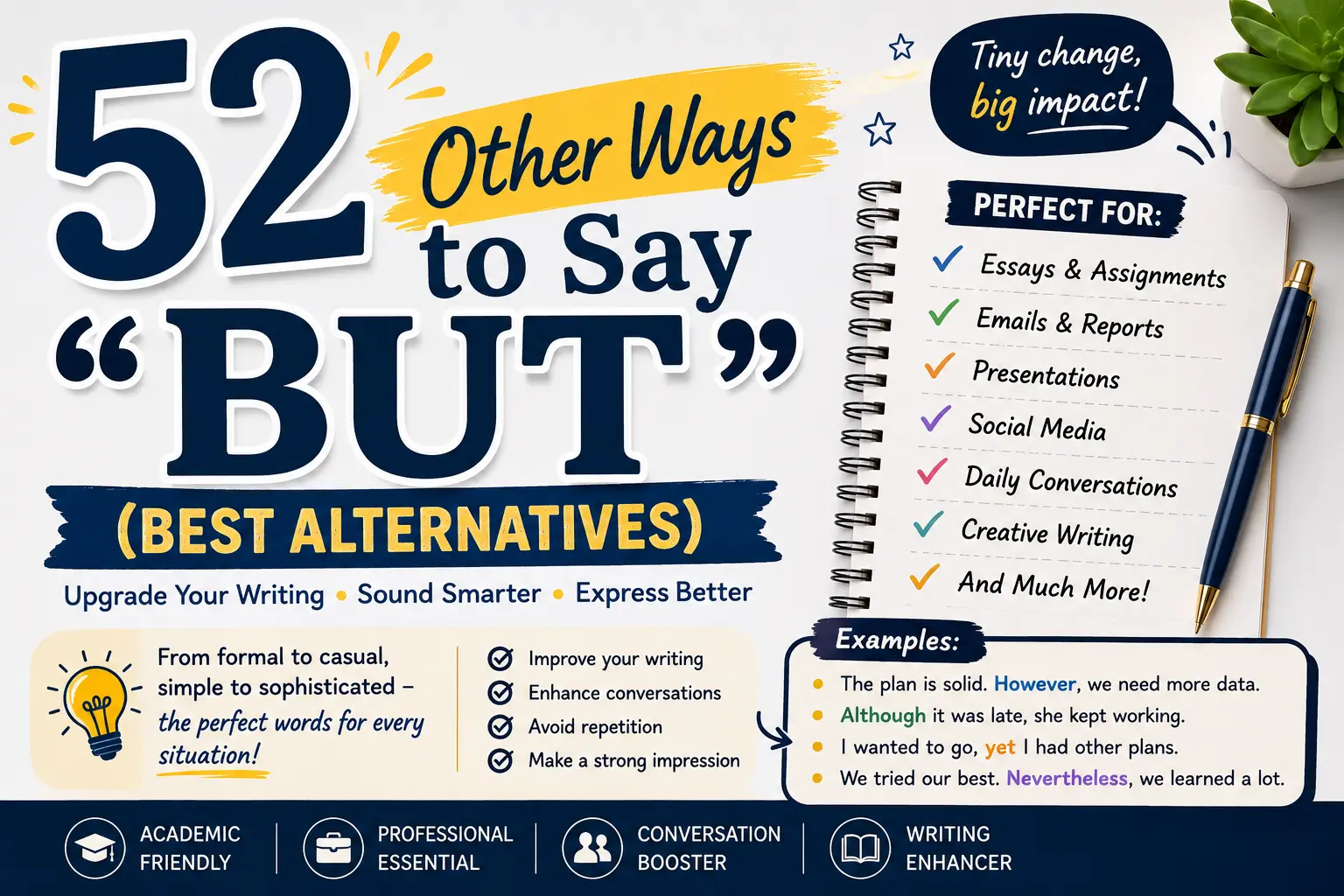
Sometimes, the word “but” is exactly what you need. Other times, you may find yourself using it again and again, especially when writing an essay, email, article, or professional message. That is when knowing different ways to say “but” becomes useful.
Words such as “however,” “although,” “nevertheless,” and “on the other hand” can help you express contrast without making your writing sound repetitive. The right alternative can also change the tone of your sentence, making it sound more formal, thoughtful, persuasive, or conversational.
Whether you are writing academically, communicating at work, or simply trying to make your everyday conversations more interesting, having several alternatives to “but” gives you more control over how your ideas connect. The key is choosing an expression that naturally fits the context rather than replacing the word just for the sake of variety.
What Does “But” Mean?
“But” is a conjunction commonly used to introduce a contrast, exception, limitation, or unexpected idea. It connects two thoughts that differ in some way.
For example:
“I wanted to go for a walk, but it started raining.”
The first part tells us what the person wanted to do, while the second part introduces the reason that prevented it.
“But” can also be used to correct or qualify a previous statement:
“She seems quiet, but she is actually very confident.”
In this sentence, “but” creates a contrast between how someone appears and what they are really like.
The word is extremely common in everyday English, which makes it simple and natural. However, repeating it too frequently can make writing feel predictable. In formal or polished writing, alternatives such as “however,” “nevertheless,” “although,” “in contrast,” and “even so” can create smoother transitions and make your ideas more precise.
The best alternative depends on what kind of contrast you want to express and how formal the situation is.
There is no single replacement for “but” that works in every sentence. Some alternatives are formal, some conversational, and others are better when you want to emphasize a strong contrast.
Below are practical options you can use depending on your writing style and situation.
Polite and Appreciative Alternatives
1. However
Meaning: Introduces a contrasting idea or statement.
Tone: Formal, professional, and versatile.
“The proposal looks promising. However, we need more information before making a decision.”
Short Explanation: “However” is one of the most useful alternatives to “but” in professional and academic writing. It works especially well at the beginning of a new sentence.
Purpose and Personalization: Use it when you want your writing to sound polished without becoming overly complicated.
2. Although
Meaning: Introduces a contrasting fact or condition.
Tone: Neutral and polished.
“Although the project was difficult, the team completed it on time.”
Short Explanation: “Although” works particularly well when you want to connect two contrasting ideas within the same sentence.
Purpose and Personalization: It is a natural choice for essays, reports, emails, and everyday writing.
3. Even Though
Meaning: Shows a strong contrast between two facts.
Tone: Natural and conversational.
“Even though I was tired, I stayed until the end.”
Short Explanation: Use “even though” when the contrast feels significant or somewhat surprising.
Purpose and Personalization: It sounds more conversational than some formal alternatives.
4. Though
Meaning: Introduces a contrast or limitation.
Tone: Casual to neutral.
“The restaurant was expensive. The food was excellent, though.”
Short Explanation: “Though” can appear at the beginning, middle, or end of a sentence, making it more flexible than many alternatives.
Purpose and Personalization: It is especially natural in everyday speech and informal writing.
5. Nevertheless
Meaning: Shows that something remains true despite a previous point.
Tone: Formal and confident.
“The journey was exhausting. Nevertheless, everyone enjoyed the experience.”
Short Explanation: This word emphasizes that the second point remains valid despite the difficulty or contradiction mentioned earlier.
Purpose and Personalization: Use it when you want to give your writing a more polished and deliberate feel.
6. Nonetheless
Meaning: Means “despite that” or “even so.”
Tone: Formal and sophisticated.
“The evidence was limited. Nonetheless, the researchers continued their investigation.”
Short Explanation: “Nonetheless” has almost the same function as “nevertheless.”
Purpose and Personalization: It works well in academic papers, reports, and professional writing.
7. Even So
Meaning: Indicates that the following statement remains true despite what was previously mentioned.
Tone: Conversational and thoughtful.
“The plan has a few weaknesses. Even so, I think it is worth trying.”
Short Explanation: This is useful when you want to acknowledge a problem without letting it completely change your conclusion.
Purpose and Personalization: It sounds natural in both conversations and informal writing.
8. Still
Meaning: Introduces an idea that remains true despite another fact.
Tone: Casual and natural.
“I understand your concerns. Still, I think we should give it a chance.”
Short Explanation: “Still” is short, flexible, and easy to use in everyday conversations.
Purpose and Personalization: Choose it when you want your sentence to sound relaxed rather than overly formal.
9. Yet
Meaning: Introduces an unexpected contrast.
Tone: Neutral and concise.
“The task was difficult, yet she managed to complete it.”
Short Explanation: “Yet” is particularly useful when the second idea is surprising given the first.
Purpose and Personalization: It can make writing sound concise and expressive.
10. Despite This
Meaning: Shows that something happened or remains true regardless of a previous difficulty.
Tone: Formal and professional.
“The company faced several setbacks. Despite this, it continued to expand.”
Short Explanation: This phrase clearly connects a previous problem with an outcome that happened anyway.
Purpose and Personalization: It works particularly well in reports and analytical writing.
Formal and Professional Alternatives
11. In Contrast
Meaning: Highlights a difference between two ideas, situations, or things.
Tone: Formal and analytical.
“The first proposal focuses on cost reduction. In contrast, the second prioritizes long-term growth.”
Short Explanation: “In contrast” is best when you are directly comparing two different ideas.
Purpose and Personalization: It is especially useful in essays, research, presentations, and reports.
12. On the Other Hand
Meaning: Presents another side or perspective.
Tone: Neutral and conversational.
“Working from home saves commuting time. On the other hand, some people miss the social interaction of an office.”
Short Explanation: Use this phrase when presenting two sides of an argument or situation.
Purpose and Personalization: It is ideal for balanced discussions and opinion writing.
13. By Contrast
Meaning: Emphasizes a difference between two things.
Tone: Formal and academic.
“The first study showed positive results. By contrast, the second study found little improvement.”
Short Explanation: “By contrast” is similar to “in contrast” but often sounds slightly more analytical.
Purpose and Personalization: It is a strong option for academic and professional writing.
14. Conversely
Meaning: Introduces an opposite or reversed situation.
Tone: Formal and academic.
“Higher prices may reduce demand. Conversely, lower prices may encourage more purchases.”
Short Explanation: “Conversely” is best when the second idea represents an opposite relationship.
Purpose and Personalization: Use it when discussing cause, effect, comparisons, or opposing outcomes.
15. Alternatively
Meaning: Introduces another possibility or option.
Tone: Professional and neutral.
“We could postpone the meeting. Alternatively, we could hold it online.”
Short Explanation: Unlike “but,” “alternatively” usually presents a different option rather than simply a contradiction.
Purpose and Personalization: It is useful when discussing solutions or possible courses of action.
16. That Said
Meaning: Acknowledges a previous point before introducing a different or qualifying idea.
Tone: Professional and conversational.
“The course is challenging. That said, it provides excellent preparation for the exam.”
Short Explanation: This phrase is excellent when you want to recognize one side of an argument while adding another perspective.
Purpose and Personalization: It sounds polished without being excessively formal.
17. Having Said That
Meaning: Introduces a qualification or contrasting thought after acknowledging something.
Tone: Conversational and professional.
“The project needs more work. Having said that, the overall concept is strong.”
Short Explanation: This expression helps soften a criticism or introduce a more positive perspective.
Purpose and Personalization: It works particularly well in discussions, reviews, and workplace communication.
18. With That Said
Meaning: Signals a transition to a different or qualifying point.
Tone: Professional and thoughtful.
“The current system has several limitations. With that said, it has served the company well for many years.”
Short Explanation: It is useful when you want to balance criticism with acknowledgment.
Purpose and Personalization: A strong choice for presentations, articles, and professional discussions.
19. At the Same Time
Meaning: Introduces another fact that should be considered alongside the first.
Tone: Neutral and conversational.
“The job is demanding. At the same time, it offers valuable experience.”
Short Explanation: This phrase is useful when two seemingly conflicting facts can both be true.
Purpose and Personalization: It creates a balanced and mature tone.
20. In Spite of This
Meaning: Indicates that something happened despite a previous situation.
Tone: Formal and neutral.
“The weather was poor. In spite of this, the event continued as planned.”
Short Explanation: This phrase emphasizes that an outcome occurred regardless of an obstacle.
Purpose and Personalization: It works well in formal writing and explanatory contexts.
Thoughtful and Academic Alternatives
21. Whereas
Meaning: Shows a direct contrast between two people, things, or situations.
Tone: Formal and academic.
“The first group preferred working independently, whereas the second preferred collaboration.”
Short Explanation: “Whereas” is particularly useful when comparing two subjects within the same sentence.
Purpose and Personalization: It is a strong alternative for essays, research papers, and analytical writing.
22. While
Meaning: Can introduce a contrasting idea or acknowledge two different situations.
Tone: Neutral and versatile.
“While the plan has some risks, it could also create significant opportunities.”
Short Explanation: “While” can make a contrast sound balanced rather than argumentative.
Purpose and Personalization: It is useful when presenting strengths and weaknesses together.
23. Despite
Meaning: Shows that something happened regardless of an obstacle or opposing condition.
Tone: Formal and concise.
“Despite the challenges, the team completed the project.”
Short Explanation: “Despite” is followed by a noun or gerund rather than a complete clause.
Purpose and Personalization: It is excellent for concise professional and academic writing.
24. Regardless
Meaning: Shows that something remains true or happens despite another factor.
Tone: Neutral and confident.
“There are several uncertainties. Regardless, we need to make a decision.”
Short Explanation: “Regardless” emphasizes that the next action or conclusion will not change because of the previous issue.
Purpose and Personalization: Use it when you want to communicate determination.
25. Even Then
Meaning: Indicates that a conclusion remains true despite a particular condition.
Tone: Conversational and thoughtful.
“He apologized, but even then, she needed some time to think.”
Short Explanation: This phrase highlights that something did not change despite an important development.
Purpose and Personalization: It works well when explaining emotional or situational contrasts.
26. All the Same
Meaning: Means “despite that” or “nevertheless.”
Tone: Conversational and slightly old-fashioned.
“The trip was stressful. All the same, I am glad we went.”
Short Explanation: It communicates acceptance of a drawback while maintaining a positive or opposing conclusion.
Purpose and Personalization: Use it when you want your writing to sound natural but slightly distinctive.
27. For All That
Meaning: Indicates that something remains true despite what has just been mentioned.
Tone: Literary and sophisticated.
“The task was demanding, but for all that, it was incredibly rewarding.”
Short Explanation: This is less common in everyday speech but can add variety to creative or polished writing.
Purpose and Personalization: Use it sparingly when you want a more expressive style.
Here is Part 3, continuing with the remaining alternatives, followed by real-life situations, common mistakes, pro tips, the conclusion, and quick-use options. No emojis included.
More Natural and Conversational Alternatives
28. But Still
Meaning: Shows that a contrasting point remains true despite what was just mentioned.
Tone: Casual and conversational.
“I know it was a difficult decision, but still, I think you made the right choice.”
Short Explanation: “But still” is common in everyday speech and emphasizes a person’s continuing opinion.
Purpose and Personalization: Use it when you want your response to sound natural and emotionally expressive.
29. Except That
Meaning: Introduces an exception to a statement.
Tone: Neutral and conversational.
“I would have joined you, except that I already had plans.”
Short Explanation: This expression works when you generally agree with something but need to mention one specific exception.
Purpose and Personalization: It is particularly useful for explaining why something could not happen.
30. Other Than That
Meaning: Indicates that one issue or exception exists while everything else remains positive or unchanged.
Tone: Casual and friendly.
“The hotel was great. Other than that, everything about the trip was perfect.”
Short Explanation: It works well when you want to mention a small drawback without criticizing the entire situation.
Purpose and Personalization: A natural choice for reviews, conversations, and personal stories.
31. Except for
Meaning: Identifies one person, thing, or condition that differs from the rest.
Tone: Neutral.
“The presentation went smoothly except for a few technical issues.”
Short Explanation: “Except for” is useful when describing an otherwise positive or consistent situation.
Purpose and Personalization: It keeps your sentence precise without relying on “but.”
32. Rather
Meaning: Introduces a correction, preference, or alternative.
Tone: Polished and neutral.
“The problem is not the idea. Rather, it is the way the idea was presented.”
Short Explanation: “Rather” works especially well when correcting or refining a previous statement.
Purpose and Personalization: It is useful in formal writing when you want to sound precise.
33. Instead
Meaning: Introduces an alternative action or result.
Tone: Neutral and direct.
“I thought she would call. Instead, she sent a message.”
Short Explanation: Use “instead” when the second action or outcome replaces what was expected.
Purpose and Personalization: It works naturally in both everyday and professional writing.
34. Otherwise
Meaning: Shows what would happen if a particular condition were not met or introduces a different possibility.
Tone: Neutral and practical.
“We need to leave now; otherwise, we will miss the train.”
Short Explanation: “Otherwise” is useful when contrast is connected to a consequence or alternative outcome.
Purpose and Personalization: It is especially effective when explaining choices and conditions.
35. Instead of That
Meaning: Introduces a different option from the one previously mentioned.
Tone: Casual and practical.
“We could drive there. Instead of that, we could take the train.”
Short Explanation: It works best when directly comparing possible actions.
Purpose and Personalization: Use it when offering an alternative rather than simply disagreeing.
Alternatives for Showing Strong Contrast
36. On the Contrary
Meaning: Introduces a statement that directly contradicts a previous idea.
Tone: Formal and emphatic.
“I am not disappointed. On the contrary, I am extremely pleased with the result.”
Short Explanation: “On the contrary” should be used when the second statement directly opposes the first.
Purpose and Personalization: It is stronger than a simple “however,” so use it when the contradiction is clear.
37. Quite the Opposite
Meaning: Emphasizes that the opposite of something is actually true.
Tone: Confident and emphatic.
“The experience was not boring. Quite the opposite, it was unforgettable.”
Short Explanation: This phrase is ideal when you want to strongly reject an assumption.
Purpose and Personalization: It adds emphasis without sounding aggressive.
38. In Fact
Meaning: Adds information that corrects, strengthens, or contrasts with a previous statement.
Tone: Neutral and informative.
“I thought the test would be difficult. In fact, it was easier than I expected.”
Short Explanation: “In fact” is useful when the next statement reveals something different from what was expected.
Purpose and Personalization: It works naturally in explanations and storytelling.
39. Rather Than
Meaning: Shows a preference for one option over another.
Tone: Neutral and polished.
“Rather than complain about the problem, we should look for a solution.”
Short Explanation: Use “rather than” when contrasting choices or actions.
Purpose and Personalization: It is especially useful when you want to make a sentence more constructive.
40. As Opposed to
Meaning: Directly compares one option with another.
Tone: Formal and analytical.
“The course focuses on practical skills as opposed to theoretical concepts.”
Short Explanation: This expression clearly identifies a difference between two alternatives.
Purpose and Personalization: It works well in professional presentations, essays, and comparisons.
41. Unlike
Meaning: Shows how one person or thing differs from another.
Tone: Neutral and concise.
“Unlike the previous model, this version uses less energy.”
Short Explanation: “Unlike” is a simple way to establish contrast without using a conjunction.
Purpose and Personalization: It is excellent for comparisons and descriptive writing.
42. Different from
Meaning: Indicates that two things are not the same.
Tone: Neutral and clear.
“Her approach is different from what we originally expected.”
Short Explanation: This phrase is straightforward and useful when explaining differences.
Purpose and Personalization: It is appropriate for both everyday and professional communication.
Alternatives for Softening Disagreement
43. That May Be True, Yet
Meaning: Acknowledges someone’s point before presenting a different perspective.
Tone: Diplomatic and thoughtful.
“That may be true, yet we still need to consider the long-term consequences.”
Short Explanation: This phrase is excellent when you want to disagree without dismissing the other person’s opinion.
Purpose and Personalization: It creates a mature tone during debates or discussions.
44. I Understand, Although
Meaning: Recognizes another person’s point while introducing a qualification.
Tone: Polite and diplomatic.
“I understand your concern, although I think there may be another solution.”
Short Explanation: This structure is useful when you want to disagree respectfully.
Purpose and Personalization: It works particularly well in workplace conversations.
45. I See What You Mean, However
Meaning: Acknowledges someone’s reasoning before offering another perspective.
Tone: Respectful and professional.
“I see what you mean. However, the results suggest something different.”
Short Explanation: It allows you to disagree while showing that you have listened.
Purpose and Personalization: A strong choice for meetings, discussions, and professional emails.
46. Granted
Meaning: Acknowledges that a previous point is valid before presenting another consideration.
Tone: Sophisticated and concise.
“Granted, the plan is expensive, but it could save money in the long run.”
Short Explanation: “Granted” is useful when you want to concede one point while continuing your argument.
Purpose and Personalization: It gives persuasive writing a confident and balanced feel.
47. Admittedly
Meaning: Recognizes that something is true before introducing a contrasting point.
Tone: Formal and reflective.
“Admittedly, the process is time-consuming, but the final results are worthwhile.”
Short Explanation: Use “admittedly” when you want to openly acknowledge a weakness or limitation.
Purpose and Personalization: It is especially effective in essays, reviews, and persuasive writing.
48. To Be Fair
Meaning: Acknowledges another side of an argument or situation.
Tone: Conversational and balanced.
“The deadline was tight. To be fair, everyone had been given plenty of notice.”
Short Explanation: This phrase helps you present a balanced opinion instead of focusing on only one side.
Purpose and Personalization: It is excellent for everyday discussions and thoughtful writing.
49. At the Risk of Contradicting That
Meaning: Politely signals that you are about to offer an opposing thought.
Tone: Thoughtful and diplomatic.
“At the risk of contradicting that, I think the situation may be more complicated.”
Short Explanation: It prepares the listener for a different perspective without making the disagreement sound harsh.
Purpose and Personalization: Best suited to discussions where tact matters.
50. That May Be the Case, But
Meaning: Accepts that something could be true while introducing another consideration.
Tone: Neutral and diplomatic.
“That may be the case, but we still need to examine the evidence.”
Short Explanation: This is useful when you want to recognize a possibility without fully agreeing with it.
Purpose and Personalization: It works well in serious discussions and professional settings.
51. Even If
Meaning: Introduces a condition that does not change the main conclusion.
Tone: Neutral and logical.
“Even if the price increases, we may still decide to proceed.”
Short Explanation: “Even if” is useful when discussing hypothetical situations or conditions.
Purpose and Personalization: It works well in arguments, explanations, and planning.
52. Notwithstanding
Meaning: Means “despite” or “regardless of.”
Tone: Very formal and sophisticated.
“Notwithstanding the challenges, the organization achieved its objectives.”
Short Explanation: This is a highly formal alternative and is more common in legal, academic, and official writing.
Purpose and Personalization: Use it sparingly because it can sound unnatural in casual conversation.
Real-Life Situations: Which Alternative Should You Use?
Knowing alternatives is helpful, but choosing the right one for the situation matters even more.
1. When You Disagree With a Friend
Your friend says:
“I think we should cancel the trip because the weather might be bad.”
A good response:
“I see your point, but I think we should wait and see how the weather develops.”
This keeps the disagreement friendly rather than turning it into an argument.
2. When You Are Writing a Professional Email
You need to acknowledge a problem while remaining positive.
A good response:
“The proposal has some limitations. However, I believe it has strong potential.”
“However” sounds more polished and professional than repeatedly using “but.”
3. When You Are Writing an Essay
You want to compare two opposing ideas.
A good response:
“Although technology has made communication easier, it has also created new challenges.”
“Although” allows both sides of the idea to fit naturally into one sentence.
4. When Someone Makes a Good Point
You initially disagree with someone, but their argument makes you reconsider.
A good response:
“That’s a fair point. Still, I think we should consider the other side as well.”
This sounds thoughtful rather than defensive.
5. When You Want to Correct an Assumption
Someone says:
“The event was probably boring.”
You know otherwise.
A good response:
“Actually, quite the opposite. It was one of the most interesting events I’ve attended.”
“Quite the opposite” creates a strong and clear contrast.
Common Mistakes to Avoid
1. Using formal alternatives everywhere
Words such as “notwithstanding” and “conversely” are useful, but they can sound unnatural in casual conversations.
2. Choosing an alternative with the wrong meaning
Not every contrast word means exactly the same thing. “Alternatively,” for example, usually introduces another option rather than a simple contradiction.
3. Overusing transition words
Replacing every “but” with “however” can make your writing feel forced. Sometimes “but” is still the most natural choice.
4. Ignoring sentence structure
Words such as “although,” “despite,” and “whereas” follow different grammatical patterns. Make sure the rest of the sentence fits the expression.
5. Making simple writing unnecessarily complicated
Good writing is not about using the most sophisticated word available. It is about choosing the clearest word for the situation.
6. Forgetting your audience
A phrase that sounds excellent in an academic essay may feel strange in a text message. Always consider who will read or hear your words.
Pro Tips for Choosing the Right Alternative
1. Match the level of formality
For casual conversations, use words such as “though,” “still,” “even so,” or “fair enough.” For formal writing, consider “however,” “nevertheless,” “whereas,” or “notwithstanding.”
2. Think about the type of contrast
Ask yourself what you are actually trying to express. Are you showing an exception, presenting another option, comparing two ideas, or disagreeing with someone? The answer will help you choose the right alternative.
3. Do not eliminate “but” completely
“But” is not a bad word. It is one of the most natural and useful conjunctions in English. The goal is not to avoid it entirely but to have enough alternatives to prevent unnecessary repetition.
Conclusion
Knowing other ways to say “but” gives you more control over your communication. Instead of relying on one familiar conjunction, you can choose words that accurately reflect the relationship between your ideas.
Use “however” for polished writing, “although” for balanced sentences, “nevertheless” for strong contrast, “on the other hand” for another perspective, and “still” for natural conversation. When you need to disagree politely, expressions such as “that said,” “to be fair,” and “I see your point” can make your response sound more thoughtful.
The best writing is not about using complicated vocabulary. It is about choosing the right words for the right moment.
Discover more
funny ways to say thank you to a friend