

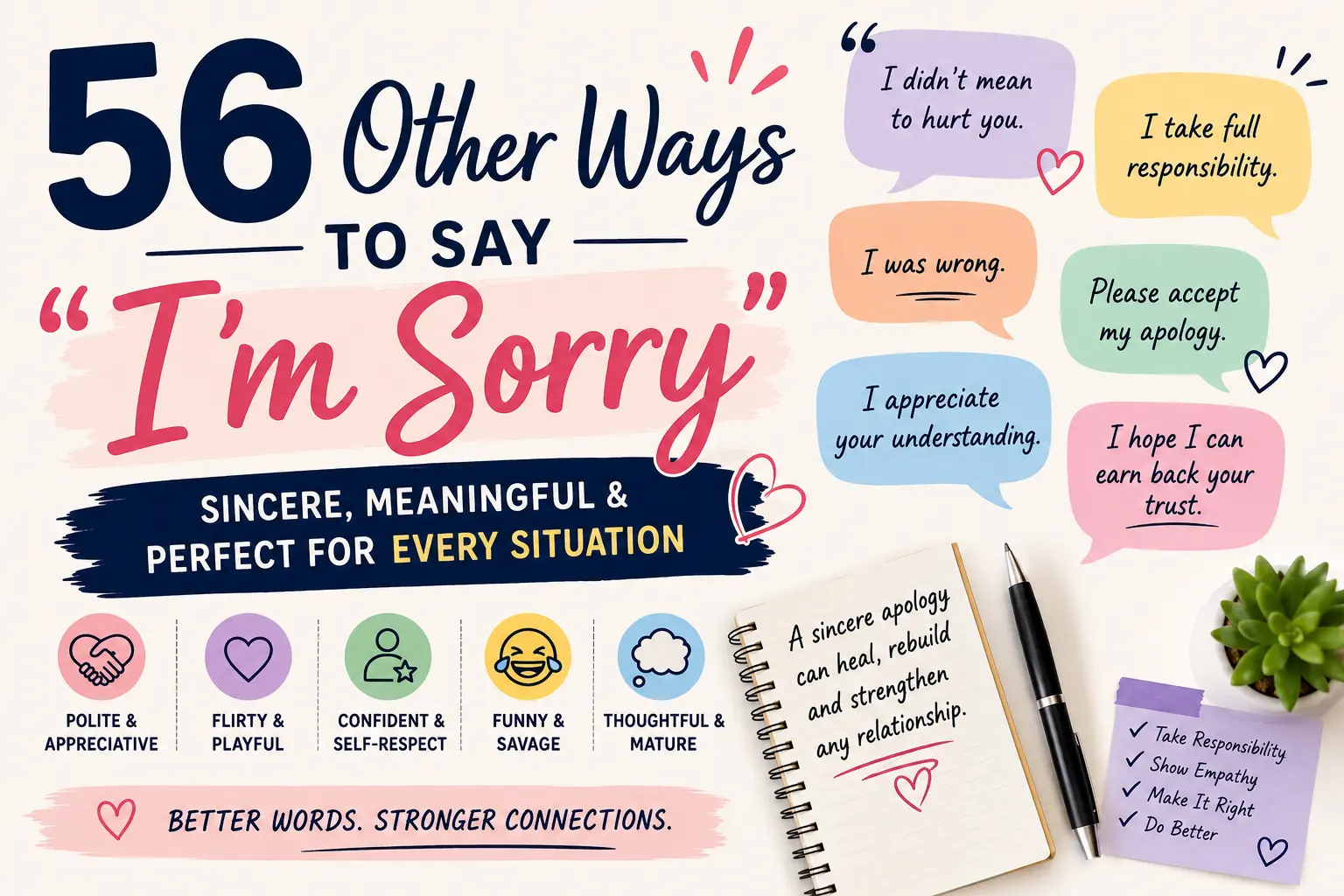
We’ve all been there. Maybe you forgot an important date, arrived late to a meeting, or accidentally said something that hurt someone’s feelings. In moments like these, saying “I’m sorry” is the first step toward making things right. But sometimes, those two words alone don’t fully express what you mean. Depending on the situation, you may want to sound more sincere, empathetic, professional, or even a little lighthearted.
Learning other ways to say “I’m sorry” helps you communicate your feelings more effectively and makes your apology feel genuine rather than automatic. Whether you’re texting a friend, speaking with a coworker, or apologizing to someone you care about, choosing the right words can strengthen relationships and rebuild trust. In this guide, you’ll discover thoughtful alternatives that fit every situation, from casual conversations to heartfelt apologies.
What Does “Other Ways to Say I’m Sorry” Mean?
The phrase “I’m sorry” is one of the most common ways to express regret after making a mistake, causing inconvenience, or hurting someone’s feelings. It tells the other person that you recognize what happened and wish things had gone differently.
However, not every situation calls for the exact same apology. Sometimes you need something warmer, more formal, more personal, or more heartfelt. Using different ways to apologize allows you to match your words to the situation and the relationship.
For example:
- To a friend, you might say, “I really didn’t mean to upset you.”
- At work, you could say, “I sincerely apologize for the oversight.”
- To a family member, you might say, “Please forgive me—I should have handled that better.”
Choosing the right expression helps your apology feel more meaningful and sincere.
Polite & Appreciative Alternatives
1. I Truly Apologize.
Reply: “I truly apologize.”
Example:
You accidentally missed an important meeting.
“I truly apologize for missing the meeting. I’ll make sure it doesn’t happen again.”
2. Please Accept My Apology.
Reply: “Please accept my apology.”
Example:
You forgot to reply to an important email.
“Please accept my apology for the delayed response.”
3. I Didn’t Mean to Hurt You.
Reply: “I didn’t mean to hurt you.”
Example:
You made a joke that upset your friend.
“I didn’t mean to hurt you. I’m really sorry for what I said.”
4. I Was Wrong.
Reply: “I was wrong.”
Example:
You blamed someone before knowing the full story.
“I was wrong, and I appreciate you correcting me.”
5. I Take Full Responsibility.
Reply: “I take full responsibility.”
Example:
You made a mistake on a team project.
“I take full responsibility for the error, and I’ll fix it immediately.”
6. I Hope You Can Forgive Me.
Reply: “I hope you can forgive me.”
Example:
You forgot your friend’s birthday.
“I hope you can forgive me. I honestly feel terrible.”
7. I Owe You an Apology.
Reply: “I owe you an apology.”
Example:
You canceled plans at the last minute.
“I owe you an apology for canceling so suddenly.”
8. That Was My Mistake.
Reply: “That was my mistake.”
Example:
You misunderstood the instructions at work.
“That was my mistake. I’ll correct it right away.”
9. I Regret What Happened.
Reply: “I regret what happened.”
Example:
You lost your temper during a discussion.
“I regret what happened. You didn’t deserve that.”
10. Thank You for Being Patient With Me.
Reply: “Thank you for being patient with me.”
Example:
You kept someone waiting longer than expected.
“Thank you for being patient with me. I appreciate your understanding.”
11. I Wish I Had Handled That Better.
Reply: “I wish I had handled that better.”
Example:
You reacted emotionally during an argument.
“I wish I had handled that better. I’m sorry for how I responded.”
12. I Feel Terrible About It.
Reply: “I feel terrible about it.”
Example:
You forgot an important promise.
“I feel terrible about it. I know I let you down.”
Flirty & Playful Alternatives
13. Can I Make It Up to You?
Reply: “Can I make it up to you?”
Example:
You arrived late for a date.
“Can I make it up to you with your favorite dessert?”
14. Don’t Stay Mad at Me.
Reply: “Don’t stay mad at me.”
Example:
You accidentally spoiled part of a TV show.
“Don’t stay mad at me. I’ll avoid spoilers from now on.”
15. I’ll Do Better Next Time.
Reply: “I’ll do better next time.”
Example:
You forgot to reply to your partner’s message.
“I’ll do better next time. You deserve better communication.”
16. I Promise I’ll Make You Smile Again.
Reply: “I promise I’ll make you smile again.”
Example:
You accidentally upset your crush.
“I promise I’ll make you smile again, even if it takes a while.”
17. That Wasn’t My Best Moment.
Reply: “That wasn’t my best moment.”
Example:
You acted impatiently during a conversation.
“That wasn’t my best moment. I’m sorry about that.”
18. I Guess I Owe You One.
Reply: “I guess I owe you one.”
Example:
You lost a friendly bet and complained anyway.
“I guess I owe you one. Dinner’s on me next time.”
Confident & Self-Respect Alternatives
19. I Appreciate Your Understanding.
Reply: “I appreciate your understanding.”
Example:
You had to reschedule a meeting at the last minute.
“I appreciate your understanding. Thank you for being flexible.”
Why it works:
Acknowledges the other person’s patience while expressing regret.
20. I Should Have Known Better.
Reply: “I should have known better.”
Example:
You spoke before understanding the full situation.
“I should have known better. I’m sorry for jumping to conclusions.”
Why it works:
Shows maturity and self-awareness.
21. I Take Responsibility for My Actions.
Reply: “I take responsibility for my actions.”
Example:
You made an error that affected your team.
“I take responsibility for my actions, and I’ll do everything I can to fix this.”
Why it works:
Demonstrates accountability instead of making excuses.
22. I Understand Why You’re Upset.
Reply: “I understand why you’re upset.”
Example:
A friend explains how your words hurt their feelings.
“I understand why you’re upset, and I’m truly sorry.”
Why it works:
Shows empathy before asking for forgiveness.
23. You Deserve a Better Response From Me.
Reply: “You deserve a better response from me.”
Example:
You reacted defensively during a conversation.
“You deserve a better response from me. I’m sorry for how I handled it.”
Why it works:
Recognizes the other person’s feelings while taking ownership.
24. I Want to Make Things Right.
Reply: “I want to make things right.”
Example:
You accidentally disappointed a family member.
“I want to make things right. Please let me know how I can help.”
Why it works:
Focuses on repairing the relationship instead of only apologizing.
25. I Regret My Decision.
Reply: “I regret my decision.”
Example:
You made a choice that negatively affected others.
“I regret my decision, and I wish I had handled things differently.”
Why it works:
Expresses genuine remorse.
26. I Let You Down, and I’m Sorry.
Reply: “I let you down, and I’m sorry.”
Example:
You forgot an important commitment.
“I let you down, and I’m sorry. I understand why you’re disappointed.”
Why it works:
Direct, honest, and sincere.
27. I Value Our Relationship Too Much to Ignore This.
Reply: “I value our relationship too much to ignore this.”
Example:
You had an argument with someone close to you.
“I value our relationship too much to ignore this. I’d like to make things right.”
Why it works:
Shows that the relationship matters more than pride.
28. I Know I Could Have Done Better.
Reply: “I know I could have done better.”
Example:
You didn’t give your best effort on a shared project.
“I know I could have done better, and I’ll improve next time.”
Why it works:
Acknowledges shortcomings without making excuses.
29. I Accept That I Made a Mistake.
Reply: “I accept that I made a mistake.”
Example:
You misunderstood important instructions.
“I accept that I made a mistake, and I’ll correct it immediately.”
Why it works:
Shows honesty and accountability.
30. You Didn’t Deserve That.
Reply: “You didn’t deserve that.”
Example:
You spoke harshly during an argument.
“You didn’t deserve that. I’m sorry for the way I spoke to you.”
Why it works:
Keeps the focus on the other person’s feelings.
31. I Wish I Could Take It Back.
Reply: “I wish I could take it back.”
Example:
You shared something hurtful in the heat of the moment.
“I wish I could take it back. I truly regret saying those words.”
Why it works:
Communicates sincere regret.
32. I Didn’t Handle That Well.
Reply: “I didn’t handle that well.”
Example:
A disagreement became more emotional than expected.
“I didn’t handle that well, and I sincerely apologize.”
Why it works:
A mature way to acknowledge poor behavior.
33. I Hope We Can Move Forward Together.
Reply: “I hope we can move forward together.”
Example:
After resolving a misunderstanding with a friend.
“I hope we can move forward together. Our friendship means a lot to me.”
Why it works:
Looks beyond the apology toward rebuilding trust.
34. Thank You for Giving Me the Chance to Apologize.
Reply: “Thank you for giving me the chance to apologize.”
Example:
Someone listens patiently after you’ve explained your mistake.
“Thank you for giving me the chance to apologize. I appreciate it.”
Why it works:
Shows gratitude and humility.
35. I’ll Learn From This Mistake.
Reply: “I’ll learn from this mistake.”
Example:
You forgot an important deadline.
“I’ll learn from this mistake and make sure it doesn’t happen again.”
Why it works:
Shows personal growth instead of empty promises.
36. I Mean Every Word of My Apology.
Reply: “I mean every word of my apology.”
Example:
You want someone to know your apology is genuine.
“I mean every word of my apology. I truly regret what happened.”
Why it works:
Ends your apology with sincerity and reassurance.
Funny & Playful Alternatives
37. Well… That Didn’t Go According to Plan.
Reply: “Well… that didn’t go according to plan.”
Example:
You accidentally sent the wrong message to a friend.
“Well… that didn’t go according to plan. Sorry about the mix-up.”
Why it works:
Lightens the mood after a small, harmless mistake.
38. My Brain Took the Day Off.
Reply: “My brain took the day off.”
Example:
You forgot your friend’s coffee order.
“My brain took the day off. I’m sorry—I completely forgot.”
Why it works:
A humorous apology for minor slip-ups.
39. I Officially Nominate Myself for Today’s Biggest Mistake.
Reply: “I officially nominate myself for today’s biggest mistake.”
Example:
You accidentally deleted an important file.
“I officially nominate myself for today’s biggest mistake.”
Why it works:
Shows accountability with a touch of humor.
40. I Deserve That Eye Roll.
Reply: “I deserve that eye roll.”
Example:
You arrived late after insisting you’d be on time.
“I deserve that eye roll. I’m really sorry.”
Why it works:
Acknowledges the mistake without becoming defensive.
41. I’ll Add That to My List of Things Not to Do Again.
Reply: “I’ll add that to my list of things not to do again.”
Example:
You accidentally interrupted someone several times.
“I’ll add that to my list of things not to do again.”
Why it works:
A lighthearted way to promise improvement.
42. Consider This My Official Peace Offering.
Reply: “Consider this my official peace offering.”
Example:
You bring coffee after forgetting lunch plans.
“Consider this my official peace offering.”
Why it works:
Perfect when paired with a thoughtful gesture.
43. Can We Pretend I Was Smarter Five Minutes Ago?
Reply: “Can we pretend I was smarter five minutes ago?”
Example:
You accidentally sent an email with obvious mistakes.
“Can we pretend I was smarter five minutes ago? Sorry about that.”
Why it works:
Adds humor while admitting fault.
44. I’d Like to Blame the Wi-Fi, but It Was Definitely Me.
Reply: “I’d like to blame the Wi-Fi, but it was definitely me.”
Example:
You forgot to reply to a message.
“I’d like to blame the Wi-Fi, but it was definitely me.”
Why it works:
Funny because it avoids making excuses.
45. I Promise I’m Usually More Organized Than This.
Reply: “I promise I’m usually more organized than this.”
Example:
You mixed up two appointments.
“I promise I’m usually more organized than this. I’m sorry.”
Why it works:
Keeps the apology positive and relatable.
Thoughtful & Mature Alternatives
46. I Understand the Impact of My Actions.
Reply: “I understand the impact of my actions.”
Example:
You missed an important family event.
“I understand the impact of my actions, and I truly regret it.”
Why it works:
Shows emotional maturity and accountability.
47. You Have Every Right to Feel That Way.
Reply: “You have every right to feel that way.”
Example:
Someone explains why they’re hurt by your actions.
“You have every right to feel that way, and I’m sincerely sorry.”
Why it works:
Validates the other person’s emotions.
48. I Appreciate You Being Honest With Me.
Reply: “I appreciate you being honest with me.”
Example:
A friend tells you how your behavior affected them.
“I appreciate you being honest with me. I’ll do better.”
Why it works:
Encourages open communication.
49. I Never Wanted to Cause You Pain.
Reply: “I never wanted to cause you pain.”
Example:
You unintentionally upset someone close to you.
“I never wanted to cause you pain. I’m deeply sorry.”
Why it works:
Expresses empathy without minimizing the mistake.
50. Thank You for Hearing Me Out.
Reply: “Thank you for hearing me out.”
Example:
Someone listens while you explain your mistake.
“Thank you for hearing me out. I appreciate your patience.”
Why it works:
Shows gratitude while apologizing.
51. I Hope I Can Earn Back Your Trust.
Reply: “I hope I can earn back your trust.”
Example:
You broke an important promise.
“I hope I can earn back your trust. I’ll work hard to prove it.”
Why it works:
Focuses on rebuilding the relationship.
52. I’m Committed to Doing Better.
Reply: “I’m committed to doing better.”
Example:
After making the same mistake more than once.
“I’m committed to doing better, and I’ll show it through my actions.”
Why it works:
Shows that the apology comes with real intention.
53. Thank You for Giving Me Grace.
Reply: “Thank you for giving me grace.”
Example:
Someone forgives your mistake.
“Thank you for giving me grace. It means more than you know.”
Why it works:
Expresses appreciation for forgiveness.
54. I Want to Rebuild What I Damaged.
Reply: “I want to rebuild what I damaged.”
Example:
After a serious misunderstanding with someone important.
“I want to rebuild what I damaged, even if it takes time.”
Why it works:
Emphasizes commitment rather than just words.
55. I’m Listening, and I Want to Understand.
Reply: “I’m listening, and I want to understand.”
Example:
Someone is explaining why they’re disappointed.
“I’m listening, and I want to understand how you’re feeling.”
Why it works:
Shows empathy and a willingness to learn.
56. My Actions Fell Short, and I’m Truly Sorry.
Reply: “My actions fell short, and I’m truly sorry.”
Example:
You failed to support someone when they needed you.
“My actions fell short, and I’m truly sorry. I hope I can make things right.”
Why it works:
A sincere, respectful, and heartfelt way to close an apology while taking full responsibility.
Real-Life Situations
When Your Crush Is Upset With You
Small misunderstandings happen in every relationship. The key is to apologize sincerely without making excuses.
Best Reply: “I didn’t mean to hurt you.”
Example:
You forgot to reply to your crush’s message for hours.
“I didn’t mean to hurt you. I’m sorry for leaving you waiting.”
When You Accidentally Offend a Friend
Friends appreciate honesty more than a perfect apology.
Best Reply: “I was wrong.”
Example:
You made a joke that crossed the line.
“I was wrong. I understand why that upset you, and I’m sorry.”
When You Miss an Important Deadline at Work
Professional apologies should focus on responsibility and solutions.
Best Reply: “I take full responsibility.”
Example:
“I take full responsibility for missing the deadline. I’ve already completed the work and will prevent this from happening again.”
When Someone Is Still Hurt
If the other person isn’t ready to move on, acknowledge their feelings instead of rushing forgiveness.
Best Reply: “You have every right to feel that way.”
Example:
“You have every right to feel that way. I understand why you’re upset, and I’m truly sorry.”
When You Want to Rebuild Trust
A meaningful apology isn’t just about saying sorry—it’s about showing you’re willing to change.
Best Reply: “I hope I can earn back your trust.”
Example:
“I hope I can earn back your trust. I’ll let my actions speak louder than my words.”
What to Avoid (Common Mistakes)
Avoid these habits if you want your apology to feel genuine:
- Saying “I’m sorry” without acknowledging what happened.
- Making excuses instead of accepting responsibility.
- Expecting immediate forgiveness after apologizing.
- Using humor when the situation is serious.
- Repeating the same mistake after promising to change.
- Turning the apology into a discussion about yourself instead of the other person’s feelings.
Pro Tips
Match Your Apology to the Situation
A quick mistake may only need a simple apology, while a serious issue deserves a thoughtful conversation. Choose words that fit the moment.
Focus on Actions, Not Just Words
The strongest apologies include a plan for improvement.
Instead of saying:
“Sorry.”
Try:
“I’m sorry. I’ll make sure this doesn’t happen again.”
Listen Before You Respond
Sometimes people want to feel heard more than they want to hear an apology. Let them express their feelings before explaining your side.
Bonus: 10 Quick One-Liner Alternatives to “I’m Sorry”
- My apologies.
- I sincerely apologize.
- I was wrong.
- Please forgive me.
- I regret that.
- That was my mistake.
- I take responsibility.
- I owe you an apology.
- I didn’t mean to hurt you.
- I’ll make it right.
Conclusion
Knowing other ways to say “I’m sorry” helps you communicate with more sincerity, empathy, and confidence. Whether you’re apologizing to a friend, coworker, family member, or someone you care about, choosing the right words can strengthen relationships and show genuine accountability. Remember, a meaningful apology isn’t about finding the perfect phrase—it’s about being honest, taking responsibility, and following through with your actions. When your words are backed by genuine effort, they have the power to rebuild trust and bring people closer together.
Discover more